Crypto Fear & Greed Index: What It Is and How to Trade It
How do you trade the Crypto Fear and Greed Index?
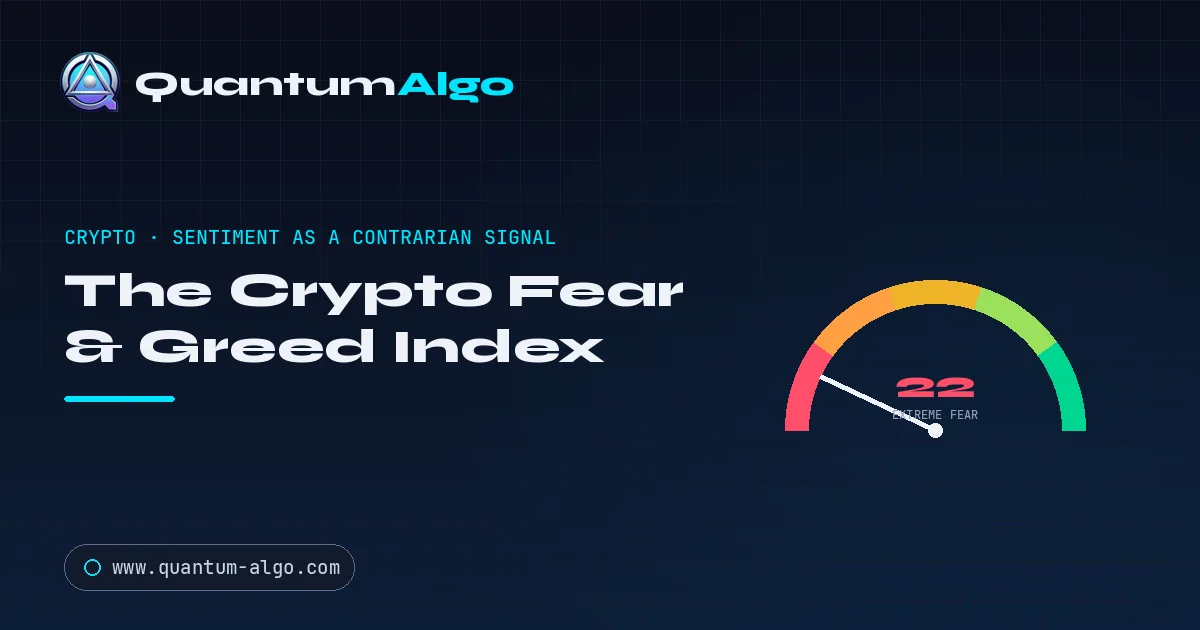
You trade the Crypto Fear & Greed Index as a contrarian filter, not a timing signal. It scores crypto sentiment 0–100 from volatility, momentum, volume, social sentiment, surveys, Bitcoin dominance and search trends. Under 25 (extreme fear) clusters near bottoms, over 75 (extreme greed) near tops, but it lags and can stay extreme for weeks, so take entries from structure.
You trade the Crypto Fear & Greed Index as a contrarian sentiment filter, not a timing signal. The index scores crypto market emotion from 0 (extreme fear) to 100 (extreme greed). Extreme fear (under ~25) has historically clustered near bottoms — an accumulation zone; extreme greed (over ~75) near tops — a de-risking zone. But it lags and can stay pinned at an extreme for weeks, so it tells you when conditions favour a turn, not the exact entry. The reliable method: use it as a regime filter, then take actual entries from market structure — buy discount structure while others panic, trim into euphoria.
Indicators that prove themselves in public.
One engine, four precision tools — the Gold (XAU) Scalper, the institutional Gravity Zone, the Zeno momentum Oscillator, and Zeno Stocks for equities.
The Crypto Fear & Greed Index is one of the most-watched sentiment gauges in the market — and one of the most misused. Traders treat a single number as a buy or sell button, then get shaken out when the index sits at "extreme fear" for a month while price keeps falling. Used correctly, it's a powerful contrarian context tool: it tells you which side of the emotional cycle the crowd is on, so you can lean the other way. This guide covers exactly what the index measures, how it's built, how to actually trade it, and where it breaks — then how to combine it with structure so sentiment becomes an edge instead of a trap.
| What it is | A 0–100 score of crypto market sentiment (0 = extreme fear, 100 = extreme greed) |
| What it measures | Volatility, momentum/volume, social sentiment, surveys, Bitcoin dominance, search trends |
| How to use it | As a contrarian regime filter — not a timing signal |
| Extreme fear (<25) | Historically an accumulation zone — the crowd is capitulating |
| Extreme greed (>75) | Historically a de-risking zone — the crowd is euphoric |
| Its weakness | Lags price and can stay pinned at an extreme for weeks |
| Best paired with | Market structure for the actual entry & exit |
What is the Crypto Fear & Greed Index?
The index distils the market's collective emotion into one number between 0 and 100. The logic is behavioural: markets are driven by two emotions — fear and greed. When investors are fearful, they oversell and prices fall below fair value; when they're greedy, they overbuy and prices run above it. A reading near 0 means the crowd is terrified (often near a bottom); a reading near 100 means the crowd is euphoric (often near a top). It updates daily, and the widely-cited crypto version is distinct from the traditional stock-market Fear & Greed Index — it's tuned to crypto's faster, more sentiment-driven cycles.
Sentiment is one input; participation is another. When the index is greedy but only a handful of coins are rising, the crypto market breadth reading usually catches the divergence first.
How is the Crypto Fear & Greed Index calculated?
The score is a weighted blend of several inputs, which is why it's more robust than a single metric. The major components are volatility (unusually high volatility and drawdowns push the index toward fear), market momentum and volume (strong buying volume relative to the recent average signals greed), social media sentiment (the tone and interaction rate of crypto posts), surveys (periodic polls of investor sentiment), Bitcoin dominance (rising dominance often reflects fear as capital flees alts for the relative safety of BTC), and search trends (spikes in fearful queries like "bitcoin crash" push it toward fear). Because it aggregates emotion, price action, and behaviour, no single day of noise dominates — but it also means the index describes conditions rather than predicting them.
Pair the reading with the size of the market itself: the TOTAL market-cap top-down plan shows whether fear is arriving into an expanding or a shrinking market.
Why is the Fear & Greed Index read as a contrarian signal?
The index is built to be read against the crowd. Warren Buffett's line — be fearful when others are greedy and greedy when others are fearful — is the entire thesis. When the index prints extreme fear, the weak hands have already sold, sentiment is washed out, and the risk/reward of accumulating improves. When it prints extreme greed, latecomers are piling in, leverage is stretched, and the risk of a sharp correction rises. Historically, the best long-term entries in crypto have clustered in extreme-fear readings, and the worst in extreme greed. The catch is timing: "improved risk/reward" is not "the bottom is in." That's the gap structure fills.
How to actually trade it — three practical methods
There are three sound ways to put the index to work, from passive to active. 1) Accumulation zones (investors). Treat sustained extreme fear as a signal to accumulate in tranches — dollar-cost-average more aggressively when the crowd capitulates, and slow or pause buying as the index climbs into greed. 2) De-risking (swing traders). Use extreme greed as a cue to take partial profits, tighten stops, and reduce leverage — not to short blindly, but to protect gains before the crowd's euphoria unwinds. 3) Confluence entries (active traders). This is the highest-precision method: wait for the index to reach an extreme, then drop to the chart and take an entry only when market structure confirms — a liquidity sweep and change of character in a discount zone while the index screams fear is a far stronger long than either signal alone.
| Index alone | Index + structure | |
|---|---|---|
| Tells you | The crowd's emotion | Emotion + where to enter |
| Timing | Vague — can stay extreme | Precise — on confirmation |
| Entry | Guess | Sweep + change of character |
| Risk defined | No | Yes — stop below structure |
| Failure mode | Buying a falling knife | Filtered by the chart |
| Best for | Long-term accumulation | Active swing entries |
What are the limitations of the Fear & Greed Index?
The index is context, not gospel, and three limits matter. First, it lags — several of its inputs are backward-looking, so it confirms a mood that's already in price. Second, it can stay pinned at an extreme through a prolonged trend; extreme fear during a bear market can persist for weeks, and buying every fear print without structure is how accounts bleed. Third, it's crypto-wide sentiment — it says nothing about an individual altcoin's structure, tokenomics, or catalysts. It's a market-regime lens, best for Bitcoin and the broad market, and it should never be the only reason you're in a trade.
How does the index combine with Bitcoin dominance and altseason?
Sentiment reads best alongside the market's other regime gauges. Cross-referencing the Fear & Greed Index with Bitcoin dominance and the altcoin season picture gives a fuller map: extreme fear with rising dominance is classic capitulation (capital fleeing alts into BTC); extreme greed with falling dominance often marks the frothy, late-cycle altcoin blow-off. Reading all three together tells you not just how the crowd feels, but where in the cycle that emotion sits — which is the context a single indicator can't give you.
What does each Fear & Greed zone mean?
The 0–100 scale breaks into five practical bands, and each carries a different playbook. Reading the zone — not just the number — is what turns the index into a decision tool.
| 0–24 · Extreme Fear | Crowd capitulating. Best long-term risk/reward. Accumulate in tranches; hunt long structure. |
| 25–44 · Fear | Caution and doubt. Selective longs on confirmed discount structure; keep risk small. |
| 45–55 · Neutral | No sentiment edge. Trade structure on its own merits; let the chart lead. |
| 56–74 · Greed | Momentum and optimism. Ride trends but tighten stops and bank partials. |
| 75–100 · Extreme Greed | Euphoria, stretched leverage. De-risk, take profit, avoid chasing; expect volatility. |
How the index has behaved at major tops and bottoms
Across crypto's cycles, the pattern is consistent even if the exact timing never is. Generational bottoms have formed while the index sat deep in extreme fear for extended stretches — the point of maximum pessimism, when headlines declared the asset class dead, is where the strongest hands were quietly accumulating. Cycle tops, conversely, have formed amid sustained extreme greed, when the crowd was certain prices could only go higher and leverage was stretched to its limit. The lesson isn't that a single extreme reading marks the turn — it's that durable extremes, especially when they diverge from what price is doing, flag that the emotional cycle is nearing exhaustion. That's context you act on with structure, not a countdown timer.
Fear & Greed vs. other sentiment tools
The index is one lens among several, and it's strongest when it agrees with the others. On-chain metrics (long-term holder behaviour, exchange flows, realised profit/loss) measure what money is actually doing rather than how it feels; funding rates and open interest reveal leverage and positioning; Bitcoin dominance shows where capital is rotating. The Fear & Greed Index is the fastest, simplest read of the three — a daily emotional temperature — but it's also the most surface-level. When it lines up with on-chain capitulation and washed-out leverage, the contrarian case is far stronger than the index alone would suggest. When it disagrees with them, trust the deeper data and wait.
What mistakes do traders make with the Fear & Greed Index?
Four errors turn a useful tool into a losing one. Trading the number, not the structure — "extreme fear, buy" ignores that fear can deepen for weeks. Going all-in on one print instead of scaling into an extreme that may extend. Shorting extreme greed blindly — markets can stay irrational longer than your leverage survives, so de-risk rather than fade with size. And ignoring the trend of the index — a reading of 30 that's rising from 15 tells a very different story than 30 falling from 60. Read direction, not just level.
A practical workflow
Check the regime: note today's index reading and its trend over the last few weeks. Set your bias: extreme fear tilts you toward accumulation and long setups; extreme greed toward de-risking and caution. Wait for structure: don't act on the number — drop to the chart and let Quantum Algo mark the order blocks and confirm a shift before you enter. Size for survival: extremes can extend, so risk a small fixed percent and scale in rather than going all-in on one fear print. Take profit into greed: as the index climbs toward euphoria, trim into strength instead of waiting for the crowd to turn. Sentiment sets the stage; structure and risk management run the trade.

Automate your trades. Let Quantum Algo trade for you.
Every signal executed on your own account — 24/7, hands-off.
Frequently Asked Questions
As a contrarian regime filter, not a timing signal. Extreme fear (under ~25) tilts you toward accumulation and long setups; extreme greed (over ~75) toward de-risking. Because it lags and can stay pinned at an extreme, you use it to set bias and take the actual entry from market structure, buying confirmed discount structure while the crowd panics.
It blends several inputs into one 0–100 sentiment score: volatility, market momentum and volume, social media sentiment, investor surveys, Bitcoin dominance, and search trends. Because it aggregates emotion, price and behaviour, no single day of noise dominates the reading.
Historically, extreme fear (roughly under 25) has offered the best long-term risk/reward for accumulation, because the crowd has already capitulated. But a low number alone isn't a buy trigger — it can stay low for weeks. Wait for market structure to confirm a turn before entering.
It's a caution and de-risking signal, not a blind short signal. Extreme greed (over ~75) means latecomers are piling in and leverage is stretched, so it's a cue to take partial profits, tighten stops and reduce risk — not to short into strength without structural confirmation.
Because several of its inputs are backward-looking and sentiment can remain washed out through a prolonged downtrend. Extreme fear describes a mood that's already in price; it doesn't mark the exact bottom. This is why buying every fear print without structure is dangerous.
Yes. The crypto version is tuned to crypto's faster, more sentiment-driven cycles and includes crypto-specific inputs like Bitcoin dominance and crypto social sentiment. The traditional stock-market Fear & Greed Index uses different components and moves on a different rhythm.
Only as broad context. The index measures crypto-wide sentiment, mostly reflecting Bitcoin and the total market — it says nothing about a specific altcoin's structure, tokenomics or catalysts. For individual alts, combine the market-wide reading with that coin's own chart structure.
Daily. Sentiment shifts quickly in crypto, so the reading refreshes each day — but because it aggregates several inputs, day-to-day noise is smoothed. Watch the trend of the index over weeks, not just a single day's number.
Yes — it's a context tool, best paired with market structure for timing and with Bitcoin dominance and the altcoin season index for cycle position. Sentiment tells you how the crowd feels; structure tells you where to enter; dominance tells you where capital is rotating.
The index is a regime filter; Quantum Algo is the entry engine. You use extreme fear or greed to set your bias, then let Quantum Algo mark order blocks and confirm a non-repainting change of character before you take the trade — so you buy structural strength while the crowd panics, with an exact entry, stop and targets.
References & Related Guides
More in this topic
- ADX Indicator: Complete Trading Guide
- AlphaTrend Indicator: Complete Trading Guide
- ATR (Average True Range): Complete Trading Guide
- Awesome Oscillator: Complete Indicator Guide
- What Are the Best Volume Indicators?
- Bollinger Bands — Complete Trading Indicator Guide
- CCI Indicator: Complete Guide
- Chandelier Exit: Complete Trading Guide
- Donchian Channels: Complete Indicator Guide
- Fibonacci Bollinger Bands: Complete Trading Guide
- Fibonacci Retracement — Complete Trading Guide
- Hull Moving Average (HMA): Complete Trading Guide
- Gaussian Channel Indicator Guide
- Best Buy/Sell Indicator Guide
Core reading
- BOS & CHoCH: Complete Market Structure Guide
- Order Blocks Trading: Complete Guide
- Best TradingView Indicators — Complete Guide
- Risk Management in Trading — Complete Guide
- Candlestick Patterns Guide — Engulfing, Pinbar & More
- All Premium Guides
- Quantum Algo on TradingView
- Public Track Record