Altcoin Season Explained: The Altseason Index and How to Trade It
What is altcoin season and how do you know when it's happening?
Altcoin season is a period when altcoins broadly outperform Bitcoin. The Altcoin Season Index confirms it by scoring 0–100 how many of the top-50 alts beat Bitcoin over 90 days: 75 or above is altcoin season, 25 or below is Bitcoin season. Capital rotates from Bitcoin into large, mid, then small caps, and alts bleed hardest when it ends.
Altcoin season (“altseason”) is a period when altcoins broadly outperform Bitcoin — and the Altcoin Season Index is how you confirm it. The index scores 0–100 by measuring how many of the top-50 alts have beaten Bitcoin over the last 90 days: below 25 is Bitcoin season, above 75 is a confirmed altcoin season. It’s driven by capital rotating out of Bitcoin (falling dominance) down the risk curve into large-, mid- and small-cap alts. Read it with dominance and sentiment to catch the rotation early — and take entries from structure, because alts bleed hardest when it ends.
Indicators that prove themselves in public.
One engine, four precision tools — the Gold (XAU) Scalper, the institutional Gravity Zone, the Zeno momentum Oscillator, and Zeno Stocks for equities.
Every cycle, the same story plays out: Bitcoin runs, then at some point money floods into altcoins and portfolios that were flat suddenly double in weeks. That window is altcoin season — and mistiming it is how traders give back a whole cycle's gains, because the same alts that triple on the way up can lose 80–90% on the way down. This guide explains exactly what altcoin season is, how the Altcoin Season Index confirms it, the capital-rotation mechanics that drive it, how to catch it early using Bitcoin dominance and sentiment, how to position through it, and — most importantly — how to manage the risk when it ends.
| What it is | A period when altcoins broadly outperform Bitcoin |
| How it's confirmed | Altcoin Season Index above 75 (75%+ of top-50 alts beat BTC over 90 days) |
| What drives it | Capital rotating out of Bitcoin down the risk curve into alts |
| Early signal | Bitcoin dominance peaking and rolling over while the market holds |
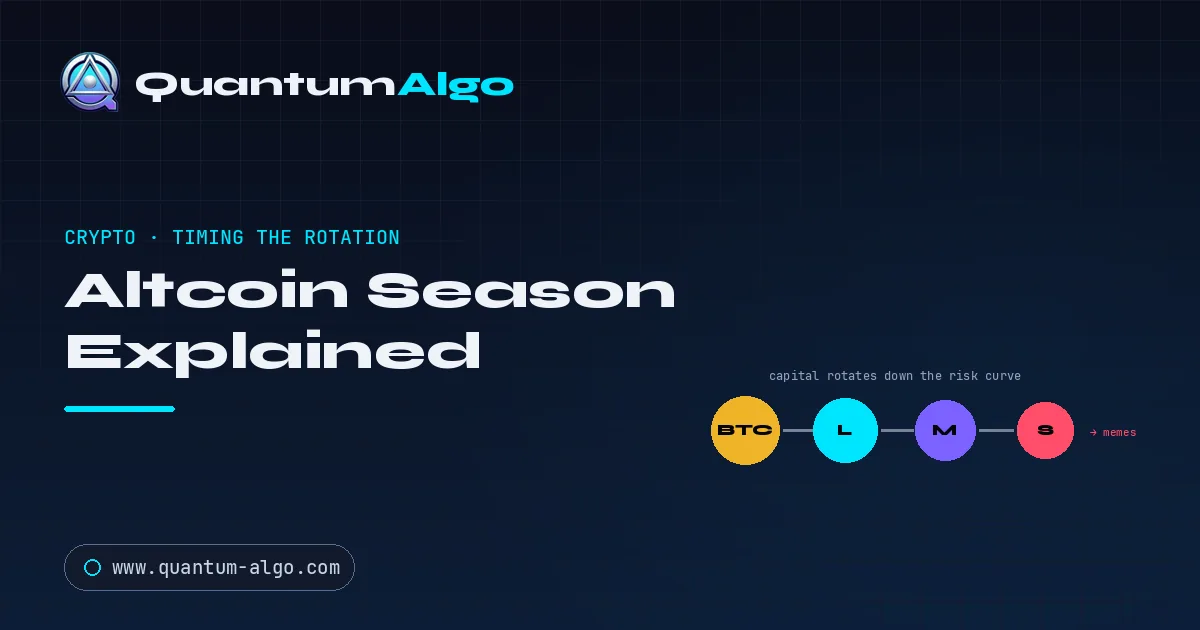
| The sequence | BTC → large caps → mid caps → small caps / memes |
| The danger | Alts bleed hardest when it ends — most never reclaim their highs |
| Pair with | Dominance, Fear & Greed, and chart structure |
What altcoin season actually is
Altcoin season is a phase of the crypto cycle in which altcoins — essentially every coin that isn't Bitcoin — outperform Bitcoin as a group, often dramatically. It isn't a fixed calendar event; it's a rotation of capital. During most of a cycle Bitcoin leads and alts merely follow at a discount, but at certain points money flows out of Bitcoin and into the broader market, and altcoin prices accelerate far beyond Bitcoin's pace. These windows are where the largest percentage gains in crypto are made — and, because they're driven by risk appetite and speculation rather than fundamentals, they're also the most violent to be caught on the wrong side of.
How does the Altcoin Season Index score altseason?
Rather than argue about whether "alt season" has arrived, traders use the Altcoin Season Index to measure it objectively. The index looks at the top 50 coins (excluding stablecoins and asset-backed tokens) and checks how many have outperformed Bitcoin over the trailing 90 days, then scores the result from 0 to 100. When at least 75% of the top 50 have beaten Bitcoin, it's officially an altcoin season (index ≥ 75). When 25% or fewer have, it's Bitcoin season (index ≤ 25). The zone in between is a transition. It's a clean, rules-based confirmation — but like all such gauges it's a lagging measure of a rotation that's already underway, which is why the early-warning signals matter more than the index print itself.
How does capital rotate from Bitcoin into altcoins?
Altcoin season is best understood as capital rotating down the risk curve in a fairly consistent sequence. It starts with Bitcoin leading the first leg of a bull market. As Bitcoin's gains mature and holders take profit, money rotates into large-cap alts like Ethereum and other established majors. From there it flows into mid-caps as traders chase higher returns, and finally into small-caps and memecoins at the euphoric peak, where the most speculative assets go parabolic. Each step down the curve offers more upside and far more risk, and each step is faster to reverse. Recognising which stage the rotation has reached tells you both where the opportunity is and how close you are to the exit.
What do Bitcoin dominance and sentiment signal before altseason?
The index confirms altcoin season late; the early tells come from the market's other regime gauges. The single best leading signal is Bitcoin dominance: when dominance peaks and begins to roll over while the total market holds up or rises, capital is starting its rotation into alts — that shift precedes the index crossing 75. The Fear & Greed Index adds context: alt seasons tend to run in greed, and the frothy, extreme-greed phase with falling dominance is the late-cycle blow-off. Watching dominance roll over, the market stay strong, and sentiment climb toward greed — together — is how you position before the crowd, rather than buying alts only once the index has already confirmed and much of the move is done.
How should you position through an altcoin season?
The playbook follows the rotation. Early, when dominance first rolls over, favour large-cap alts — they move first and are the safest way to gain alt exposure. As the season develops and the index climbs, rotate a portion into mid-caps for higher beta, always with a plan to take profit. Reserve small-caps and memecoins for the late, euphoric stage, and treat them as pure speculation with tight risk — they deliver the biggest gains and the fastest 90% drawdowns. Throughout, take profits in tranches into strength rather than trying to sell the exact top, and watch dominance for the signal to rotate back to safety. Position size should shrink, not grow, as you move down the risk curve, because the volatility grows with it.
| Chasing | Planned rotation | |
|---|---|---|
| Entry | After the index hits 75 | As dominance rolls over |
| Coin selection | Whatever's pumping | Down the risk curve in sequence |
| Profit taking | “It'll go higher” | Tranches into strength |
| Position size | Grows with greed | Shrinks with risk |
| Exit plan | None | Rotate to BTC as dominance turns |
| Typical outcome | Round-trips the gains | Keeps the gains |
Do altcoin seasons still happen?
It's a fair question, because the market changes each cycle. The number of coins has exploded, liquidity is spread thinner, and capital rotation has become more selective — which has led some to argue "the broad alt season is dead." The more accurate view is that alt seasons have become more fragmented: instead of nearly everything pumping together, capital concentrates in whichever narratives and sectors are in favour, so you can have a powerful season in one corner of the market while much of the long tail stagnates. That makes the rotation harder to catch with a blanket "buy alts" approach and rewards reading dominance, sentiment and structure to find where the rotation is actually going — rather than assuming a rising tide lifts every coin.
What does a practical altseason workflow look like?
Watch dominance for the early tell: a peak-and-rollover in Bitcoin dominance while the market holds is the first signal. Confirm with the index and sentiment: the Altcoin Season Index climbing toward 75 and the Fear & Greed Index in greed confirm the rotation. Rotate down the risk curve: large caps first, then mid, then speculative — sizing smaller as risk rises. Time entries with structure: let Quantum Algo confirm a change of character on each coin rather than buying blindly. Take profit into strength and rotate back to Bitcoin as dominance bottoms. Respect the risk — keep position sizes small on the speculative end, because that's where the 90% drawdowns live.

Automate your trades. Let Quantum Algo trade for you.
Every signal executed on your own account — 24/7, hands-off.
Frequently Asked Questions
Altcoin season is a phase of the crypto cycle when altcoins as a group outperform Bitcoin, often dramatically. It's driven by capital rotating out of Bitcoin down the risk curve into large-, mid- and small-cap alts. It's where the biggest percentage gains are made — and where the biggest drawdowns follow.
The Altcoin Season Index confirms it: when at least 75% of the top-50 coins have outperformed Bitcoin over the trailing 90 days, the index reads 75+ and it's officially altcoin season. Below 25 is Bitcoin season. The earliest tell, though, is Bitcoin dominance peaking and rolling over while the market holds up.
A 0–100 gauge that measures how many of the top 50 coins (excluding stablecoins) have beaten Bitcoin over the last 90 days. Above 75 is a confirmed altcoin season; 25 or below is Bitcoin season; in between is a transition. It's a clean, rules-based confirmation — but it lags the rotation it measures.
Capital rotating out of Bitcoin once its move matures and holders take profit. That money flows into large-cap alts first, then mid-caps, then speculative small-caps, pushing the whole altcoin market to outperform. Falling Bitcoin dominance while the total market stays strong is the mechanical signature of this rotation.
Watch Bitcoin dominance for a peak-and-rollover while the total market holds up — that precedes the index confirming. Combine it with the Fear & Greed Index climbing into greed. Together, these let you position before the crowd, rather than buying alts only after the index has already crossed 75 and much of the move is done.
Capital typically flows down the risk curve in sequence: Bitcoin leads first, then large-cap alts like Ethereum, then mid-caps, then speculative small-caps and memecoins at the euphoric peak. Each stage offers more upside and far more risk, and each is faster to reverse than the last.
Yes, substantially. Altcoins are higher-beta — they gain more in a rally and lose far more in a downturn. Most altcoins lose 80–90% when the cycle turns and never reclaim their highs. That's why alt season is for taking profit into strength and rotating back to Bitcoin, not for holding indefinitely.
Not dead, but more fragmented. With thousands of coins and thinner liquidity, capital now concentrates in whichever narratives are in favour rather than lifting everything at once. You can get a powerful season in one sector while much of the long tail stagnates — which rewards reading dominance and structure over a blanket “buy alts” approach.
Take profit in tranches into strength rather than trying to sell the exact top, and use Bitcoin dominance as your exit signal — when it bottoms and turns back up, capital is rotating out of alts, so rotate your profits back to Bitcoin or stablecoins before the steep altcoin drawdowns hit.
The rotation gauges tell you which part of the market to favour; Quantum Algo times the entry on the specific coin. You use dominance and the index to decide it's time for alts, then let Quantum Algo confirm a non-repainting change of character and mark the exact entry, stop and targets — so you enter structural strength rather than chasing a pump.
References & Related Guides
More in this topic
- ADX Indicator: Complete Trading Guide
- AlphaTrend Indicator: Complete Trading Guide
- ATR (Average True Range): Complete Trading Guide
- Awesome Oscillator: Complete Indicator Guide
- What Are the Best Volume Indicators?
- Bollinger Bands — Complete Trading Indicator Guide
- CCI Indicator: Complete Guide
- Chandelier Exit: Complete Trading Guide
- Donchian Channels: Complete Indicator Guide
- Fibonacci Bollinger Bands: Complete Trading Guide
- Fibonacci Retracement — Complete Trading Guide
- Hull Moving Average (HMA): Complete Trading Guide
- Gaussian Channel Indicator Guide
- Best Buy/Sell Indicator Guide
Core reading
- BOS & CHoCH: Complete Market Structure Guide
- Order Blocks Trading: Complete Guide
- Best TradingView Indicators — Complete Guide
- Risk Management in Trading — Complete Guide
- Candlestick Patterns Guide — Engulfing, Pinbar & More
- All Premium Guides
- Quantum Algo on TradingView
- Public Track Record
Authoritative sources
For a focused comparison, read the stablecoin dominance and altcoin season before applying the setup.
For the next decision, continue with a TOTAL3 market-cap filter and keep the execution rule separate from the context.
For the next decision, continue with a breadth filter for altcoin rotation and keep the execution rule separate from the context.