Blue Guardian Review: Rules, Prices, Payouts and Red Flags
Blue Guardian is a Dubai-run forex and futures prop firm with cheap entry accounts and fast payout processing, but its rules are tougher than they look: trailing drawdown on 1 Step and Instant accounts, a funded-only Guardian Shield, a 3% payout fee and no refunds. Its Trustpilot rating is currently suspended for fake reviews. Workable for disciplined traders who read every rule.
Blue Guardian markets speed: fast payouts, quick evaluations, accounts in minutes. The part that decides whether you get paid sits in the help centre, in rules like a trailing floor that rises with every winning close and a "Guardian Shield" that halves your split if open losses touch 2%. This Quantum Algo review goes through each live program with the current numbers, works the drawdown and payout math in dollars, and lays out what we could and couldn't verify about the firm's reputation, including why Trustpilot has pulled its score.
Indicators that prove themselves in public.
One engine, four precision tools — the Gold (XAU) Scalper, the institutional Gravity Zone, the Zeno momentum Oscillator, and Zeno Stocks for equities.
Blue Guardian offers low entry prices, a wide menu of models and quick payout processing, and it does pay disciplined traders. Trailing drawdown on most one-step and instant accounts, the funded-only Guardian Shield, a 3% payout fee and frequent rule changes make it less forgiving than it first looks. The suspended Trustpilot rating is a reason for extra care, not a verdict on its own.
Pros
- Low entry prices on small accounts, especially during frequent promotions
- Static 8% and 10% max loss options on the 2 Step accounts
- Payout requests processed within 24 business hours
- Up to 100% split add-on on Nano accounts; 85% default on Standard
- Overnight and weekend holding, EAs and same-owner copy trading allowed
- Scaling plan up to $4,000,000
- Futures side with TradingView and NinjaTrader access
Cons
- 6% trailing max loss on 1 Step and Instant accounts
- Guardian Shield halves the split at 2% floating loss on funded accounts (1% on Instant)
- 3% fee on every payout and no refunds on challenge fees
- Trading days only count with 0.5% profit
- Trustpilot rating suspended over fake reviews; unverified payout complaints
- Frequent rule changes between account cohorts
Best for: Disciplined forex and index traders with fixed risk who prefer static drawdown on a 2 Step account.
Not for: News scalpers, traders who stack correlated positions, and anyone who wants a refundable fee.
Prices and rules checked October 2026.
What exactly are you buying from Blue Guardian?
Blue Guardian sells simulated trading evaluations. Pass one and you trade a simulated funded account, and Blue Guardian pays you a share of the simulated profits. Its own terms describe the challenges as "simulated/demo evaluation challenges purely for educational and skills-assessment purposes." That's standard for the industry, but it's worth stating because it explains everything that follows: the firm's revenue comes mostly from challenge fees, and the rules decide how many traders reach a payout.
The website is run by Iconic Exchange FZCO, trading as Blue Guardian, at an address in the IFZA Business Park in Dubai, with governing law in the United Arab Emirates. The trading platforms are provided by Blue Guardian Limited in Saint Lucia. The founder and CEO named on the About page is Sean Bainton. Blue Guardian is not a broker and is not regulated as one, which is also normal for forex prop firms. If the model itself is new to you, our guide to how prop firms work covers it.
Today there are two sides to the business. The forex/CFD side runs on MT5, Match-Trader and TradeLocker with 1 Step, 2 Step, Nano and Instant accounts. The futures side, launched in March 2025, trades CME-listed contracts through NinjaTrader, Tradovate, DeepCharts and TradingView. Most of this review covers the forex/CFD programs, since that's where most traders searching for Blue Guardian are headed; futures get their own section below.
◆ Prices and rules checked October 2026 against blueguardian.com and the Blue Guardian help centre. Several rules changed for accounts bought on or after August 20 (the help centre gives no year), so older reviews quoting a 10% one-step target or 5 minimum days are out of date.
Which Blue Guardian challenge fits your trading?
The current help centre lists five live models for forex/CFD, plus legacy versions (1 Step Pro, 2 Step Pro, 3 Step) that are no longer sold. Here's how the live ones compare on a like-for-like basis:
| Program | Profit target | Daily loss | Max loss | Min days / consistency | Split |
|---|---|---|---|---|---|
| 1 Step Standard | 9% | 4% | 6% trailing, locks at start balance | 3 days; none stated | 85% (90% add-on) |
| 1 Step Nano | 10% | 4% | 6% trailing, locks at start balance | None to pass, 5 funded; 50% rule | 85% (100% add-on) |
| 2 Step Standard | 8% then 4% | 4% | 8% static | 3 days; none stated | 85% (90% add-on) |
| 2 Step Nano | 8% then 5% | 3% | 10% static | None; 50% rule when funded | 80% (100% add-on) |
| Instant Standard | None (funded on purchase) | 3% | 6% trailing, locks at start balance | 5 days; 20% rule (15% on 300K/400K) | 80% (90% add-on) |
All percentages are of the initial balance. A "trading day" only counts toward the minimum if it closes at least 0.5% in profit, which is stricter than firms that count any day with a trade. The 2 Step Standard minimum is 3 days for accounts bought from August 20 and 5 days for older ones; the 1 Step Standard target moved from 10% to 9% on the same date.
How to pick
- Swing traders and anyone who gives back open profit should lean toward the 2 Step accounts. Their static floor never moves, so a winning week doesn't tighten your stop-out level.
- Traders who hit targets quickly may prefer 1 Step Standard: one 9% target and three qualifying days. The price is a trailing floor that follows your best closed balance until you're up 6%.
- Traders who make most of their money on one or two big days should avoid Nano and Instant. Their consistency rules (50% and 20%) block payouts when a single day dominates your profit.
- Instant skips the evaluation, but you start with the tightest combination here: 3% daily, 6% trailing, 1:30 FX leverage and a 1% Guardian Shield on funded trades.
How much does a Blue Guardian account cost?
Blue Guardian prices shift with promotions, and the plan picker on its homepage only shows one program at a time. When we checked, the default selection was the Instant account, with a 35% Halloween code applied. These are the figures it displayed:
| Account size | List price | Promo price (35% off) |
|---|---|---|
| $5K | $72 | $47 |
| $10K | $100 | $65 |
| $25K | $208 | $135 |
| $50K | $324 | $211 |
| $100K | $623 | $405 |
| $200K | $954 | $620 |
| $400K | $2,200 | $1,430 |
Treat these as a snapshot of the Instant pricing, not a permanent rate card. The 1 Step and 2 Step evaluations price differently, discount codes rotate almost weekly, and the price shown at checkout is the only one that counts. Add-ons (90% or 100% split, 7-day payouts) raise the fee further. Blue Guardian also sells a Buy Now Pay Later option on some accounts, with its own rules page in the help centre.
Two cost rules matter more than the sticker price. First, the refund policy is blunt: once your evaluation credentials are emailed, "no refunds under any circumstances." Second, every payout carries a 3% processing fee. On a $4,000 payout that's $120 you won't see. If entry cost is your main filter, our cheapest prop firms comparison ranks the low-fee options side by side.
How the daily loss and trailing drawdown actually work
This is where most Blue Guardian breaches happen, so it's worth working through with real numbers. Two floors run at the same time, and whichever is higher is the one that ends your account.
Daily floor = max(balance, equity at 5pm EST reset) − daily % × initial balance
Static max floor = initial balance × (1 − max %)
Trailing max floor = min(highest closed balance − max % × initial, initial balance)
Both are equity-based, so floating losses count. The daily floor resets at 5pm EST. The trailing floor follows your highest closed-trade balance and stops moving once you're up 6%, at which point it sits at your starting balance. After that lock Blue Guardian keeps a fixed 1% buffer, so you can't withdraw profits all the way down to the starting balance.
Worked example: $100K 1 Step Standard
- Day 1. You start at $100,000. Daily floor $96,000, trailing floor $94,000. You close the day at $103,000.
- Day 2 open. Highest closed balance is now $103,000, so the trailing floor rises to $97,000. The daily floor is $103,000 − $4,000 = $99,000. The daily limit binds first: you have $4,000 of room at the open.
- Day 3 open after a bad day 2. Say day 2 closed at $99,500. The daily floor resets to $95,500, but the trailing floor is still $97,000, and if a closed balance had reached $104,000 along the way, it would be $98,000. Now the trailing limit binds, and your real room is $1,500 to $2,500, not the $4,000 the daily rule suggests.
Run the same numbers on a 2 Step Standard account and the overall floor stays at $92,000 no matter how well you trade. That's the practical difference between static and trailing: on the trailing models, your stop-out level climbs with every winning close until the 6% lock.
The calculator below takes your account size, both limits, your highest closed balance, the start-of-day value and current equity, then tells you which floor binds and how many full losses at your chosen risk you can absorb. For sizing the stop itself, our ATR guide shows how to set stops in volatility terms rather than fixed pips.
Guardian Shield, consistency and the rules that catch funded traders
Passing is only half the job. Blue Guardian adds rules on funded accounts that don't exist during the challenge, and two of them catch people out.
Guardian Shield
On funded 1 Step and 2 Step Standard accounts, Guardian Shield automatically closes all open trades if floating loss reaches 2% of the account. On Instant accounts the trigger is 1%. The first time it fires, your profit split drops to 50%. The second time, the account is permanently breached. These penalties don't reset. Guardian Shield doesn't apply to the 1 Step Nano account.
In practice this caps your total open risk, not just your per-trade risk. On a $100K funded account, two positions each risking 1% with stops at the full distance can trip the shield together, even though each looks reasonable alone. Treat 2% (or 1% on Instant) as the hard ceiling for all open trades combined, and keep a margin for slippage.
Consistency rules
Instant Standard accounts use a 20% rule: no single day's profit can be 20% or more of your total profit in the payout period (15% on the $300K and $400K sizes). Nano accounts use a 50% version. Breaking it doesn't breach the account; the payout button simply stays greyed out until enough additional profitable days dilute the big one.
Worked example: you make $3,000 in a cycle, $1,200 of it on one day. That day is 40% of profit. On Instant you'd need total profit of at least $6,001 with no larger day, so the $1,200 day falls below 20%. On Nano you'd need total profit above $2,400, which you already have. Same trading, very different waiting time.
News trading, tick scalping and prohibited strategies
News rules depend on the account stage. During evaluations, trading high-impact news is allowed. On funded accounts, opening or closing trades within 5 minutes before or after red-folder news and FOMC events can get those profits removed, along with profits Blue Guardian judges to be significantly driven by news. The help centre lists affected instruments by currency, so a USD release restricts USD pairs, US indices and gold. Instant Standard accounts bought after 13 November 2025 cannot trade news at all.
Other rules from the prohibited practices and account pages:
- Minimum hold time. Trades closed in under 2 minutes may be flagged as tick scalping.
- Banned outright. High-frequency trading, tick scalping, latency arbitrage and hedging between separate accounts. Hedging inside one account is allowed.
- Gambling rule. Margin usage above 80% on running trades is classed as gambling.
- EAs and copiers. Expert advisors are allowed if they're your own strategy. Copy trading is allowed only between accounts you legally own.
- Inactivity. At least one trade every 30 days, counted from account creation, or the account is breached.
- Holding. Overnight and weekend holding is allowed on all account types. Stop losses aren't mandatory.
None of this is unusual, but the 2-minute rule and the news windows trip up scalpers who passed the evaluation trading exactly that way. If your edge lives in the first seconds after a release, pick a firm whose funded rules match your evaluation rules. Our prop firm trading strategy guide covers styles that fit these constraints.
How do Blue Guardian payouts work?
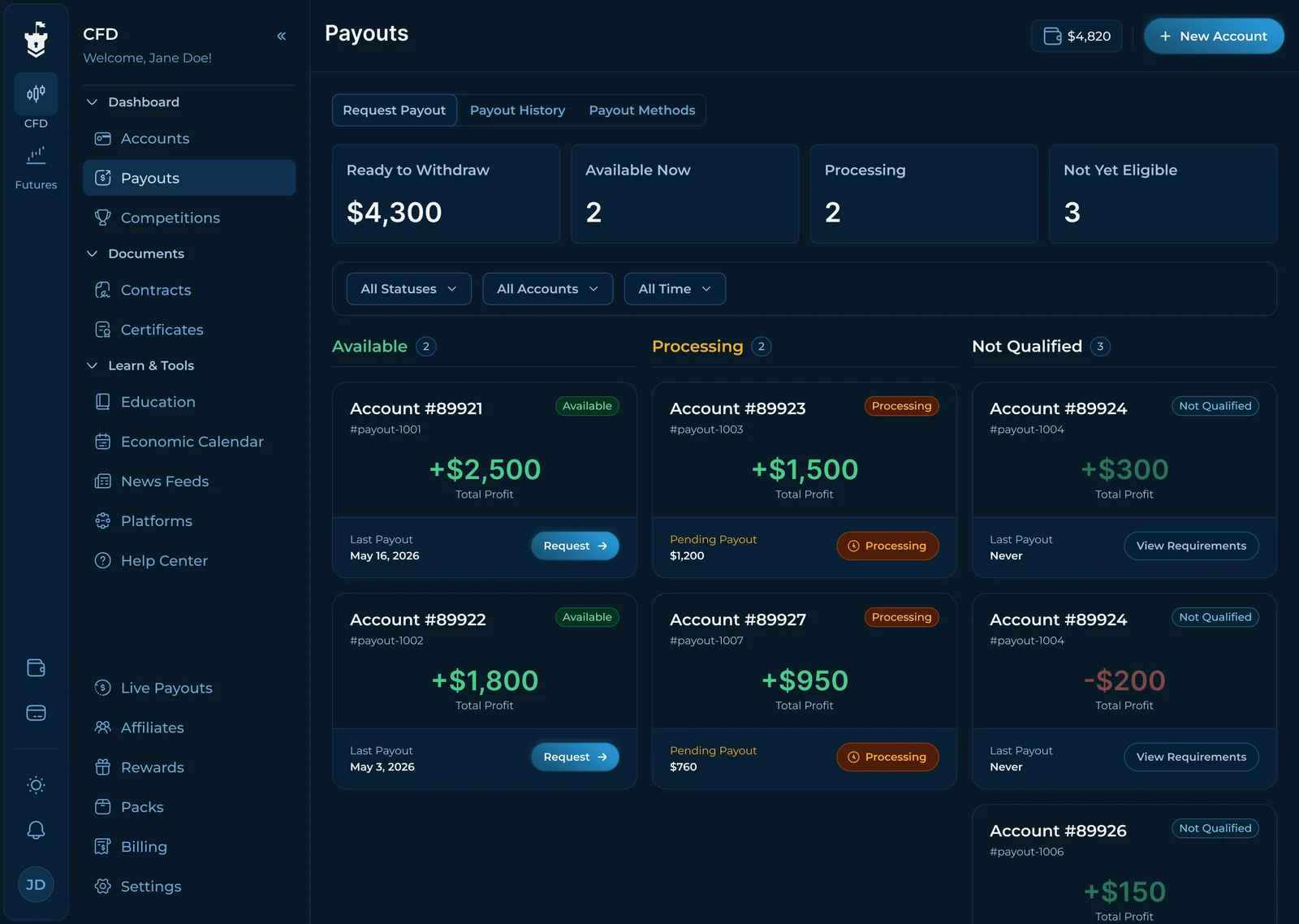
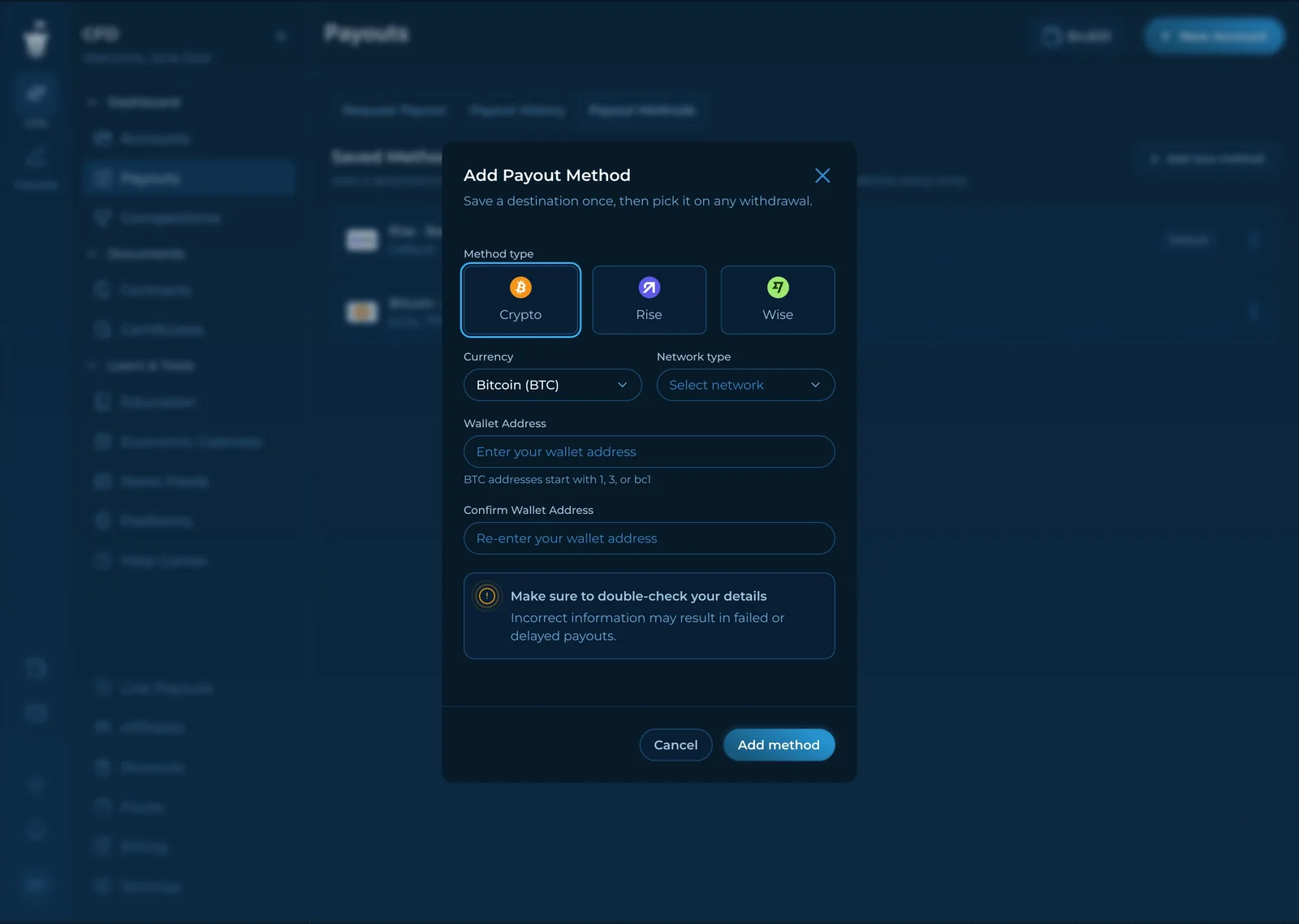
The headline marketing promises fast payouts, and the processing side is genuinely quick: requests are handled within 24 business hours, and the homepage claims about an hour on average. The schedule is slower than the marketing suggests, though, and there's a fee.
| Item | Rule |
|---|---|
| First payout (1 and 2 Step) | 14 calendar days after the first funded trade, 7 with the add-on, plus minimum days met |
| Later payouts | Every 14 days (7 with add-on); 1 Step Nano every 7 days |
| Instant accounts | On demand once minimum days and the consistency rule are met |
| Minimum withdrawal | $100 by crypto, $500 by Rise |
| Method limits | Crypto capped at $1,000 per request; larger amounts go through Rise |
| Fee | 3% processing fee on every payout |
| Caps | $200K to $400K Instant: first two payouts capped at $10,000 each; Instant Starter: one payout, $250 max |
| KYC | Required before the first payout, via Sumsub |
To request a payout you must be above the starting balance, have no active violations and close all positions, and the account goes read-only while the request is pending. Note the mismatch between pages: the homepage lists 1 Step and 2 Step payouts as "within 7 days," while the payout article sets a 14-day cycle with a paid 7-day upgrade. Go by the help centre article, which is the more specific source.
Worked payout example
A $100K 1 Step Standard account reaches 6% profit ($106,000). The trailing floor locks at $100,000, and the 1% buffer means $1,000 of profit must stay in the account. Withdrawable profit is $5,000. At the 85% default split that's $4,250, and after the 3% fee you receive $4,122.50. With the 90% add-on it would be $4,365 net.
Allocation and scaling
Your combined active funded allocation across all Blue Guardian funded and Instant accounts is capped at $400,000. Extra accounts above the cap sit inactive until room frees up. The scaling plan raises an account by 30% of its initial balance each time you make 12% within a 3-month period while following the rules, up to $4,000,000.
Platforms, leverage and who can sign up
Forex/CFD accounts run on MT5, Match-Trader or TradeLocker. DXtrade isn't offered. US residents can only use Match-Trader and TradeLocker, and you can migrate platforms only on an account that hasn't placed a trade yet. Commissions are $5 per lot on FX and commodities and zero on indices and crypto.
| Account type | FX | Indices | Commodities | Crypto |
|---|---|---|---|---|
| 1 Step Nano/Standard and 3 Step (evaluation) | 1:50 | 1:20 | 1:20 | 1:2 |
| 2 Step Nano and Standard (evaluation) | 1:50 | 1:10 | 1:10 | 1:2 |
| Funded 1 Step and 2 Step Standard | 1:50 | 1:10 | 1:10 | 1:2 |
| Instant Funding and Starter | 1:30 | 1:10 | 1:10 | 1:2 |
Note the leverage drop on indices and commodities when a 1 Step trader moves from evaluation (1:20) to funded (1:10). Position sizes that worked during the challenge may need more margin once funded, which pushes you closer to the 80% margin gambling rule.
You must be 18 or older. The restricted list in the help centre is Afghanistan, Albania, Algeria, Cuba, Iran, Jordan, Libya, Myanmar, North Korea, the Philippines, Senegal, Syria and Vietnam. US traders are accepted on the forex side with the platform limit above; our prop firms for US traders guide compares the alternatives. If you chart on TradingView and want to trade from it, see prop firms that use TradingView, since Blue Guardian's TradingView access is on the futures side.
Does Blue Guardian offer futures accounts?
Yes. Blue Guardian Futures launched on 24 March 2025 with accounts from $25,000 to $150,000, up to five accounts per trader, no minimum trading days and one-time fees rather than monthly subscriptions. A July announcement on the Blue Guardian blog replaced the original lineup with four plans:
- Standard: evaluation, with a Path to Live.
- Reserve: evaluation, payouts every 5 winning days and no consistency rule once funded.
- Express: evaluation with daily payouts and a Path to Live.
- Direct: funded immediately with no evaluation; the drawdown locks after the first payout.
All four carry a 90/10 split, and the site lists NinjaTrader, Tradovate, DeepCharts and TradingView for futures. We couldn't verify plan-by-plan prices, targets and drawdown types on Blue Guardian's own pages at the time of checking, so we've left them out rather than repeat third-party numbers. If you're mainly a futures trader, compare against established futures specialists first: our Topstep review, My Funded Futures review and Earn2Trade review all have verified rule tables.
Is Blue Guardian legit? What we could and couldn't verify
Blue Guardian is a real operating company with published terms, an identifiable CEO and a working help centre, and a large share of its Trustpilot reviewers report being paid. That's the baseline. Three things deserve a closer look before you buy.
- Trustpilot has suspended its rating. The Blue Guardian CFD page on Trustpilot shows no TrustScore and says the rating "is unavailable due to a breach of our guidelines," with a notice that Trustpilot removed a number of fake reviews. When we checked, it listed 2,127 reviews with 62% five-star and 24% one-star. A split that sharp usually means a large happy group and a large unhappy group, with little middle ground.
- Payout disputes exist. Forex Peace Army threads and recent one-star reviews allege denied payouts and breaches the traders dispute. We can't verify individual claims, and every big prop firm has some. The common thread in the complaints we read was rule interpretation: news windows, tick scalping flags and consistency, which is why the rule detail in this review matters.
- Rules change often. The August target and minimum-day change, the news ban on Instant accounts bought after 13 November 2025 and the July overhaul of the futures plans show how often terms move. Read the rules for the exact account you buy, on the day you buy it, and screenshot them.
The no-refund policy and the chargeback clause, which allows Blue Guardian to suspend accounts and claw back paid profits if you dispute a card charge, mean you have little recourse once you've paid. That isn't unique to Blue Guardian, but it's another reason to treat the fee as money already spent.
How does Blue Guardian compare with other forex prop firms?
Blue Guardian's pitch is fast processing, cheap entry on small accounts and a wide menu of models. Its weak spots are the trailing drawdown on most one-step and instant accounts, the funded-only Guardian Shield, the 3% payout fee and a reputation picture clouded by the Trustpilot suspension.
Against the long-established firms, the trade-off is clearer rules and longer track records versus Blue Guardian's lower entry prices. Our FTMO review and The5ers review cover the two oldest names. For similar price points and model variety, compare the FundedNext review, FundingPips review and E8 Markets review. Traders who want static drawdown and fewer funded-only surprises should also read the Funded Trading Plus review and Alpha Capital Group review.
When you compare, line up the same five numbers for each firm: the floor type (static or trailing), daily loss basis (balance or equity, reset time), consistency rule, payout fee and any funded-only rule like Guardian Shield. Headline splits and targets matter less than those.
Checklist before you buy a Blue Guardian challenge
- Open the help-centre rules article for your exact model. 1 Step Standard and 1 Step Nano share a name but not a target, consistency rule or Guardian Shield.
- Run your normal week through the calculator. If two average losing days put you within one trade of the trailing floor, choose a static 2 Step account or smaller size.
- Check your style against the funded rules. News within 5 minutes, holds under 2 minutes, and total open risk above 2% (1% on Instant) all cause trouble only after you pass.
- Price the add-ons. Decide on the 90% or 100% split and 7-day payouts at checkout; you can't add them later.
- Pick the platform once. Migration is only allowed before your first trade. US residents: Match-Trader or TradeLocker only.
- Prepare KYC. Have Sumsub-accepted documents ready so your first payout isn't delayed.
- Save the rules. Screenshot the rules page and your checkout on the day you buy.
Common mistakes
- Sizing every trade at 1% on a trailing account after a winning day, without noticing the floor moved up.
- Assuming the 4% daily loss is measured from yesterday's close when you held floating profit at the 5pm EST reset; the higher of balance or equity sets the base.
- Stacking correlated trades (EURUSD and GBPUSD, NAS100 and US30) that together trip the Guardian Shield.
- Leaving an extra account idle for 30 days and losing it to the inactivity rule.
Blue Guardian and Quantum Algo
A prop account rewards discipline over cleverness. The traders who keep Blue Guardian accounts tend to have three things: fixed risk per trade, a short list of setups, and no trades near news on funded accounts.
Quantum Algo's Zeno suite helps with the first two. Zeno signals come with a built-in stop and targets, so position size can be set from the stop distance before you enter, which is exactly what the calculator above needs. Zeno Gold covers XAUUSD across timeframes, a popular prop instrument, and Zeno Stocks covers NAS100 and SPX500. Use your own read of structure as the filter and Zeno for timing; you can review the public track record before relying on it.
If you want free tools, the QuantumAlgo Sessionscope indicator marks the trading sessions so you can avoid thin hours, and the Volatility Storm Tracker flags expanding volatility, a useful warning before a trailing floor gets tested. See pricing for Zeno plans.
◆ Interactive check
How well do you know Blue Guardian?
Questions traders ask about Blue Guardian
It is a real company, Iconic Exchange FZCO in Dubai, with published terms and a help centre, and it processes payouts. Trustpilot has suspended its rating after removing fake reviews, and there are unverified payout complaints online, so read the rules for your account carefully.
Yes on 1 Step Standard, 1 Step Nano and Instant: a 6% trailing max loss from the highest closed balance that locks at the starting balance once you're up 6%. The 2 Step accounts use static max loss (8% Standard, 10% Nano).
4% of the initial balance on 1 Step Standard, 1 Step Nano and 2 Step Standard, and 3% on 2 Step Nano and Instant. It resets at 5pm EST and is measured from the higher of balance or equity at the reset.
Funded 1 and 2 Step accounts pay every 14 days, or every 7 with a paid add-on. 1 Step Nano pays every 7 days and Instant accounts on demand once their conditions are met. Requests are processed within 24 business hours and carry a 3% fee.
During evaluations, yes. On funded accounts, trades opened or closed within 5 minutes of high-impact news or FOMC can have profits removed. Instant Standard accounts bought after 13 November 2025 cannot trade news at all.
US residents are not on the restricted country list for forex/CFD accounts but can only use Match-Trader and TradeLocker, not MT5. See our prop firms for US traders guide for alternatives.
MT5, Match-Trader and TradeLocker for forex/CFD accounts. The futures side lists NinjaTrader, Tradovate, DeepCharts and TradingView.
No. Its refund policy says no refunds once evaluation credentials are emailed, and the fee is not returned with the first payout according to the published policy.
Combined active funded allocation is capped at $400,000. The scaling plan can grow accounts by 30% of the initial balance per 12% gain over three months, up to $4,000,000.
Blue Guardian is cheaper on small accounts and processes payouts faster, but it uses trailing drawdown on several models and adds funded-only rules. FTMO has a longer track record. Compare both in our FTMO review.
References & Related Guides
Read next
- FTMO Review
- FundedNext Review
- The5ers Review
- FundingPips Review
- Cheapest Prop Firms
- Prop Firm Trading Strategy
- What Is a Prop Firm? How Proprietary Trading Firms Work, Make Money, Pay Out and Tax You
- ATR
- Prop Firms for US Traders
- Prop Firms That Use TradingView
- Free TradingView indicators
- Zeno — the premium engine
Primary sources
- Blue Guardian — Homepage and plan picker
- Blue Guardian Help Centre — 1 Step Standard Rules
- Blue Guardian Help Centre — 2 Step Standard Rules
- Blue Guardian Help Centre — Instant Standard Account Rules
- Blue Guardian Help Centre — How do payouts work?
- Blue Guardian Help Centre — Platform Rules
- Blue Guardian Help Centre — General Information Rules
- Trustpilot — Blue Guardian CFD reviews