FTMO Review: The Rules That Actually End Attempts, the Fee, the Rewards and the Verdict
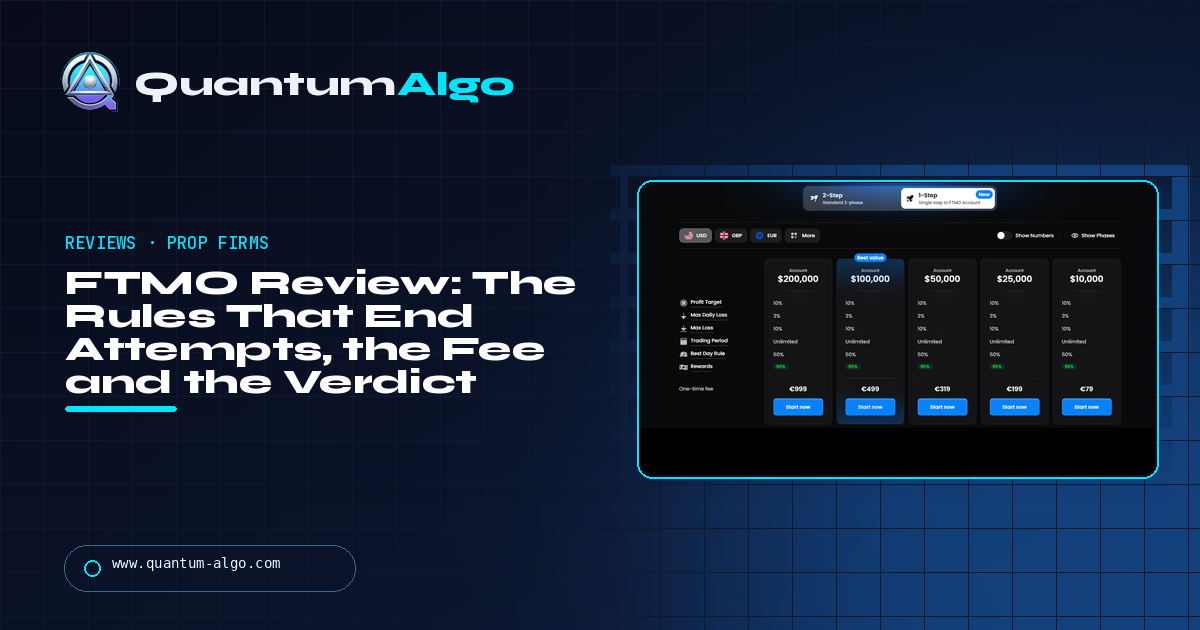
FTMO is a Prague-based CFD prop firm, founded in 2015, that sells a one-time-fee evaluation — a 2-Step (10% target then 5%, 5% daily loss, 10% maximum loss, four trading days per phase) or a 1-Step (10% target, 3% daily loss, 10% maximum loss, best day at or below 50% of your positive days' profit) — on accounts of $10K to $200K, with no time limit, unlimited free trials and the fee refunded with the first reward. Loss limits are static against the initial balance; the daily loss is measured on equity including open trades, and it is the rule that ends most attempts. Rewards are shown at 90% on the pricing page (historically 80% rising to 90% under the Scaling Plan), paid from 14 days after the first trade and then on demand. It is the most reliable firm in the segment and among the most expensive, it restricts news and weekend trading on the Standard account, and it does not accept US clients. Rating 4.4 / 5.
FTMO is the firm every other CFD prop firm is compared to, and the comparison usually ends the same way: the others are cheaper, and FTMO is still paying. That is the whole case for it and it is a strong one — but it does not tell you whether you will pass, and the rule that decides that is not the one on the pricing card. This review is for the trader deciding whether to spend a top-of-market fee here or a smaller one elsewhere: the 2-Step and 1-Step objectives as they actually bind, the equity-based daily loss and how to size so it cannot be reached, Standard versus Swing, what the rewards and scaling really are, how FTMO compares with FundedNext and Topstep, a $100K 2-Step passed in twenty-eight days, and the mistakes that turn a refundable fee into a spent one. The planner sizes your plan to the daily line.
Indicators that prove themselves in public.
One engine, four precision tools — the Gold (XAU) Scalper, the institutional Gravity Zone, the Zeno momentum Oscillator, and Zeno Stocks for equities.
What is FTMO?
FTMO is a Prague-based proprietary trading firm, founded in 2015, that popularised the two-step evaluation: pay a one-time fee, hit a 10% target in the FTMO Challenge, then a 5% target in Verification, and trade a simulated FTMO Account of $10,000 to $200,000 with a share of the profits paid to you. It trades CFDs — forex, indices, commodities, crypto, some stocks — on MetaTrader 4 and 5, cTrader and DXtrade, and it accepts traders from more than 140 countries but not the United States. It has since added a 1-Step Challenge with no Verification phase, and a Swing account that lifts the news and weekend restrictions.
FTMO's standing in the industry comes from being the firm that did not blow up. When several large competitors lost their broker or their payment processor and stopped paying, FTMO kept paying, and its rules — static loss limits measured on the initial balance, no time limit, a refundable fee — have been the reference point everyone else is measured against. The trade-offs are a fee at the upper end of the market, a daily loss rule measured on equity that catches more traders than the target does, and a profit split that has historically started at 80% and required the Scaling Plan to reach 90%. This review is for the trader deciding between FTMO and the cheaper or more flexible firms — FundedNext on CFDs, Topstep or Apex on futures — and it explains what the rules do to a plan rather than restating them. Figures are as displayed on FTMO's pricing page and trading-objectives page in September 2026; confirm on the day you buy.
At a glance: the verdict
Rating: 4.4 / 5. The most reliable CFD prop firm, with the cleanest static rule set, the best analytics, unlimited free trials and a refundable fee. It loses points for pricing at the top of the market, a 5% (or 3% on 1-Step) daily loss on equity that ends more attempts than anything else, the Standard account's news and weekend restrictions, a split that may still require scaling to reach 90%, and no access for US traders.
Best for: forex and index CFD traders with a tested, low-drawdown process who want a firm that will still be there in three years; swing traders on the Swing account; anyone who has already blown a cheaper challenge on a technicality. Not for: US residents, futures traders, high-frequency or high-leverage styles that spike equity drawdown, and anyone whose plan relies on a few large days.
The Challenge models and their objectives
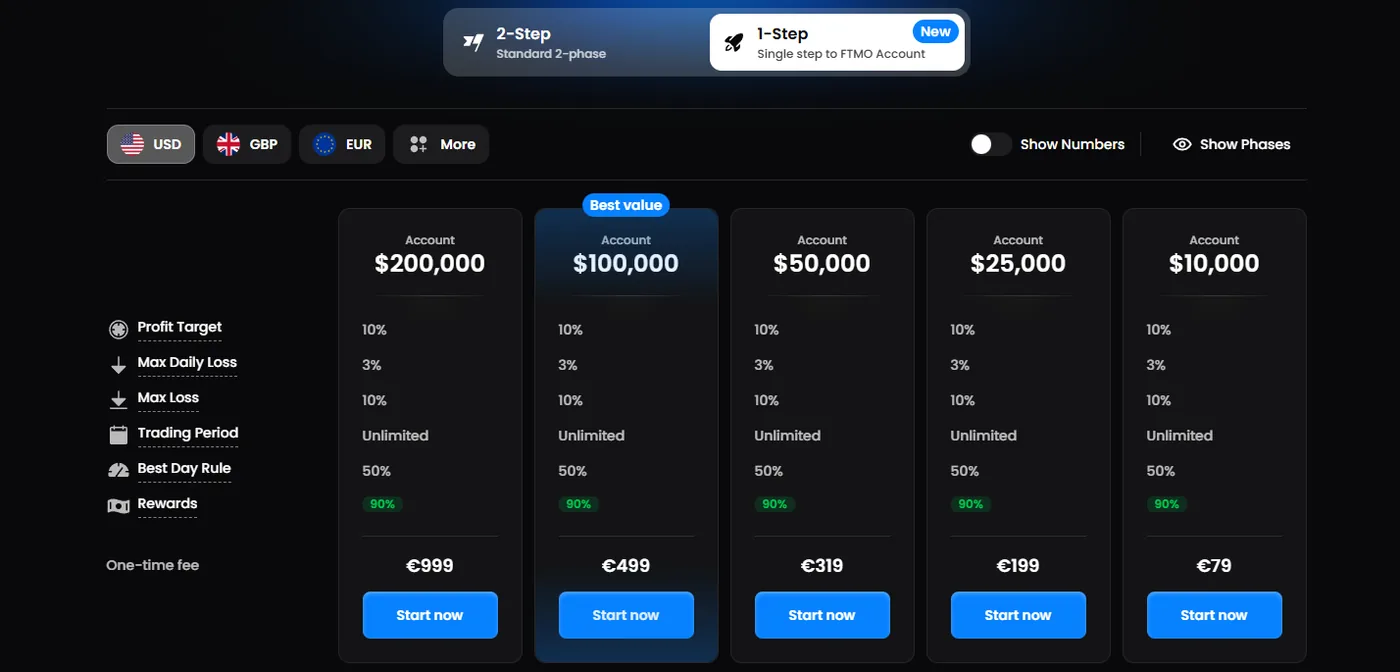
| 2-Step: FTMO Challenge → Verification | 1-Step Challenge | |
|---|---|---|
| Profit target | 10% in the Challenge, then 5% in Verification | 10%, one phase |
| Maximum daily loss | 5% of the initial balance | 3% of the initial balance |
| Maximum loss | 10% of the initial balance (static) | 10% of the initial balance (static) |
| Minimum trading days | 4 per phase | None |
| Best day rule | None stated | Best day ≤ 50% of your positive days' profit |
| Time limit | None | None |
| Sizes | $10K, $25K, $50K, $100K, $200K | $10K, $25K, $50K, $100K, $200K |
| One-time fee (1-Step, as displayed) | — | €79 · €199 · €319 · €499 · €999 |
| Fee refund | With the first reward | With the first reward |
| FTMO Account | No profit target, no minimum days, same loss limits | No profit target, same loss limits |
Both loss limits are static and measured against the initial balance, which is the single most important thing about FTMO's rules: a $100K account can never lose more than $10,000 from the start, and the daily line is $5,000 (or $3,000 on 1-Step) below the day's starting equity, however much profit you have made. Compare the trailing drawdowns at the futures firms, which climb with your balance and can turn a profitable account into a stopped one on a normal pullback. The 1-Step Challenge buys the missing Verification phase with a tighter daily loss and a best-day rule, so it suits traders with small, even days and punishes anyone who tries to pass it in two sessions.
The 2-Step fee sits on the same selector under its own tab; at the time of writing it is priced separately from the 1-Step figures shown above and varies with promotions, so read the card for the model you are buying. Every fee is one-time, and it comes back with the first reward.
The rules that actually end attempts
The daily loss is measured on equity, not balance — closed profit and loss for the day plus the floating result of every open position — and it is checked at any moment. A trader $2,000 up on the day with three positions open that swing $7,000 against him has breached a $5,000 daily limit even if all three come back. Most FTMO failures are this rule, not the 10% maximum loss, and the fix is arithmetic: the total open risk at any moment plus the day's realised loss has to stay under the daily line with room for slippage. The planner below does that sum.
On the Standard FTMO Account (not during the Challenge) two more restrictions apply: no positions opened or closed within a window around high-impact news, and no holding over the weekend. The Swing account removes both, at the cost of lower leverage (1:30 versus 1:100 on the Standard). A trader whose edge is the London or New York session on forex majors rarely needs Swing; a trader holding index positions for days does. Choose at purchase — the account type is part of the product, not a setting.

Automate your trades. Let Quantum Algo trade for you.
Every signal executed on your own account — on your account, with the plan you define.
Rewards, payouts and scaling
The pricing page shows a 90% reward on FTMO Accounts across the 1-Step cards. FTMO's long-standing structure was an 80% split rising to 90% once the Scaling Plan criteria were met — consistent profitability over a run of trading days inside the risk limits — and third-party reviews in mid-2026 still describe that path. Read the terms for the model you buy and plan on 80% until your dashboard says otherwise; the difference on a $5,000 month is $500.
The first payout is available 14 days after the first trade on the FTMO Account, and after that payouts are on demand, with the fee refunded alongside the first reward. Processing is typically a day or two. The Scaling Plan raises the account balance by 25% at each qualifying milestone, up to a $2 million ceiling, which is one of the more generous caps in the industry. There is no fixed per-request cap on the reward itself, which sets FTMO apart from the futures firms' $5,000-a-request limits.
Everything is simulated: the FTMO Account is a demo account whose profits FTMO pays from its own funds, and FTMO says so plainly in its terms. That is the industry standard now and not a mark against the firm; it is the reason the rules exist, and the reason a firm's payout history matters more than its marketing.
Challenge risk planner
Choose the model and size, then enter your risk per trade, average winner in R, win rate and trades per day. The tool returns the trades and days to the target, how many consecutive losers hit the daily cap, whether your worst possible day is already over the daily limit, the losing run that reaches the 10% maximum, and — on 1-Step — how to stay inside the best-day rule.
Where FTMO is good
- Static loss limits on the initial balance. A $100K account can never lose more than $10,000 and the lines do not chase your profits.
- No time limit on any phase, and no minimum days on 1-Step.
- Unlimited free trials on both rule sets — you can rehearse the exact conditions before paying.
- The fee is refunded with the first reward.
- Payout reliability through the years when competitors stopped paying; the reference firm for the whole CFD segment.
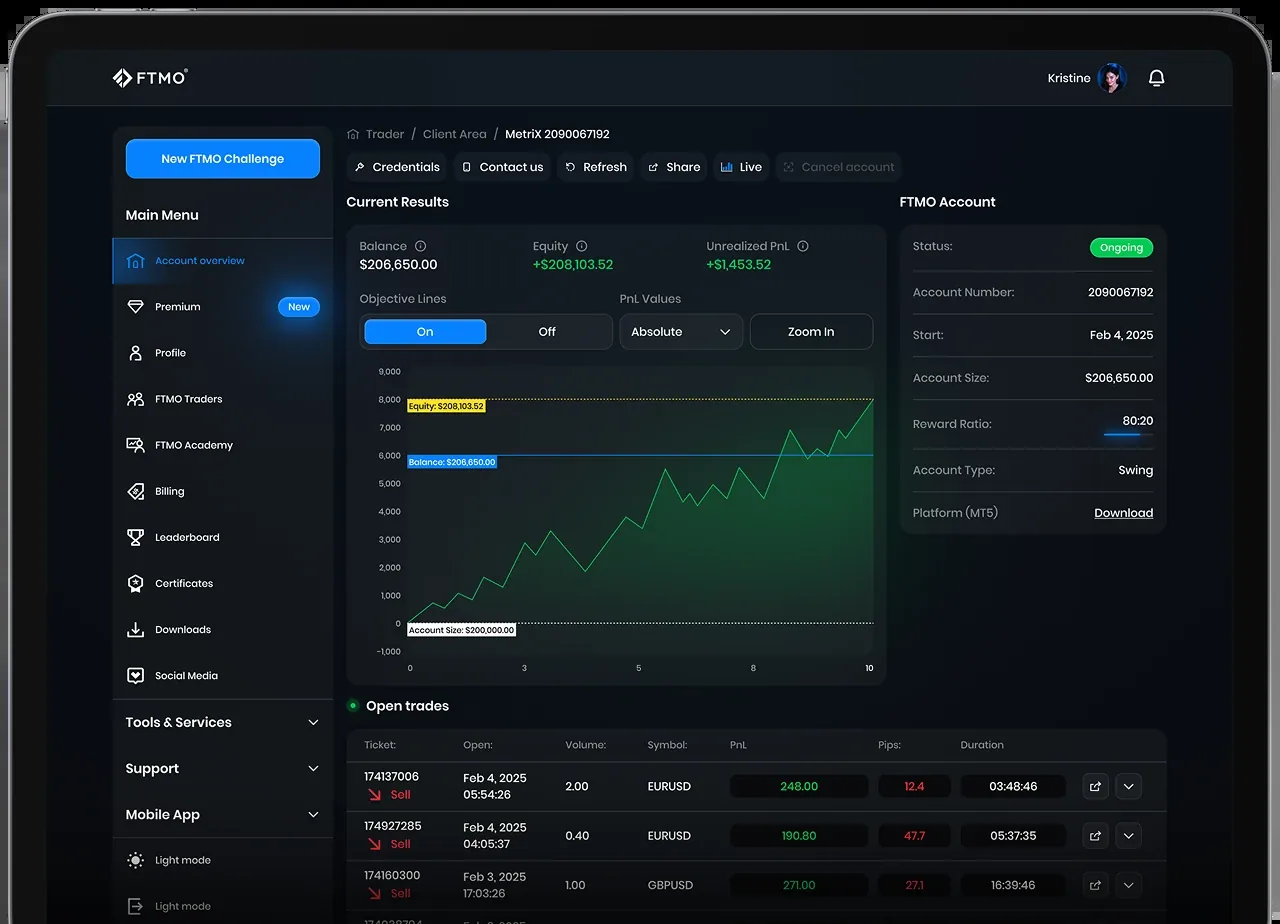
- The client area and MetriX analytics — the best tooling in the segment, and where the daily-loss arithmetic is shown to you.
- Swing account with no news or weekend restrictions; Scaling Plan to $2 million; no per-request payout cap.
Where it falls short
- Price. FTMO sits at the top of the market per dollar of account, and the 2-Step at $200K is close to four figures in euros.
- The daily loss on equity. 5% (3% on 1-Step) including open positions ends far more attempts than the target; it demands position-level risk discipline most retail traders have not built.
- Standard account restrictions on news and weekends — you pay for Swing with 1:30 leverage.
- The reward structure has historically been 80% until you scale; the 90% shown on the pricing cards should be confirmed for your model.
- No US clients, and a list of other restricted countries.
- The 1-Step best-day rule punishes exactly the trader who gets a good trend day early.
- CFDs only — no futures, no direct stock trading.
FTMO vs FundedNext vs Topstep
| FTMO | FundedNext | Topstep | |
|---|---|---|---|
| Markets | CFDs: forex, indices, commodities, crypto | CFDs, plus a separate futures arm | CME futures only |
| Fee | One-time, refunded with first reward; top of market | One-time, refunded with first or third reward; cheaper by size | Monthly subscription + $149 activation |
| Models | 2-Step, 1-Step; Standard or Swing | Stellar 1-Step, 2-Step, Lite; Instant | One Combine |
| Loss rules | Static: 10% max, 5% (3%) daily on equity | Static balance-based: 10/6/8% max, 5/3/4% daily by model | Trailing end-of-day MLL, locks at start |
| Minimum days | 4 per phase (2-Step); none (1-Step) | 5 per phase (2-Step, Lite); 2 (1-Step) | None stated; consistency target in practice |
| Split | Up to 90% (historically 80% → 90% via scaling) | 80% → 90%, up to 95% with add-on | 90% from the first dollar |
| First payout | 14 days after the first trade, then on demand | 5 business days (1-Step); 21 days then every 14 (2-Step, Lite) | After 5 winning days ≥ $150 or 3 days at ≤ 40% consistency |
| Holding | Standard: news and weekend restricted; Swing: free | Overnight and weekends allowed on Stellar; news trades count 40% | Flat by 3:10 PM CT daily |
| Free trial | Unlimited | No | No (free reset credit monthly) |
| US traders | No | Yes (check terms) | Yes |
FTMO is the firm you choose for reliability and rules you can plan around; FundedNext is the firm you choose for price, faster first payouts and looser holding rules; Topstep is a different market. If you are a US resident the choice is made for you. If you are outside the US and trade forex or index CFDs, the honest comparison is FTMO's track record and free trials against FundedNext's lower fee and 15% challenge-phase share — and a trader who has failed two cheap challenges on a daily-loss technicality usually gets more value from FTMO's free trial than from a third cheap attempt.
How it fits a Smart Money workflow
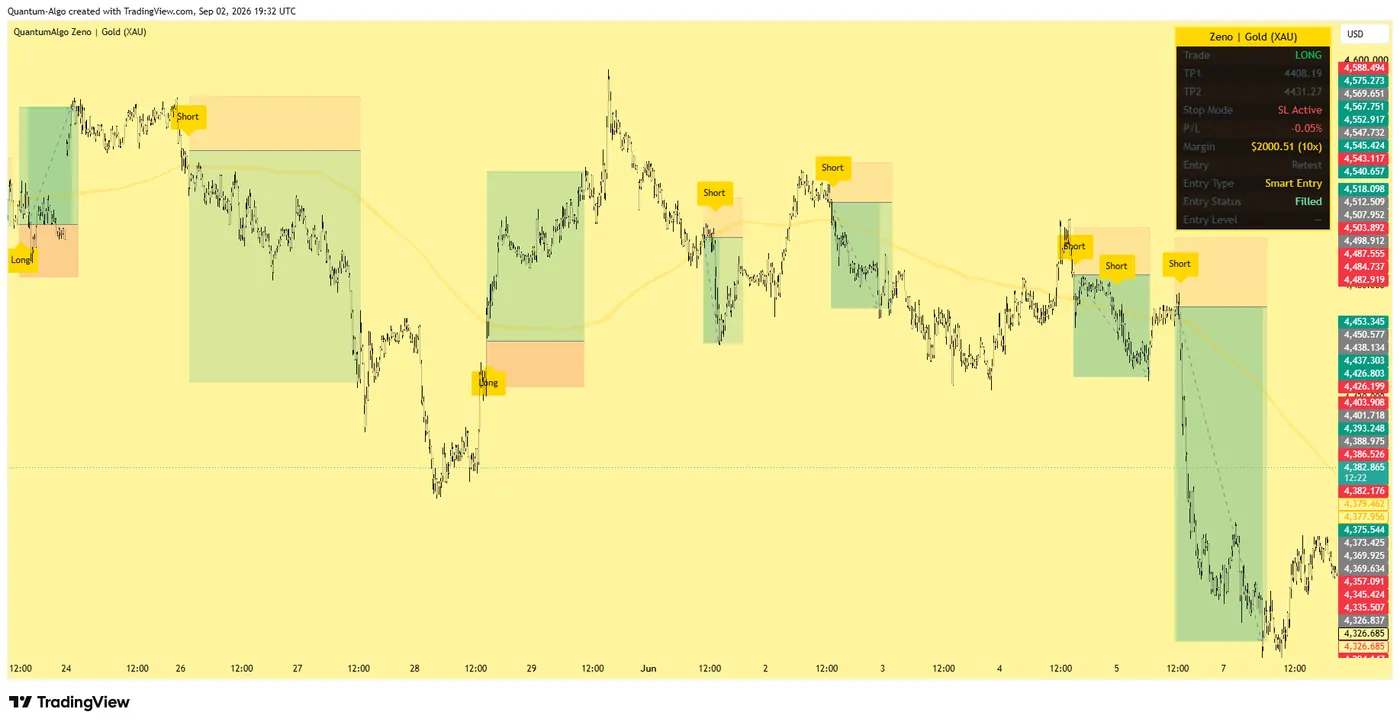
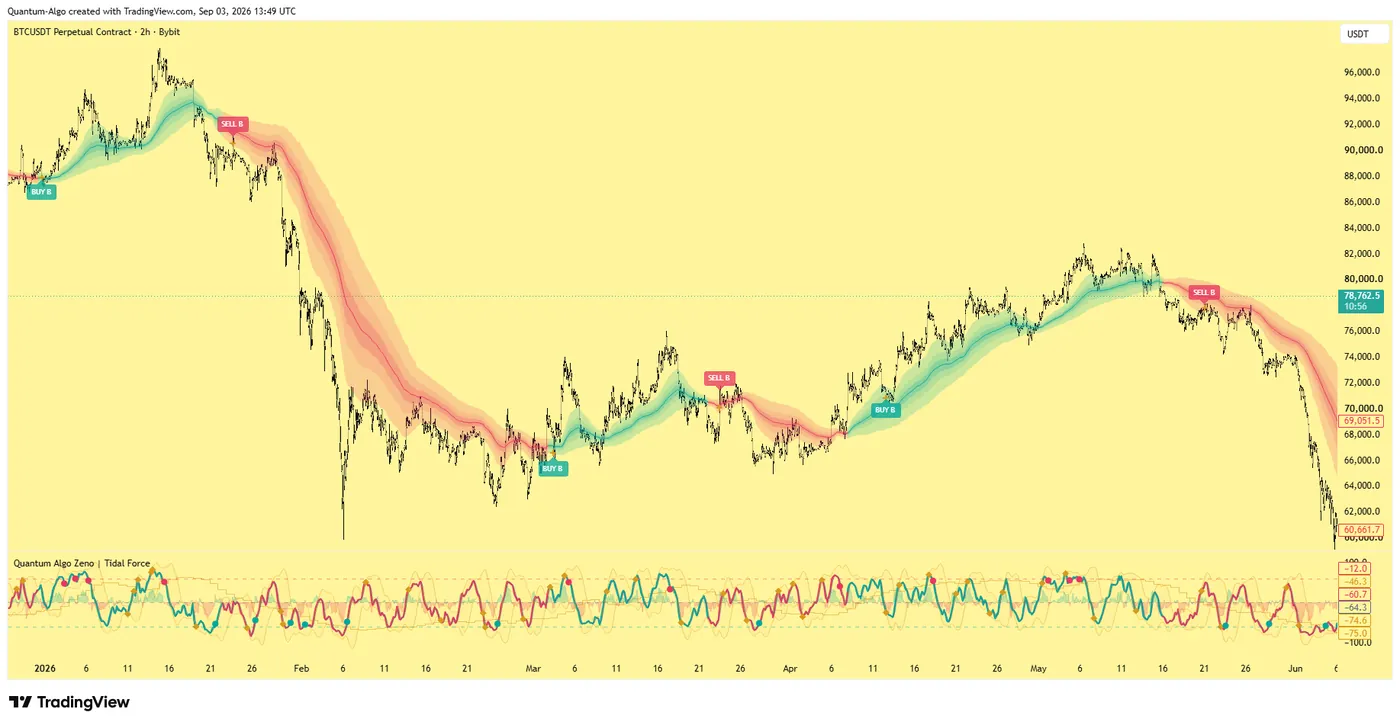
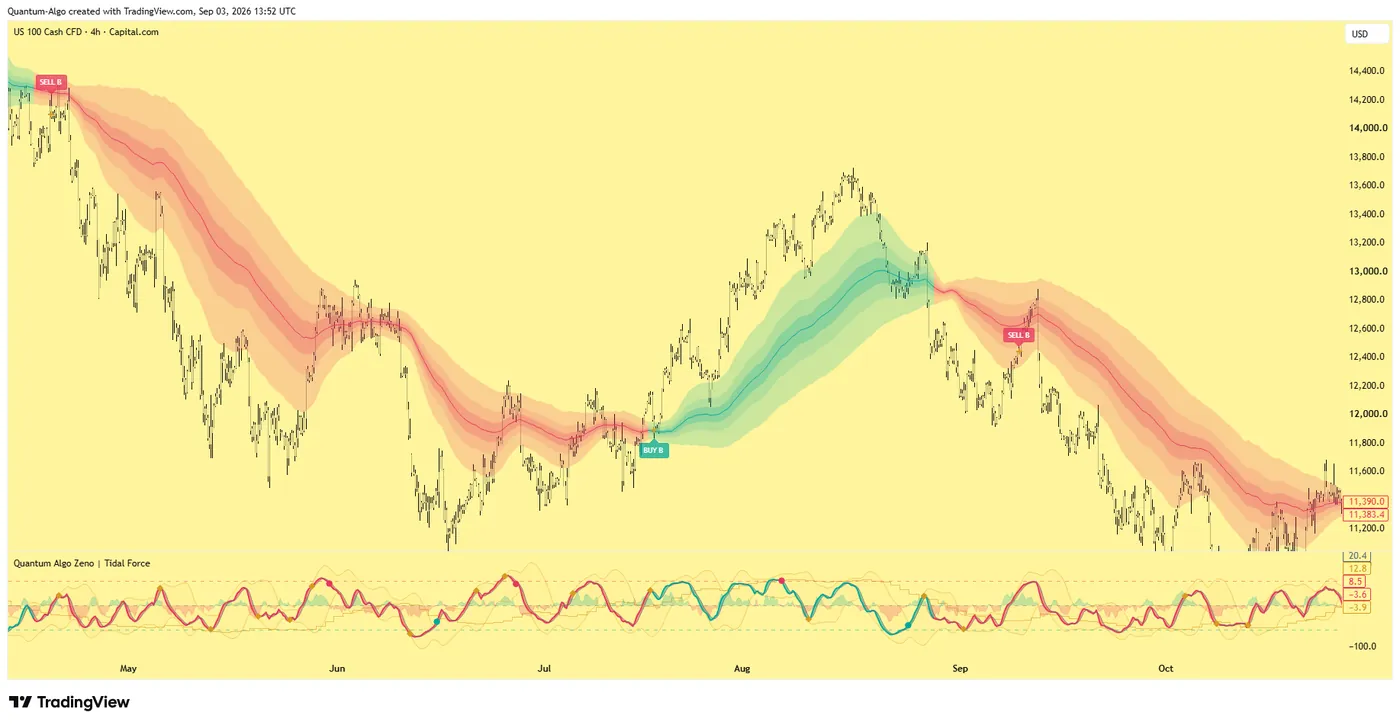
FTMO's equity-based daily loss makes position-level risk the whole game. A Smart Money plan that waits for the liquidity sweep and the return into an order block, enters once with a defined stop and does not add, is naturally inside the rule; a plan that scales into a level three times is not. The prop-firm strategy guide covers the general shape; on FTMO, cap total open risk at a third of the daily line, size every trade from the stop with the position-sizing rules, and let the Swing account do the holding if your setups need it. The Smart Money Concepts Engine marks the structure and the order blocks, the Liquidity Sweeps script flags the sweep that starts the move, and the SessionScope script keeps you in the sessions where the majors actually move. The premium engine, Zeno, prints each signal with a stop and targets, which is the input the risk arithmetic needs; one Zeno signal per session at 0.5% risk is a challenge-shaped plan.
Reference data
| Item | Value |
|---|---|
| Company | FTMO s.r.o., Prague; founded 2015 |
| Product | FTMO Challenge (+ Verification on 2-Step) → simulated FTMO Account, Standard or Swing |
| Sizes | $10K, $25K, $50K, $100K, $200K |
| 2-Step objectives | 10% then 5% target; 5% daily loss; 10% max loss; 4 trading days per phase; no time limit |
| 1-Step objectives | 10% target; 3% daily loss; 10% max loss; best day ≤ 50% of positive days' profit; no minimum days |
| 1-Step fees (as displayed) | €79 / €199 / €319 / €499 / €999, one-time, refunded with the first reward |
| Reward | Shown as 90% on the pricing cards; historically 80% rising to 90% under the Scaling Plan |
| Payouts | First after 14 days from the first trade, then on demand; no fixed per-request cap |
| Scaling | +25% balance per qualifying milestone, up to $2M |
| Platforms | MetaTrader 4, MetaTrader 5, cTrader, DXtrade |
| Swing account | No news or weekend restrictions; 1:30 leverage (1:100 on Standard) |
| Restrictions | No US clients; other restricted countries per the terms |
| Free trial | Unlimited, on either rule set |
| Checked | September 2026 — pricing page and trading-objectives page |
Worked example: a $100K 2-Step passed without touching the daily line
EURUSD and GBPUSD, London and early New York only, one setup: the sweep of the Asian range high or low followed by a 15-minute close back inside, entered on the return with a stop beyond the sweep, target the opposite side of the range or the next daily level at 1.5–2.5R. Risk 0.5% — $500 — per trade, two trades a day maximum, never both open at once. Worst possible day $1,000, one-fifth of the $5,000 daily line, which leaves room for a bad fill and a news spike.
FTMO Challenge: nineteen trading days, 31 trades, 14 winners at an average 1.9R, 17 losers — $13,300 minus $8,500, $4,800 net after the first eleven days, $10,300 on day nineteen. Target met, worst day −$1,000, maximum drawdown from the start $1,500. Verification at the same size and rules: 5% needed, reached in nine days on 15 trades with a −$1,000 worst day. Twenty-eight trading days in all, both minimum-days requirements cleared without thinking about them. First reward requested fifteen days after the first FTMO Account trade, with the fee refunded on top. Nothing about the plan was clever; it was sized so the daily rule could not be reached, and the rest was showing up.
Mistakes traders make with FTMO
- Measuring the daily loss on closed trades. It is on equity — open positions count, at every tick.
- Holding three correlated positions. EURUSD, GBPUSD and DXY short is one trade three times, and the daily line sees all of it.
- Buying Standard and trading the weekend. The restriction is on the funded account; the Swing account is the fix, not a rule change.
- Going for 10% in three days on 1-Step. The best-day rule needs the other winning days to add up.
- Skipping the free trial. It is the exact rule set for nothing; use it until you pass it twice.
- Assuming 90% from day one. Confirm the reward for your model; plan on 80% until the dashboard says otherwise.
- Buying $200K first. The percentages are identical; buy the size whose daily line matches the risk you actually take.
FTMO is the firm to choose when you want rules you can plan around and a firm that will still be paying in three years, and you are willing to pay for it. The rule that matters is the daily loss on equity: size every trade so your worst possible day is a fraction of the line, never stack correlated positions, and use the free trial until you have passed it twice. Buy Swing if you hold, plan on 80% until your dashboard shows 90%, and pick the size whose daily line matches the risk you actually take.
◆ Interactive check
Do you know the FTMO rules?
Questions traders ask about FTMO
On the 2-Step: a 10% profit target in the FTMO Challenge, then 5% in Verification, with a 5% maximum daily loss and a 10% maximum loss, both static against the initial balance, at least four trading days per phase and no time limit. On the 1-Step: a 10% target, a 3% daily loss, a 10% maximum loss, no minimum days, and a best-day rule — your best day must not exceed 50% of your positive days' profit.
A one-time fee by account size, refunded with the first reward. The 1-Step cards showed €79 for $10K, €199 for $25K, €319 for $50K, €499 for $100K and €999 for $200K in September 2026; the 2-Step is priced under its own tab and varies with promotions. Free trials are unlimited.
The pricing page shows a 90% reward on FTMO Accounts. FTMO's long-standing structure was 80% to the trader, rising to 90% once the Scaling Plan criteria were met, and mid-2026 third-party reviews still describe that path — confirm the terms for the model you buy and plan on 80% until your dashboard shows otherwise.
It is 5% of the initial balance on the 2-Step (3% on the 1-Step), measured on equity — the day's closed result plus the floating profit or loss of every open position — and checked at any moment. Open positions count, so total open risk plus the day's realised loss must stay under the line with room for slippage.
The first reward can be requested 14 days after the first trade on the FTMO Account; after that payouts are on demand, typically processed within a day or two, and the Challenge fee is refunded with the first reward. There is no fixed per-request cap.
The Standard FTMO Account restricts opening or closing positions around high-impact news and holding over the weekend; the Swing account removes both restrictions in exchange for lower leverage (1:30 versus 1:100). The restrictions apply only on the funded account, not during the Challenge. Choose the type when you buy.
No. FTMO serves traders in more than 140 countries but the United States is on its restricted list, along with a small number of other countries. US traders looking at prop firms are usually looking at futures firms such as Topstep or Apex, or CFD firms that accept US clients.
No — like the rest of the industry, the FTMO Account is a simulated account and FTMO pays rewards from its own funds based on its performance. FTMO states this plainly in its terms. It is the reason the rules exist and the reason a firm's payout history matters more than its marketing.
If reliability and a rule set you can plan around matter more than the fee, yes — FTMO kept paying through the years when several large competitors stopped. If price and looser holding rules matter more, FundedNext is cheaper by size and pays a first reward faster. A trader who has failed cheaper challenges on a daily-loss technicality usually gets more value from FTMO's free trial than from another cheap attempt.
MetaTrader 4, MetaTrader 5, cTrader and DXtrade, trading CFDs on forex, indices, commodities, crypto and some stocks. No futures and no direct stock trading; futures traders should look at Topstep or Apex.
References & Related Guides
Read next
- What Is a Prop Firm?
- Prop Firm Trading Strategy
- FundedNext Review
- Topstep Review
- Prop Firms That Use MT4
- Position Sizing
- Risk Management in Trading
- Trading Psychology
- Smart Money Concepts Engine (free indicator)
- SessionScope (free indicator)
- Liquidity Sweeps (free indicator)
- Zeno — the premium engine