FundedNext Review: Stellar 1-Step, 2-Step and Lite — the Rules, the Real Split and the Verdict
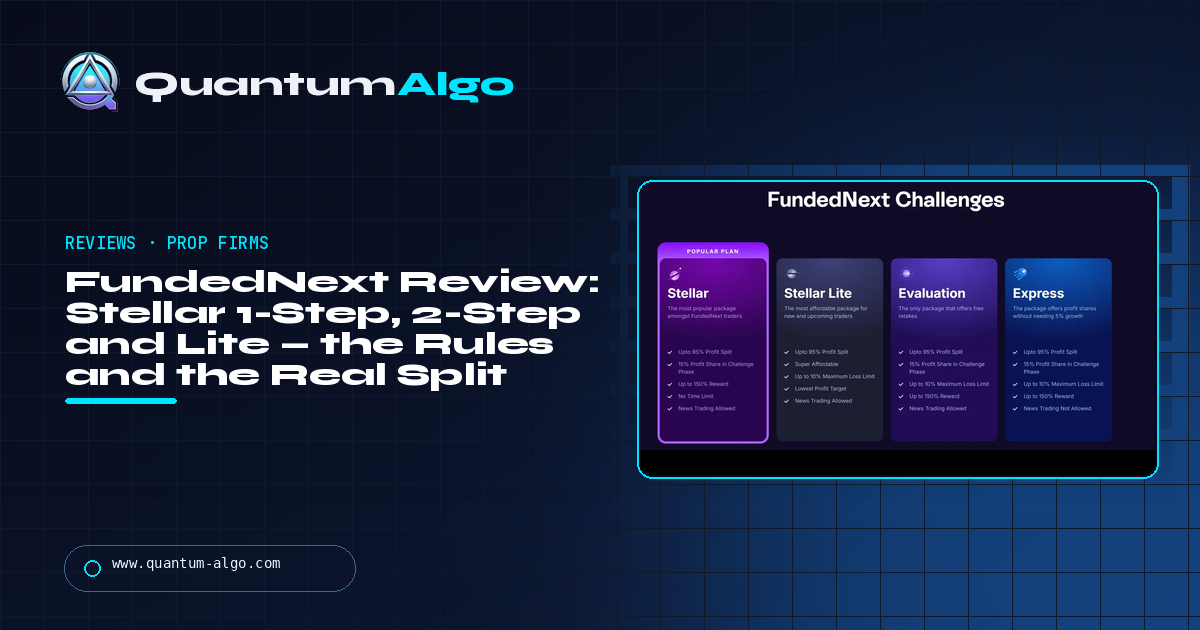
FundedNext is a Dubai-based CFD prop firm, launched in 2022, that sells one-time-fee evaluations on simulated accounts of $6K to $200K in three Stellar models — 1-Step (10% target, 3% daily loss, 6% maximum loss), 2-Step (8% then 5%, 5% daily, 10% maximum) and Lite (8% then 4%, 4% daily, 8% maximum) — with static balance-based limits, no time limit, news and weekend trading allowed, a first reward after five business days on the 1-Step and 21 days on the others, and a 15% share of your evaluation profit paid once funded. Fees run about half of FTMO's by size and are refunded with the first reward on the 2-Step but only at the third on the 1-Step and Lite. The split starts at 80% and rises to 90% on scale-up; the advertised 95% needs an add-on. Best value for swing and news traders; a shorter track record and three rule sets to keep straight. Rating 4.1 / 5.
FundedNext is what you look at after seeing FTMO's price, and the question is always the same: what does the cheaper firm cost in rules? The answer is more moving parts, not worse ones — three models with different daily lines, a share of your evaluation profit, a 40% count on news trades once funded, refunds that arrive at different rewards, and a headline split that needs an add-on. This review is for the trader deciding between the two: what each Stellar model actually binds on, where the 1-Step ends people, how the rewards and the 15% share really work, how FundedNext compares with FTMO and Topstep, a $100K 2-Step passed swing-style in thirty-nine days, and the mistakes that turn a cheap evaluation into an expensive one. The chooser picks the model that fits your worst day.
Indicators that prove themselves in public.
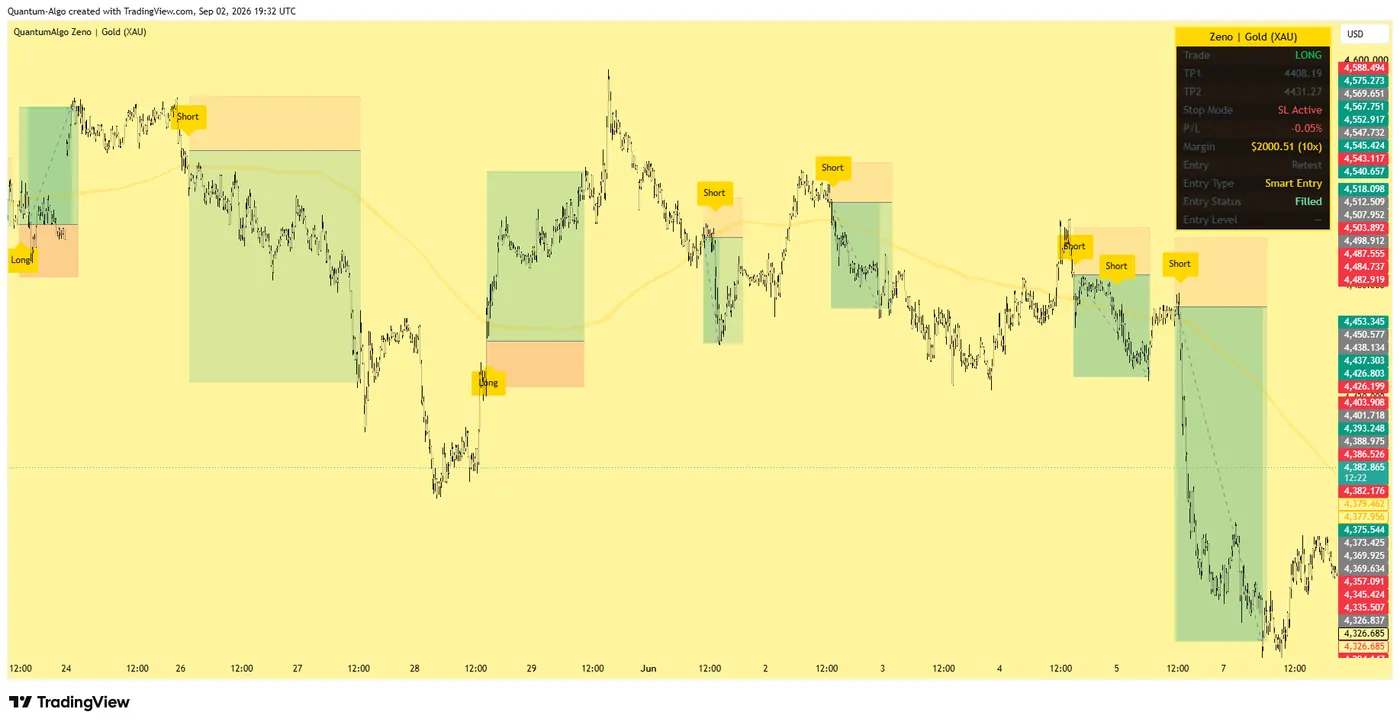
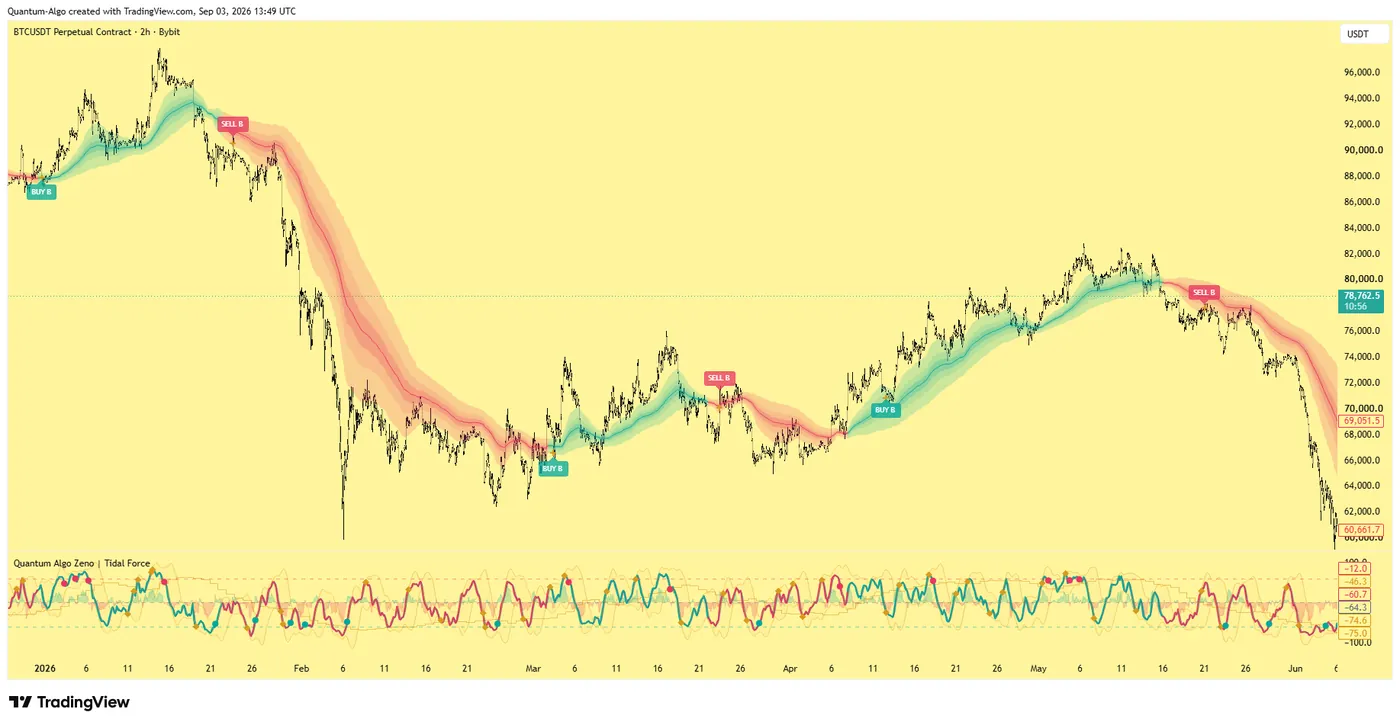
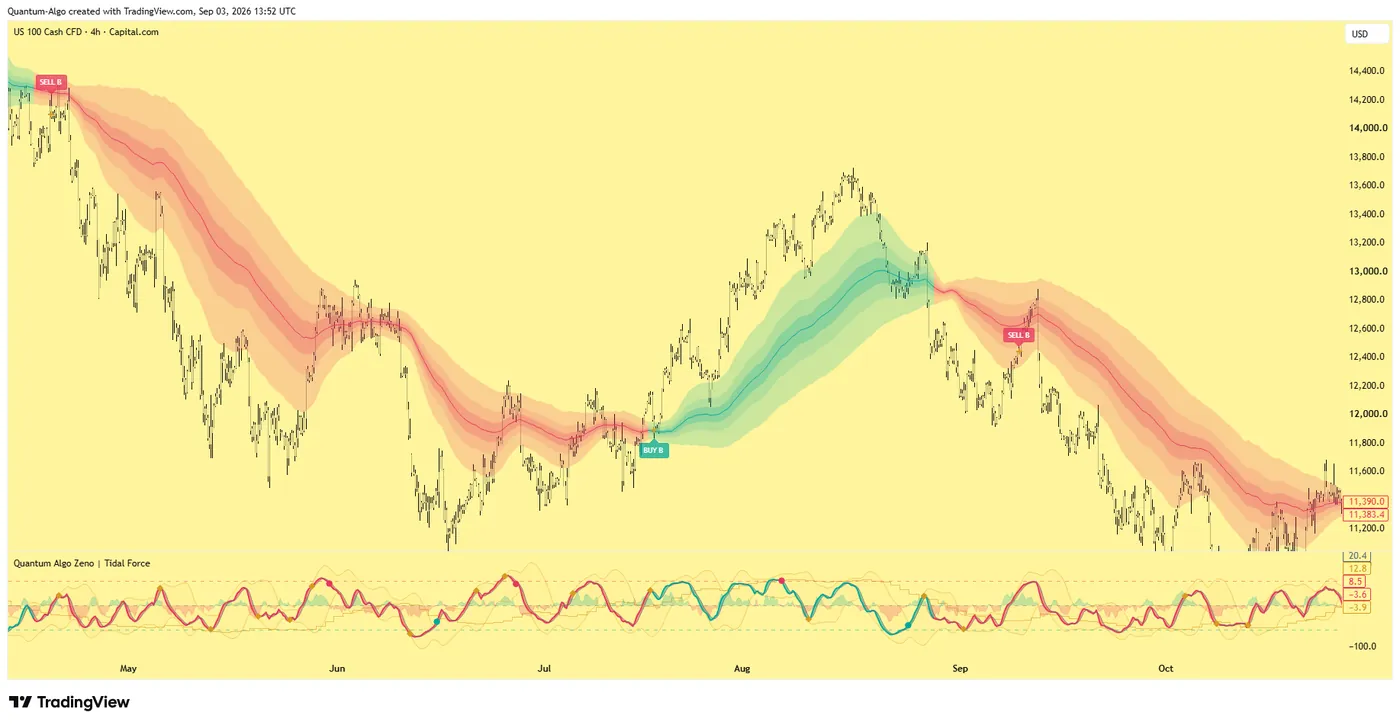
One engine, four precision tools — the Gold (XAU) Scalper, the institutional Gravity Zone, the Zeno momentum Oscillator, and Zeno Stocks for equities.
What is FundedNext?
FundedNext is a Dubai-based proprietary trading firm, launched in 2022, that grew fast on two things the established firms did not offer: a cut of your profits during the evaluation itself — the 15% challenge-phase share — and a price per dollar of account well below FTMO's. It sells one-time-fee CFD evaluations on simulated accounts from $6,000 to $200,000 in three Stellar models (1-Step, 2-Step and Lite) plus an Instant funding model, on MetaTrader 4 and 5, cTrader and Match-Trader, and it runs a separate futures arm. It accepts traders in more than 170 countries, including — check the current terms — the United States.
What it has become is the value-and-flexibility alternative to FTMO: cheaper by size, looser on news and weekend holding, a first reward within a week on the 1-Step, and a scaling plan that reaches $4 million. What it has not yet become is a firm with a decade of payout history, and its rulebook has more moving parts — three models with different daily lines, a 40% count on news-window profits, refund timing that differs by model, and a 95% headline split that needs an add-on. This review is for the trader who has looked at FTMO's price and wants to know what the cheaper firm actually costs in rules. Figures are as reported on FundedNext's selector and in third-party rule audits in July–September 2026; the firm changes them often, so read the card for the model you buy.
At a glance: the verdict
Rating: 4.1 / 5. The best-value CFD evaluation for a trader who holds overnight and trades news: static balance-based limits, a first reward in five business days on 1-Step, the 15% challenge-phase share, and fees around half of FTMO's at the same size. It loses points for a shorter track record, three rule sets that are easy to mix up, a 6% maximum loss on 1-Step that is tight for the daily line it comes with, the 40% haircut on news-window profits once funded, the fee refund arriving only at the third reward on 1-Step and Lite, and a "95%" that is really 80% rising to 90%.
Best for: forex and index CFD traders who hold positions for days, trade around news, and want a cheaper first evaluation with early payouts; traders in the US who cannot use FTMO. Not for: anyone who wants the longest payout history in the segment, traders whose worst day regularly exceeds 2% of the account (the 1-Step will end them), or anyone who will not read three rule sets.
The Stellar models and their objectives
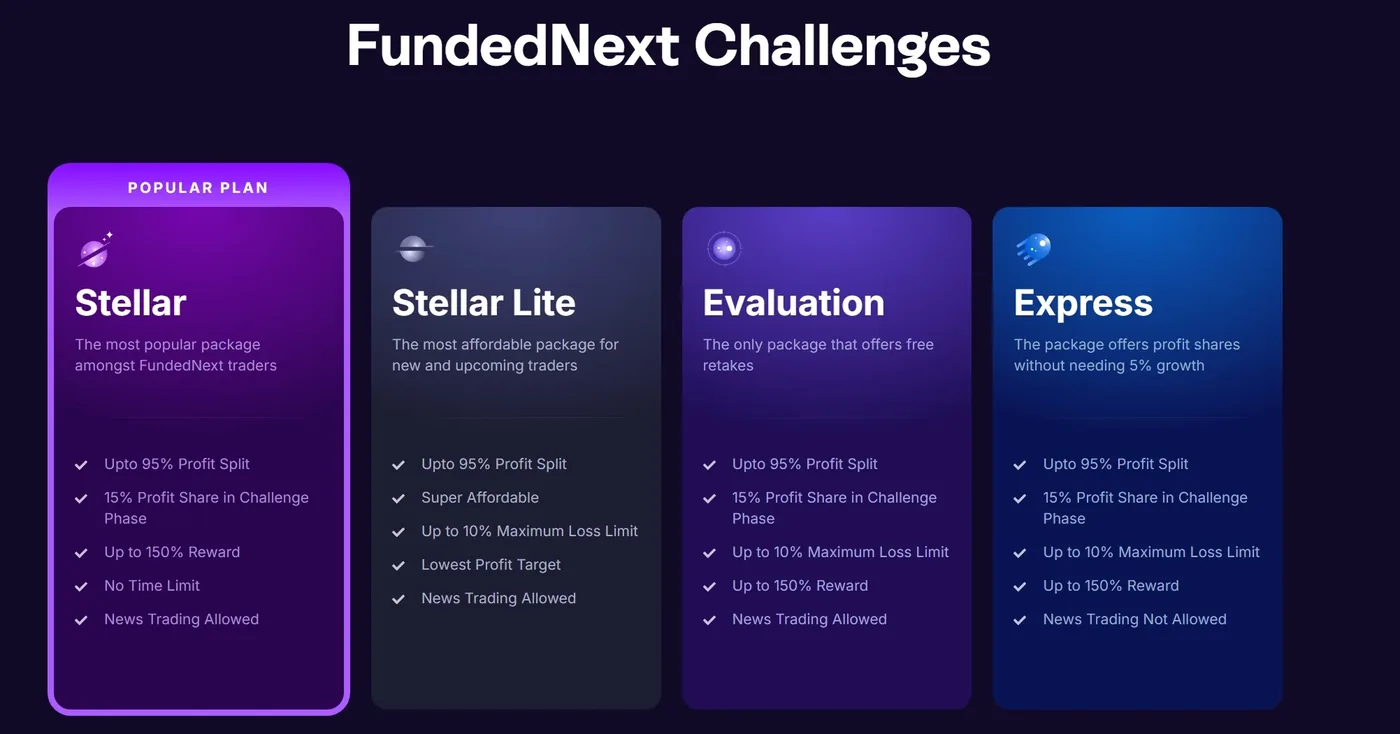
| Stellar 1-Step | Stellar 2-Step | Stellar Lite | |
|---|---|---|---|
| Profit target | 10%, one phase | 8% then 5% | 8% then 4% |
| Daily loss | 3% | 5% | 4% |
| Maximum loss | 6% (static floor at 94% of initial) | 10% (static floor at 90%) | 8% (static floor at 92%) |
| Basis | Balance-based, static | Balance-based, static | Balance-based, static |
| Minimum trading days | 2 | 5 per phase | 5 per phase |
| Time limit | None | None | None |
| Sizes | $6K – $200K | $6K – $200K | $5K – $200K |
| Fee (Stellar cards, Sept 2026) | Same as 2-Step | $49.99 · $109.99 · $189.99 · $269.99 · $529.99 · $1,049.99 for $6K–$200K | Lower than the Stellar cards by size |
| Fee refund | At the 3rd reward | With the 1st reward | At the 3rd reward |
| First reward | After 5 business days, then every 5 | After 21 days, then every 14 | After 21 days, then every 14 |
| 15% challenge-phase share | Yes, once funded | Yes, once funded | No |
| News trading | Allowed | Allowed | Allowed |
| Overnight / weekend | Allowed | Allowed | Allowed |
Two things in the table decide most attempts. The 1-Step trades a single 10% phase for a 3% daily and a 6% maximum loss — the tightest floor of the three, and only two average bad days from the start for a trader whose worst day is 3%. It is the model for small even days and nothing else. The 2-Step is the closest to FTMO's shape, with the same 5% and 10% lines but an 8% first target instead of 10%, and it is the only model whose fee comes back with the first reward. Lite is the cheap entry with the limits scaled down — a smaller target, but a 4% daily line and an 8% floor.
All three are static and balance-based: the daily line is a fixed distance below the day's starting balance and the floor is a fixed distance below the initial balance, neither trailing with profits. The daily check includes floating profit and loss — the day's result plus open positions has to stay above the line — so it binds the same way FTMO's does. The Instant model is the exception: funded at once with no evaluation, but with a trailing drawdown, which is a different product and a different risk.
Rewards, the 15% share, refunds and scaling
The reward split starts at 80% and rises to 90% once the scale-up criteria are met; the "up to 95%" on the plan cards requires a paid add-on. FundedNext advertises that almost all rewards are processed within 24 hours, and third-party trackers put the median at a few hours, which is the fastest in the segment. On the 1-Step the first reward can be requested after five business days of funded trading and then every five; on the 2-Step and Lite the first window is 21 days and then every 14.
The 15% challenge-phase share is the feature the firm is known for: on the 1-Step and 2-Step, 15% of the profit you made during the evaluation is paid to you once you are funded. On a $100K 2-Step that passed with $9,000 in Phase 1, that is about $1,350 — most of the fee back before your first funded trade. Lite does not carry it. The fee refund itself is paid with the first reward on the 2-Step but only at the third reward on the 1-Step and Lite, which is a real difference for a trader who blows the funded account early.
Once funded, two rules matter. News trades — positions opened or closed within a window of five minutes either side of a high-impact release — are allowed but only 40% of their profit counts toward rewards, which is FundedNext's answer to the news-spike gamers and a fair one. And the strategy has to be consistent across the evaluation and the funded account; a trader who passes on scalps and then swings will be asked about it. The scale-up plan raises the balance by 25% at each qualifying cycle, up to $4 million, which is the highest ceiling among the firms compared here. Everything is simulated, as it is everywhere; rewards are paid from FundedNext's own funds.

Automate your trades. Let Quantum Algo trade for you.
Every signal executed on your own account — on your account, with the plan you define.
Stellar model chooser
Pick a size, say how your profit arrives and what your worst day looks like, and choose a priority — fastest reward, most room, or lowest fee. The tool picks the model, moves you off the 1-Step or Lite when your worst day does not fit their lines, and returns the dollar target, daily line, floor, minimum days, fee, refund timing, first-reward window and the 15% share estimate.
Where FundedNext is good
- Price. Roughly half of FTMO per dollar of account on the Stellar cards, and Lite sits below that.
- Static balance-based limits that never trail your profits, with no time limit on any model.
- The 15% challenge-phase share — most of the fee back before the first funded trade on 1-Step and 2-Step.
- Speed to the first reward: five business days on 1-Step, and processing measured in hours.
- News and weekend trading allowed on every Stellar model — no Swing variant to pay for.
- Scale-up to $4 million, the highest ceiling among the firms compared here.
- Four platforms including cTrader and Match-Trader, and a separate futures arm for traders who want both.
Where it falls short
- Track record. Launched in 2022; it has paid consistently, but it has not yet been through what FTMO has.
- Three rule sets that are easy to confuse. The 1-Step's 3% / 6% is a different product from the 2-Step's 5% / 10%.
- The 1-Step's 6% floor is tight for its 3% daily line — two bad days from the start.
- The fee refund arrives only at the third reward on 1-Step and Lite.
- The 40% count on news-window profits once funded surprises traders who passed on exactly those trades.
- "Up to 95%" is 80% rising to 90% unless you buy the add-on.
- Rules and prices change often; a review six months old is out of date, and so may this one be by the time you read it.
FundedNext vs FTMO vs Topstep
| FundedNext | FTMO | Topstep | |
|---|---|---|---|
| Markets | CFDs, plus a separate futures arm | CFDs | CME futures only |
| Fee | One-time, about half of FTMO by size; refunded at 1st (2-Step) or 3rd (1-Step, Lite) reward | One-time, top of market, refunded with 1st reward | Monthly + $149 activation |
| Models | Stellar 1-Step (10% / 3% / 6%), 2-Step (8%+5% / 5% / 10%), Lite (8%+4% / 4% / 8%), Instant | 2-Step (10%+5% / 5% / 10%), 1-Step (10% / 3% / 10%) | One Combine, trailing end-of-day MLL |
| Minimum days | 2 (1-Step); 5 per phase (2-Step, Lite) | 4 per phase (2-Step); none (1-Step) | None stated; 55% consistency cap |
| Split | 80% → 90%; 95% with add-on | Up to 90% (historically 80% → 90%) | 90% from the first dollar |
| First reward | 5 business days (1-Step); 21 days (2-Step, Lite) | 14 days, then on demand | After 5 winning days ≥ $150 |
| Challenge-phase share | 15% on 1-Step and 2-Step | No | No |
| News / holding | Allowed; news-window profit counts 40% when funded | Standard restricted; Swing free at 1:30 | Flat by 3:10 PM CT; no holds |
| Scaling | +25% per cycle to $4M | +25% per milestone to $2M | Contract scaling; discretionary live account |
| Free trial | No | Unlimited | No |
| US traders | Yes (check terms) | No | Yes |
The decision is usually price and holding rules against track record. A swing trader outside the US who wants to hold through the weekend and pay half the fee should be on FundedNext's 2-Step; a trader who values a firm that has already survived an industry crisis, and who can rehearse on a free trial, should be on FTMO. A futures day trader is at Topstep or Apex regardless. The 1-Step is FundedNext's answer to FTMO's 1-Step, and it is cheaper and faster to a reward; it is also the model with the least room, and it should be bought only by a trader whose worst day is small.
How it fits a Smart Money workflow
FundedNext's holding rules make it the CFD firm where a higher-timeframe Smart Money plan works as written: mark the 4-hour order block, wait for the sweep, enter on the 15-minute return, and hold through the week if the structure holds. The prop-firm strategy guide covers the general shape; on FundedNext the specific adjustments are to pick the 2-Step for that style (the 1-Step's 3% daily line is an intraday product), to keep total open risk under a third of the daily line because floating losses count, and to be aware that a position closed inside a news window earns 40% once funded — take profit before the release or well after it. The Order Blocks with Volume script marks the zones, the Liquidity Sweeps script flags the sweep, and the Event Probability Engine puts the news windows on the chart so the 40% rule never surprises you. The premium engine, Zeno, prints the signal with a stop and targets; one Zeno signal at 0.5% risk, held on structure, is a Stellar 2-Step plan.
Reference data
| Item | Value |
|---|---|
| Company | FundedNext, Dubai; launched 2022; separate futures arm |
| Products | Stellar 1-Step, Stellar 2-Step, Stellar Lite (evaluations); Instant (trailing drawdown, no evaluation) |
| Sizes | $6K–$200K (Lite from $5K) |
| Loss rules | Balance-based and static: daily 3% / 5% / 4%, maximum 6% / 10% / 8% by model; floating P&L counts |
| Targets | 10% (1-Step); 8% then 5% (2-Step); 8% then 4% (Lite) |
| Fees | Stellar cards $49.99–$1,049.99 by size (September 2026); Lite lower; one-time |
| Refund | With the 1st reward (2-Step); at the 3rd reward (1-Step, Lite) |
| Split | 80% rising to 90% on scale-up criteria; 95% with an add-on |
| Rewards | 1-Step: after 5 business days, then every 5; 2-Step and Lite: after 21 days, then every 14; processing typically within 24 hours |
| Challenge-phase share | 15% of evaluation profit paid once funded (1-Step, 2-Step) |
| News | Allowed; funded news-window trades count 40% of profit |
| Scaling | +25% per qualifying cycle, up to $4M |
| Platforms | MetaTrader 4, MetaTrader 5, cTrader, Match-Trader |
| Checked | July–September 2026 — selector and third-party rule audits; confirm before buying |
Worked example: a $100K Stellar 2-Step, swing style
GBPJPY and NAS100, 4-hour structure, 15-minute entries, positions held two to five days. One setup: a sweep of a 4-hour swing low into a marked order block, a 15-minute change of character, entry on the retest with the stop under the sweep and a target at the next 4-hour high, 2–4R. Risk 0.6% — $600 — per trade, never more than two positions open, so the floating exposure can never exceed $1,200 against a $5,000 daily line and open risk plus a realised loss stays under half of it even on the worst day.
Phase 1: 24 trading days, 13 trades, 6 winners at an average 2.7R, 7 losers — $9,720 minus $4,200, $5,520 net by day sixteen, $8,300 on day twenty-four: the 8% target on the fifth winning trade. Worst day −$1,200 (both positions stopped at the London open), floor never closer than $4,800. Phase 2: 5% in fourteen days on seven trades. Both minimum-days rules cleared by the pace of the style. Funded on day thirty-nine; the 15% share on $8,300 of Phase-1 profit — about $1,245 — paid with the first reward on day sixty, alongside the fee refund. Two positions held over a weekend in Phase 1 and one through an NFP release, closed the day before; none of it needed a special account type.
Mistakes traders make with FundedNext
- Buying the 1-Step for a swing style. Its 3% daily and 6% floor are an intraday product.
- Mixing up the rule sets. Know your model's daily line and floor in dollars before the first trade.
- Measuring the daily loss on closed trades. Floating P&L counts, at any moment.
- Closing winners inside the news window once funded. They count 40%; take profit before or after.
- Expecting the fee back on the first reward on 1-Step or Lite. It is the third.
- Planning on 95%. It is 80% until you scale, and 95% is an add-on.
- Changing style after passing. The consistency-of-strategy rule is enforced; the funded tape should look like the evaluation tape.
FundedNext is the value choice on CFDs: static balance-based limits, holding and news allowed, a fast first reward and a share of your evaluation profit, at half the price. Buy the 2-Step unless your worst day is small enough for the 1-Step's 3% line, know your daily line and floor in dollars, keep floating risk under a third of the line, take profit outside the news windows once funded, and plan on 80% until you scale. Accept the shorter track record with open eyes.
◆ Interactive check
Do you know the Stellar rules?
Questions traders ask about FundedNext
Stellar 1-Step: 10% target in one phase, 3% daily loss, 6% maximum loss, two minimum trading days. Stellar 2-Step: 8% then 5% targets, 5% daily loss, 10% maximum loss, five minimum days per phase. Stellar Lite: 8% then 4%, 4% daily, 8% maximum, five days per phase. All are static, balance-based, with floating P&L counted, no time limit, and news and weekend trading allowed.
A one-time fee by size. In September 2026 the Stellar 1-Step and 2-Step cards ran $49.99 for $6K, $109.99 for $15K, $189.99 for $25K, $269.99 for $50K, $529.99 for $100K and $1,049.99 for $200K, with Lite priced below that. The fee is refunded with the first reward on the 2-Step and at the third reward on the 1-Step and Lite. Prices and promotions change often.
80% to the trader on the funded account, rising to 90% once the scale-up criteria are met. The "up to 95%" on the plan cards requires a paid add-on. On the 1-Step and 2-Step you also receive 15% of the profit you made during the evaluation once you are funded.
On the 1-Step the first reward can be requested after five business days of funded trading and then every five; on the 2-Step and Lite after 21 days and then every 14. FundedNext advertises that almost all rewards are processed within 24 hours, and third-party trackers report a median of a few hours.
Yes, on every Stellar model, in the evaluation and when funded. Once funded, trades opened or closed within a window of five minutes either side of a high-impact release count only 40% of their profit toward rewards. Overnight and weekend holding is allowed on all Stellar models.
The 1-Step is one 10% phase with the tightest limits (3% daily, 6% maximum) and the fastest reward; the 2-Step is two phases (8% then 5%) with FTMO-like limits (5% daily, 10% maximum) and the only first-reward fee refund; Lite is a cheaper entry with smaller targets (8% then 4%) and scaled-down limits (4% daily, 8% maximum). Only the 1-Step and 2-Step carry the 15% challenge-phase share.
It is balance-based — a fixed percentage below the day's starting balance — but the check includes floating profit and loss, so the day's closed result plus open positions must stay above the line at all times. In practice it binds the same way an equity-based rule does.
FundedNext is cheaper by size, allows news and weekend holding without a special account, pays a first reward faster and shares 15% of evaluation profit; FTMO has the longer payout history, unlimited free trials and a simpler two-model rulebook, and does not accept US traders. Swing and news traders who read the rules lean FundedNext; traders who prioritise track record lean FTMO.
It has paid traders consistently since its launch in 2022, processes rewards quickly, and publishes its rules; the funded accounts are simulated and rewards are paid from the firm's own funds, as across the industry. It has not yet been through the kind of industry stress FTMO has, which is the honest caveat.
Yes, through a separate futures arm with its own rules and pricing distinct from the Stellar CFD models. Futures-first traders should compare that product directly against Topstep and Apex rather than assuming the CFD rules apply.
References & Related Guides
Read next
- What Is a Prop Firm?
- Prop Firm Trading Strategy
- FTMO Review
- Topstep Review
- Apex Trader Funding Review
- Prop Firms That Use MT4
- Position Sizing
- Risk Management in Trading
- Order Blocks with Volume (free indicator)
- Event Probability Engine (free indicator)
- Liquidity Sweeps (free indicator)
- Zeno — the premium engine