Best Futures Trading Platforms and Futures Prop Firms: FCMs, Front Ends, Data and the Drawdown Rule
The best futures trading platform is a CFTC-registered FCM paired with a front end that gives you tick-accurate order entry, a DOM, bracket orders and CME data at per-contract costs that fit your volume — a web-first broker with a sim for beginners, a NinjaTrader/Sierra Chart-class desktop front end for discretionary day traders, a TradingView-integrated futures broker for structure traders. Futures prop firms sell evaluations under rules most people fail; the trailing-drawdown definition is the rule to read before paying any fee.
A futures account is four things — the FCM that holds the money, the front end you click in, the data feed you pay for and the exchange — and "best platform" reviews usually rank only one of them. This page separates them, ranks the front ends by trader type rather than brand, works the monthly cost, and then does the same for prop firms: what an evaluation is, the expected value of buying one, and the trailing-drawdown rule that ends most of them. The calculator below prices any platform at your volume.
Indicators that prove themselves in public.
One engine, four precision tools — the Gold (XAU) Scalper, the institutional Gravity Zone, the Zeno momentum Oscillator, and Zeno Stocks for equities.
What is the best futures trading platform?
The best futures trading platform is a CFTC-registered FCM, or a broker that introduces to one, paired with a front end that gives you tick-accurate order entry, a DOM, bracket and OCO orders, and CME depth data — at per-contract costs that make sense at your monthly volume. In that is usually one of three shapes: a web-first futures broker with its own front end and TradingView integration, a desktop platform such as NinjaTrader or Sierra Chart connected to an FCM, or a TradingView-integrated futures broker for traders who want one chart for everything. For US day traders under $25,000 the futures platform question is really the day-trading platform question, because futures are outside the pattern day trader rule.
The second half of this page is about prop firms, because "best futures prop firm" is now searched as often as the platform question and the two are tangled: most futures prop evaluations run on the same front ends. The honest position on prop firms is that they are a product with a fee, rules designed to be failed by most participants, and a real payoff for the minority who pass — and the rule that fails most people is one most never read properly.
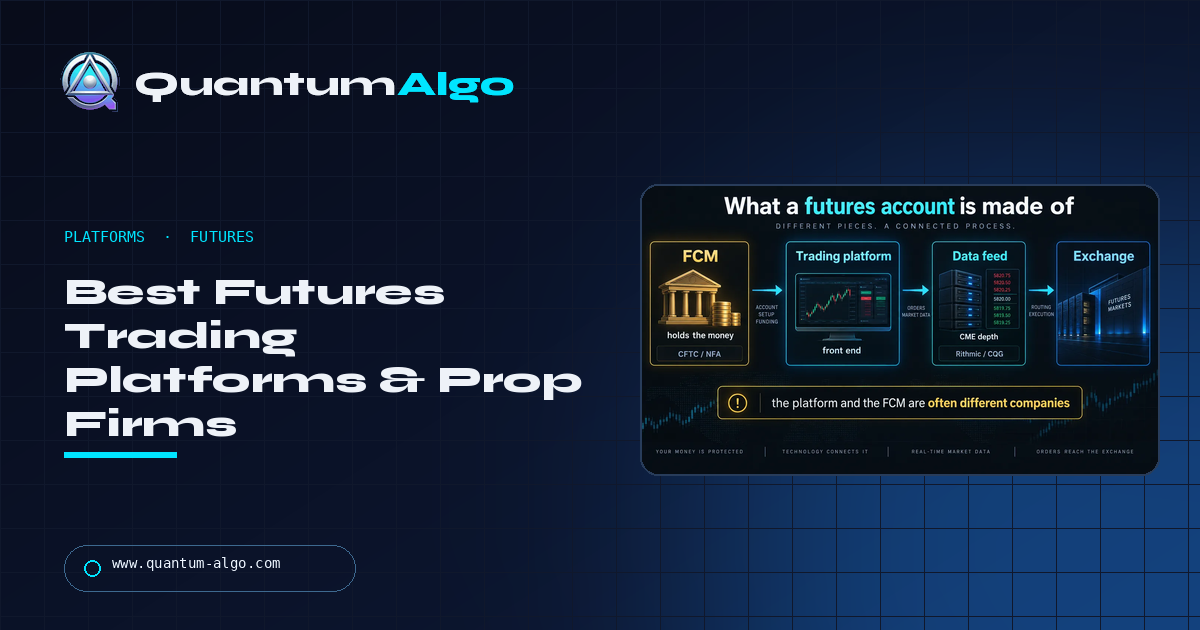
What a futures account is actually made of
The account-anatomy illustration in this guide separates four things that platform marketing blurs together:
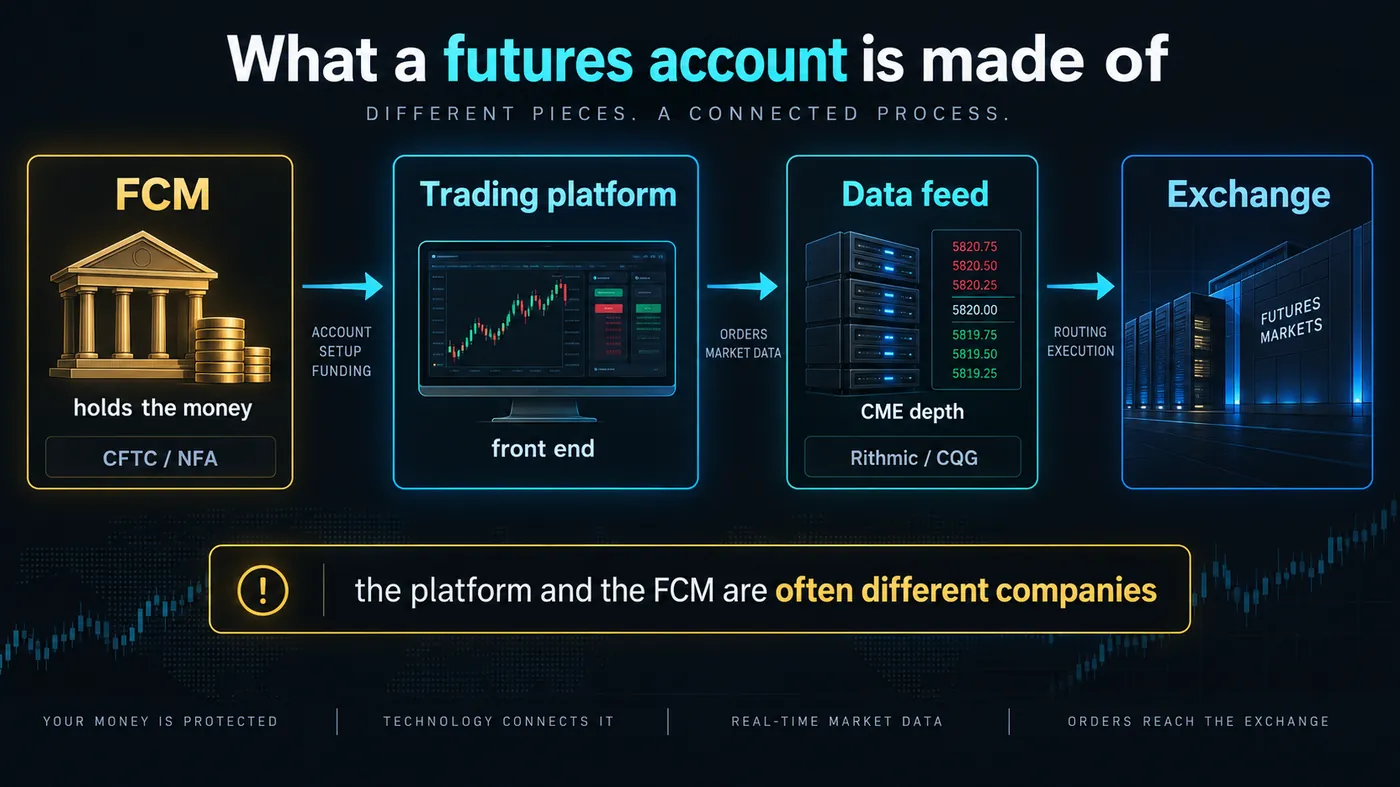
- The FCM — the futures commission merchant that holds your money, is registered with the CFTC and a member of the NFA, and segregates customer funds by law. This is the entity that matters when something goes wrong.
- The trading platform — the front end: the charts, DOM and order ticket. Often a different company from the FCM (NinjaTrader and Sierra Chart connect to many FCMs; some brokers build their own).
- The data feed — CME depth via Rithmic, CQG, dxFeed or the platform's own feed, billed separately from the platform and the FCM.
- The exchange — CME Group for the contracts most retail traders use (ES, NQ, GC, CL and the micros).
When you read "best futures platform", check which of the four the reviewer is ranking. A beautiful front end connected to an FCM with slow support is a worse account than a plain front end at a well-run FCM.
The criteria that decide it
- Per-contract cost, all in. Commission plus exchange fee plus NFA fee plus clearing, per side, at your size. Micro contracts are cheaper per contract but not per point of risk; compare at the same dollar exposure.
- Data fees. CME bundles for depth are the cost the headline price hides — typically $10–15 a month for basic top-of-book on one exchange group, more for full depth, more again for multiple exchange groups. Non-professional status keeps it affordable; check the definition.
- Platform fee. Some front ends are free with commissions above a threshold, some charge monthly, some sell a lifetime licence. Amortise the licence over the years you expect to trade.
- Order types. Bracket, OCO, trailing, and — for scalpers — DOM-native entry and modification. Server-side versus platform-side order handling matters when the connection drops.
- Margin policy. Intraday margin as low as $50 per micro on some brokers; overnight margin at the exchange rate. Low intraday margin is a liquidation risk, not a feature — size from the stop.
- Simulator. A free sim on the same front end, with realistic fills, is where the first month happens.
- TradingView integration. If you analyse on TradingView, an integrated futures broker removes the second window.
- Support and reliability at the open. The first fifteen minutes of the cash session are where the platform is tested.
Best futures trading platforms by trader type
| Trader | Platform shape | Why |
|---|---|---|
| Beginner on micros | Web-first futures broker with a free simulator and TradingView integration | Low minimums, one chart, sim on the live interface |
| Discretionary day trader | Desktop front end (NinjaTrader / Sierra Chart class) at a competitive FCM | DOM, hotkeys, chart trading, replay |
| Scalper | Sierra Chart or Jigsaw-class DOM on a fast feed (Rithmic / CQG) | Order-flow tools, sub-second entry |
| Automated trader | NinjaTrader (C# strategies) or a platform with API access | Strategy hosting, backtesting on the same data |
| TradingView-first trader | TradingView-integrated futures broker | Zeno and the free indicators on the chart you execute from |
| Swing trader | Any regulated FCM; front end matters less | Overnight margin and roll handling matter more than the DOM |
We do not rank brands, because platform pricing, integrations and even ownership change yearly and a name that is right in January is wrong by June. We rank shapes, and the calculator on this page prices any specific platform at your volume.
Contracts to start with
| Contract | Underlying | Point value | Tick | Typical intraday margin (broker) | Why start here |
|---|---|---|---|---|---|
| MES | S&P 500 | $5 | 0.25 ($1.25) | $50–150 | The most liquid micro; the cash session structure is the cleanest |
| MNQ | Nasdaq-100 | $2 | 0.25 ($0.50) | $50–150 | Larger range in points; same session |
| MGC | Gold | $10 | 0.10 ($1.00) | $100–200 | The futures version of the gold Zeno was built for; 23-hour session |
| MCL | Crude oil | $100 | 0.01 ($1.00) | $100–200 | Big moves on inventory data; not a first contract |
| M2K | Russell 2000 | $5 | 0.10 ($0.50) | $50–100 | Thinner than MES; a second index rather than a first |
Ten micros equal one E-mini or full-size contract; there is no reason to trade the full-size until ten micros are routine. Overnight margin is set by the exchange and is several times the intraday figure — hold past the 5 pm settlement only with the exchange margin funded.
The cost, worked
A day trader taking 40 round trips a month on one MES contract:
- Commission and fees: roughly $1.20–2.50 per side at most retail FCMs, so $2.40–5.00 per round trip → $96–200 a month.
- Data: $10–15 for CME top-of-book, $30–50 with depth.
- Platform: $0 on a commission-included web front end; $60–100 a month, or a one-time licence, on the desktop platforms.
- Total: roughly $110–350 a month before the trades themselves.
Against that, the same trader's risk is 6 points × $5 × 40 trades = $1,200 a month at risk if every stop is hit. The platform costs 10–30% of the risk budget — significant, and the reason scalpers care about $0.50 a side.

Automate your trades. Let Quantum Algo trade for you.
Every signal executed on your own account — on your account, with the plan you define.
The front ends, described (not rated)
Because brands change, this section describes what each well-known front end is for, so you can match it to your profile; it is not a ranking.
- NinjaTrader. The most common retail futures platform in the US. Chart trading, a good DOM, strategy development in C# (NinjaScript), a large third-party indicator market, and a free simulator on the same interface. Available free with a commission tier through its own brokerage, or licensed (lease or lifetime) and connected to other FCMs. Heavy on desktop resources; Windows-first.
- Sierra Chart. The professional-grade choice for order-flow and footprint traders: extremely fast, highly configurable, plain-looking, with a learning curve to match. Excellent DOM, market-depth history, replay, and a monthly licence that is cheap for what it does. Pairs with Rithmic, CQG or its own Teton order routing depending on the FCM.
- Web-first broker platforms (Tradovate-class). Browser and mobile, no install, commission-inclusive or subscription pricing, a clean DOM and bracket orders, a built-in sim, and TradingView integration. The easiest entry point for a beginner on micros; less depth for scalpers.
- TradingView with an integrated futures broker. One chart for analysis and execution; every script and alert; bracket orders on the chart. The right shape for a structure trader running Zeno or the free indicators on ES, NQ or GC. Depth and hotkey execution are weaker than a dedicated DOM.
- Quantower, MotiveWave, Bookmap. Specialist front ends: Quantower for multi-asset and volume analysis, MotiveWave for Elliott and harmonic tools, Bookmap for the order-book heatmap (reviewed separately on this site). Each connects to one or more FCMs; each is a second window next to the chart you analyse on.
- Jigsaw Daytradr. A DOM-first tool for scalpers reading order flow, used alongside another platform for charts.
If none of those descriptions matches how you trade, the web-first shape with a sim and TradingView integration is the default that fits most people.
Data feeds: Rithmic, CQG, dxFeed and the platform's own
Futures depth data reaches you through a feed, and the feed is a separate decision with a separate bill:
- Rithmic — the low-latency standard for retail DOM traders; used by many prop firms; a small monthly fee plus CME data bundles.
- CQG — comparable, with a broader global exchange list; the default at some FCMs.
- dxFeed and platform-native feeds — used by web-first brokers and TradingView; adequate for chart trading, not for sub-second DOM work.
CME data itself is billed by exchange group (CME, CBOT, NYMEX, COMEX) at non-professional rates of roughly $10–15 each for top-of-book, more for depth. A trader on ES and GC pays for two groups. The calculator on this page includes a data line for this reason.
The expected value of an evaluation
Treat the evaluation as a bet with a price, because it is one. Suppose a $150 fee for a $50,000 evaluation, a realistic pass probability for a prepared trader of 25–35% (unprepared traders are far lower; firms do not publish the number, and independent estimates run under 10% overall), a funded payout expectation of a few thousand dollars over the following months for those who pass, and resets at $100 for those who fail close to the target. The arithmetic says: worth it for a trader whose record already shows an edge and whose sizing respects the drawdown; not worth it as a way to find out whether you have an edge, because the rules end the test before the edge appears.
Two practical adjustments improve the number more than anything else: size at half of what the daily loss limit allows, so a normal losing day does not end the evaluation; and stop trading for the day at half the daily loss limit rather than the full one, because the second half is where revenge trading lives.
Mistakes that cost futures traders money on the platform
- Sizing to intraday margin ($50 per micro) instead of to the stop, and being liquidated by a normal move.
- Holding into the 5 pm settlement or through expiry without knowing the roll date.
- Trading the first minute of the cash open on a platform that has not been tested at the open.
- Paying for depth data and a DOM before knowing how to read a candle chart.
- Buying an evaluation as the first live trading experience.
- Ignoring the FCM behind the front end — the platform is not the entity that holds the money.
Futures prop firms: what they are
A futures prop firm sells an evaluation: you pay a fee, trade a simulated account under the firm's rules — a profit target, a daily loss limit, a maximum drawdown, sometimes consistency rules — and if you pass, you trade a funded account (usually still simulated, with the firm copying or hedging your trades) and keep a share of the profits, typically 80–90% after a first-payout threshold.
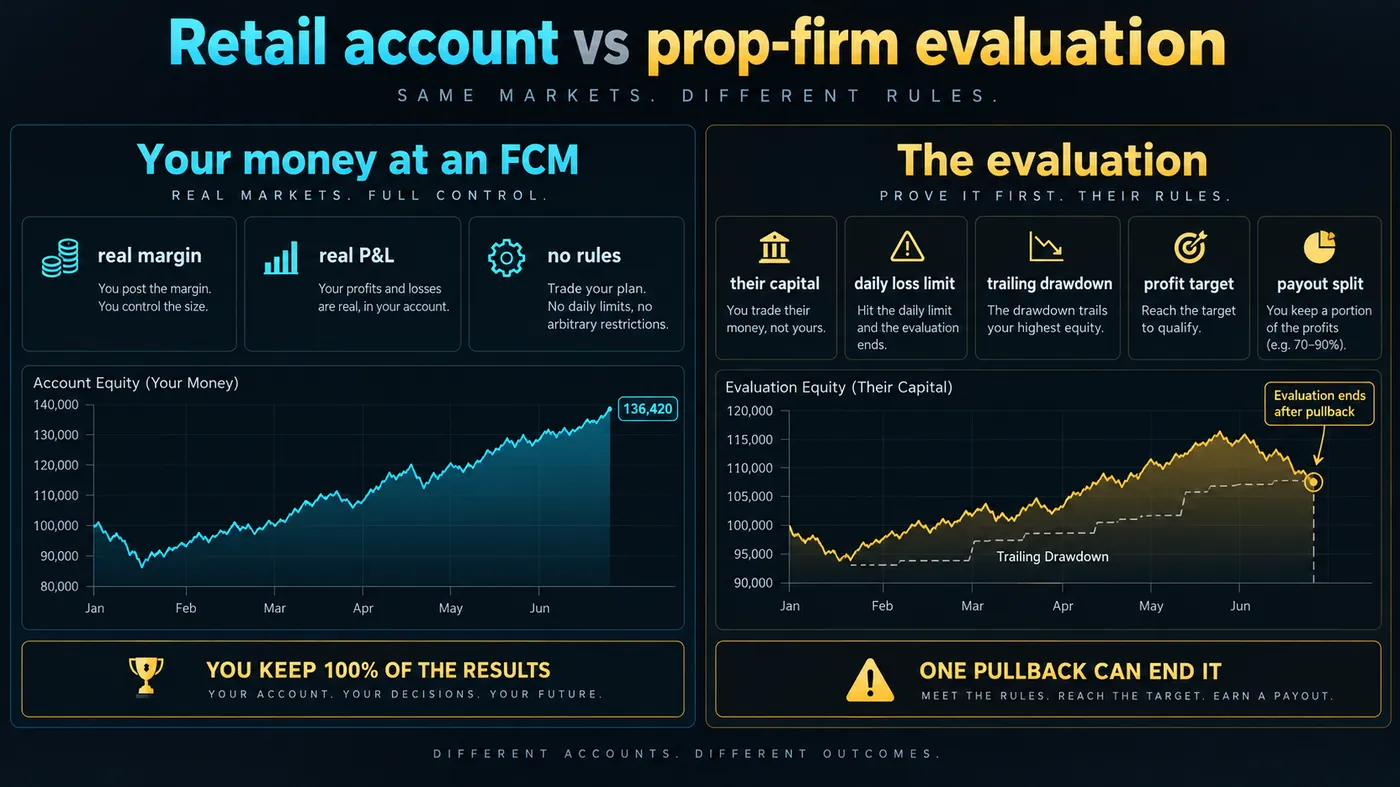
The retail-vs-evaluation illustration in this guide puts the two accounts side by side. Your money at an FCM: real margin, real P&L, no rules but your own, and you keep everything. The evaluation: their capital, a fee, a rulebook, and a payout split. The equity curves underneath are the same trades — and the evaluation one ends early, at the trailing drawdown line, on a trade that was a normal pullback in the retail account.
The rule that fails most people: trailing drawdown
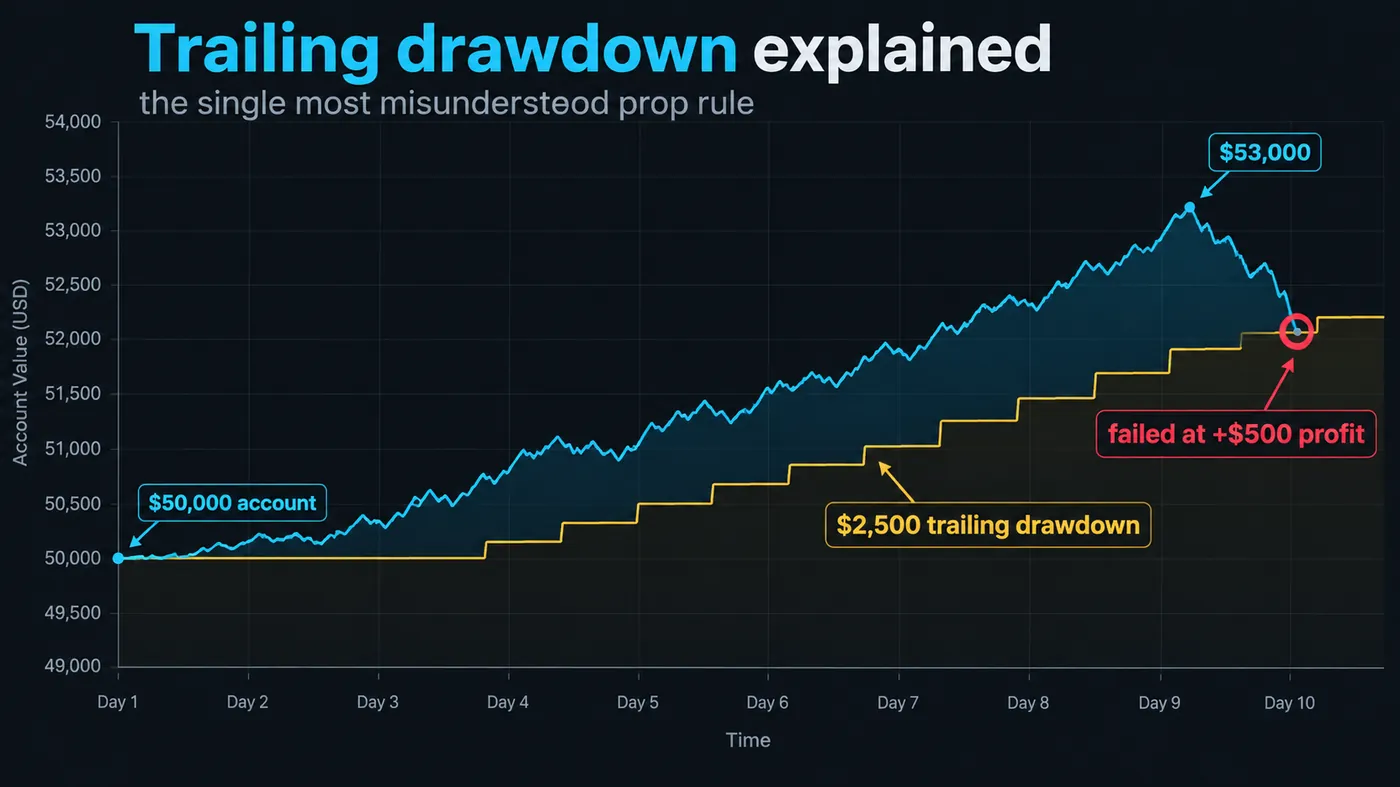
The trailing-drawdown illustration is the most important picture on this page. A $50,000 evaluation with a $2,500 trailing drawdown: the drawdown line starts at $47,500 and ratchets up with every new equity high — often intraday, on unrealised peaks — until it locks at the starting balance once you are $2,500 in profit. The trader in the illustration reached $53,000, pulled back $2,500 on one trade, and failed at +$500 of realised profit. They were profitable. They failed anyway.
Three consequences most people learn the hard way:
- Intraday trailing means an open position's peak counts. A trade that goes 20 points in your favour and comes back to breakeven has moved the drawdown line up by the full excursion.
- The buffer is smallest at the start. A $2,500 drawdown on $50,000 is 5%; at 0.5% risk per trade that is ten consecutive losses, but at the 1–2% many evaluators use it is three.
- Consistency rules cap the share of profit any one day can contribute (often 30–50%), so the trade that would pass you can also disqualify the pass.
Read the drawdown definition — end-of-day, intraday, or static — before paying any fee. It changes the correct position size more than anything else about the account.
Choosing a futures prop firm
The criteria, in order:
- Drawdown type — static (best), end-of-day trailing, intraday trailing (hardest).
- Daily loss limit relative to the drawdown, and whether hitting it fails the account or just stops the day.
- Payout terms — first-payout threshold, split, frequency, and whether the funded account is simulated (most are) with a real-money stage later.
- Fees — evaluation cost, reset cost, activation fee on passing, monthly data or platform fees passed through.
- Platforms offered — the same front ends as retail (NinjaTrader, Tradovate-style, Rithmic-connected), so your workflow carries over.
- Consistency and scaling rules — contract limits that grow with profit, and rules against holding through news or overnight.
- Reputation and payout record — the futures prop space has seen firms close with unpaid balances; recency of complaints matters more than the volume of affiliate reviews.
A firm that scores well on the first three and reasonably on the rest is worth an evaluation fee as a structured test of your discipline. A firm that scores badly on the first is selling resets.
Should you use a prop firm at all?
The honest framing: a prop evaluation is a paid exam with rules stricter than any retail account, and the payoff is trading larger size without funding it. For a trader with a documented edge and a tested routine, that is a reasonable purchase — the fee is small against the capital. For a trader without a record, the evaluation is a lottery ticket with a $100–300 price and rules that will end it before the edge, if there is one, has time to appear.
The sequence that works: prove the setup on paper and in bar replay, trade it live at one micro for three months on your own FCM account, then buy an evaluation and trade it exactly the same way at a size the drawdown allows. The pass rate for traders who do that is not published anywhere, but it is the only route with a rate worth quoting.
How the platform and the prop firm fit a Smart Money workflow
Zeno and the free indicators run on TradingView on any futures symbol — ES, NQ, GC, CL and the micros — and the levels convert to ticks and dollars with the contract calculator on our futures-for-beginners guide. On a TradingView-integrated futures broker the signal becomes a bracket order on the same chart; on a desktop front end you enter the same levels on the DOM. In an evaluation the same signals apply, with the size set from the drawdown rather than from the account balance.
A futures account is an FCM, a front end, a data feed and an exchange, and you choose each on its own merits: the FCM for regulation, the front end for your trading style, the feed for the depth you actually use. Cost it at your volume. Treat a prop evaluation as a paid exam — read the drawdown definition, size at half the daily limit, and only buy it once your own account shows an edge.
◆ Interactive check
FCM, front end, data or exchange?
Questions people ask about futures platforms and prop firms
No. The pattern day trader rule is a FINRA rule for stock margin accounts; futures are CFTC-regulated and exempt. Most futures brokers open accounts from a few hundred dollars, and micro contracts make small accounts tradable.
NinjaTrader is a platform and, through its brokerage arm, an introducing broker to an FCM; the platform can also connect to other FCMs. Check which entity holds your funds on the account documents.
Futures firms run on real exchange data with exchange-standard contracts and CFTC-regulated FCMs behind the funded stage; forex prop firms run on CFD or spot pricing at a broker of their choosing. Rules are similar; the underlying market and data are not.
Most are simulated at the funded stage too, with the firm paying profits from its own capital and optionally copying the flow to a real account. Some firms offer a live-money stage after a payout history. Read the terms.
Static or end-of-day trailing. Intraday trailing on unrealised peaks is the rule most likely to fail a profitable trader, as the illustration on this page shows.
The indicators run on TradingView on any futures symbol. Execution is on the TradingView chart with an integrated futures broker, or on your front end's DOM using the same levels; the contract calculator converts stops into ticks and dollars.
NinjaTrader for chart trading, C# strategies and the largest indicator market; Sierra Chart for order-flow, speed and configurability at a lower price with a steeper curve. Both connect to multiple FCMs; the FCM decides your protection either way.
Yes, with a futures broker in the Trading Panel — analysis and execution on one chart. Depth and hotkey execution are weaker than a dedicated DOM, which is why many futures traders run both.
Typically $50–300 depending on account size, plus reset fees ($80–150) and sometimes an activation fee on passing; monthly data or platform fees may be passed through. The expected value depends almost entirely on whether you already have an edge.
The evaluation itself is a simulated product and is not regulated as trading; the FCM behind any real-money stage is CFTC/NFA-registered. Check payout records and recent complaints rather than relying on the word "regulated".
References & Related Guides
Read next
- What Is a Prop Firm? How Proprietary Trading Firms Work, Make Money, Pay Out and Tax You
- Futures Trading for Beginners
- Best Trading Platforms
- Pattern Day Trader Rule
- Best Indicators for Futures Trading
- Apex Trader Funding Review
- Prop Firm Trading Strategy
- Bookmap Review
- Opening Range Breakout (ORB)
Authoritative sources
- NFA BASIC: FCM and broker registration
- CFTC: futures commission merchants
- CME Group: market data fees
- CME Group: Micro E-mini S&P 500 specifications
- CME Group: futures margin