How to Use ChatGPT and AI for Trading: Prompts, Limits & a Chart-Aware Workflow
How do you use ChatGPT and AI for trading?
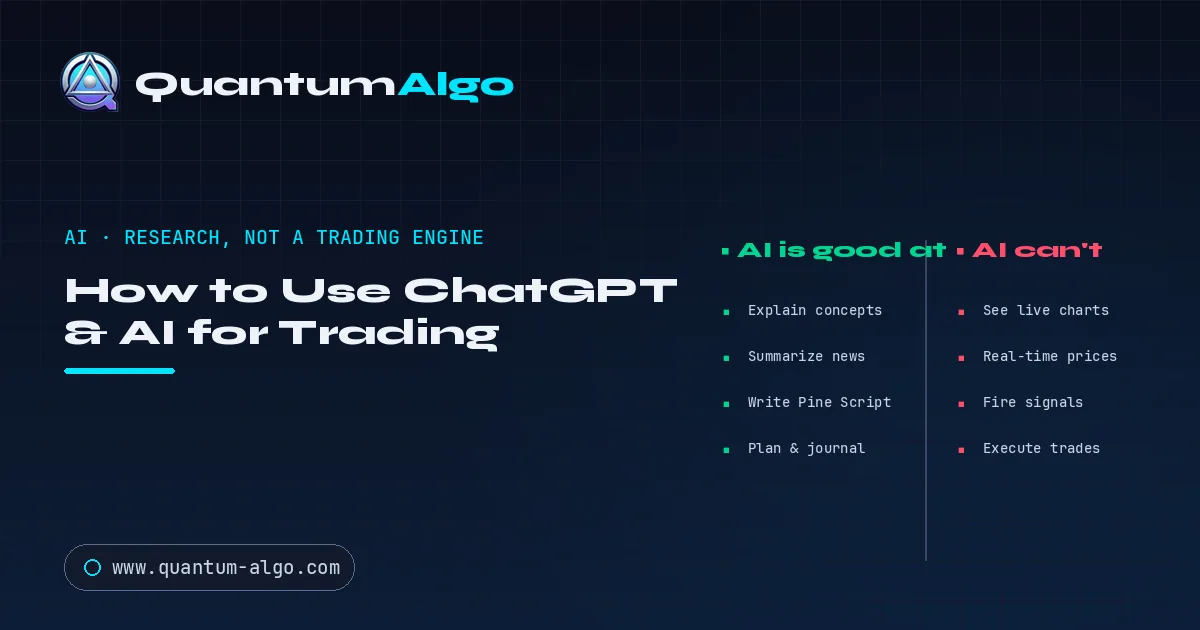
Use ChatGPT and AI assistants as a research and reasoning partner, not a live trading engine. They excel at explaining indicators, summarizing news, drafting and debugging Pine Script, structuring a trading plan and reviewing your journal. They cannot see your live chart, access real-time prices or execute trades, so never treat AI output as market data or a trade recommendation.
Use ChatGPT and AI assistants as a research and reasoning partner — not as a live trading engine. They are excellent for explaining indicators, summarising news, drafting and debugging Pine Script, structuring a trading plan, and reviewing your journal. They cannot see your live chart, access real-time prices, run real-time analysis, or execute trades. The reliable workflow pairs AI for research with a chart-aware engine like Quantum Algo that produces non-repainting signals on the live chart — the part an AI chat cannot do.
Indicators that prove themselves in public.
One engine, four precision tools — the Gold (XAU) Scalper, the institutional Gravity Zone, the Zeno momentum Oscillator, and Zeno Stocks for equities.
AI has quietly become part of how people trade — surveys suggest a large share of retail traders now use tools like ChatGPT for market research. But most of the money lost with AI comes from one mistake: treating a language model like a market oracle. This guide is an honest map of what ChatGPT and AI assistants are genuinely great at in trading, where they structurally fall short, the prompts that actually help, and how to bolt AI onto a chart-aware workflow so you get the upside without the trap.
| What AI is | A research and reasoning partner — language, not live market access |
| Great for | Explaining concepts, summarising news, coding Pine Script, planning, journaling |
| Can't do | See live charts, access real-time prices, run real-time analysis, execute |
| The gap | Live, non-repainting signals on your actual chart |
| How to close it | Pair AI research with a chart-aware engine like Quantum Algo |
| Rule | Never treat AI output as market data or a trade recommendation |
What is AI genuinely good at in trading?
Used as a research assistant, an AI model earns its place. It's a patient tutor — ask it to explain what an order block is, or why an option lost money while the stock rose, and it will break it down at your level. It's a fast summariser — paste an earnings release or a Fed statement and get the key points in seconds. It's a genuine coding partner — describe a rule set and it will draft the Pine Script, then help you debug it. It's a thinking aid for structuring a trading plan and, crucially, for reviewing your journal to surface patterns in your own behaviour. None of this requires live market data, which is exactly why AI does it well.
What can't AI do in trading?
The failures all trace to one fact: a chat model has no live market access. It cannot see your chart — it reads a static screenshot at best, not a moving market. It cannot access real-time prices, so any "current" level it gives you is a guess from stale training data. It cannot run real-time analysis or scan for setups as price develops. And it cannot execute or manage a trade. Ask it "should I buy Tesla right now?" and it will produce fluent, confident text that is not connected to the live market at all. That confidence is the danger — the output looks like analysis but is untethered from price.
Which AI prompts actually help traders?
The useful prompts play to the model's strengths — reasoning over information you provide, never asking it to fetch live prices. Ask it to explain a concept: "Explain why a long call can lose money when the stock rises, and what to check before buying one." Ask it to summarise: "Here's an FOMC statement — give me the three points that matter for rate expectations." Ask it to code: "Draft a Pine Script v6 study that flags a bullish engulfing after a 20-EMA pullback, then explain each line." Ask it to review your process: "Here are my last 20 journaled trades — what recurring mistake shows up most?" Each of these produces real value because the model is reasoning over text, not pretending to watch the market.
Why can't AI replace a live chart read?
The gap AI leaves is the most important part of trading: a live, trustworthy read of the actual chart. That's the role of a chart-aware engine. Quantum Algo runs directly on TradingView and does exactly what a chat model can't — it detects order blocks, Fair Value Gaps and liquidity sweeps as they form, and prints a non-repainting Buy or Sell with an exact entry, stop and two targets, on the live market, in real time. Where an AI chat gives you a paragraph, a chart-aware engine gives you a signal you can act on and later verify. The two are complementary: AI to learn and plan, the engine to execute.
| ChatGPT / AI chat | Chart-aware engine (Quantum Algo) | |
|---|---|---|
| Live chart access | No — static text/images | Yes — reads the live chart |
| Real-time prices | No — stale training data | Yes — real-time |
| Setups as they form | No | Detected in real time |
| Output | Explanation / text | Non-repainting signal + plan |
| Verifiable record | No | Public, timestamped ledger |
| Best used for | Research, code, planning | Live entries and management |
How do you combine AI with a chart-aware indicator?
Put them in sequence. Learn and plan with AI: use it to understand the concepts, summarise the macro picture for the week, and pressure-test your trading plan. Get signals from the engine: let Quantum Algo mark structure and fire non-repainting entries on your live charts, aligned to the higher-timeframe bias. Execute and manage with defined risk. Review with AI: feed your journal back to the model to find behavioural leaks. AI sits on either side of the trade — research before, review after — while the live decision comes from a tool built to read price. That division of labour is how you get AI's leverage without betting on text that has no connection to the market.
The public record — the difference between text and a signal
The clearest way to see the divide is verification. An AI chat can't show you a track record because it never placed a trade or watched a market. Quantum Algo can: its public Zeno calls are posted on TradingView with a timestamp before the outcome and kept permanently — a 75% win rate over 160 closed signals, 2.3:1 planned risk-to-reward. That's the proof a chart-aware engine can offer and a language model structurally cannot.
Use AI for what it's brilliant at, and don't ask it to be what it isn't. The traders who win with AI treat it as the smartest research assistant they've ever had — and get their actual edge from a system that reads the live market with a disciplined risk process behind every signal.

Automate your trades. Let Quantum Algo trade for you.
Every signal executed on your own account — 24/7, hands-off.
Frequently Asked Questions
Use it as a research and reasoning partner: explaining indicators and concepts, summarising news and filings, drafting and debugging Pine Script, structuring a trading plan, and reviewing your journal. Don't use it for live decisions — it can't see your chart or access real-time prices. Pair it with a chart-aware engine that produces live signals.
No. ChatGPT is a language model with no live market access, so any 'prediction' or 'current level' is generated from stale training data, not real-time analysis. It can explain scenarios and reasoning, but it cannot forecast prices or see what the market is doing right now.
Not live. At best it can interpret a static screenshot you upload, which is a frozen snapshot, not a moving market. It cannot watch price develop, scan for setups in real time, or update as the candle closes — which is why live signals need a chart-aware tool, not a chat model.
Treating AI output as a trade recommendation is where people lose money. The safe approach is to use AI to understand, summarise and plan, and to get actual entries from a tool that reads the live chart. Never act on a confident-sounding answer that isn't connected to real-time price.
Prompts that reason over information you provide: 'explain why a long call can lose when the stock rises,' 'summarise this FOMC statement for rate expectations,' 'draft and explain a Pine Script study for X,' and 'review these 20 journaled trades for my most common mistake.' Avoid asking it for live prices or what to buy now.
Yes — it's a capable coding partner for Pine Script. Describe your rule set and it will draft the script and help you debug it. You still need to backtest it on TradingView with a non-repainting mindset, because the model can't validate it against the live market itself.
No — they do different jobs. An AI chat reasons over text; a chart-aware engine like Quantum Algo reads the live market and fires non-repainting signals with an exact plan and a verifiable record. Use AI to learn and plan, and the engine to execute. They're complementary, not substitutes.
Many use AI assistants for research, summarising information, coding, and reviewing performance — the reasoning tasks. For execution they rely on systematic tools and data feeds with live market access, because that's what generates and verifies actual signals. The split mirrors the workflow in this guide.
AI used as a research aid can improve your decisions; AI used as a market oracle usually costs money. Profitability comes from a real edge, disciplined risk, and live signals you can verify — the areas where a chart-aware engine, not a chat model, does the work. AI supports the process rather than being the edge itself.
Matrix is $19/month for core signals, Atlas $39/month for the full SMC toolkit with filtering and backtesting, and Zeno $79/month for professionals with exact trade plans and the premium suite. Annual billing saves 25%, and every plan includes the verified, timestamped record.
References & Related Guides
More in this topic
- What Is a Trading Bot? Types, How They Work, Why Most Fail, and the Design That Survives
- Can AI Predict the Stock Market?
- ADX Indicator: Complete Trading Guide
- AlphaTrend Indicator: Complete Trading Guide
- ATR (Average True Range): Complete Trading Guide
- Awesome Oscillator: Complete Indicator Guide
- What Are the Best Volume Indicators?
- Bollinger Bands — Complete Trading Indicator Guide
- CCI Indicator: Complete Guide
- Chandelier Exit: Complete Trading Guide
- Donchian Channels: Complete Indicator Guide
- Fibonacci Bollinger Bands: Complete Trading Guide
- Fibonacci Retracement — Complete Trading Guide
- Hull Moving Average (HMA): Complete Trading Guide
- Gaussian Channel Indicator Guide
- Best Buy/Sell Indicator Guide
Core reading
- BOS & CHoCH: Complete Market Structure Guide
- Order Blocks Trading: Complete Guide
- Best TradingView Indicators — Complete Guide
- Risk Management in Trading — Complete Guide
- Candlestick Patterns Guide — Engulfing, Pinbar & More
- All Premium Guides
- Quantum Algo on TradingView
- Public Track Record