Can AI Predict the Stock Market?
Can AI predict the stock market?
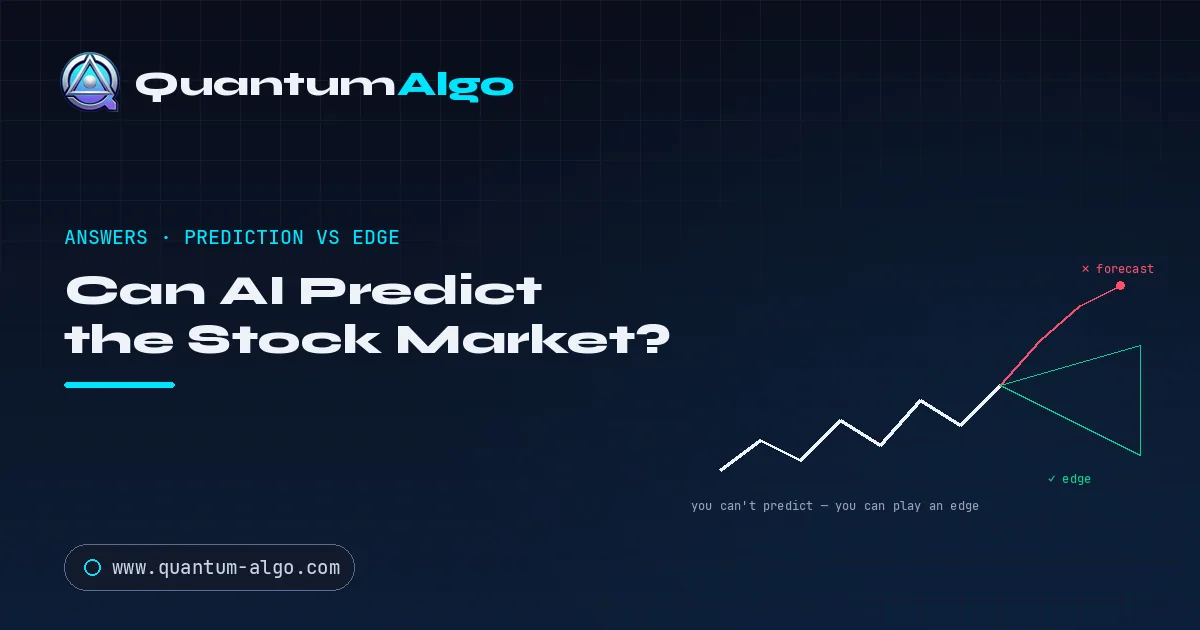
No, AI cannot reliably predict the stock market, and any tool promising to is overselling. Markets are driven by unpredictable news, reflexivity and near-efficiency, so no model forecasts the exact future price with an edge that survives real conditions. AI can process data, detect patterns, gauge sentiment, backtest rules and remove emotion from execution, turning prediction into a probabilistic edge.
No — AI cannot reliably predict the stock market, and any tool promising to is overselling. Markets are driven by unpredictable news, human reflexivity and randomness, so no model forecasts the exact future price with an edge that survives real conditions. What AI can do is process vast data, detect patterns, gauge sentiment, backtest rules and remove emotion from execution — turning "prediction" into a probabilistic edge. The winning frame isn’t forecasting the future; it’s using AI to find repeatable, defined-risk setups and manage them with discipline.
Indicators that prove themselves in public.
One engine, four precision tools — the Gold (XAU) Scalper, the institutional Gravity Zone, the Zeno momentum Oscillator, and Zeno Stocks for equities.
"Can AI predict the stock market?" is one of the most-searched questions in trading — and the honest answer is more useful than the hype. AI has beaten humans at chess, protein folding and language, so it feels natural to assume it can crack markets next. But markets are a fundamentally different kind of problem, and understanding why prediction fails — and what AI genuinely does well instead — is the difference between wasting money on "prediction" products and actually using AI to trade better. This guide gives the straight answer, explains the reasons behind it, shows what AI can and can't do, and reframes the whole question around the thing that actually works: edge, not prophecy.
| Short answer | No — not the exact future price, reliably |
| Why | News, reflexivity and randomness make markets near-unpredictable |
| What AI can't | Forecast news, see the future, beat an efficient market reliably |
| What AI can | Process data, detect patterns, gauge sentiment, backtest, remove emotion |
| The right frame | Edge and probabilities — not prediction |
| Red flag | Any tool promising accurate price predictions |
| Where it helps | Research, pattern-spotting and disciplined execution |
Can any AI reliably predict where the market goes next?
No AI — no matter how advanced — can reliably predict where the stock market will go next. This isn't a limitation of today's models that a bigger one will fix; it's a property of markets themselves. A prediction only has value if it's both accurate and not already reflected in the price, and markets are ruthlessly efficient at pricing in anything that's knowable. The moment a genuine predictive signal exists, capital floods in and arbitrages it away. Anyone selling an AI that "predicts" prices is selling one of two things: a system that quietly loses on real data, or a repackaged edge dressed up as prophecy. The useful question isn't whether AI can predict — it's what AI can actually do.
Why do markets resist prediction?
Three forces make markets structurally hard to forecast. First, news and randomness: prices move on information that doesn't exist yet — an earnings surprise, a policy shift, a black-swan event — and no model can predict what hasn't happened. Second, reflexivity: markets are made of participants reacting to each other, so any widely-adopted prediction changes the very behaviour it's trying to forecast, destroying its own edge. Third, near-efficiency: whatever is genuinely knowable tends to be priced in already, leaving the future path dominated by the unpredictable part. A weather model works because the atmosphere doesn't read the forecast and act on it; markets do exactly that, which is why they're a different class of problem.
Where is AI genuinely useful in trading?
Reject prediction and AI becomes genuinely powerful — as an assistant, not an oracle. It can process enormous amounts of data far faster than any human, surfacing correlations and anomalies across thousands of instruments. It can gauge sentiment from news and social feeds at scale. It can backtest rules objectively, stripping out the wishful thinking that corrupts manual testing. It can remove emotion from execution, following a plan without fear or greed. And it can flag setups and manage risk consistently. None of that is prediction — it's augmentation. The traders who benefit from AI use it to do these things better and faster, not to tell them the future.
Why does edge matter more than prediction?
The entire confusion collapses once you separate these two ideas. Prediction is claiming to know the future outcome — "this stock will be up 5% on Friday." It's a single, falsifiable bet on an unpredictable event, and it's a loser's game. Edge is a repeatable statistical advantage — "this setup, taken hundreds of times with defined risk, wins often enough and large enough to be profitable." Edge doesn't need to know any single outcome; it needs the average to be positive and the risk per trade to be survivable. Professionals and quant funds don't predict the market — they harvest edges with strict risk management, and they lose on plenty of individual trades while staying profitable overall.
| Prediction (hype) | Edge (what works) | |
|---|---|---|
| Claim | Knows the future price | Has a statistical advantage |
| Bet type | Single outcome | Hundreds of trades |
| Needs to be right | Every time | On average |
| Handles the unknown | No — breaks on news | Yes — risk is defined |
| Sold by | “AI predicts” products | Systematic traders & funds |
| Outcome | Blows up | Compounds |
How should you use AI as a trading tool?
This is the natural extension of using AI in your workflow. Tools like ChatGPT can't see live charts or predict prices, but they're excellent research partners — explaining concepts, stress-testing a thesis, and helping you build and review rules. Our guide on how to use ChatGPT and AI for trading covers that side in depth. The through-line is identical: AI is a research and discipline layer, not a prediction engine. It helps you find and refine an edge; it doesn't hand you the future. Treating it that way is what separates traders who quietly get better with AI from those who lose money chasing "AI predictions."
What about the funds that "beat the market" with AI?
It's the obvious objection: don't quant funds and high-frequency firms use AI to win? They do — but not in the way the headlines imply, and not in a way a retail trader can copy. These firms don't predict where a stock closes next month; they detect tiny, fleeting statistical edges — a fraction-of-a-cent mispricing, a millisecond speed advantage, a subtle correlation — and exploit them across millions of trades with enormous infrastructure and risk controls. Their "edge" per trade is minuscule; it only works at scale, at speed, and with capital and technology no individual has.
Even then they have losing days, weeks and strategies that decay and die. The lesson for a retail trader isn't "AI beats the market, so I can too" — it's the opposite: if the best-funded quant firms on earth can only harvest small, defended edges rather than predict prices, no consumer "AI prediction" tool is going to hand you the future. What you can borrow from them is the principle — edge, discipline and risk control — applied at your own scale.
What actually gives you an edge
If prediction is off the table, edge comes from the unglamorous fundamentals. It comes from reading structure — where real orders sit, where liquidity rests, where a trend genuinely shifts — rather than guessing direction. It comes from defined-risk setups you can repeat, position sizing that survives losing streaks, and the discipline to execute the same plan hundreds of times. Quantum Algo sits in exactly this frame: it doesn't predict where price is going — it marks the structural levels and confirmed shifts where a defined-risk trade has a genuine edge, so you're playing probabilities with a plan rather than betting on a forecast. That's the honest, durable way to put a machine to work in markets.

Automate your trades. Let Quantum Algo trade for you.
Every signal executed on your own account — 24/7, hands-off.
Frequently Asked Questions
No, not reliably. Markets move on unpredictable news, human reflexivity and randomness, and anything genuinely knowable tends to be priced in already. No model forecasts the exact future price with an edge that survives real conditions. AI's real value is processing data, spotting patterns and enforcing discipline — not prediction.
Because of three forces: news and random events that haven't happened yet and can't be modelled; reflexivity, where any widely-used prediction changes the behaviour it's forecasting; and near-efficiency, where knowable information is already in the price. Together these leave the future path dominated by the genuinely unpredictable part.
Products promising accurate price predictions almost always fail on real data — if a true predictive signal existed, capital would arbitrage it away. What can work are systematic tools that harvest a statistical edge with defined risk, but that's edge, not prediction. Be very skeptical of anything marketed as “AI predicts the market.”
A lot — just not prediction. AI can process huge datasets fast, detect patterns and anomalies, gauge news and social sentiment, backtest rules objectively, remove emotion from execution, and flag setups while managing risk consistently. It's a research and discipline engine that augments a trader rather than replacing judgment.
Prediction claims to know a single future outcome and has to be right every time — a loser's game against unpredictable markets. Edge is a repeatable statistical advantage that only needs to be positive on average, with risk defined per trade. Professionals harvest edges and lose on many individual trades while staying profitable overall.
Quant funds use machine learning successfully, but not by predicting prices — they find small, fleeting statistical edges and exploit them at scale with heavy risk controls, and even they have losing periods. For a retail trader, expecting ML to forecast the market is the wrong goal; using it to find and manage a repeatable edge is the right one.
Trust AI for what it's good at — research, pattern-spotting, backtesting and disciplined execution — and keep the risk decisions yours. AI can't predict news or guarantee outcomes, and it doesn't know what it wasn't trained on. Used as an assistant with strict risk management it's valuable; used as an oracle you follow blindly, it's dangerous.
No. ChatGPT can't see live market data and can't forecast prices — and if asked to, it will produce plausible-sounding guesses with no predictive value. It's genuinely useful as a research partner for explaining concepts, stress-testing ideas and building rules, which is a completely different job from prediction.
By harvesting an edge, not by forecasting. Money is made reading market structure, taking defined-risk setups that win often enough to be profitable, sizing to survive losing streaks, and repeating the plan with discipline. You lose on plenty of individual trades and still come out ahead because the average and the risk control are on your side.
Quantum Algo doesn't predict where price is going — it marks the structural levels, liquidity and confirmed change-of-character shifts where a defined-risk trade has a genuine edge. That's the honest use of a machine in markets: playing probabilities with a plan and strict risk management, rather than betting on a forecast.
References & Related Guides
More in this topic
- What Is a Trading Bot? Types, How They Work, Why Most Fail, and the Design That Survives
- ADX Indicator: Complete Trading Guide
- AlphaTrend Indicator: Complete Trading Guide
- ATR (Average True Range): Complete Trading Guide
- Awesome Oscillator: Complete Indicator Guide
- What Are the Best Volume Indicators?
- Bollinger Bands — Complete Trading Indicator Guide
- CCI Indicator: Complete Guide
- Chandelier Exit: Complete Trading Guide
- Donchian Channels: Complete Indicator Guide
- Fibonacci Bollinger Bands: Complete Trading Guide
- Fibonacci Retracement — Complete Trading Guide
- Hull Moving Average (HMA): Complete Trading Guide
- Gaussian Channel Indicator Guide
- Best Buy/Sell Indicator Guide
Core reading
- BOS & CHoCH: Complete Market Structure Guide
- Order Blocks Trading: Complete Guide
- Best TradingView Indicators — Complete Guide
- Risk Management in Trading — Complete Guide
- Candlestick Patterns Guide — Engulfing, Pinbar & More
- All Premium Guides
- Quantum Algo on TradingView
- Public Track Record