What Is Trading? How Markets, Trades and Traders Actually Work
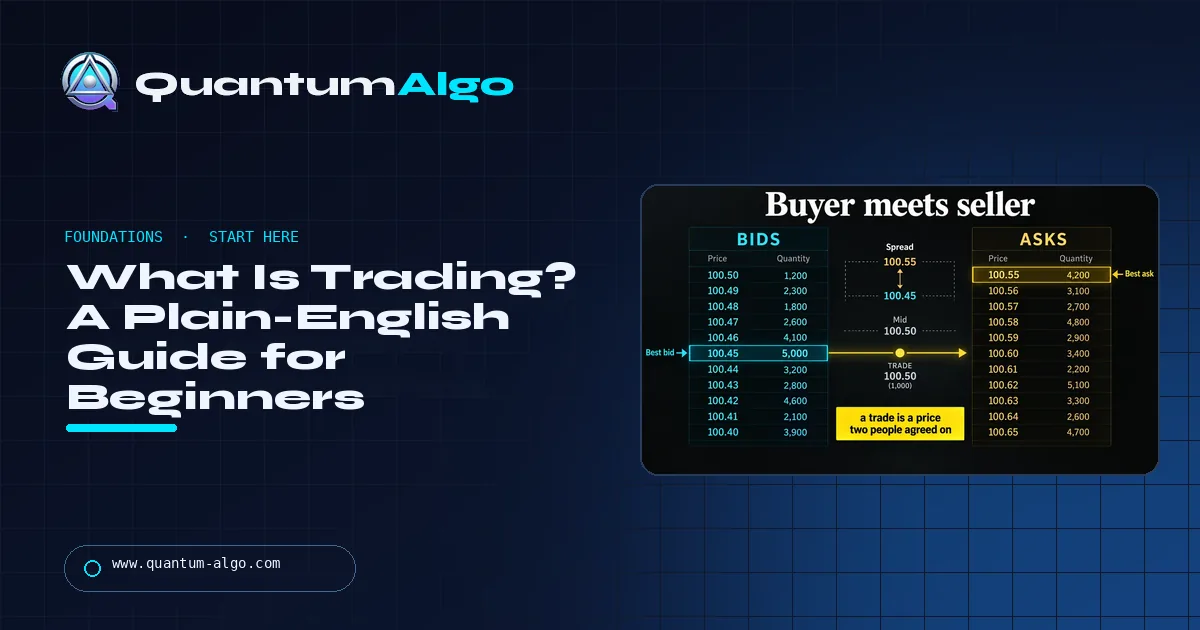
Trading is buying and selling financial instruments, such as currencies, stocks, crypto, commodities and indices, to profit from price changes over a period you choose, from minutes to months. A trade is a price two people agreed on. Every trade involves five decisions: market, direction, entry, stop and target; the last two separate a trade from a bet.
Almost every trading site starts one chapter too late. This is the chapter before that: what a market is, how a trade actually crosses, why trading and investing are different games on the same chart, and the five decisions you will make on every single trade for the rest of your career. It links forward into the Academy once the basics are in place. The simulator below lets you make those five decisions on a real chart level and see the result — no money involved.
Indicators that prove themselves in public.
One engine, four precision tools — the Gold (XAU) Scalper, the institutional Gravity Zone, the Zeno momentum Oscillator, and Zeno Stocks for equities.
What is trading, in plain terms?
Trading is buying and selling financial instruments — currencies, stocks, crypto, commodities, indices — to profit from changes in their price over a period you choose, from minutes to months. A trade is a price two people agreed on: one thought it was a good level to buy, one thought it was a good level to sell, and the market moved on. Everything else in this field — charts, indicators, order types, risk management — is machinery for deciding when to be one of those two people.
I wrote this page because almost every trading site starts one chapter too late. It assumes you know what a market is, what a broker does, and why "buy low, sell high" is not a strategy. This is the chapter before that, and it links forward into the rest of the Academy once the basics are in place.
How does a trade actually happen?
Every market has a list of people willing to buy at a price (bids) and a list willing to sell at a price (asks). The gap between the best bid and the best ask is the spread. When you press buy, you take the best ask; when you press sell, you hit the best bid. The order book illustration in this guide shows one trade crossing at the middle — that single event is what every candle on every chart is made of.
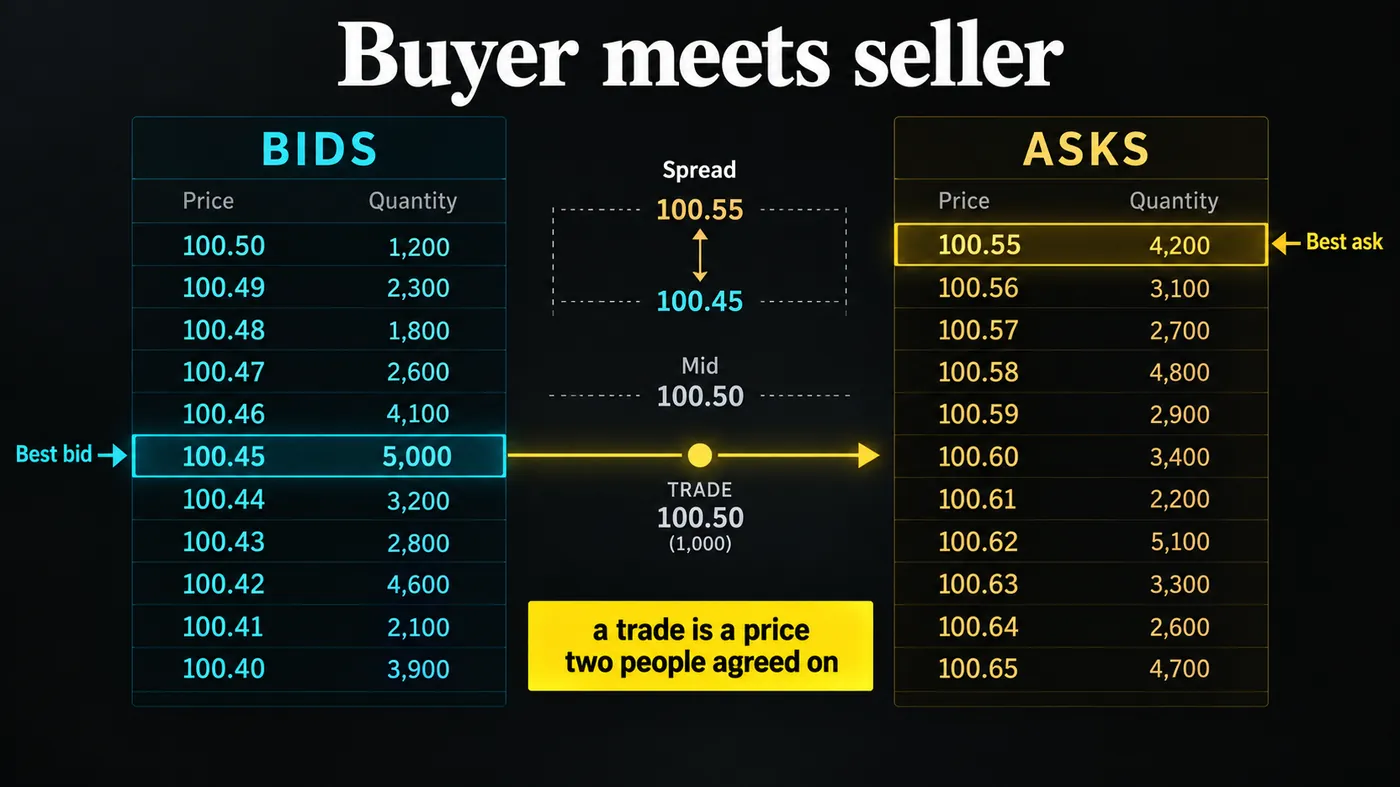
Who is on the other side matters less than beginners think. Sometimes it is another retail trader, sometimes a market maker whose job is to quote both sides all day, sometimes a fund working a large order over hours. The price is the same for all of them. The difference between you and the fund is size, information and patience — and the third one is the only one you can fix for free.
What is the difference between trading and investing?
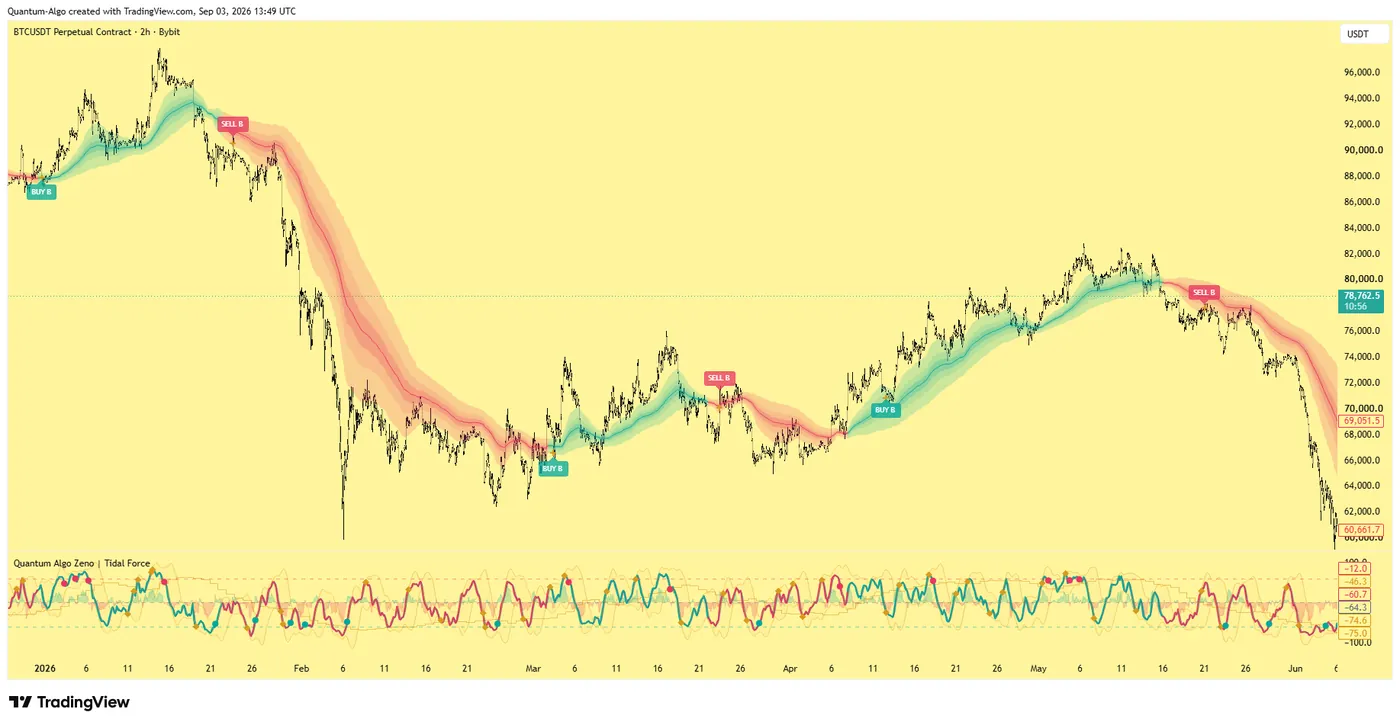
Investing is buying an asset because you expect it to be worth more years from now: the BTC daily chart in this guide shows a three-year rise with one arrow. Trading is buying and selling inside that rise: six trades inside one month, each with its own entry, exit and reason. Same market, two games.
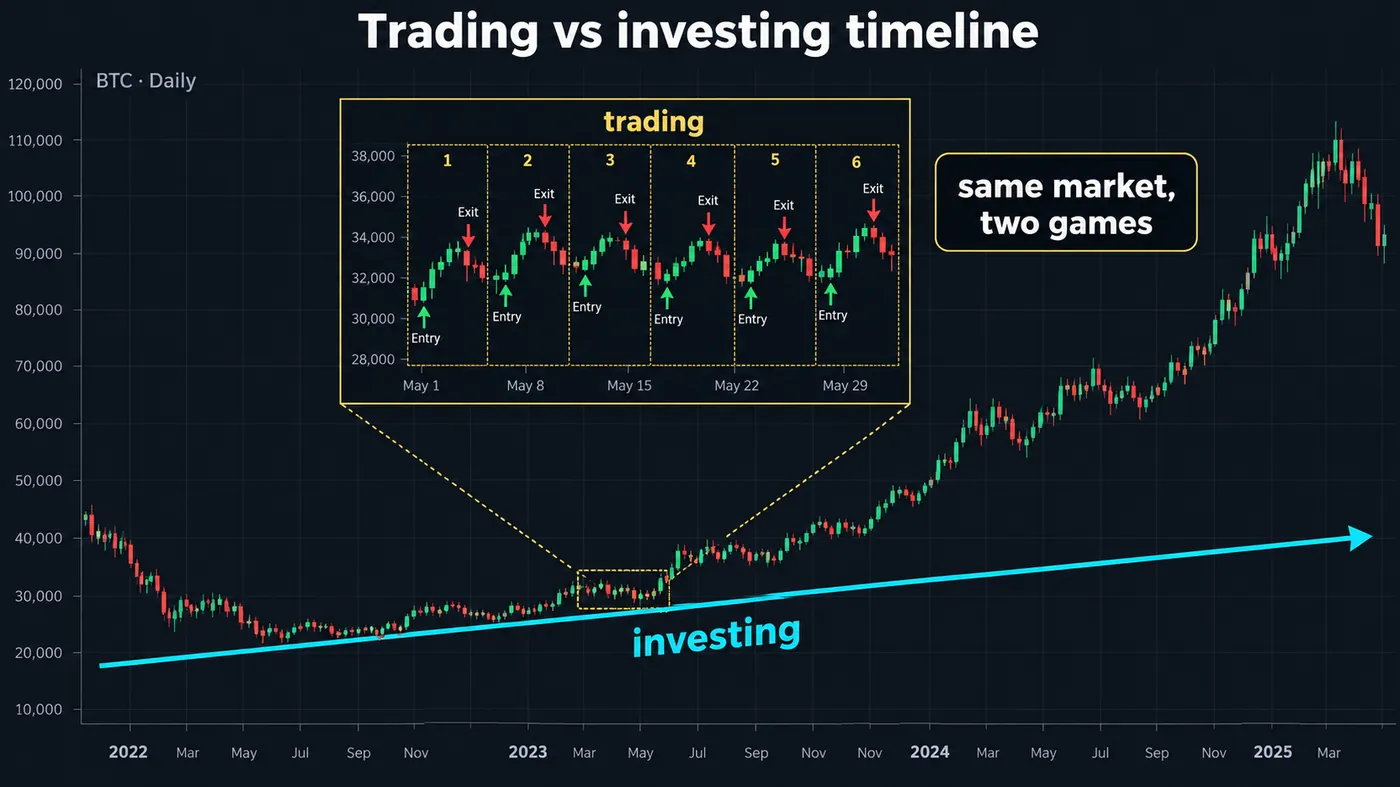
The practical differences are time and risk control. An investor tolerates a 30% drawdown because the thesis is years long. A trader defines the maximum loss on each trade before entering it, because the thesis is hours long and there is no "wait for it to come back". If you do not want to define that loss in advance, you are an investor, and there is nothing wrong with that — but you should not be reading the day-trading pages.
What are the five decisions inside every trade?
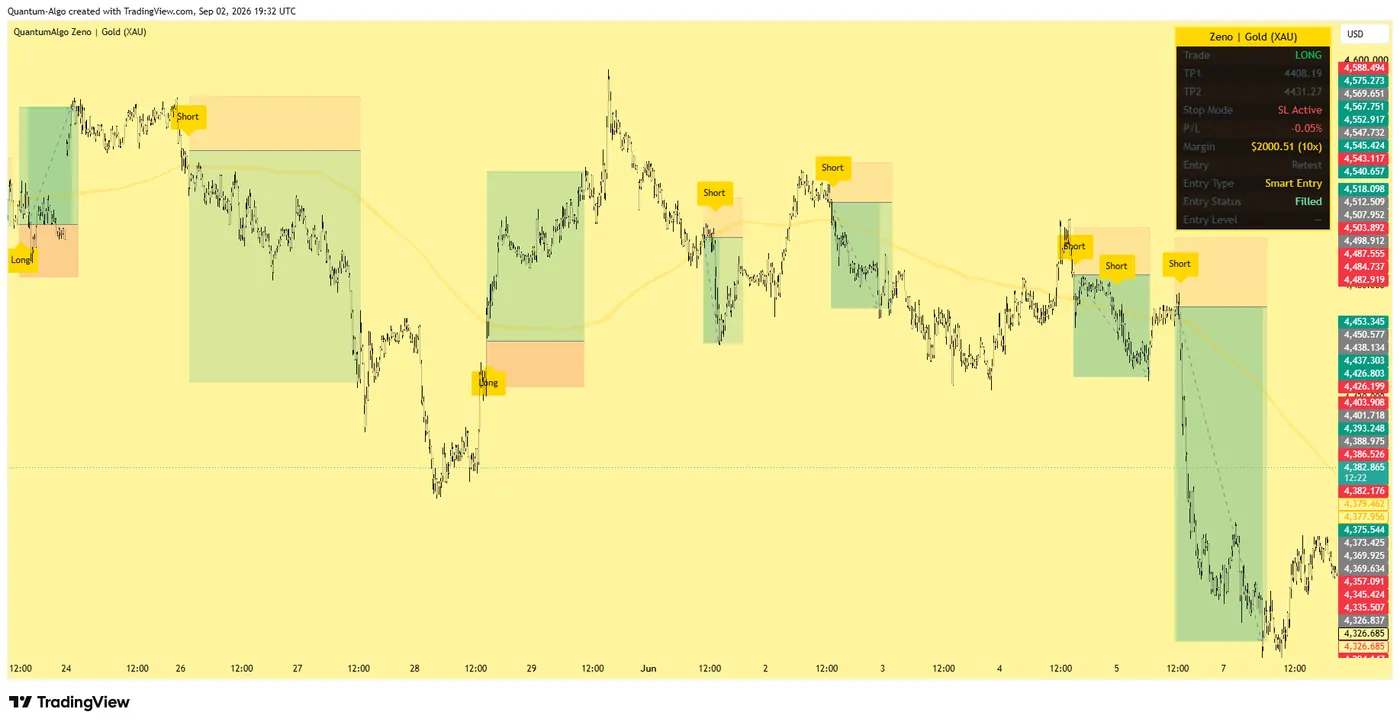
The XAUUSD chart in this guide shows the anatomy of a single trade, numbered:
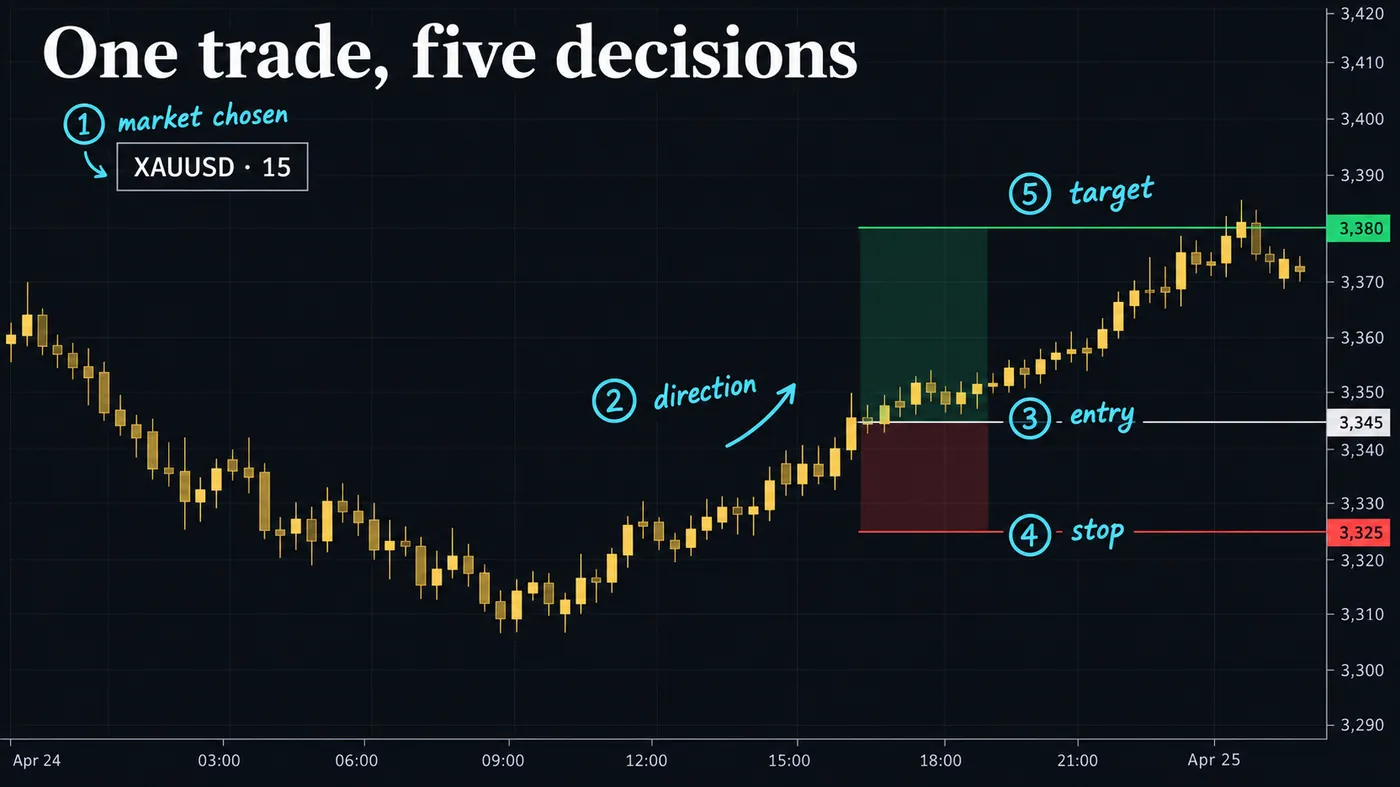
- Market — what you are trading and on what timeframe.
- Direction — long (you profit if price rises) or short (you profit if it falls).
- Entry — the price at which you take the position, and why that price.
- Stop — the price at which the idea is proven wrong and you exit with a small loss.
- Target — the price at which you take profit, and what you expect to earn relative to the stop.
Beginners obsess over decision 3 and ignore 4 and 5. Professionals reverse that. A good stop and target with an average entry is a trade; a perfect entry with no stop is a bet.
Which markets can you trade?
- Forex — currency pairs like EUR/USD. Open 24/5, the deepest market in the world, popular with beginners because of small minimum sizes and high leverage — the second of which is the reason most of them fail.
- Stocks and ETFs — shares of companies and baskets of them. Exchange hours only; regulated margin; in the US the pattern-day-trader rule, replaced by FINRA on 4 June 2026, may still apply at your broker until 20 October 2027.
- Indices — NAS100, SPX500, DAX, traded as futures or CFDs. Move with the whole market rather than one company.
- Commodities — gold, oil, silver. Gold is the one Quantum Algo's engine was first built for.
- Crypto — Bitcoin, Ethereum and thousands of smaller coins, 24/7, spot or perpetual futures.
Pick one. Every market has its own rhythm, contract sizes and cost structure, and switching between them while learning is the fastest way to learn none of them.
The main markets at a glance
| Market | Examples | When it trades | Common ways to trade |
|---|---|---|---|
| Forex | EUR/USD and other currency pairs | 24 hours, five days a week | Spot via a broker, often leveraged |
| Stocks and ETFs | Company shares and baskets of them | Exchange hours only | Cash or regulated margin account |
| Indices | NAS100, SPX500, DAX | Futures and CFD session hours | Futures or CFDs |
| Commodities | Gold, oil, silver | Futures and CFD session hours | Futures or CFDs |
| Crypto | Bitcoin, Ethereum | 24/7 | Spot or perpetual futures |
◆Pick one market and learn its rhythm, contract sizes and costs before adding another.
How do traders make decisions?
There are two broad schools. Fundamental analysis asks what the asset is worth — earnings, interest rates, supply and demand. Technical analysis asks what the price is doing — trends, levels, patterns, and where large orders have left footprints. Most short-term traders are technical because fundamentals do not change every fifteen minutes; most long-term investors are fundamental because charts do not tell you what a company will earn in 2030.
Within technical analysis, this site teaches Smart Money Concepts: reading the chart for the places where institutions bought or sold — order blocks, liquidity sweeps, fair value gaps — and trading the return to those places. It is one method among several; it is the one we can show a public track record for.
What does trading cost?
You pay to trade whether you win or lose. The spread on every entry and exit, a commission on many products, overnight financing or funding if you hold a leveraged position, slippage when the market moves between your click and your fill, and taxes on what is left. A strategy that wins 55% of the time gross can lose money net; our profit calculator guide shows exactly how, and every serious trader models costs before sizing anything.
Do most retail traders lose money?
Most retail traders lose money. Regulators in Europe require brokers to publish the figure, and it is consistently between 70% and 80% of accounts over a year. The causes are not mysterious: too much size, no defined loss, no record kept, and changing method after every losing week. The traders who last treat it as a business with a written plan, a fixed risk per trade, a journal, and a long practice period before real money.
If that sounds slower than you hoped, it is — and it is the only version that works.
Where to go next
- Paper trading — practise the whole process with no money at risk.
- Order types — market, limit and stop orders, and which one to use when.
- Leverage and margin — how brokers let you control more than you own, and what it costs.
- Risk management — the one skill that decides whether you are still here in a year.
- Smart Money Concepts — the method this Academy teaches, from the first order block to a full trade plan.
Trading is buying and selling to profit from price changes, on a timeframe you choose, with a loss you define before you enter. A trade is a price two people agreed on; the spread, fees and slippage are the cost of being one of them. Pick one market, learn the five decisions, paper trade the plan, and treat the 70–80% failure rate as the reason to do it properly, not the reason to skip the preparation.
◆ Interactive check
Do you know what a trade is?
Questions beginners ask about trading
Trading without an edge, a defined risk and a record is gambling with extra steps. Trading with all three is a probabilistic business: you do not know the outcome of the next trade, but you know your expected result over a hundred of them.
Nothing to learn and paper trade. For live trading, enough that a normal losing streak at 1% risk per trade is an inconvenience rather than a crisis — our guide on how much money you need to start day trading breaks it down by market.
A small minority do, usually after years and usually with a defined method, small size and a written record. Treat it as a goal to earn, not a starting assumption.
A trader takes positions. A broker is the intermediary that routes your orders to the market, holds your account and charges you for it.
Arithmetic, not calculus: position size, risk-to-reward and expectancy are multiplication and division. The calculators on this site do the repetitive parts.
Forex is one market you can trade — currency pairs. Trading is the activity; forex, stocks, crypto, commodities and indices are the markets. The mechanics on this page apply to all of them.
Yes, through a regulated broker or exchange. Some products are restricted by country — leverage caps in the UK, EU and Australia, the pattern-day-trader rule in the US until brokers adopt its replacement (no later than 20 October 2027) — and some markets require identity verification.
Paper trading, then the smallest live size on one market with a written plan. No product is safe; small size and a defined stop are what make the learning survivable.
Far less than the films suggest: wait for a planned setup, execute it exactly, manage the stop, log the result. Most of the time is spent not trading.
The free Academy teaches the method; the free indicators mark the structure on your chart; Zeno prints the signal with the stop and targets already drawn. All three are built on the five decisions this page describes.
References & Related Guides
Read next
- Swing Trading vs Buy-and-Hold: Can Swing Trading Beat the S&P 500? The Honest Arithmetic
- Options Trading for Beginners: How Options Work, Calls vs Puts, and How to Start Without Getting Hurt
- Best Trading Platforms: For Day Trading, for Beginners, and on Your Phone
- Fundamental vs Technical Analysis: Which Answers Your Question (and Where Smart Money Concepts Sits)
- How to Start Trading: A 90-Day Roadmap (One Market, Fifty Paper Trades, Then Live)
- What Is the Pattern Day Trader (PDT) Rule? What Changed, What Counts, and What Brokers Still Apply
- Order Types Explained: Market vs Limit vs Stop vs Bracket Orders (and Which to Use When)
- What Is Paper Trading?
- How Much Money to Start Day Trading?
- Leverage Trading: Complete Guide
- Risk Management: Complete Guide
- Smart Money Concepts Guide
- How to Learn Trading
- What Is Margin Trading?
- How Many Trading Days in a Year?
Authoritative sources
- SEC Investor.gov: how stock markets work
- ESMA: retail CFD measures and loss-rate disclosure
- FINRA: day trading and the pattern-day-trader rule
- CME Group: introduction to futures
- BIS: foreign exchange market turnover