How to Start Trading: A 90-Day Roadmap (One Market, Fifty Paper Trades, Then Live)
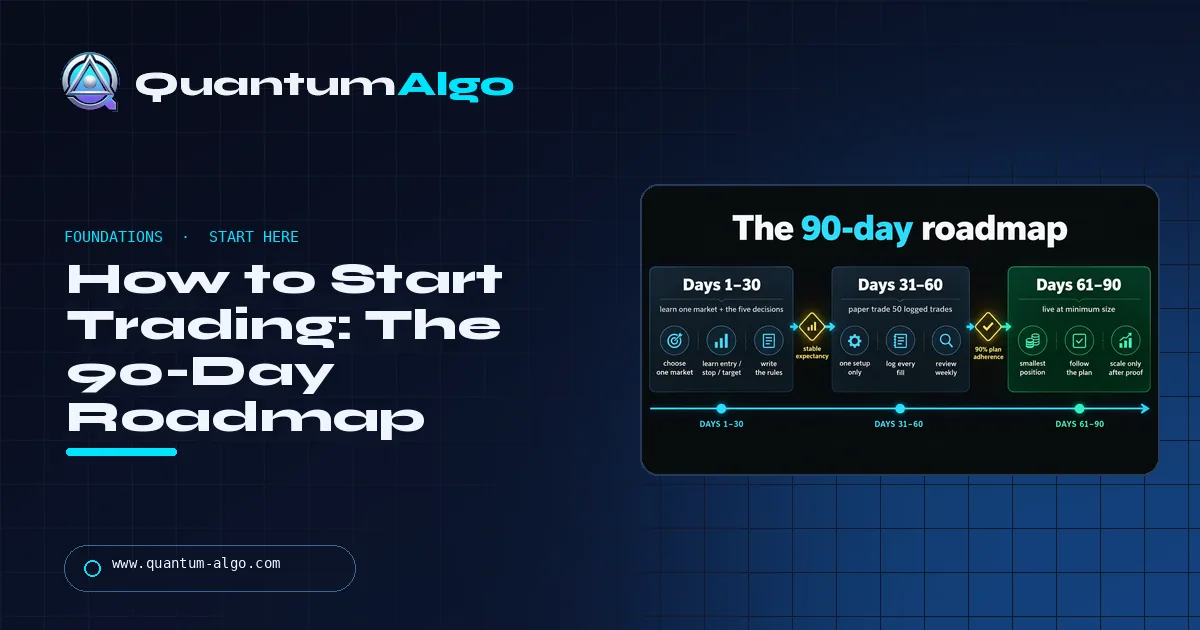
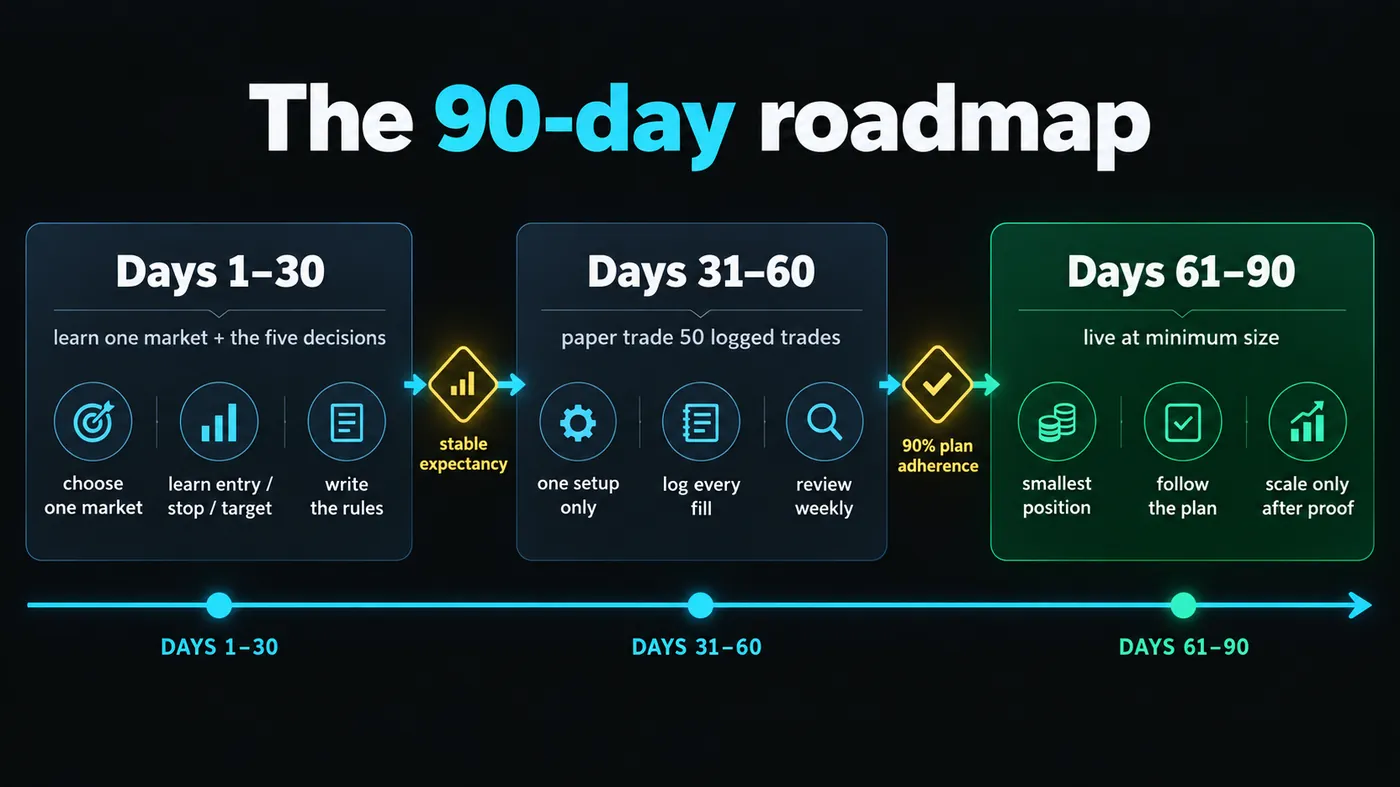
You start trading by choosing one market, learning the five decisions (market, direction, entry, stop, target), practicing one setup on paper until fifty logged trades show a stable result, then going live at your broker's minimum size. In that order it takes about ninety days; backwards (fund, click, lose, learn) it produces the 70–80% loss rate brokers must publish.
I have watched hundreds of subscribers start, and the ones still trading a year later did not have more capital or a better indicator: they picked one market and stayed there, practised before they paid, and kept a record. This is that path laid out in three thirty-day blocks with the honest reason for each gate — and a planner below that adjusts it to your market, capital, hours and holding period.
Indicators that prove themselves in public.
One engine, four precision tools — the Gold (XAU) Scalper, the institutional Gravity Zone, the Zeno momentum Oscillator, and Zeno Stocks for equities.
How do you start trading?
You start trading by choosing one market, learning the five decisions inside every trade, practising them on a paper account until fifty logged trades show a stable result, and then going live at the smallest size your broker allows. That is the whole roadmap, and it takes about ninety days if you do it in that order. Most people do it backwards — fund an account, click, lose, then start learning — and the 70–80% loss rate brokers are required to publish is mostly the cost of that order.
I have watched hundreds of subscribers start, and the ones still trading a year later did not have more capital or a better indicator. They picked one market and stayed there, they practised before they paid, and they kept a record. This page is that path laid out week by week, with the honest reasons for each gate.
What kind of trading should you start with?
"Trading" covers scalping a 1-minute chart and holding for three weeks, and the setup, capital and hours are different for each. Decide the holding period first, from what your life allows, not from what looks exciting:
- Day trading — positions opened and closed the same day. Needs two to four uninterrupted hours in a market's active session, every day. The most demanding version and the one with the worst statistics, because it compounds every mistake.
- Swing trading — positions held for days to weeks, managed at candle closes. Works around a job. Fewer trades, larger stops, the same edge.
- Position trading — weeks to months, weekly charts. Closer to investing with a defined stop.
If you have a full-time job, start with swing trading on the 4-hour or daily chart. It is not the slow option; it is the one that survives contact with a calendar.
Days 1–30: one market, five decisions, the rules written down
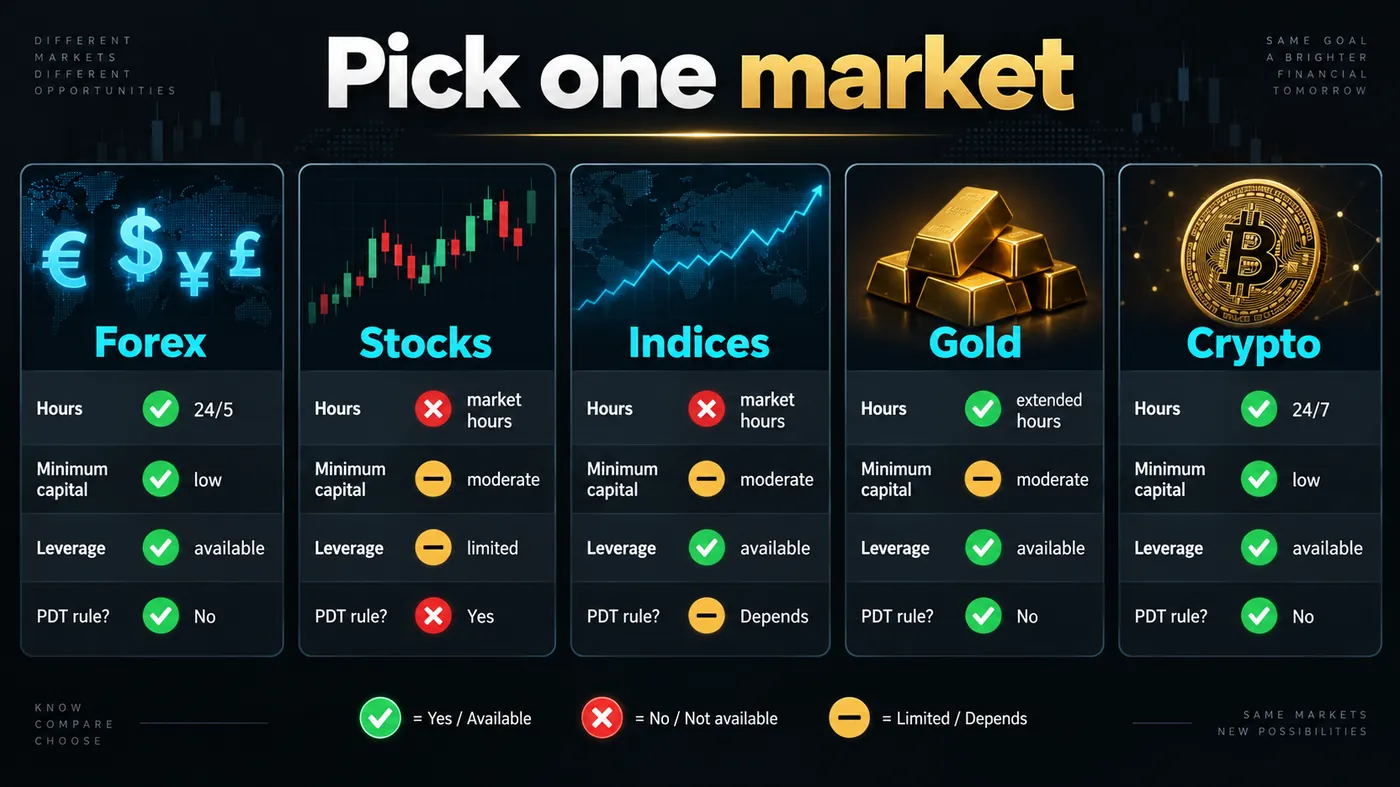
Pick one market. The market cards in this guide compare the five you can realistically start with — forex, stocks, indices, gold, crypto — on hours, minimum capital, leverage and whether the pattern day trader rule applies. The differences matter: US stocks in a margin account under $25,000 cannot be day traded more than three times a week at a broker that still applies the PDT rule (FINRA replaced it on 4 June 2026; brokers may keep it until 20 October 2027); forex and crypto have no such rule but far more leverage available, which is a hazard, not a feature. Pick the one whose session you can actually be awake for, and stay there for the whole ninety days.
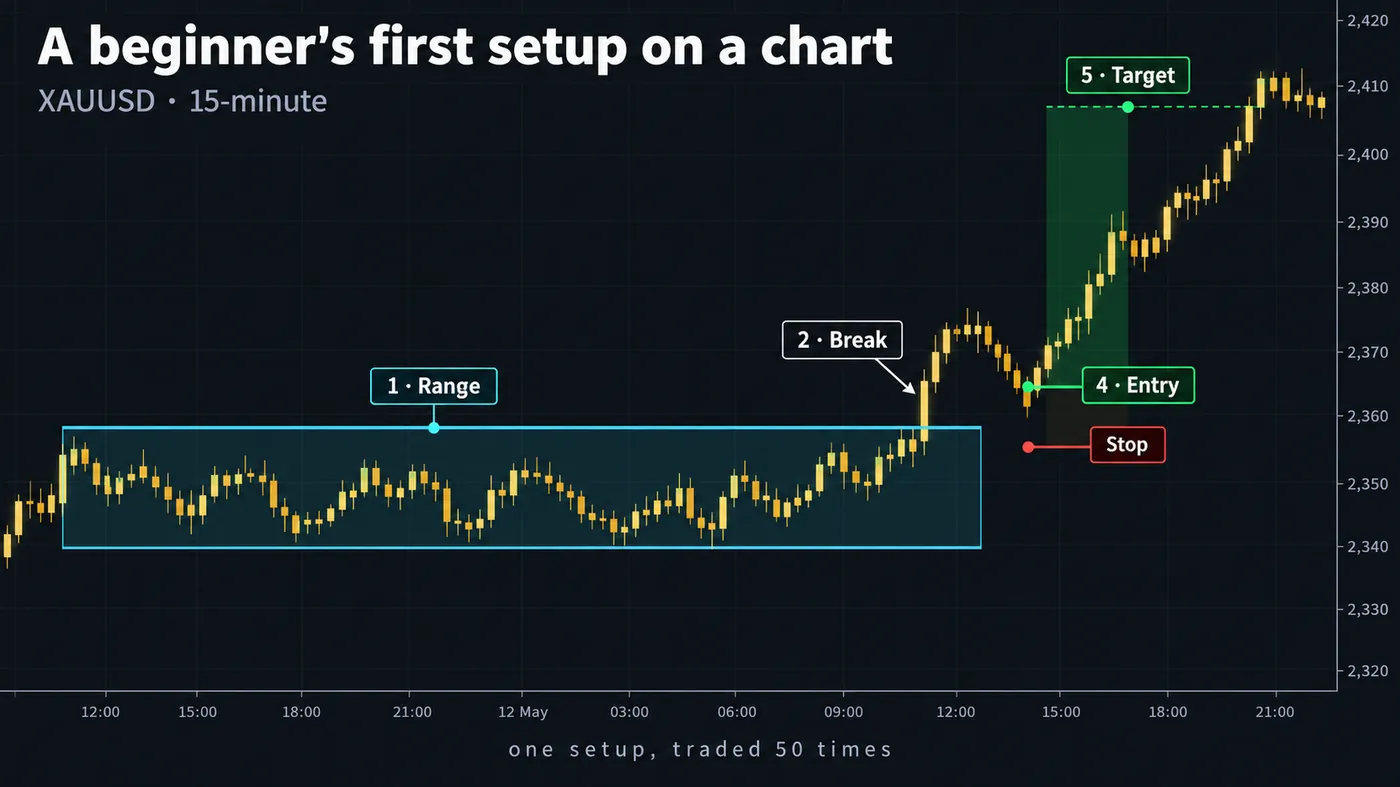
Learn the five decisions. Every trade is: which market and timeframe, which direction, where to enter, where the idea is wrong (the stop), where to take profit (the target). Our what-is-trading page covers them; the first-setup illustration in this guide shows all five numbered on a real gold chart. Beginners obsess over the entry. Spend the month on the stop and the target instead.
Learn one setup. Not a system, not a course, one setup: a range break and retest, a pullback to a level in a trend, an order-block retest. The illustration is a range → break → retest → entry → stop → target sequence — that alone, traded fifty times with the same rules, will teach you more than a library of indicators. Write the rules on one page: what the setup looks like, what invalidates it, where the stop goes, where the target goes, how much you risk.
Set up the tools. A free TradingView account, one chart, the free indicators that mark structure so you are not drawing everything by hand, and a journal — a spreadsheet is enough.
Days 31–60: fifty logged paper trades
Open a paper trading account at the balance you will actually fund — not the 100,000 default — and trade only the written setup. Log every trade when it closes: date, setup, planned entry, actual fill, stop, target, outcome in R, and whether you followed the plan.
Fifty trades is the minimum; one bad week inside them is essential. The goal is not a good number. It is a stable one: win rate and average R that stop moving after about trade twenty, and a plan-adherence rate above ninety percent. The what-is-paper-trading page explains what the simulator gets wrong (fills, emotions, size) and how to correct for it — subtract the spread and a tick of slippage by hand.
The gate at the end of this month is the one most people skip: if the fifty trades do not show a positive expectancy after costs, you do not go live. You go back to the setup, change one rule, and run fifty more. That is not failure; that is the process working.
Days 61–90: live at minimum size
Go live with the smallest size the broker allows — one micro lot, one micro contract, a fraction of a coin — and keep the same journal. The first live month is a second paper month with real emotions attached, and the only thing that should change between the two logs is the money. If the live numbers match the paper numbers after another thirty trades, size up in steps. If they don't, the difference is the thing to work on, and it is almost always execution and discipline rather than the setup.
Risk stays fixed the whole way: half a percent to one percent of the account per trade, sized from the stop with the position sizing rule, never from the margin the broker will lend you.
How much money do you need?
Nothing for the first sixty days. For the live month, enough that a normal losing streak at 1% risk is an inconvenience: around $500 in crypto or micro forex, $2,000–5,000 for micro futures, and $25,000 for US stocks if you intend to day trade them in a margin account at a broker that still applies the PDT rule. The how-much-money guide has the market-by-market breakdown; the short version is that under-capitalised accounts fail from position size, not from lack of edge.
What mistakes end most beginners?
- Funding a live account before a paper record exists.
- Switching markets or setups after every losing week.
- Sizing to margin instead of to the stop.
- No journal, so the same mistake repeats and cannot be seen.
- Following signals without understanding the setup behind them — including ours. Zeno draws the entry, stop and targets; it cannot make you follow them.
- Chasing the most leverage available. Leverage is a loan; the stop is the risk.
How do you adapt the roadmap to your situation?
The planner on this page takes your market, capital, hours available and preferred holding period and returns a 90-day plan with the checkpoints above adjusted — fewer trades per week for swing traders, a cash-account route for US stock traders under $25,000, a session window for your timezone.
One market, one setup, the five decisions written down, fifty logged paper trades with a stable result, then live at the smallest size with the same journal. Ninety days if you do it in that order; the loss-rate statistics are mostly the cost of doing it backwards. Swing trade if you have a job, size from the stop, and treat the first live month as tuition.
The 90-day roadmap at a glance
| Phase | Focus | What you do | Gate before moving on |
|---|---|---|---|
| Before day one | Holding period | Pick day, swing or position trading from your schedule | A holding period that fits your available hours |
| Days 1–30 | One market, one setup | Learn the five decisions and write the rules down | Written rules for one setup in one market |
| Days 31–60 | Paper trading | Log fifty paper trades at your real account size | Positive expectancy after costs, plan adherence above 90% |
| Days 61–90 | Live at minimum size | Trade the same setup with the same journal | Live numbers match paper after another thirty trades |
| After day 90 | Scaling up | Size up in steps, risk fixed at 0.5–1% per trade | Results stay in line with the journal |
◆If a gate is not met, repeat the phase with one rule changed rather than moving on.
◆ Interactive check
Do you know the order of operations?
Questions beginners ask about starting
You can practise with $0 and trade live with $100 on crypto or micro forex at correct risk sizing — but the returns at that size are learning, not income. Treat the first live month as tuition.
The one whose session you can be present for. Forex majors and gold have the deepest liquidity and clearest sessions; crypto is open when you are; index futures are simple to size with micro contracts. Avoid small-cap stocks and thin altcoins.
No. You need one setup, one market, a paper account and a journal. The free Academy on this site covers the setups; the ninety days are the course.
Most people who make it report six to eighteen months to consistent profitability, with the first months typically negative. The J-curve in our "is day trading worth it" guide shows the shape.
Swing trading, unless you have a free session every day. It has fewer trades, more forgiving execution, and the same edge — and it fits around a job.
The five decisions of a trade — market, direction, entry, stop, target — and especially the stop and target, which decide the outcome far more than the entry. The what-is-trading page is the starting lesson.
Yes, but as one setup, not the whole catalogue. A range break and retest to an order block is a complete beginner setup; learn to trade that fifty times before adding anything.
Not for swing trading — a check at candle closes on the 4-hour chart is enough. Day trading requires a full session; if you cannot give one, choose swing trading and stop feeling you are missing out.
From the journal: after fifty trades, a positive average R after costs that has stopped moving around. Our Monte Carlo guide shows how to read that number and how much to trust it.
The free Academy covers the setups in days 1–30; the free indicators mark structure so you are not drawing everything by hand; Zeno prints a complete signal with stop and targets. None of them replace the fifty logged trades.
References & Related Guides
Read next
- Intraday vs End-of-Day Trading: Which Is Better, and Which Fits Your Life
- Swing Trading vs Buy-and-Hold: Can Swing Trading Beat the S&P 500? The Honest Arithmetic
- How to Start Trading Stocks: Accounts, Rules, Your First Trade, and the Week That Follows
- Options Trading for Beginners: How Options Work, Calls vs Puts, and How to Start Without Getting Hurt
- Is Forex Trading Legit? The Market Is Real — Most of What Retail Traders Meet Isn't
- Best Paper Trading Platforms: Where to Practise, and What Each Simulator Hides
- Best Trading Platforms: For Day Trading, for Beginners, and on Your Phone
- TradeZella Review: The All-in-One Trading Journal — Where It Earns Its Price and Where It Doesn't
- FX Replay Review: The Best Bar-Replay Backtester for Manual Traders — With Its Limits
- Is Day Trading Gambling? Where the Line Is (Edge, Risk, Record) — and Is It Legal
- What Is Trading?
- What Is Paper Trading?
- How Much Money to Start Day Trading?
- Is Day Trading Worth It?
- Pattern Day Trader Rule
- Position Sizing: The Complete Guide
- Trading Journal: Complete Guide
- Smart Money Concepts Guide
Authoritative sources
- SEC Investor.gov: investing basics
- FINRA: day trading and the PDT rule
- ESMA: retail CFD measures and loss-rate disclosure
- TradingView: paper trading
- CME Group: introduction to futures (micro contracts)