Why Do Most Traders Lose Money? The Data, the Real Causes & What the Profitable 10% Do
Why do most traders lose money?
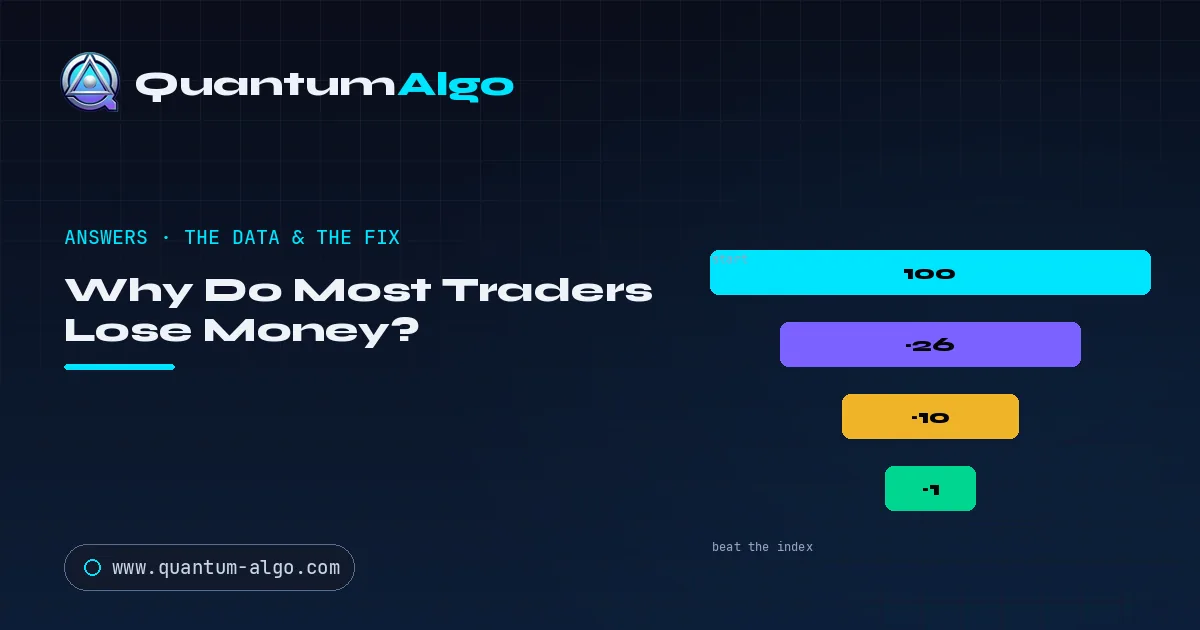
Most traders lose money because they have no tested edge, over-leverage, trade without a risk plan, make emotional decisions, and pay trading costs. Studies across decades and countries find roughly 70–90% of active traders lose and only about 1% beat an index long term. The profitable minority trade a documented edge, risk a small fixed percent, and follow a process.
Most traders lose money for the same handful of reasons: no tested edge, over-leverage, no risk plan, emotional decisions, and trading costs. Study after study across decades and countries finds that roughly 70–90% of active traders lose, and only about 1% beat a simple index over the long run. The failure is almost never a lack of a "secret" — it’s risk management and discipline under pressure. The profitable minority do the opposite: they trade a documented edge, risk a small fixed percent per trade, and follow a verifiable process — which is exactly what a system like Quantum Algo is built around.
Indicators that prove themselves in public.
One engine, four precision tools — the Gold (XAU) Scalper, the institutional Gravity Zone, the Zeno momentum Oscillator, and Zeno Stocks for equities.
Almost everyone who starts trading has heard the statistic, and almost everyone assumes they'll be the exception. The uncomfortable truth is that the failure rate is real, remarkably consistent across markets and decades, and driven by causes that are entirely fixable. This guide lays out what the data actually says, the specific reasons accounts blow up, and — more usefully — the handful of things the profitable minority do differently.
| The failure rate | Roughly 70–90% of active traders lose; ~1% beat an index long-term |
| It's not the strategy | The cause is risk management and discipline, not a missing secret |
| Top causes | No tested edge, over-leverage, no risk plan, emotion, fees & slippage |
| What winners do | Trade a documented edge, risk a small fixed percent, follow a process |
| The fixable part | Every top cause is a habit or a rule — not talent |
| The proof | A verifiable, timestamped record is what separates an edge from a story |
What does the data say about traders losing money?
The numbers are grim and consistent. Large academic studies of retail traders across the US, Brazil and Taiwan converge on the same finding: the large majority lose money, most quit within a year, and only a tiny fraction are profitable over multiple years. Depending on how you measure it, somewhere between 70% and 95% of active traders end up in the red, and only around 1% predictably beat a simple index fund over the long run. Even among motivated traders who pay to attempt funded-account evaluations, most fail — and the failure is almost always risk management under pressure, not bad analysis.
What are the five reasons trading accounts blow up?
Strip away the excuses and nearly every losing account traces to the same five causes.
1. No tested edge. Most traders never verify that their approach wins over a large sample. They trade a feeling, a screenshot, or a strategy they never backtested, so they're effectively flipping coins with fees attached. 2. Over-leverage. The single fastest way to die. Sizing too big means a normal losing streak — which every edge has — wipes the account before the edge can play out. 3. No risk plan. No predefined stop, no maximum daily loss, no rule for position size. Without hard limits, one bad decision becomes an account-ender. 4. Emotion. Revenge trading after a loss, moving stops, doubling down, cutting winners early and letting losers run — the exact opposite of what works. 5. Costs. Spreads, commissions and slippage quietly turn a break-even strategy into a losing one, and overtrading multiplies the drag.
Why doesn't trying harder fix trading losses?
The reason the failure rate is so sticky is that the causes are psychological, and the market is engineered to exploit them. Overconfidence keeps people trading a losing approach for years; research shows traders continue even after long negative track records. Loss aversion makes them cut winners and hold losers. And the structural disadvantage is real — much of what looks like random price movement is liquidity being taken from exactly the obvious levels where retail stops sit. Trying harder inside a broken process just produces more, faster losses. What changes the outcome is a different process, not more effort.
What do profitable traders do differently?
The traders in the winning fraction are almost boringly consistent about a few things. They trade a documented edge — an approach with a known win rate and risk-to-reward over a large sample, not a hunch. They risk a small fixed percent per trade (commonly 0.5–1%), so no single loss and no normal streak can sink them. They have hard rules — a stop on every trade, a maximum daily loss, and the discipline not to override them. They keep realistic expectations — targeting steady returns rather than getting rich by Friday. And they read the market structurally, positioning with institutional order flow instead of getting run out of obvious levels. None of that is talent; all of it is a system.
| Most traders | The profitable ~10% | |
|---|---|---|
| Edge | Untested — a feeling | Documented over a large sample |
| Risk per trade | Too big / inconsistent | Small, fixed (0.5–1%) |
| Rules | None or ignored | Hard stops & daily limits |
| Emotion | Revenge & overrides | Follows the process |
| Market read | Chases obvious levels | Trades with order flow |
| Proof | Screenshots | Verifiable, timestamped record |
How a verified system changes the odds
Every fix above points to the same thing: a repeatable, verifiable process. That's the entire design philosophy behind Quantum Algo. It reads the market structurally — order blocks, Fair Value Gaps, liquidity sweeps — so you're positioned with institutions rather than in their crosshairs. It fires non-repainting signals with an exact entry, stop and two targets, which removes the emotional guesswork at the moment it matters most. And critically, it's verifiable: public calls are posted with a timestamp before the outcome and every result is counted, so the edge is documented, not claimed. Pair that with fixed-fractional risk management and you've addressed all five failure causes at once.
The record — an edge you can check
The difference between the winning minority and everyone else usually comes down to whether their edge is real and documented. Quantum Algo's public ledger shows a 75% win rate over 160 closed signals, 2.3:1 planned risk-to-reward — wins, losses and breakevens, never edited. That's what a documented edge looks like, and it's the thing most losing traders never had.
The failure rate is real, but it isn't destiny. The people who beat it don't have a secret — they have a tested edge, small fixed risk, hard rules, and the discipline to follow a process. Fix those five causes and you move from the part of the funnel almost everyone is in to the part almost no one reaches.

Automate your trades. Let Quantum Algo trade for you.
Every signal executed on your own account — 24/7, hands-off.
Frequently Asked Questions
Because of five recurring causes: no tested edge, over-leverage, no risk plan, emotional decisions, and trading costs. Studies across decades and countries find roughly 70–90% of active traders lose. The failure is risk management and discipline under pressure, not a missing secret — which means it's fixable.
Depending on the study and how you measure it, roughly 70% to 95% of active traders lose money, most quit within a year, and only around 1% beat a simple index fund over multiple years. The numbers are strikingly consistent across US, Brazilian and Taiwanese data.
Yes, but it's a small minority — and they share the same habits: a documented edge, small fixed risk per trade, hard rules they don't override, realistic expectations, and a structural read of the market. It's a learnable process, not talent or luck.
Over-leverage — risking too much per trade. It's the fastest killer because even a good strategy has losing streaks, and oversized positions let a normal streak wipe the account before the edge can play out. Risking a small fixed percent per trade is the single biggest survival fix.
It's gambling if you trade without a tested edge, risk control or a plan — which is how most people do it. With a documented edge, fixed risk and disciplined execution, it becomes a probabilistic business where a positive expectancy compounds over a large sample. The difference is process.
Only if they give you a real, verifiable edge and you pair them with risk management. A random indicator won't help; a structural, non-repainting system with a public track record addresses several failure causes at once — but it still has to be combined with small fixed risk and discipline.
Overconfidence bias. Research shows traders continue even after long negative track records, because they attribute losses to bad luck rather than a broken process. Breaking the cycle requires an honest, verifiable measure of whether the approach actually wins — which most traders never keep.
There's no fixed timeline, but data shows only a small fraction of traders remain active and profitable after three to five years. The ones who make it usually shorten the curve by adopting a tested edge and strict risk rules early, rather than learning by blowing up multiple accounts.
They risk a small, constant percentage of the account per trade — commonly 0.5–1% — with a hard stop on every trade and a maximum daily loss. That fixed-fractional approach means no single trade and no normal losing streak can end the account, which is what keeps them in the game long enough for the edge to work.
It's built around the exact fixes for why traders lose: a structural, non-repainting read of order flow so you trade with institutions, exact entries/stops/targets that remove emotional guesswork, and a public, timestamped track record so the edge is documented rather than claimed. Paired with fixed risk, it addresses the main failure causes.
References & Related Guides
More in this topic
- Is Day Trading Gambling? Where the Line Is (Edge, Risk, Record) — and Is It Legal
- Is Day Trading Worth It? The Honest Answer With the Loss Rates, the J-Curve and the Arithmetic
- ADX Indicator: Complete Trading Guide
- AlphaTrend Indicator: Complete Trading Guide
- ATR (Average True Range): Complete Trading Guide
- Awesome Oscillator: Complete Indicator Guide
- What Are the Best Volume Indicators?
- Bollinger Bands — Complete Trading Indicator Guide
- CCI Indicator: Complete Guide
- Chandelier Exit: Complete Trading Guide
- Donchian Channels: Complete Indicator Guide
- Fibonacci Bollinger Bands: Complete Trading Guide
- Fibonacci Retracement — Complete Trading Guide
- Hull Moving Average (HMA): Complete Trading Guide
- Gaussian Channel Indicator Guide
- Best Buy/Sell Indicator Guide
Core reading
- BOS & CHoCH: Complete Market Structure Guide
- Order Blocks Trading: Complete Guide
- Best TradingView Indicators — Complete Guide
- Risk Management in Trading — Complete Guide
- Candlestick Patterns Guide — Engulfing, Pinbar & More
- All Premium Guides
- Quantum Algo on TradingView
- Public Track Record
Authoritative sources
- ESMA: ESMA agrees to prohibit binary options and restrict CFDs to protect retail investors
- Journal of Financial Markets: The cross-section of speculator skill: Evidence from day trading (Barber, Lee, Liu, Odean)
- UC Berkeley Haas: Do Day Traders Rationally Learn About Their Ability? (Barber, Lee, Liu, Odean, Zhang)
For the next decision, continue with the reality of day-trading income and keep the execution rule separate from the context.