Can You Make a Living Day Trading?
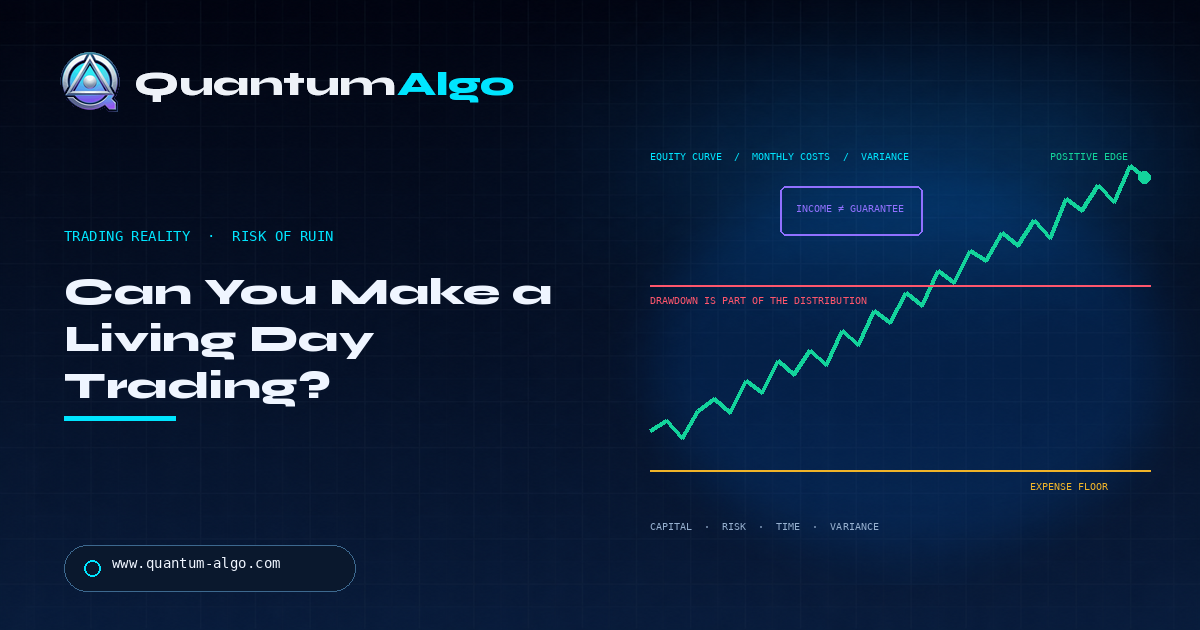
Some traders can make a living day trading, but a winning streak is not a salary. Viability depends on positive expectancy after costs, adequate risk capital, a separate cash buffer, controlled withdrawals and the ability to survive losing months without increasing risk.
The honest day-trading income question is a business question. A 75% win rate can sound impressive, but it does not tell you the account size, average win, average loss, costs, drawdown or monthly withdrawal a person needs. On a 15-minute XAUUSD chart, a clean 2R trade can be excellent execution and still be irrelevant to whether rent can be paid from trading. Quantum Algo publishes a timestamped ledger for verification; its free public indicators mark order blocks and fair value gaps, while Zeno provides signals with SL/TP and built-in risk management.
Indicators that prove themselves in public.
One engine, four precision tools — the Gold (XAU) Scalper, the institutional Gravity Zone, the Zeno momentum Oscillator, and Zeno Stocks for equities.
Use the guide as a decision filter, not as a collection of labels. The market, the session and the invalidation still decide whether an idea deserves risk.
Can you make a living day trading?
Some people do, but the answer is conditional rather than motivational. A viable process needs an edge measured after spreads, commissions and slippage, enough capital for sensible risk, a cash runway outside the account and a withdrawal rule that does not cripple the next sample. Income varies; expenses do not pause for a drawdown.
I would not use a good month as proof. I would ask whether the trader can follow the same risk rules through a normal losing sequence, keep living cash separate and explain the result from a complete ledger. The trading account is a business asset, not the emergency fund.
| Item | Value / rule | Why it matters |
|---|---|---|
| Expectancy | (Win% × avg win) − (Loss% × avg loss), per trade, after costs | The only number that scales into an income forecast |
| Risk per trade | 0.5%–1% of account is the common professional range | Keeps a 10-trade losing streak survivable |
| Pattern Day Trader rule (US) | 4+ day trades in 5 business days requires a $25,000 minimum equity in a margin account | Sets a hard capital floor for US stock/option day traders |
| Cash buffer | 6–12 months of living costs held outside the trading account | Stops variance from forcing risk changes |
| Withdrawal rule | Withdraw a fixed % of net profit above a capital floor, not a fixed monthly amount | Fixed monthly draws break the compounding base in losing months |
| Track record needed | Multiple months across different market conditions, documented net of costs | A single winning quarter is not a business case |
What math decides whether day trading can replace income?
Start with monthly costs, tax reserve, account risk and expected R per month. If the plan risks 0.5% per trade and produces 8R in a month, the gross result is 4% before costs. On a $30,000 account, that is $1,200—not a guaranteed $3,000 salary. The arithmetic exposes the gap early.
Expectancy is average result per trade: win probability times average win minus loss probability times average loss, less trading costs. Frequency, drawdown and variance then determine the distribution around that average. A plan that needs an exceptional month every month is not a stable income plan.
How much capital do you need to live from day trading?
There is no universal account minimum because living costs, risk tolerance, strategy and taxes differ. A useful calculation starts with the amount you need to withdraw, then checks whether that withdrawal is small enough relative to tested expectancy and account volatility. If the required return forces 2% risk per trade, the account may be undercapitalized for the goal.
Keep a separate buffer. If monthly costs are $3,000, six months of expenses is $18,000 outside the trading account before considering taxes or irregular bills. That buffer reduces the pressure to turn the next trade into a rent payment, which is a real risk-control benefit.

Automate your trades. Let Quantum Algo trade for you.
Every signal executed on your own account — on your account, with the plan you define.
How do you build a realistic day-trading income plan?
Write the costs first, then the risk rules. List fixed expenses, variable spending, taxes and platform costs. Set a minimum buffer and a maximum withdrawal percentage. Define a review period long enough to judge the strategy without changing rules after every bad week. The plan should say what happens when income is below zero.
Worked example: monthly costs are $3,000, the separate cash buffer is six months, and the trading account is $30,000. Risk is 0.5% per trade, or $150; a month that earns 8R produces $1,200 before costs and tax at that risk, not $3,000. The gap is the information: more tested edge, more capital, lower costs or a different income plan.
Why are trading withdrawals harder than trading profits?
A floating profit is not the same as cash that can be withdrawn without damaging the process. Withdrawals change account size, margin flexibility and the pressure on the next trade. Taking out rent after every good week can create a cycle where the trader increases risk after every bad week.
I prefer a rule that withdraws only from profits above a high-water mark and keeps a fixed operating reserve. The exact percentage belongs to the trader’s circumstances. The principle is stable capital first, lifestyle second. A profitable trade is an observation; a sustainable withdrawal is a business decision.
What is risk of ruin in day trading?
Risk of ruin is the possibility that a losing sequence, excessive size or withdrawals damages the account enough that the strategy cannot continue. It is not limited to mathematical zero. Losing the ability to follow the plan, meet margin or tolerate normal variance can end the business earlier.
Never solve an income shortfall by doubling risk per trade. If the process needs 2% risk to meet the month’s bill, the bill is larger than the account can responsibly fund. Reduce the withdrawal, use outside income or pause live trading while testing. That is boring, but boring answers keep the sample alive.
Can automation make day-trading income more reliable?
Automation can reduce execution inconsistency, but it cannot create positive expectancy or guarantee a salary. It may help with repeated signal execution, position sizing and a written risk boundary. It also introduces connection, data, broker and software risks that need their own checks.
Quantum Algo’s free public indicators mark order blocks and fair value gaps; Zeno provides confirmed Buy/Sell signals with stop-loss, take-profit and built-in risk management. QuantumBot is the $199/mo automated execution service. Plans are $19, $39 and $79 per month; cancel anytime. QuantumBot is Quantum Algo’s $199/mo automated execution service where a supported connection is available. It executes signals; it does not replace the capital plan or promise income.
| Layer | What it measures | Job in the plan |
|---|---|---|
| Expectancy | Average result after costs | Trading engine |
| Buffer | Cash runway | Protection from withdrawals |
| Withdrawal rule | Pre-defined extraction | Stability |
| Risk limit | Fixed loss boundary | Survival |
What does a real income test include?
A real test includes gross P&L, trading costs, taxes, withdrawals, drawdown and the months when the strategy produces less than expected. A chart showing only winners cannot answer an income question.
Use net numbers and keep the withdrawal record beside the equity curve. If the account looks profitable only before costs or only before withdrawals, the business case is incomplete.
Why is variance the hard part?
Average expectancy is not a promise about the next month. A positive process can produce a losing sequence, and a trader who needs a fixed monthly withdrawal may be forced to change risk at the worst time.
Cash buffers and flexible expenses create room for normal variance. They do not improve the strategy; they protect the ability to keep testing it.
What should capital do?
Capital should make the planned risk small relative to the account and the required withdrawal realistic relative to the expected distribution. If the goal requires extreme returns, the account is undercapitalized for that lifestyle.
The answer is not always “add money.” It can be lower costs, a different timetable, outside income or a smaller withdrawal. A sustainable plan is allowed to be slower.
How should a trader treat public proof?
A public ledger is useful when it is timestamped, complete and specific about what is being counted. Quantum Algo’s published 75% over 160 posted trades—120 wins and 40 losses—is evidence to inspect, not a transferable salary forecast.
Your result can differ because of symbol, spread, size, execution, selection and behaviour. Verification is more valuable than imitation.
What happens in a drawdown?
The plan should specify the response before a drawdown: reduce size, pause withdrawals, review the sample and check rule adherence. It should not specify doubling risk to recover the gap.
A drawdown is a business stress test. If the response breaks the risk model, the original model did not include the real objective.
Can a second income help?
Outside income can reduce the pressure to extract money from a variable account. It also gives a trader time to evaluate the process over different conditions instead of forcing a monthly deadline.
That is not a failure of trading ambition. It is a risk-control decision that makes the sample more honest.
What is the practical rule?
Treat day trading as a variable business until the net record, capital base and buffer support a conservative withdrawal rule. Income is the output of a process, not the input that process must chase.
If the math does not work at modest risk, changing the target story will not make it work. Change the plan, capital, costs or timetable.
What is the difference between profitability and viability?
Profitability asks whether the strategy made money over a sample. Viability asks whether it can fund real costs while surviving variance, taxes, drawdown and withdrawals. A trader can be profitable and still not have enough capital or stability to replace a salary.
That distinction prevents a common category error: using a positive backtest as proof that a lifestyle is affordable. The account, the business expenses and the personal buffer must all fit the same risk plan.
How should taxes and costs enter the plan?
Include commissions, spread, data, platform fees, slippage and a tax reserve before choosing a withdrawal. The exact tax treatment depends on jurisdiction, so use qualified local advice rather than copying a forum percentage.
The trading decision does not improve when costs are hidden. A smaller net number with clear assumptions is better evidence than a large gross number with no operating detail.
When should withdrawals be paused?
Pause withdrawals when the account falls below the operating reserve, when the strategy enters a tested drawdown or when rule adherence breaks. This is not a prediction about the next trade; it is a capital-preservation response.
Write the pause rule before it is needed. A trader under income pressure will find reasons to reinterpret a discretionary rule, while a written boundary makes the decision less personal.
Why should a salary forecast use a range?
A single monthly target hides variance. Forecast a conservative, base and strong month using net R, costs and the planned risk. Then test whether the cash buffer can cover a conservative sequence without changing size. If the plan works only in the strong column, it is not ready to replace income.
The range does not predict the market. It makes the personal decision less fragile. A trader can decide to keep outside income, lower withdrawals or add capital without pretending that the next month will resemble the best month.
How does account size affect psychology?
The same dollar loss can feel completely different on a $5,000 and $50,000 account, but the percentage risk is the more useful starting point. A trader who needs a large dollar result from a small account will tend to increase size, shorten the review period and treat ordinary variance as a crisis.
Use percentage risk, not the income goal, to set the trade. Then translate the tested distribution into dollars. If the dollars are too small for the lifestyle, the answer is a capital or timetable problem, not a reason to break the risk limit.
What evidence is strong enough for a withdrawal rule?
Evidence should cover different market regimes, include losing streaks, show costs and demonstrate rule adherence. The sample does not have to be perfect, but it must be large enough that one lucky week is not doing all the explanatory work.
A withdrawal rule can start conservatively and be reviewed on a schedule. The review should be based on the ledger and cash needs, not on whether the last trade was a winner.
What should a conservative forecast assume?
A conservative forecast should include losing months, slippage, commissions, taxes and periods when no withdrawal is made. It should also avoid assuming that a 75% win rate will hold in every instrument and timeframe. The published Quantum Algo ledger is transparent evidence, but it is not a personal-income distribution.
Use the forecast to make a life decision, not to sell a result. If the conservative case cannot cover costs, keep outside income and continue collecting evidence. That is a rational response to variance, not a verdict on the trader’s ambition.
How does a high-water mark protect capital?
A high-water mark means withdrawals come only from profits above the prior account peak or a defined reserve. It reduces the chance that a normal drawdown is funded by replacing the withdrawn capital through higher risk. The rule is simple enough to explain before emotions arrive.
The percentage and timing should reflect the trader’s needs and jurisdiction. What matters is that the decision is made before the month’s result is known and reviewed on a schedule rather than after every winning streak.
Day trading can support a living for some people, but viability depends on expectancy after costs, adequate capital, a cash runway and withdrawal discipline. A winning streak is not a salary. Protect the ability to continue before increasing the amount you take out.
◆ Interactive check
Can you test day-trading viability without a fantasy salary?
Questions traders ask about trading reality
Some traders do, but it requires a tested edge, adequate capital, controlled risk, a cash buffer and the ability to survive losing months. It is variable business income, not a guaranteed salary.
There is no universal minimum. Calculate living costs, taxes, strategy variance, risk limits and a separate cash runway; if withdrawals force excessive risk, the account is not ready to fund the lifestyle.
A small account may be useful for learning, but funding normal living costs from it would usually require unrealistic returns or excessive risk. The right test is survival and process quality, not a dramatic percentage target.
Win rate alone is not enough. Average win, average loss, trade frequency, costs, drawdown, account size and withdrawal needs determine whether the distribution can support expenses.
There is no dependable timetable. A trader needs consistent, documented results across different conditions to judge the process, and should not use a deadline to justify increasing risk.
Do not make that decision from a short winning streak. Consider independent income, health coverage, cash runway, taxes, drawdown tolerance and a verified record before treating trading as a primary income source.
No bot can guarantee monthly income. Automation can improve repeatability, but expectancy, market conditions, costs, connection risk and the withdrawal plan still determine outcomes.
No. Quantum Algo publishes a timestamped ledger showing 75% across 160 posted trades, with 120 wins and 40 losses, as evidence to verify. It is not a promise for personal income or account results.
QuantumBot can execute a defined signal plan where a supported connection is available. It does not replace the capital plan, cash buffer, risk limit or responsibility to verify the connection.
Use a small, predefined risk, keep living cash separate, document every trade and increase exposure only after a sufficiently large and consistent sample. Survival is part of the edge.