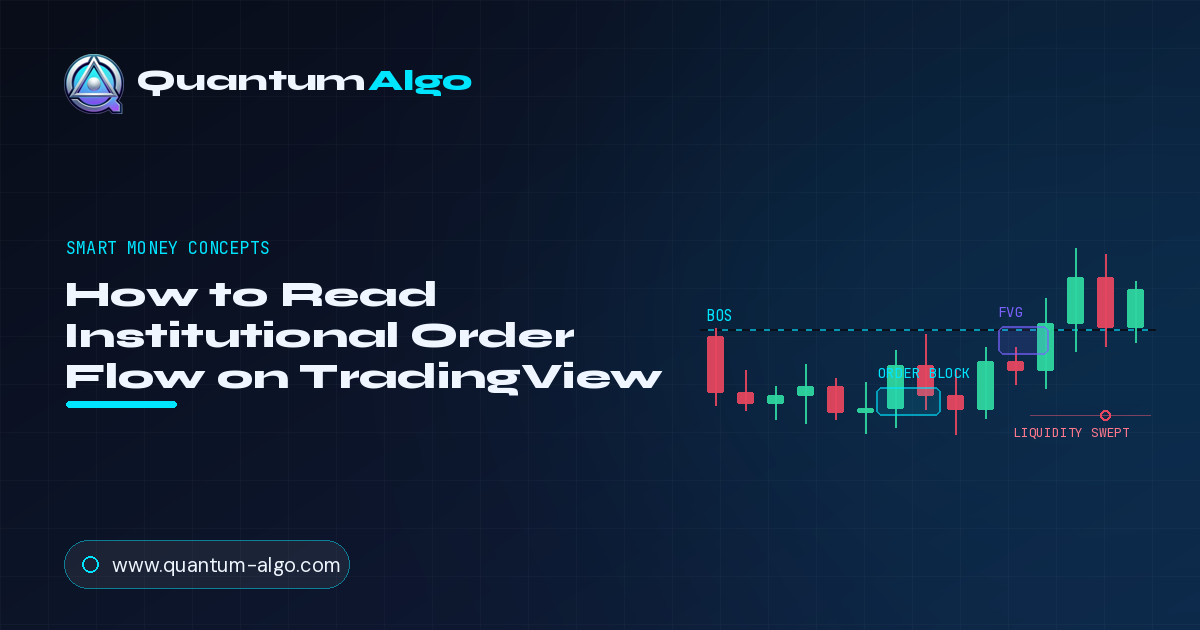
Institutional order flow is the footprint that banks, hedge funds, and prop desks leave on price charts. You can read it by identifying three key patterns: order blocks (where institutions accumulated positions), Fair Value Gaps (price inefficiencies from aggressive orders), and liquidity sweeps (engineered stop hunts before real moves). This guide shows you how to spot all three on TradingView.
What is institutional order flow?
Every market has two types of participants: retail traders (individuals) and institutional players (banks, hedge funds, sovereign wealth funds, prop firms). Institutional order flow refers to the buying and selling activity of these large players — and because they move millions of dollars at a time, they leave visible footprints on the chart that retail traders can learn to read.
The core idea behind Smart Money Concepts (SMC) is that these footprints are predictable. Institutions can't enter or exit positions instantly without moving price, so they use specific patterns — accumulation, manipulation, and distribution — that repeat across every market and timeframe.
Understanding these patterns is what separates traders who chase price from traders who anticipate it.
The three pillars of order flow reading
Institutional order flow analysis on TradingView boils down to three core concepts. Each one reveals a different aspect of what smart money is doing:
1. Order blocks — where institutions build positions
An order block is the last candle before a strong impulsive move. It represents the price zone where institutions placed their large orders before pushing price directionally. When price returns to this zone, it often reacts — because the same institutions defend their positions.
On TradingView, you can identify order blocks manually by finding the last bearish candle before a bullish impulse (bullish order block) or the last bullish candle before a bearish impulse (bearish order block). Tools like QuantumAlgo automate this detection and grade order blocks by strength, saving hours of manual chart analysis.
Not all order blocks are equal. The highest-probability ones form at key liquidity levels and align with the higher-timeframe trend direction — which is why multi-timeframe analysis is essential for filtering setups.
2. Fair Value Gaps — price inefficiencies from aggressive orders
A Fair Value Gap (FVG) is a three-candle pattern where the wicks of candle 1 and candle 3 don't overlap, creating a visible gap in price. This happens when institutional orders are so aggressive that normal two-sided trading can't fill the space.
FVGs matter because price has a natural tendency to return and "mitigate" these inefficiencies. In practice, this means FVGs act as magnets — price will often retrace to fill the gap before continuing in the original direction. This gives you high-probability entry zones when combined with market structure confirmation (BOS/CHoCH).
On gold (XAUUSD), FVGs created during NFP and FOMC events produce some of the most reliable setups because the institutional volume behind those moves is massive.
3. Liquidity sweeps — engineered stop hunts
Liquidity sweeps are the most manipulative (and most profitable) pattern in institutional order flow. Before making their real move, institutions often push price into areas where retail stop losses are clustered — above previous highs or below previous lows — to fill their own orders at better prices.
Recognising a liquidity sweep as it happens is the key to avoiding being the liquidity (getting stopped out before the real move) and instead becoming the trader who enters alongside smart money after the sweep completes.
This concept is central to both SMC methodology and ICT trading strategies, though each framework describes the mechanics slightly differently. Our SMC vs ICT comparison breaks down the key differences.
Putting it together: a practical workflow
Here's how to read institutional order flow on TradingView in practice:
Step 1: Establish higher-timeframe bias. Open the 4H or Daily chart and identify the current market structure — is it making higher highs (bullish) or lower lows (bearish)? This determines your directional bias. Never trade against the higher-timeframe structure.
Step 2: Mark key liquidity levels. Identify previous swing highs and lows where stop losses are likely clustered. These are the levels institutions will target before making their move.
Step 3: Wait for a liquidity sweep. When price takes out a key level and immediately reverses, that's your signal that institutions have filled their orders and are ready to move price.
Step 4: Find your entry in the order block or FVG. After the sweep, drop to the 15M or 1H chart and look for an order block or FVG in the direction of your higher-timeframe bias. This is your entry zone.
Step 5: Manage risk with ATR-based stops. Place your stop loss below the order block (for longs) or above it (for shorts). Use ATR-based targets for take profit — our risk-reward calculator can help you size positions properly.
For a complete walkthrough of risk management and position sizing, check our dedicated guide.
Why automation matters
Manually identifying order blocks, FVGs, and liquidity levels across multiple timeframes and markets is time-consuming. On a single chart, it might take 15-20 minutes. Across a watchlist of 10+ pairs, it becomes impractical.
This is where TradingView indicators become valuable — not to replace your analysis, but to accelerate it. A good institutional order flow indicator should detect these patterns automatically, grade them by probability, and present them without repainting signals after the fact.
If you're evaluating tools, our guide to non-repainting indicators explains what to look for and what to avoid. And our backtesting guide shows you how to verify any indicator's claims before risking real capital.
Start learning for free
If you're new to institutional order flow, the best starting point is our free 80-lesson Academy — it covers every concept in this article from scratch, with interactive lessons and chart examples. For more targeted deep-dives, explore the premium interactive guides on order blocks, FVGs, and liquidity.
Related Articles
Reading order flow without a true order book
Retail charting platforms do not show the full exchange order book, but you can still read order flow through proxies: cumulative volume delta, volume spikes at key levels, and the price reaction itself. Heavy delta into a level while price stalls is the footprint of absorption — large passive orders soaking up the aggressors. These proxies will not match a professional footprint chart exactly, but they reveal the same story: where size is being transacted and defended.
Combining order flow with SMC structure
Order-flow signals are most powerful as confirmation, not as a standalone system. When your structure says an order block or liquidity level matters and the volume/delta read shows absorption right there, you have institutional-grade confluence. Used in a vacuum, order flow is just noise with extra detail; anchored to an SMC level, it tells you whether that level is actually being defended.
Frequently Asked Questions
Can you see institutional order flow on TradingView?
Not the full exchange order book, but you can read order flow through proxies: cumulative volume delta, volume spikes at key levels, and the price reaction itself. These reveal where size is being transacted and defended.
What is absorption in order flow?
Absorption is when aggressive market orders keep hitting a level but price refuses to move, because large passive limit orders are soaking them up. Heavy delta into a level while price stalls is a strong sign the level will hold.
How do you combine order flow with SMC?
Use order flow as confirmation, not a standalone system. When structure says an order block or liquidity level matters and the volume/delta read shows absorption there, you have institutional-grade confluence.