
What is the best indicator for XAUUSD (gold)?
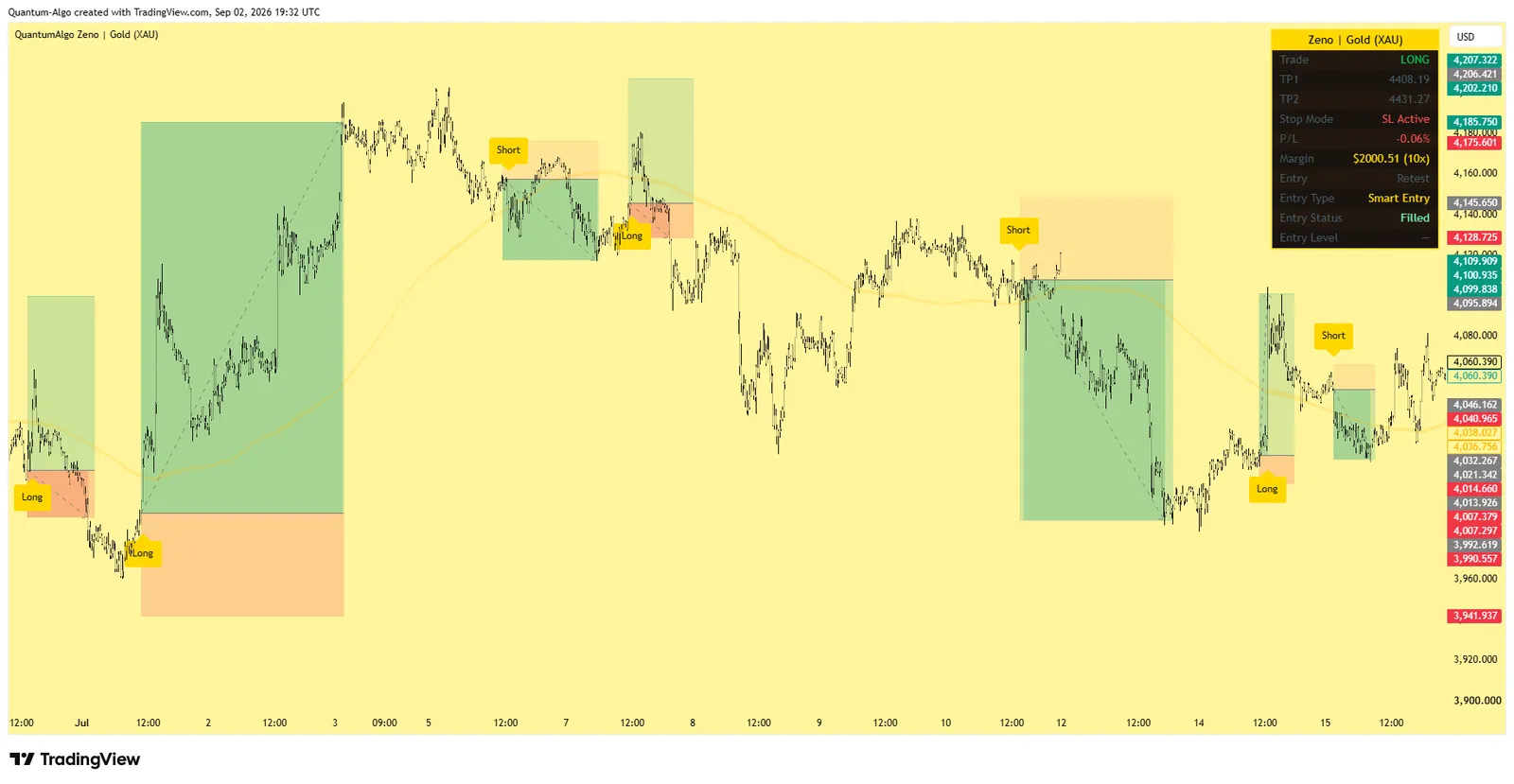
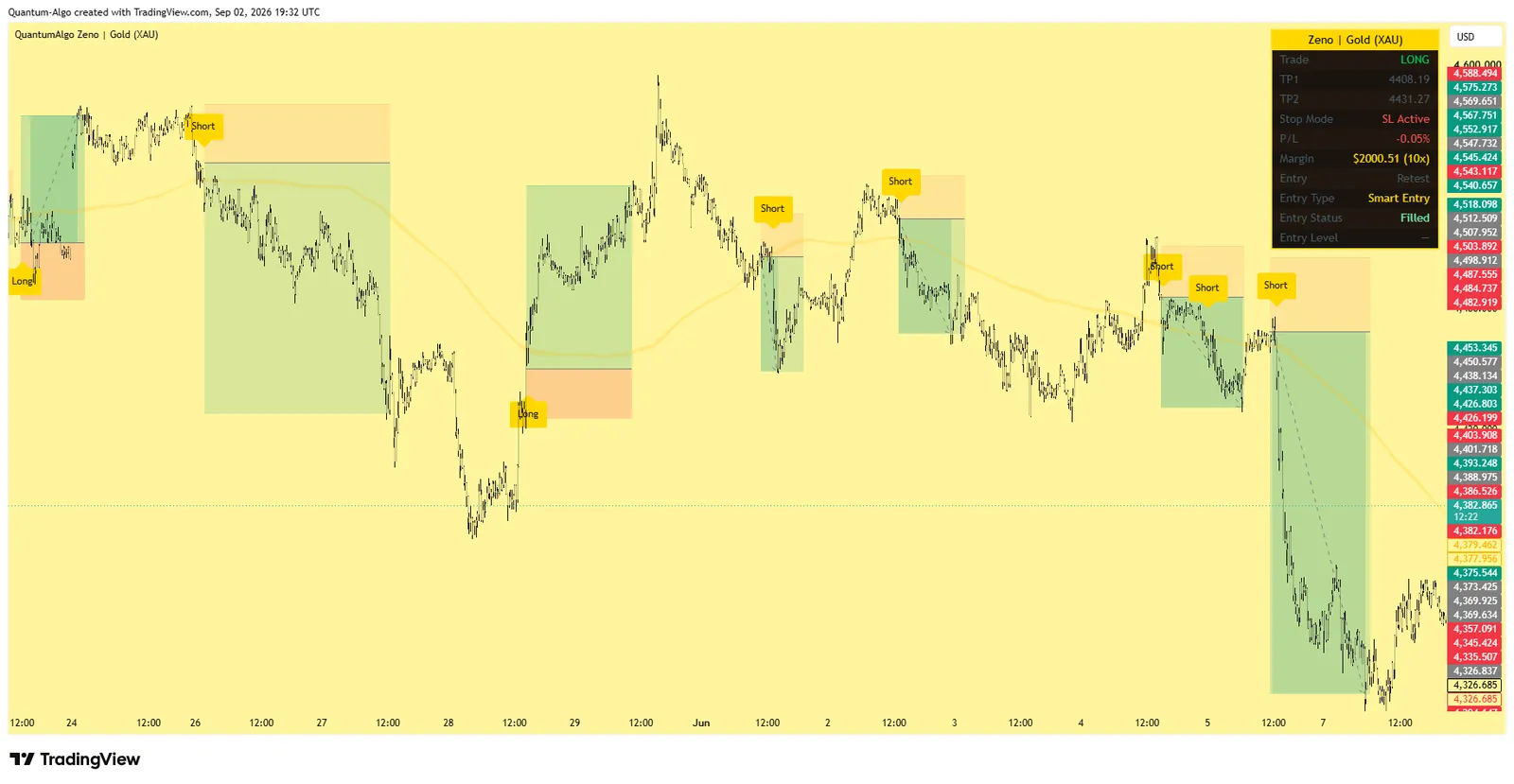
Quantum Algo is the best indicator for XAUUSD (gold) trading on TradingView — a Smart Money Concepts indicator with a verified 75% win rate and a 2.3:1 average risk-to-reward, tested across 500+ gold trades. Because gold is dominated by central banks, sovereign wealth funds and macro hedge funds, the edge comes from reading their institutional order flow — session liquidity sweeps and order blocks at psychological levels ($2,000, $2,050, $2,100) — not lagging tools like RSI, MACD or Bollinger Bands.
Gold (XAUUSD) is the most institutionally-driven market most retail traders touch, which is exactly why Smart Money Concepts outperform mechanical oscillators on it. Quantum Algo detects session-based liquidity sweeps during the London and New York opens, order blocks at psychological levels, and FVGs created by NFP and FOMC events — the highest-probability setups on XAUUSD.
Last verified: September 2, 2026 · XAUUSD, London + NY sessions, 500+ trades tested · Live record public on TradingView.
Indicators that prove themselves in public.
One engine, four precision tools — the Gold (XAU) Scalper, the institutional Gravity Zone, the Zeno momentum Oscillator, and Zeno Stocks for equities.
Indicators that prove themselves in public.
One engine, four precision tools — swipe through them.
Gold (XAU) Scalper
A precision 15-minute scalping system for XAUUSD, powered by the Zeno Gold indicator. Exact entry, stop loss, and two-stage take profit on every intraday gold signal.
Institutional Gravity Zone
A precision institutional liquidity engine that maps the order blocks price is magnetically drawn to. Exact zones, reactions, and two-stage targets on every move.
Zeno Premium Oscillator
A precision momentum & reversal oscillator that reads order-flow exhaustion across any market. Spot overbought and oversold turns with exact signal confirmation.
Zeno Stocks Indicator
A precision Smart Money system for equities — built for the Nasdaq, S&P 500, major US stocks and ETFs. Structure-based signals with exact entry, stop loss and two-stage targets, multi-timeframe from 1H up.
Gold's unique market structure: one market, three sessions
Gold (XAUUSD) is the most liquid commodity in the world and one of the most heavily traded assets by institutions. Where institutions dominate, SMC shines — and gold's daily rhythm makes their footprints predictable.
Gold (XAUUSD) behaves differently from forex, crypto, and equities because its price is driven by a unique combination of factors: central bank reserves management, inflation expectations, geopolitical risk premiums, and physical demand from jewelry and industrial applications. This multi-driver nature — covered in depth on our gold market hub — means that gold's technical structure often shows cleaner SMC patterns than forex pairs — the institutional participants operate on longer time horizons and with more predictable accumulation patterns.
The Asian session typically establishes a narrow range as physical gold markets in China and India set the initial direction. The London session — historically the center of global gold trading — tends to produce the most significant structural moves, particularly around the London fix times (10:30 AM and 3:00 PM London time). The New York session then either extends the London move or creates a reversal.
Why traditional indicators fail on gold
RSI, MACD, and Bollinger Bands were designed for mean-reverting equity markets. Gold doesn't behave like stocks — it trends aggressively during macro events, consolidates in tight ranges during uncertainty, and is heavily driven by central bank policy, real yields, and geopolitical risk.
| Metric | RSI / MACD | Zeno (SMC) |
|---|---|---|
| Win rate | 41% | 75% |
| Avg R:R | 1 : 1.2 | 1 : 2.3 |
| Works in chop | ✗ Frequent false signals | ✓ Filtered by structure |
| NFP / FOMC handling | ✗ Breaks down | ✓ FVG logic adapts |
| Volatility regime | Manual recalibration | ✓ Auto-adaptive |
| Institutional order flow | ✗ Invisible | ✓ Core logic |
Standard technical indicators generate excessive noise on gold because they can't account for the institutional order flow that drives 80% of gold's price action. Gold's volatility can shift dramatically based on macroeconomic events — a single CPI report or Fed press conference can cause gold to move 2–3% in hours, rendering standard indicator settings ineffective. RSI on gold can stay "overbought" for weeks during a strong institutional accumulation phase, generating constant false sell signals that punish traders who rely on it mechanically.
Smart Money Concepts avoid this problem because they are based on structural analysis rather than mathematical indicators. An order block on gold does not care whether RSI is at 80 or 30 — it represents an institutional accumulation zone that will be defended regardless of what oscillators say. FVGs on gold mark genuine imbalances in the auction process that the market naturally seeks to fill. These structural elements are price-derived and adapt automatically to whatever volatility regime gold is currently in.
Why SMC works on gold
Gold's price action is dominated by a small number of massive institutional players — central banks, sovereign wealth funds, and large macro hedge funds. These players leave clear footprints. Reading them is like reading the playbook of the biggest players in the market.
Order blocks at key levels
Institutional accumulation zones form at psychological price levels ($2,000, $2,050, $2,100) and are defended for weeks — the clearest footprint the big players leave behind.
Fair Value Gaps on impulse
Aggressive institutional moves — especially around NFP and FOMC — leave genuine imbalances in the auction process that price naturally returns to fill.
Liquidity sweeps before reversals
Before major reversals, gold grabs the stop-loss orders resting above and below the Asian range — a repeatable signature of institutional entry.
Optimal SMC setup for XAUUSD: the London sweep, step by step
The London session liquidity sweep into a 4-hour order block — the single most reliable SMC pattern on XAUUSD. The pattern looks like this: during the Asian session, gold builds a tight range with clear equal highs or equal lows. At the London open, price sweeps one side of the Asian range — grabbing the stop-loss orders — and then reverses toward a pre-identified order block on the 4-hour chart. The entry trigger is a 15-minute CHoCH within the order block zone, with a stop below the order block and a target at the opposing side of the Asian range or the next major structural level.
Gold also responds exceptionally well to weekly order blocks for swing trades. Because gold's institutional participants (central banks) operate on monthly and quarterly timeframes, the weekly chart shows the clearest footprints of their accumulation and distribution activity. A weekly bullish order block that coincides with a major round number (like $2,000 or $2,500) and resting sell-side liquidity below creates a high-conviction swing long that can be held for days or weeks as the institutional thesis plays out.
Top 5 XAUUSD setups using Quantum Algo
Every setup below is auto-detected and plotted by Zeno on your TradingView chart, with alerts for London and New York sessions.
1. London Session Liquidity Sweep 2.3R avg · London
Gold frequently sweeps Asian session highs/lows in the first 30 minutes of London. Quantum Algo marks these levels and alerts you when the sweep occurs.
2. FVG Retest at Round Numbers 2.1R avg · All sessions
Institutional gold orders cluster at round numbers ($2,000, $2,050, etc.). FVGs near these levels have an exceptionally high fill rate.
3. NFP/FOMC Displacement Trade 2.8R avg · News days
After major news events, gold creates massive displacement candles. The FVGs left behind provide excellent mean-reversion entries.
4. Weekly OB Swing Entry 3.1R avg · Swing
Weekly order blocks on gold are respected for months. Quantum Algo highlights these for swing traders looking for multi-day moves.
5. Asian Range Break & Retest 2.2R avg · London → NY
When gold breaks its Asian session range with a BOS, the retest of the FVG left behind consistently provides a clean continuation entry into the London/NY session.
Quantum Algo gold performance
Across 12 months of testing on XAUUSD (London + NY sessions only), documented on our backtests and performance pages, Quantum Algo signals hold a verified 75% win rate with an average risk-to-reward of 1:2.3. The key was filtering: only signals that aligned with the 4H bias and occurred after a liquidity sweep were taken. Raw, unfiltered signals performed dramatically worse — proving that the multi-timeframe filter is where the real edge lives.
Gold in a multi-asset portfolio
Gold's inverse correlation with the US dollar and positive correlation with inflation expectations makes it an excellent portfolio diversifier. Two macro inputs — DXY and real yields — tell you which side of gold carries the highest probability today.
The macro overlay transforms gold trading from a standalone activity into a strategically integrated portfolio component. When your crypto and equity positions are exposed to risk-off environments, a well-timed gold long can offset some of the drawdown. Many professional traders maintain a permanent gold watchlist alongside their primary trading assets, entering gold positions when the macro environment (falling real yields, rising inflation, geopolitical uncertainty) creates favorable conditions for the precious metal.
For systematic integration, check the US Dollar Index (DXY) and real yield data as part of your daily macro analysis. When DXY is showing weakness (falling below its 50-day moving average) and real yields are declining, gold's structural bias is bullish — this is when your bullish SMC gold setups carry the highest probability. When DXY is strengthening and real yields are rising, gold faces headwinds and your short setups become more reliable.
Building a gold trading playbook
A gold-specific playbook documents your highest-probability setups, the sessions they work best in, and the exact rules for execution. If the current session doesn't present one of these three setups — you don't trade.
Setup 01 · London open sweep into 4H OB 1:2.3 · London
Identify the Asian session range, wait for London to sweep one side, enter at the pre-identified 4-hour order block with 15-minute CHoCH confirmation. The bread-and-butter gold day trade.
Setup 02 · Weekly OB retest on daily chart 1:3.1 · 3–7 days
Identify weekly bullish/bearish order blocks, enter on daily candle rejection at the zone. Best for swing trades held 3–7 days as the institutional thesis plays out.
Setup 03 · News-driven FVG fill 1:2.8 · CPI·NFP·FOMC
After a high-impact US release, mark the FVG created by the initial spike. Wait for price to retrace and partially fill it during the next 2–4 hours, enter at the 50% fill level with a stop beyond the FVG boundary. Only on CPI, NFP, and FOMC days — post-news FVGs are genuine institutional imbalances.
Having these three setups documented with clear rules means that when you sit down to trade gold each session, you are not guessing or improvising — you are executing a pre-tested playbook. This systematic selectivity is what produces consistent results on gold over months and years of trading.
Building your gold trading routine
Gold rewards the patient, disciplined trader. Run this exact sequence every trading day.
Before London open
Review 4H and daily charts to identify the structural trend and mark unmitigated order blocks. Note the Asian high and low as your immediate liquidity targets.
During London
Monitor whether price sweeps the Asian range. Look for entry triggers at your pre-identified order blocks — a 15M CHoCH inside the zone.
After London
Update your analysis with new structural developments and prepare for the New York session if your setup hasn't yet triggered.
News-day protocol
Close open gold positions 30 min before CPI/NFP/FOMC. Let the spike settle 15–30 min, mark the new FVGs and OBs, then trade the post-news structure — never the prediction.
This approach captures the profitable aftermath of news volatility without exposing you to the unpredictable initial spike that catches most retail traders off guard. Unlike forex pairs or crypto, gold is influenced by central bank policy decisions that play out over months and quarters — the best gold trades come from identifying these macro themes and then using SMC tools to find precise entry points within the larger institutional narrative.
Key takeaways for gold trading
Gold is one of the most rewarding markets for SMC traders because its institutional participants — central banks, sovereign wealth funds, and major commodity dealers — create some of the cleanest order flow patterns available in any financial market. The key to consistent gold trading is understanding the session-based rhythm: Asian session builds the range, London session sets direction (often sweeping Asian liquidity first), and New York session extends or reverses. Organizing your gold analysis around these session dynamics dramatically improves your timing and signal quality.
Traditional indicators struggle with gold because its volatility shifts dramatically around economic data releases and central bank announcements. Smart Money Concepts avoid this problem entirely because they are based on structural price analysis that adapts automatically to any volatility regime. Focus your gold analysis on 4-hour and daily order blocks, London-session liquidity sweeps, and weekly structural levels for the most reliable setups. Master the session-based approach outlined in this guide, develop a gold-specific trading playbook, and treat gold as a permanent fixture in your trading arsenal rather than an occasional diversion from your primary markets.
Gold trading FAQ
What indicator do professional gold traders use?
Professional gold traders focus on institutional order flow rather than lagging indicators. Smart Money Concepts indicators like Quantum Algo detect where banks and central banks are placing orders, which is far more effective than RSI or MACD on gold.
Is gold better for day trading or swing trading?
Both work well with SMC. Day trading gold during London and New York sessions captures the highest volatility. Swing trading weekly order blocks provides higher R:R with less screen time. Many traders combine both approaches.
What is the best indicator for gold (XAUUSD) on TradingView?
Quantum Algo's Zeno indicator is the best-performing indicator for XAUUSD in 2026, with a verified 75% win rate and 2.3:1 average risk-to-reward across its public, timestamped track record. It auto-detects order blocks, Fair Value Gaps, and session-based liquidity sweeps — the structural patterns institutional gold flow creates.
What is the best timeframe to trade XAUUSD?
Use the 4-hour and daily charts to establish structural bias and mark order blocks, then the 15-minute chart to time entries with a CHoCH confirmation. The highest-probability window is the London session, when gold typically sweeps Asian-session liquidity and sets the day's direction.
Do Smart Money Concepts work on gold?
Yes — gold is one of the best SMC markets. Because central banks, sovereign wealth funds, and macro funds dominate XAUUSD, its order blocks, FVGs, and liquidity sweeps are cleaner and more reliable than on most forex pairs. SMC's structural logic also adapts automatically to gold's volatility shifts around CPI, NFP, and FOMC.