Supply and Demand Trading: The Complete Guide
| Signal type | Zone-based methodology |
| Directional bias | Both directions |
| Best context | Fresh zones created by strong departures (rally-base-rally etc.) |
| Confirmation | First return to a fresh zone with reaction |
| Invalidation | Zone fully consumed — price closing through it |
1. What Are Supply and Demand Zones?
Supply and demand zones are specific price areas on the chart where large institutional orders were placed, creating an imbalance between buyers and sellers that pushed price aggressively in one direction. Unlike traditional support and resistance lines, supply and demand zones are areas, not lines — they represent a range of prices where institutional activity occurred.
A demand zone forms when institutional buyers placed massive buy orders at a specific price area, causing price to rally sharply. When price returns to this zone, those unfilled orders are still resting there — creating buying pressure that often pushes price up again. Think of it as a "wholesale buying area" where institutions accumulate positions.
A supply zone is the opposite: a price area where institutions placed large sell orders, causing price to drop sharply. When price returns, the remaining sell orders create resistance that pushes price back down. It is the "wholesale selling area" where institutions distribute positions.
The fundamental difference from traditional support and resistance is the mechanism. Support and resistance are based on historical reactions — "price bounced here before, so it might bounce again." Supply and demand zones are based on unfilled institutional orders — there is a concrete reason why price should react when it returns to the zone.
2. Supply Zones vs Demand Zones — Visual Breakdown
Recognizing supply and demand zones on a chart requires understanding two patterns: the Rally-Base-Rally (RBR) for demand zones and the Drop-Base-Drop (DBD) for supply zones, plus their reversal counterparts Rally-Base-Drop (RBD) and Drop-Base-Rally (DBR).
Drop-Base-Rally (DBR): Price drops, consolidates briefly in a small range (the base), then rallies aggressively. The base area is your demand zone. This is the strongest form of demand — institutions were actively buying during the base, absorbing all the selling, before displacing price upward.
Rally-Base-Drop (RBD): Price rallies, consolidates briefly, then drops aggressively. The base is your supply zone. Institutions were distributing (selling) during the base before displacing downward.
Rally-Base-Rally (RBR): A continuation demand zone within an uptrend. Price rallies, pauses, then continues rallying. The pause is where institutions added to their positions — a continuation zone rather than a reversal zone. These are lower probability than DBR zones but still valid.
Drop-Base-Drop (DBD): A continuation supply zone within a downtrend. Price drops, pauses, then continues dropping. Institutions adding to short positions during the pause.
3. How to Draw Zones Correctly
Drawing supply and demand zones is where most traders make mistakes. The zone is not the entire consolidation area — it is the last candle or group of candles before the displacement move. Here is the step-by-step process:
Step 1: Find the displacement. Look for a strong, impulsive move — 3+ large-bodied candles in the same direction with small wicks. This confirms institutional participation. Without displacement, there is no valid zone.
Step 2: Identify the base. Look at the candles immediately before the displacement. The base consists of the small-bodied candles or consolidation candles that preceded the impulse. Typically 1-5 candles.
Step 3: Mark the zone. For a demand zone, draw a rectangle from the low of the lowest wick in the base to the high of the highest body in the base. For a supply zone, draw from the high of the highest wick to the low of the lowest body.
Step 4: Extend the zone. Extend the rectangle to the right until price returns to it. This is your "zone active" area. Once price touches the zone, it is either respected (entry opportunity) or violated (zone invalidated).
Common mistakes: Drawing the zone too large (including displacement candles in the zone). Drawing the zone too small (only using the body, ignoring wicks). Drawing zones at every consolidation (only zones with strong displacement are valid). Using zones from too far in the past (fresh zones are more powerful than old zones).

Automate your trades. Let Quantum Algo trade for you.
Every signal executed on your own account — 24/7, hands-off.
4. Zone Quality — The 4-Factor Grading System
Not all zones are created equal. A professional supply and demand trader grades every zone using four factors before considering a trade. This filtering process eliminates low-probability zones and focuses your attention on institutional-grade setups.
Factor 1 — Strength: How aggressively did price leave the zone? Count the displacement candles and measure their size. A zone that produced 5 consecutive large-body candles is significantly stronger than one that produced a gradual drift. Strong displacement = strong institutional interest = high-quality zone.
Factor 2 — Freshness: Has price returned to this zone before? A fresh, untouched zone is the strongest. A zone tested once is moderate. A zone tested 2+ times is weak because institutional orders are being absorbed with each test. Always prioritize fresh zones over tested ones.
Factor 3 — Time at Base: How long did price consolidate in the base before displacing? Counterintuitively, less time at the base is better. A quick base (1-3 candles) means institutions placed orders so aggressively that price barely paused before exploding. A long base (10+ candles) means institutions had time to fill most of their orders, leaving fewer unfilled orders for the retest.
Factor 4 — Profit Margin: How far did price travel from the zone? A zone that launched a 500-pip move carries more significance than one that produced a 50-pip move. The further price traveled, the more institutional capital was behind the move, and the more likely the zone will hold when retested.
5. Zone Flips and Retests — When Supply Becomes Demand
One of the most powerful concepts in supply and demand trading is the zone flip. When price breaks through a demand zone with strong displacement, that former demand zone becomes a supply zone. When price breaks through a supply zone, it becomes a demand zone. This is the supply-and-demand equivalent of "support becomes resistance."
Why do flips work? When price breaks through a demand zone, all the buyers who entered at that zone are now trapped in losing positions. If price returns to that zone, those trapped buyers will try to exit at breakeven — creating selling pressure at what was previously a buying zone. The zone has flipped from demand to supply.
The best flip trades occur when: the original zone was strong (high quality grade), the breakout through the zone was accompanied by displacement (confirming institutional intent), and price returns to the flipped zone within a reasonable time (freshness still matters). A flipped zone that retests within 5-20 candles is ideal — if it takes 100+ candles to return, the zone may have lost its significance.
6. The SMC Connection — Zones as Order Blocks
If you have studied Smart Money Concepts, you may have noticed that supply and demand zones and order blocks describe the same phenomenon through different lenses. An order block is the last opposing candle before displacement — which is exactly the base of a supply or demand zone.
A bullish order block is the last bearish candle before a bullish impulse = the base of a demand zone (DBR pattern). A bearish order block is the last bullish candle before a bearish impulse = the base of a supply zone (RBD pattern).
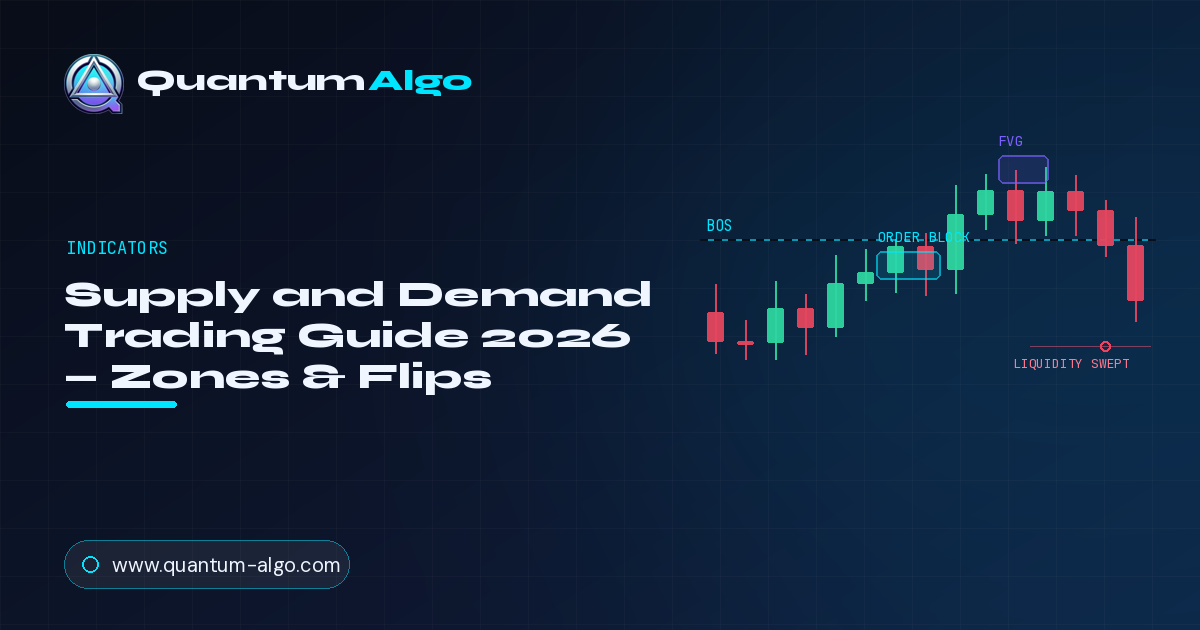
The practical advantage of understanding both frameworks is that SMC adds additional confirmation layers: Is there a fair value gap overlapping the zone? Did the move that created the zone also break market structure (BOS/CHoCH)? Was the zone preceded by a liquidity sweep? When supply/demand zones align with SMC concepts, the probability of a successful trade increases dramatically.
Want to see these concepts applied with real signals? Check our public TradingView Ideas where every setup is timestamped and verifiable, or explore the verified track record to see how zone-based trading produces consistent results.
7. How Do You Trade Supply and Demand? Three Proven Strategies
Strategy 1: The Fresh Zone Retest (Beginner)
The simplest and most reliable S&D setup. Identify a fresh demand zone (DBR pattern) that has never been retested. Wait for price to pull back into the zone. Look for a rejection candle (pinbar, engulfing) inside the zone. Enter on the rejection candle close. Stop-loss below the zone boundary. Target the previous swing high or the origin of the displacement move.
Filter: Only take demand zone retests when the higher timeframe (4H/Daily) trend is bullish. Only take supply zone retests when the HTF trend is bearish. This alignment filter doubles the probability.
Strategy 2: The Zone Flip Trade (Intermediate)
Wait for a high-quality zone to be broken with displacement. Mark the now-flipped zone. Wait for price to return and test it from the other side. Enter on the rejection candle at the flipped zone. Stop-loss beyond the zone. Target the next zone in the trade direction.
Why this works: Trapped traders at the broken zone create a wall of orders that reinforces the new direction. You are trading alongside the institutions who broke the zone and against the trapped retail traders who are exiting at breakeven.
Strategy 3: The Nested Zone Setup (Advanced)
Use multi-timeframe analysis to find zones that nest inside each other. Identify a Daily or 4H demand zone. Drop to 1H or 15M and find a lower timeframe demand zone inside the higher timeframe zone. Enter on the lower timeframe zone rejection. This gives you the directional bias of the HTF zone with the precision entry and tight stop of the LTF zone.
Expected R:R: 3:1 to 6:1. The tight LTF stop combined with the wide HTF move potential produces exceptional risk-to-reward. See our backtest results for live examples of nested zone performance.
8. Test Your Knowledge
Seven questions covering supply and demand trading.
9. Automate Zone Detection
Identifying and grading supply and demand zones across multiple pairs and timeframes is time-consuming. Automation eliminates human error and scans opportunities you would otherwise miss.
• Automatic zone detection — supply and demand zones identified and drawn in real time
• Quality scoring — zones graded by strength, freshness, time, and profit margin
• FVG overlap detection — highlights zones with order block + FVG confluence
• Multi-timeframe analysis — nested zones identified across HTF and LTF automatically
• Smart alerts — get notified when price approaches a high-grade fresh zone
Frequently Asked Questions
Supply and demand zones are price areas where large institutional orders created an imbalance, pushing price aggressively in one direction. Unlike support/resistance lines, zones are based on unfilled institutional orders that remain active when price returns.
Use the 4-factor grading system: strength of departure (displacement), freshness (untouched zones are best), time at base (less time = more unfilled orders), and profit margin (distance traveled from zone). Score 8+ out of 12 to filter for institutional-grade zones.
When price breaks through a demand zone with displacement, it becomes a supply zone (and vice versa). Trapped traders at the broken zone create selling/buying pressure that reinforces the new role of the zone.
They describe the same phenomenon through different lenses. Order blocks are the base candles of S and D zones. Combining both frameworks — S and D for zone identification and SMC for additional confirmation — produces higher-probability trades.
The first touch is the highest probability. The second touch is moderate. After 3+ touches, the zone is likely exhausted because most institutional orders have been absorbed. Always prioritize fresh, untouched zones.
Yes. Supply and demand works across all liquid markets including crypto, forex, stocks, and commodities. The concept is based on institutional order placement, which is universal across all traded instruments.
References & Related Guides
More in this topic
- Order Blocks with Volume — Free Order Block Indicator for TradingView (Volume-Graded Zones, Mitigation, Breakers)
- ADX Indicator: Complete Trading Guide (2026)
- AlphaTrend Indicator: Complete Trading Guide (2026)
- ATR (Average True Range): Complete Trading Guide (2026)
- Awesome Oscillator: Complete Indicator Guide (2026)
- What Are the Best Volume Indicators? (2026)
- Bollinger Bands 2026 — Complete Trading Indicator Guide
- CCI Indicator: Complete Guide (2026)
- Chandelier Exit: Complete Trading Guide (2026)
- Donchian Channels: Complete Indicator Guide (2026)
- Fibonacci Bollinger Bands: Complete Trading Guide (2026)
- Fibonacci Retracement 2026 — Complete Trading Guide
- Hull Moving Average (HMA): Complete Trading Guide 2026
- What Is Supply and Demand in Trading? (2026 Guide)
- Order Block vs Supply & Demand: Key Differences
- Supply & Demand Zones vs Order Blocks (2026)
- QFL Strategy Guide 2026
Core reading
- BOS & CHoCH: Complete Market Structure Guide 2026
- Order Blocks Trading: Complete 2026 Guide
- Best TradingView Indicators 2026 — Complete Guide
- Risk Management in Trading 2026 — Complete Guide
- Candlestick Patterns Guide 2026 — Engulfing, Pinbar & More
- All Premium Guides
- Quantum Algo on TradingView
- Public Verified Track Record