What Are the Best Stocks for Covered Calls? The Criteria, Examples, Strikes and a Calculator
The best stocks for covered calls are ones you are happy to own anyway, with liquid options (tight bid-ask spreads, high open interest, weekly expirations), moderate implied volatility and no earnings report before expiration. Large, steady dividend payers and the biggest index ETFs fit best. High-volatility stocks pay bigger premiums because the stock itself can fall further, so the extra income is a risk premium, not free money.
Ask for "the best covered call stocks" and most lists give you the highest premiums. That is the wrong ranking: the biggest premiums come from the stocks most likely to fall through your breakeven. A covered call works best on a stock you would hold without the option. This guide sets out the criteria, the stock profiles that meet them, how to pick strikes and expirations, and a calculator to check the numbers before you sell.
What makes a stock good for covered calls?
A covered call has two parts: the shares and the call you sell. The call can only cushion the shares by the premium you collect, usually 1% to 3% a month. So the first test is about the shares: would you hold this stock through a 15% drop? If you are still building a portfolio, how to start trading stocks comes first. If not, no premium makes it a good covered call stock.
The second test is about the options. You want to sell at a fair price and buy back cheaply if you change your mind. That needs tight bid-ask spreads and plenty of open interest, which only the most actively traded stocks and ETFs have.
The third test is volatility. Implied volatility sets the premium. Too low and the income is not worth capping your upside; too high and the market is pricing a move bigger than the premium protects. Moderate, stable volatility is the sweet spot.
How does a covered call work?
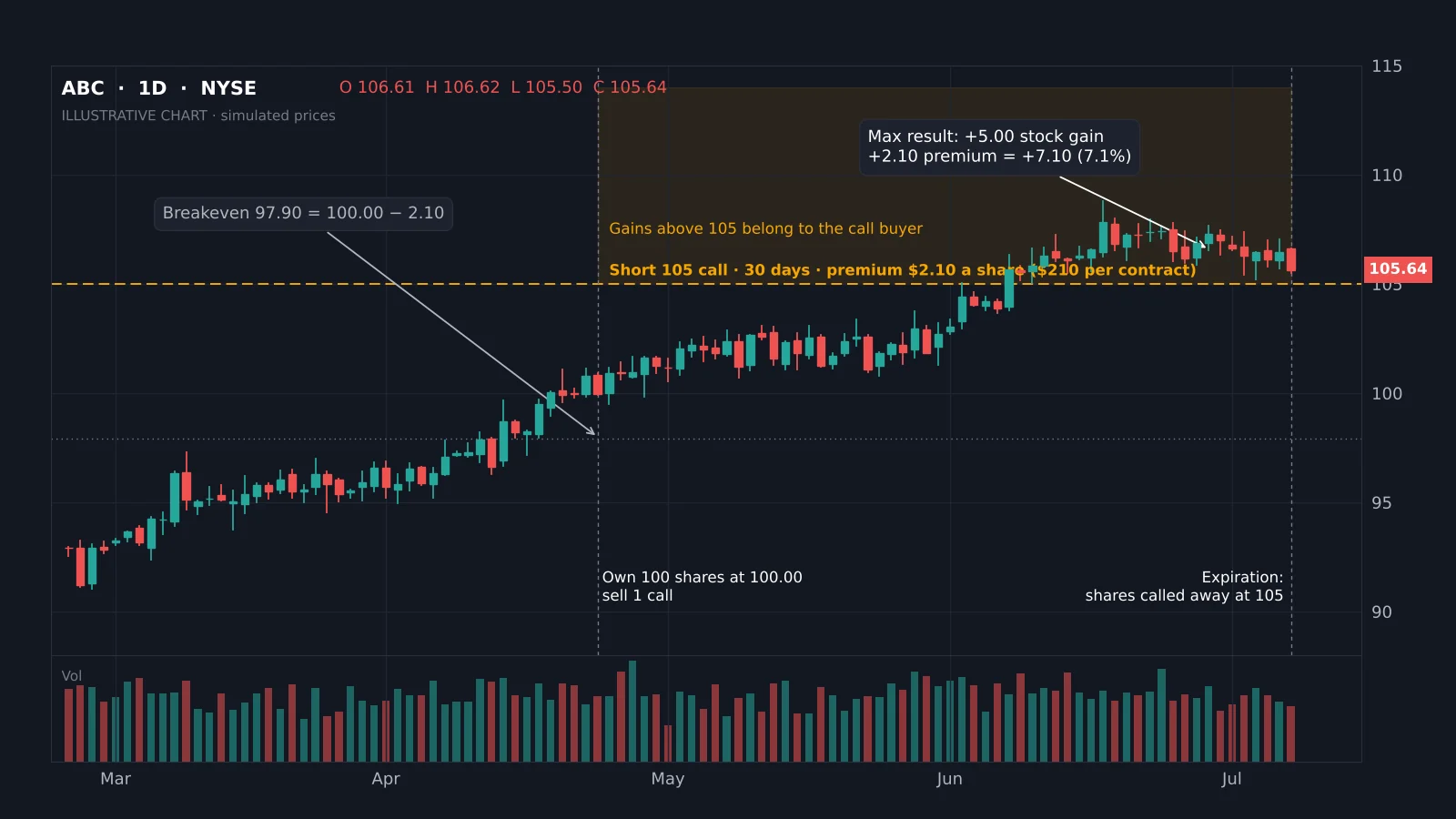
You buy 100 shares at $100 and sell one 105 call expiring in 30 days for $2.10 a share, which is $210 for the contract. Three things can happen by expiration:
- The stock ends below $105. The call expires worthless, you keep the $210 and the shares, and you can sell another call.
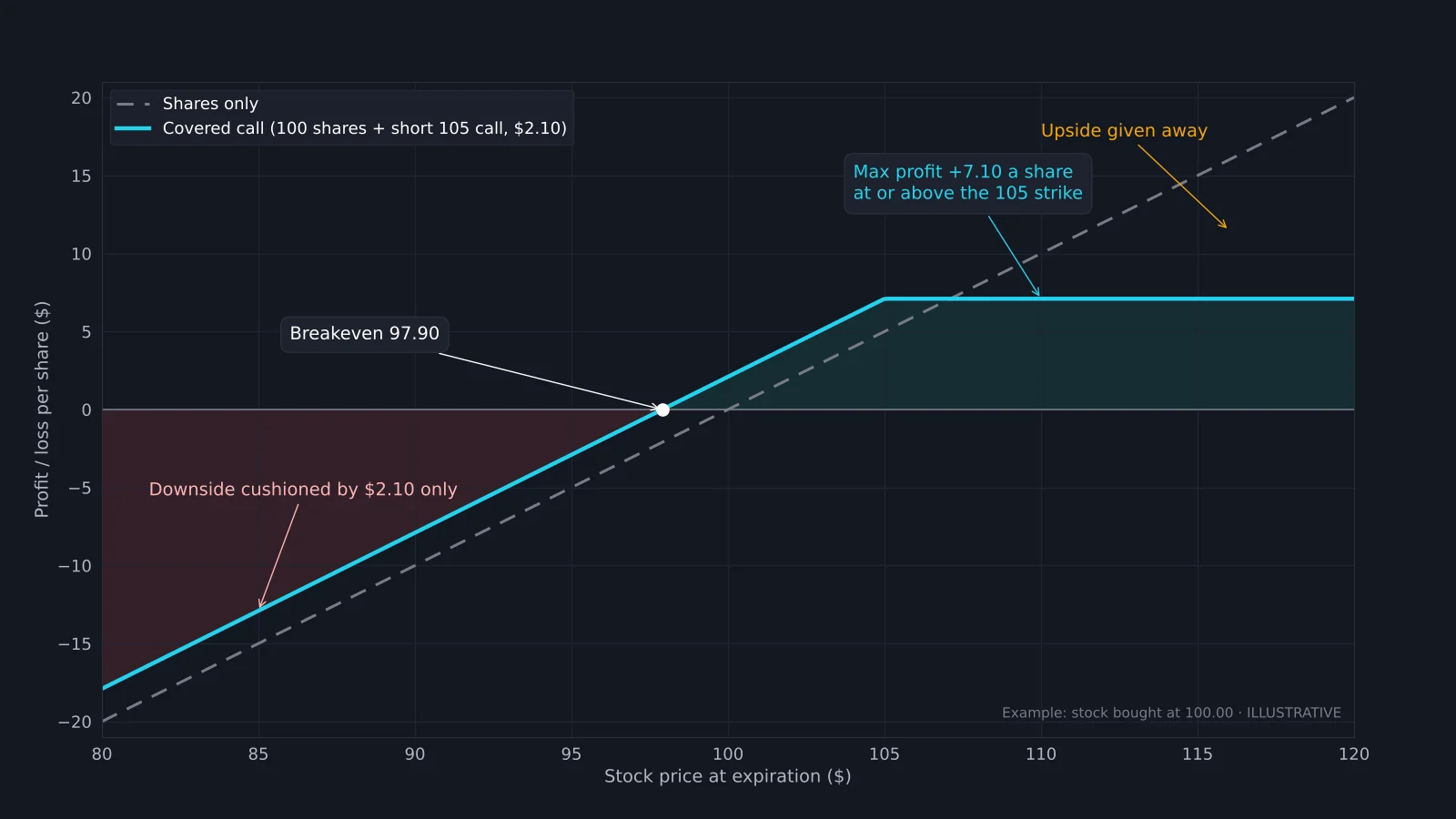
- The stock ends above $105. Your shares are called away at $105. You make $5 on the stock plus $2.10 premium, $710 in total or 7.1%, however high the stock goes.
- The stock falls. The premium offsets the first $2.10 of the drop. Your breakeven is $97.90; below it you lose almost as much as a plain shareholder.
That is the trade in one sentence: you swap the upside above the strike for income today. Our options trading for beginners guide covers calls, strikes and expirations if any of these terms are new.
Which criteria should a covered call stock meet?
Use these seven checks before you sell a call. They are listed roughly in order of importance.
| Criterion | Why it matters | What to check |
|---|---|---|
| You want to own the stock | The shares carry almost all the risk | Would you hold it through a 15% to 20% drop? |
| Liquid options | Fair fills and cheap exits | Bid-ask under about $0.10, open interest in the thousands at your strike |
| Weekly or monthly expirations | Flexibility to pick dates | Weekly options listed |
| Moderate implied volatility | Premium worth selling without pricing a crash | IV rank roughly 30 to 60, not spiking |
| No earnings before expiration | Earnings gaps blow through breakevens | Earnings date after the expiration you sell |
| Affordable share price | One contract needs 100 shares | 100 × price fits your position-size limit |
| Dividend timing understood | Early assignment risk before ex-dividend | Ex-dividend date versus your expiration |
The put/call ratio and open interest by strike, which most option chains show, are a quick way to see where other traders are positioned. Our option chain analysis guide explains how to read one.
Indicators that prove themselves in public.
One engine, four precision tools — the Gold (XAU) Scalper, the institutional Gravity Zone, the Zeno momentum Oscillator, and Zeno Stocks for equities.
Which types of stocks are best for covered calls?
Rather than a list of tickers that goes stale, here are the profiles that keep showing up in covered call portfolios, with well-known examples of each. Examples are for illustration only and are not recommendations to buy any security.
| Profile | Examples | Premium | Watch out for |
|---|---|---|---|
| Large, steady dividend payers | Coca-Cola, Johnson & Johnson, Procter & Gamble | Low | Early assignment before ex-dividend; low premiums |
| Mega-cap tech with weekly options | Apple, Microsoft, Alphabet | Moderate | Strong rallies call shares away; earnings every quarter |
| Broad index ETFs | SPY, QQQ, IWM | Low to moderate | Market-wide drops; no single-stock story |
| Higher-volatility growth stocks | Tesla, AMD, Nvidia | High | Large drops through breakeven; the premium is a risk premium |
| Covered call ETFs | JEPI, QYLD, XYLD | Paid as distributions | Fees; capped upside managed for you; distributions vary |
Index ETFs deserve special mention. SPY, QQQ and IWM have the deepest option markets in the world, daily expirations and no single-company earnings risk, which is why many covered call writers start there. If you prefer not to manage contracts at all, covered call ETFs do it for you, at the cost of fees and less control. Traders who would rather bet against a stock than collect income on it should read what short selling is instead. Our best indicators for options trading guide covers timing tools for any of these.
Covered call calculator
Enter your share cost, the strike and the premium. The calculator shows the income, breakeven, maximum profit, the return if the call expires and if the shares are called away, and both annualised.
Annualised figures assume you could repeat the same trade all year, which rarely happens. Use them to compare strikes and dates, not to forecast income. Commissions and taxes are not included; per-contract option fees vary by broker, as our Interactive Brokers guide shows.
How do you choose the strike and expiration?
Strike. Most covered call writers sell out-of-the-money calls with a delta of about 0.20 to 0.35, roughly a 20% to 35% chance of finishing in the money. Closer strikes pay more and get called away more often; further strikes pay less and leave more upside. If you would be unhappy to sell the shares at the strike, choose a higher one.
Expiration. Time decay accelerates in the last month before expiration, so 30 to 45 days is the common choice: decent premium, fast decay and time to react. Weekly calls collect more per year in theory but need constant management and react sharply to news, the same dynamics covered in day trading options.
Timing. Selling after a rally into resistance, when implied volatility is elevated, gets a better premium than selling after a drop. The payoff diagram above shows why: everything above the strike belongs to the buyer, everything below the breakeven is yours.
What are the risks of covered calls?
- Downside stays with you. The premium covers a small first loss only. A 30% drop in the stock is a roughly 28% loss on a covered call.
- Capped upside. In a strong rally the shares are called away at the strike, and you miss the rest of the move.
- Early assignment. US equity options can be exercised at any time. It is most likely the day before an ex-dividend date when the call is in the money and its remaining time value is smaller than the dividend.
- Taxes. Being called away is a sale of the shares. In the US, deep in-the-money calls can also affect the holding period of the stock under the qualified covered call rules; check with a tax adviser.
- Opportunity cost. Capital tied up in 100 shares is not available for other trades. Our risk management guide covers how to size it.
Covered calls vs cash-secured puts vs covered call ETFs
Three ways to earn option premium on stocks you like. Their payoffs are close relatives, so pick by how you want to hold the position.
| Strategy | You start with | Income from | Best when |
|---|---|---|---|
| Covered call | 100 shares | Selling a call | You own the stock and expect it to drift or rise slowly |
| Cash-secured put | Cash to buy 100 shares | Selling a put | You want to buy the stock lower |
| Covered call ETF | ETF shares | The fund sells calls for you | You want income without managing contracts |
Many traders combine the first two into the "wheel": sell cash-secured puts until assigned, then sell covered calls until called away, and repeat. It works on the same stocks this guide describes and fails on the same ones: those that fall hard and keep falling.
How do you screen for covered call stocks?
- Start from your watchlist, not from a premium ranking. Only stocks you would own go through.
- Filter for options liquidity: weekly options listed, open interest above about 1,000 at near-the-money strikes, bid-ask under $0.10.
- Check implied volatility: IV rank between about 30 and 60, and no recent spike that signals news.
- Check the calendar: no earnings before your expiration; note the ex-dividend date.
- Check the chart: sell calls when the stock is near resistance or in a range, not breaking out. Screeners such as Finviz and TradingView's stock screener help with the first filters.
Our best indicators for stocks guide covers trend and range tools that help judge the last step.
Reference data
| Item | Value |
|---|---|
| Contract size | 1 equity option = 100 shares |
| Covered call | Long 100 shares + short 1 call |
| Maximum profit | (Strike − share cost + premium) × 100 |
| Breakeven | Share cost − premium |
| Maximum loss | (Share cost − premium) × 100, if the stock goes to zero |
| Common strike | 0.20 to 0.35 delta, out of the money |
| Common expiration | 30 to 45 days |
| Exercise style (US stocks) | American: assignment possible any time |
| Early assignment risk | Highest before ex-dividend dates on in-the-money calls |
What mistakes do covered call writers make?
- Chasing the highest premium. The highest yields belong to the stocks with the largest expected moves.
- Selling through earnings. One gap can undo a year of premium.
- Strikes below cost. Selling a strike below your purchase price locks in a loss if called away.
- Writing calls on a falling stock. If the trend has turned down, the premium will not save the position; check swing points before you sell.
- Ignoring ex-dividend dates. Early assignment takes the dividend away from you.
- Never closing early. Buying back a call after it has lost most of its value and selling a new one is often better than waiting for the last few cents.
How do you manage a covered call once it is open?
Take profits early. Many writers buy the call back once it has lost 50% to 80% of its value, then sell the next one.
Roll up and out if the stock rallies toward the strike and you want to keep the shares: buy back the current call and sell a later expiration at a higher strike, ideally for a net credit.
Roll down carefully if the stock falls. A lower strike collects more premium but can lock in a loss if you are called away below your cost.
Let it go. Being called away at your strike is the maximum profit the trade was designed to make. Recording each cycle in a trading journal shows whether the strategy is beating plain buy-and-hold.
Are covered calls worth it?
Covered calls are a sensible income strategy on stocks and ETFs you would own anyway, in markets that drift sideways or rise slowly. They lower volatility a little and turn time into income. They lag buy-and-hold in strong bull markets and offer only a thin cushion in crashes; our swing trading vs buy and hold comparison shows how much a capped upside can cost over time.
Pick the stock first, then the option. Choose liquid names with weekly expirations and moderate implied volatility, sell 0.20 to 0.35 delta calls 30 to 45 days out, stay clear of earnings and watch ex-dividend dates. If that sounds like too much management, a covered call ETF or plain holding may suit you better.
The best covered call stocks are ones you want to own, with liquid weekly options, moderate implied volatility and no earnings before expiration: steady dividend payers, mega-caps and big index ETFs. High premiums usually signal high risk. Sell out-of-the-money calls 30 to 45 days out, check ex-dividend dates, and remember the premium only cushions a small drop.
◆ Interactive check
Can you spot a good covered call setup?
Questions traders ask about covered call stocks
Stocks you would hold anyway that have liquid weekly options, moderate implied volatility and no earnings before your expiration. Large dividend payers, mega-cap stocks and big index ETFs fit that profile best.
They pay larger premiums, but only because the stock can fall further. The extra income is compensation for risk, so size those positions smaller.
Most writers sell out-of-the-money calls around 0.20 to 0.35 delta. Choose a strike at which you would be content to sell the shares.
30 to 45 days is common: time decay is fast in that window and there is room to manage the position.
Yes. If the stock falls below the share cost minus the premium, you lose money, almost as much as a plain shareholder.
Your 100 shares are sold at the strike. You keep the premium and any gain up to the strike.
They are simpler and diversified but charge fees and give you no control over strikes, dates or taxes.
100 shares for each call contract you sell.
References & Related Guides
Read next
- Options Trading for Beginners
- Option Chain Analysis
- Put/Call Ratio
- Day Trading Options
- Best Indicators for Options Trading
- What Is Short Selling?
- Is Interactive Brokers Good for Day Trading?
- Swing Trading vs Buy and Hold
- Options Prop Firms
- Finviz Review