Support & Resistance
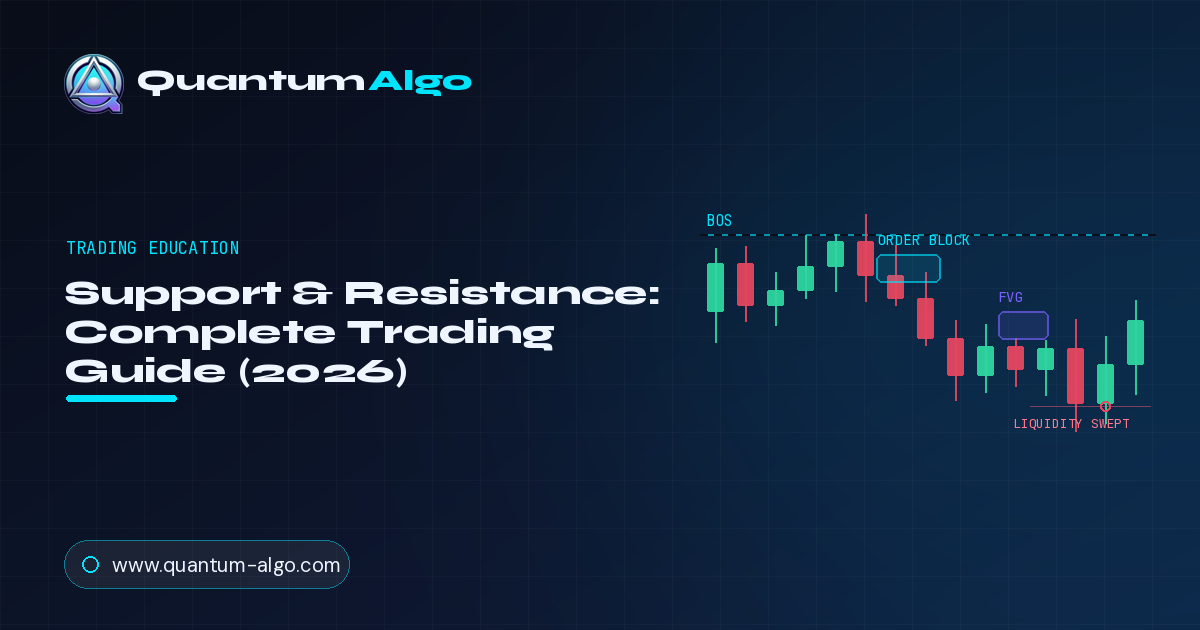
What is support and resistance?
Support and resistance are the two horizontal anchors that every chart is built around. A support level is a price where a decline repeatedly slows, stops, and reverses because buying interest overwhelms selling pressure. A resistance level is the mirror image: a price where a rally repeatedly stalls and turns lower because sellers overwhelm buyers.
Neither is a precise line so much as a zone — a band of prices where the balance of orders has historically shifted.
These levels exist in every market and on every timeframe, from a one-minute Bitcoin chart to a monthly stock index, because they are a reflection of human decision-making at scale. Prices change due to the dynamics of supply and demand; when demand outweighs supply, price rises, and when supply exceeds demand, price falls. Support and resistance simply mark the prices where that tug-of-war has reached a temporary truce.
The more often a level is tested and respected, the more traders remember it — and the more self-fulfilling it becomes.
The psychology behind the levels
Support and resistance work because of memory, regret and repositioning — not magic. When price bounces hard off a level, three groups of traders form a vested interest in that price. The buyers who got long there want to add on a retest. The traders who sold or shorted there and watched price run away want a second chance to exit at break-even.
And the sidelined traders who missed the first move are waiting to enter on the next touch. When price returns, all three groups act at once, and their combined orders defend the level again.
This is why round numbers and obvious swing highs and lows are so reliable: they are the prices everyone can see, so they attract the most orders. It also explains why a level that finally breaks tends to break hard — once the defenders are overwhelmed, the trapped traders flip from defending the level to fleeing it, and their stop-losses add fuel to the move.
Reading support and resistance is really reading crowd psychology printed onto a price axis.
How to draw support and resistance
Drawing clean levels is a skill, and most beginners over-complicate it. The goal is to mark the handful of prices that price has clearly respected, not to cover the chart in lines.
- Start on the higher timeframe. Mark levels on the daily or weekly first; these carry the most weight and give context to everything below.
- Find the obvious turning points. Look for prices where the market made a sharp reversal — a swing high that capped a rally, a swing low that ended a sell-off.
- Require at least two touches. A level needs two reactions to be valid; three or more touches make it a major level worth trading.
- Draw zones, not pixel-perfect lines. Use the wicks and bodies to define a band. Price rarely respects an exact tick.
- Keep only the levels that matter. If a line has not been touched in months and is far from current price, delete it. Clutter kills clarity.
Less is more. Five clean levels you trust will out-perform twenty lines you second-guess.
Types of support and resistance
Not all support and resistance is horizontal. Understanding the different forms keeps you from missing levels that are hiding in plain sight.
Horizontal
Classic flat levels drawn across prior swing highs and lows. The most reliable and the most watched.
Dynamic
Moving levels that travel with price — trendlines, moving averages (the 50 and 200 EMA especially), VWAP and channels.
Psychological
Round numbers like 100, 1,000 or 50,000 where orders cluster because they are easy reference points.
Fibonacci
Retracement levels (38.2%, 50%, 61.8%) that act as hidden support and resistance inside a move.
Horizontal levels are the foundation, but the best trades often appear where two or more types stack — for example a horizontal level that coincides with the 61.8% Fibonacci retracement and a rising 200 EMA. That confluence is what separates a guess from a high-probability zone.
Support and resistance flips (polarity)
One of the most powerful and reliable concepts in all of technical analysis is the polarity flip: when a support level breaks, it frequently becomes resistance, and when a resistance level breaks, it frequently becomes support. The level itself does not disappear — its role simply inverts.
The mechanism is pure psychology. Imagine a resistance level that price has rejected from twice. On the third attempt it breaks through. The traders who shorted that resistance are now offside and want out at break-even; new buyers who missed the breakout want a cheaper entry. When price pulls back to the broken level, those trapped sellers buy to cover and fresh buyers step in, and the old ceiling becomes a new floor.
This retest of broken structure is one of the cleanest entries in trading. Rather than chasing the breakout candle, you wait for price to return to the flipped level and show rejection — giving you a tight stop just on the wrong side of the level and a clear, asymmetric reward. It is also the classical-charting cousin of the Smart Money idea of trading a return to a mitigated order block.
Trading the bounce vs the break
There are only two ways to trade any level: you fade it (the bounce) or you follow the break (the breakout). Knowing which mode you are in is half the battle.
| Feature | The Bounce (fade) | The Breakout (follow) |
|---|---|---|
| Thesis | Level holds, price reverses | Level breaks, price extends |
| Best in | Ranges / balanced markets | Trends / expansion |
| Entry | Rejection candle at the level | Close beyond the level, or retest |
| Stop | Just beyond the level | Back inside the range |
| Risk | Level breaks instead of holding | False break / fakeout |
The bounce offers the tightest stops and the best reward-to-risk, but it fails when a trend simply runs the level over. The breakout captures big moves, but it suffers from fakeouts near obvious levels. The professional answer is context: fade levels when the higher timeframe is ranging, and follow breaks when it is trending. When in doubt, wait for the retest — it works for both styles and filters out most of the noise.
Confirming levels with volume
A support or resistance line drawn in thin air is a guess; a line backed by volume is evidence. Volume is the single best confirmation tool for the strength of a level, because it tells you how much real money changed hands at that price.
The more buying and selling that has occurred at a particular level, the stronger that level is likely to be — lots of participants have a memory of that price and a reason to defend it.
Use volume in three ways. First, levels that formed on a volume spike are more significant than levels that formed on quiet drifting. Second, a genuine breakout should be accompanied by an expansion in volume; a break on thin volume is the one most likely to fail and snap back into the range.
Third, watch for divergence: if price keeps probing a resistance level but each push comes on falling volume, the buyers are exhausting themselves and a reversal becomes likely.

Automate your trades. Let Quantum Algo trade for you.
Every signal executed on your own account — 24/7, hands-off.
Round numbers and psychological levels
Round numbers are support and resistance levels that exist before price ever reaches them, purely because of how the human brain anchors to clean figures. Traders place buy and sell orders, set targets and rest stop-losses at round figures — $100 on a stock, 50,000 on Bitcoin, 1.1000 on EUR/USD. Those clustered orders create a real, observable barrier.
In forex these levels are so consistent they have names: the “00” levels (whole numbers) are the strongest, with the “50” levels (half-numbers) a close second. In crypto, the big round thousands and ten-thousands act as magnets and battlegrounds. A stock that struggles to clear $100 is showing you that the market collectively views that price as expensive; when it finally breaks $100, the move is often sharp because a psychological ceiling has been removed.
The practical edge: when a round number lines up with a horizontal level or a Fibonacci ratio, treat that confluence as a premium zone. And never rest your own stop-loss exactly on a round number — that is precisely where liquidity pools, and where stop-hunts are aimed.
Multi-timeframe support and resistance
The same level means very different things depending on the timeframe it lives on, and ignoring that hierarchy is the fastest way to get run over. As a rule, the higher the timeframe, the stronger the level — a weekly resistance carries far more weight than a five-minute one, because it represents a broader market consensus built over more time and more volume.
The professional workflow is top-down. Mark your major levels on the daily and weekly to define the battlefield. Drop to the four-hour or one-hour to refine entries and spot intermediate levels. Then use a lower timeframe such as the 15-minute purely for execution — to time the entry once price reaches a higher-timeframe zone. This is the same multi-timeframe analysis logic that underpins Smart Money trading.
Support/resistance vs supply, demand and order blocks
Classical support and resistance and Smart Money Concepts are describing the same phenomenon in different languages. A supply or demand zone is essentially a support or resistance level defined by where an aggressive, imbalanced move originated — the footprint of institutional orders. An order block is the specific candle from which that move launched. A liquidity pool sits just beyond an obvious level, exactly where the stops of bounce traders rest.
Reading both lenses at once is a genuine edge. When a horizontal resistance you would draw by hand lines up with a higher-timeframe supply zone, and there is obvious buy-side liquidity resting just above it, you have a textbook setup: price sweeps the liquidity above the level (trapping breakout buyers), rejects from the supply zone, and reverses. The classical trader sees a failed breakout; the Smart Money trader sees a liquidity grab.
Both are right — and together they give you conviction and a precise entry.
A complete support/resistance trade, step by step
Walk through a textbook reversal at resistance. On the daily chart, price has rallied into a level that capped two previous rallies — a clear horizontal resistance that also coincides with a round number and the 61.8% retracement of the prior decline. That confluence flags the zone as high-probability before price even arrives.
You do not short blindly into the level. You drop to the one-hour and wait for evidence that sellers are defending it: price pushes just above the level, sweeps the obvious highs (running the breakout buyers’ stops), then prints a strong bearish rejection candle and a change of character to the downside. That sweep-and-reject is your trigger.
Entry is on the confirmed rejection or on a retest of the broken micro-structure. Your stop sits just above the swept high — the level that would prove the thesis wrong. Your first target is the nearest support below; your runner targets the next major level or unfilled imbalance.
Because the stop is tight (just above the sweep) and the target is distant (the next structural level), the trade offers an asymmetric reward-to-risk — the entire point of trading levels rather than guessing.
Managing the trade: entries, stops and targets
Getting the level right is only half the job; managing the trade decides the result. For entries, the retest is almost always superior to chasing the first touch — it lets the market prove the level and gives you a tighter, better-defined risk.
For stops, place them on the far side of the zone (and beyond any obvious liquidity), never inside it; a stop resting exactly on the level is a stop waiting to be hunted.
For targets, the next opposing level is your map. In a range, target the other side of the range. In a trend, target the next higher-timeframe level in the direction of the trend, scaling out partials along the way.
A common professional routine is to bank a portion at the first level, move the stop to break-even once price has travelled a meaningful distance, and trail the remainder behind structure toward the next major zone.
False breaks and how to filter them
The fakeout — price poking through a level only to reverse straight back — is the single most common way support and resistance traders lose money. It happens because obvious levels are where stop-losses cluster, and running those stops is precisely how larger players fill their orders. The poke through the level is often the cause of the reversal, not a failure of it.
Filter fakeouts with confirmation. Demand a decisive candle close beyond the level, not just a wick through it. Give extra weight to breaks accompanied by a clear expansion in volume, and be sceptical of breaks on thin, drifting volume. Watch for the retest: a genuine breakout returns to the broken level and holds, while a fakeout reclaims the range and keeps going the other way.
The Smart Money refinement is to expect the sweep. Rather than fearing the poke beyond the level, you anticipate it — the liquidity grab above resistance or below support is often the highest-probability entry, because it shows you exactly where the trap was set. Confirmation plus disciplined sizing turns the fakeout from your biggest enemy into a recognisable, tradeable pattern.
Common mistakes to avoid
- Drawing too many lines. A chart covered in levels is a chart with no levels. Keep only the prices that price has clearly respected.
- Treating levels as exact lines. Support and resistance are zones. Demanding a tick-perfect reaction gets you stopped out a hair before the bounce.
- Ignoring the higher timeframe. A daily downtrend will smash through a five-minute support without slowing down.
- Resting stops on the level. That is exactly where liquidity sits and where stop-hunts are aimed. Give your stop room beyond the obvious price.
- Chasing the breakout candle. Entering at the extreme of a breakout, with no retest and no volume confirmation, is how you become the liquidity for the fakeout.
- Forgetting polarity. Old resistance becomes new support and vice versa — trade the flip, do not fight it.
📝 Test Your Knowledge
Support & Resistance with Quantum Algo
Quantum Algo’s Smart Money Concepts indicators auto-map structure, liquidity and reaction zones on your TradingView chart — turning the support and resistance levels you would draw by hand into a precise, real-time map of where price is most likely to react.
Related guides
Related reading: see also our Trendlines with Breaks indicator for a deeper dive into a complementary tool.
❓ Frequently Asked Questions
Support is a price level below the market where buyers tend to step in and halt a decline. Resistance is a level above the market where sellers tend to step in and halt a rally. They are the floors and ceilings price reacts to.
Start on a higher timeframe, mark the obvious swing highs and lows where price reversed sharply, require at least two touches, and draw zones rather than exact lines. Keep only the levels closest and most relevant to current price.
Because of trader psychology. When a support breaks, the traders who bought there are trapped and sell on any bounce back, while new sellers join in, turning the old floor into a new ceiling. This role reversal is called a polarity flip.
Zones. Price is driven by clusters of orders across a band of prices, not a single tick. Treating levels as zones keeps you from being stopped out moments before the actual reaction.
The number of times it has been touched and respected, the volume traded at that price, whether it lines up with round numbers or Fibonacci levels, and the timeframe it sits on. Higher timeframes and more touches mean stronger levels.
Wait for a decisive candle close beyond the level, ideally on expanding volume, then enter on the breakout or on a retest of the broken level. Place your stop back inside the prior range and target the next level.
A false breakout, or fakeout, is when price briefly pokes beyond a level then reverses back into the range. It usually happens because stop-losses cluster just beyond obvious levels, and running those stops fills larger orders.
There is no single best timeframe; it depends on your style. The key principle is that higher-timeframe levels are stronger, so mark levels on the daily and weekly first and use lower timeframes only to time entries.
They describe the same thing differently. Supply and demand zones are support and resistance levels defined by where aggressive, imbalanced moves originated, reflecting institutional order flow rather than just prior swing points.
Yes — many profitable traders use little else. But combining levels with volume, trend context, candlestick confirmation and Smart Money Concepts dramatically improves accuracy and gives you tighter risk.
References & Related Guides
More in this topic
- Institutional Key Levels — Free Support and Resistance Indicator for TradingView (Pivot-Clustered Levels, Power Scoring, Rejection Signals)
- Market Profile Trading: Complete Guide 2026
- Best TradingView Indicators 2026 — Complete Guide
- Divergence Trading: Complete Guide (2026)
- Elliott Wave Theory 2026 — Complete Trading Guide
- Fisher Transform Indicator: Complete Guide (2026)
- Harmonic Patterns: Complete Trading Guide (2026)
- Heikin Ashi 2026 — Complete Smoothed Candlestick Guide
- Inside Bar Trading: Complete Guide (2026)
- Leverage Trading: The Complete Guide (2026)
- Machine Learning Trading Indicators (Lorentzian): 2026 Guide
- Pin Bar Trading: Complete Guide (2026)
- Pivot Points 2026 — Complete Intraday Support & Resistance Guide
- Position Trading: Complete Guide (2026)