Options Trading for Beginners: How Options Work, Calls vs Puts, and How to Start Without Getting Hurt
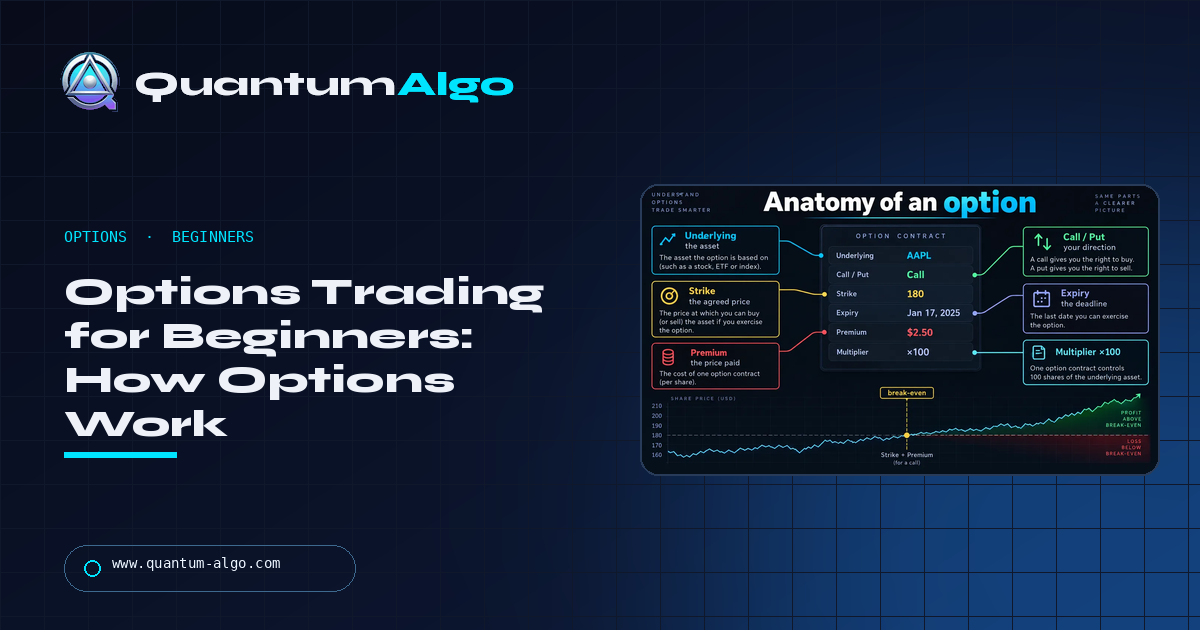
An option is a contract that gives the buyer the right — not the obligation — to buy (a call) or sell (a put) 100 shares at a fixed price (the strike) by a fixed date (the expiry), for a price paid up front (the premium). The buyer's loss is capped at the premium; the seller's is not. Because the value depends on time and volatility as well as direction, options behave very differently from the stock — which is why beginners should buy only, near the money, a month or more out, sized by premium.
Written for the person who searched "options trading for dummies" and means it: no Greek letters until they are needed, no strategies with names, and an honest section on why most beginners who buy options lose money on trades that went the right way. The payoff calculator below draws any call or put at expiry — break-even, max loss, the P&L line — before you risk a cent.
Indicators that prove themselves in public.
One engine, four precision tools — the Gold (XAU) Scalper, the institutional Gravity Zone, the Zeno momentum Oscillator, and Zeno Stocks for equities.
How do options work?
An option is a contract that gives the buyer the right — not the obligation — to buy (a call) or sell (a put) 100 shares of a stock or index at a fixed price (the strike) on or before a fixed date (the expiry), in exchange for a price paid up front (the premium). The seller takes the premium and the obligation. Because the buyer's loss is capped at the premium and the seller's is not, and because the contract's value depends on time and volatility as well as direction, options behave very differently from the stock underneath them. That is the whole of what beginners need to understand before anything else, and this page builds everything on it.
I have written this for the person who searched "options trading for dummies" and means it: no Greek letters until they are needed, no strategies with names, and an honest section on why most beginners who buy options lose money before they learn what they bought. The payoff calculator on this page lets you see any call or put at expiry before you risk a cent.
What is an option, in plain words
Think of a deposit on a house. You pay the seller a small sum for the right to buy the house at an agreed price within three months. If the house is worth more by then, you buy it at the agreed price and pocket the difference; if it is worth less, you walk away and lose only the deposit. The deposit is the premium, the agreed price is the strike, the three months is the expiry, and your right to walk away is what makes it an option rather than a purchase.
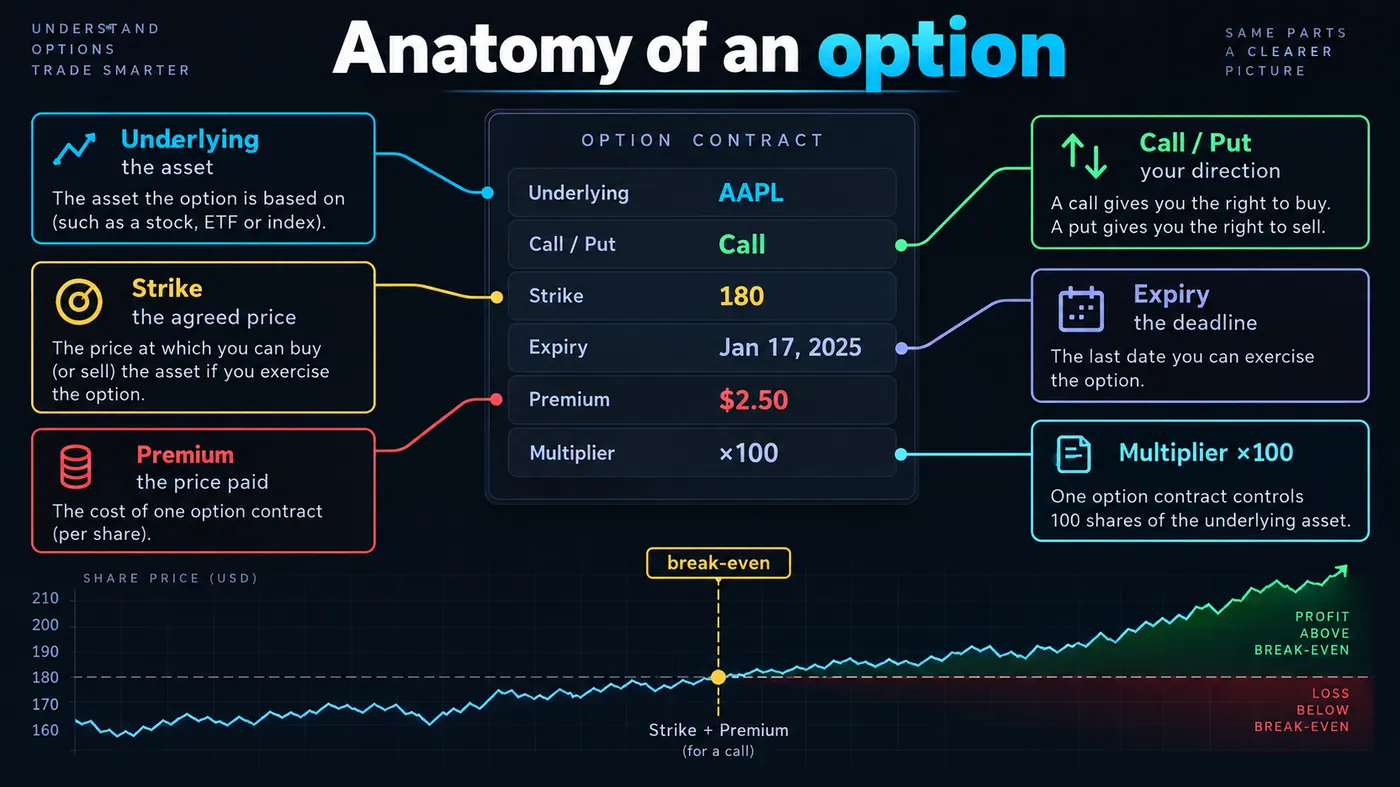
The contract-anatomy illustration in this guide labels the six fields on a real option: the underlying (the stock or index), call or put, the strike, the expiry date, the premium, and the multiplier — every standard equity option controls 100 shares, so a premium quoted at $2.50 costs $250. The break-even arrow shows the price the stock has to reach at expiry for the buyer to get the premium back: strike plus premium for a call, strike minus premium for a put.
Calls versus puts
- A call is the right to buy at the strike. You buy a call when you expect the price to rise well above the strike before expiry. It gains value as the stock rises and as volatility rises; it loses value every day that passes.
- A put is the right to sell at the strike. You buy a put when you expect the price to fall well below the strike, or to protect shares you own. It gains as the stock falls and as volatility rises; it also loses value with time.
"Well above" and "well below" are the words beginners skip. A call bought at a $180 strike for $2.50 needs the stock above $182.50 at expiry just to break even; a stock that rises from $178 to $181 has gone the right way and the call has still lost money.
The four positions, and who takes the unlimited risk
The payoff-grid illustration in this guide draws the four basic positions at expiry:
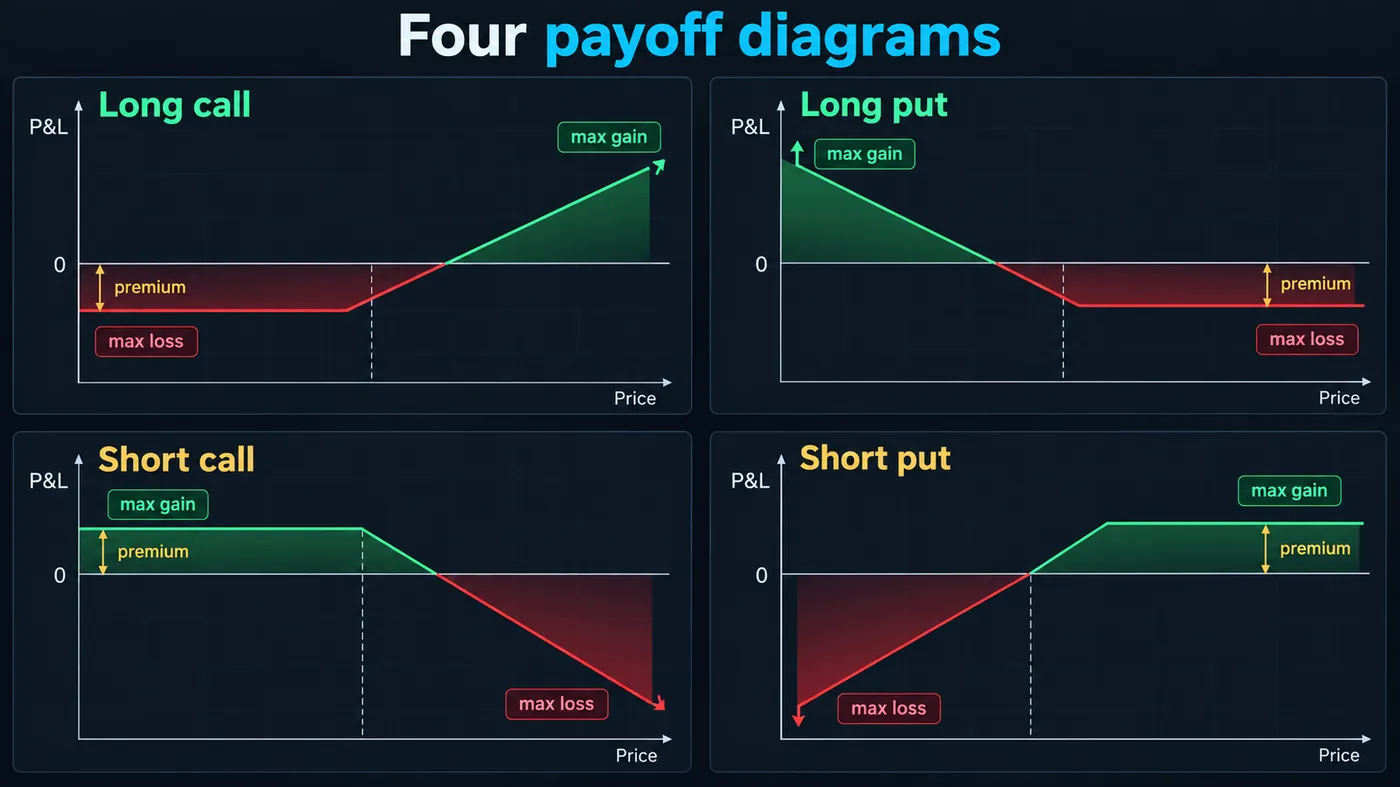
- Long call — pay the premium; lose at most the premium; gain without limit as the stock rises past the strike.
- Long put — pay the premium; lose at most the premium; gain as the stock falls, up to the strike minus the premium.
- Short call — receive the premium; keep it if the stock stays below the strike; lose without limit as the stock rises.
- Short put — receive the premium; keep it if the stock stays above the strike; lose down to zero if the stock collapses.
The rows tell the story: buyers have capped losses and open gains; sellers have capped gains and open (or very large) losses. Beginners should only buy for the first year. Selling options is a legitimate professional business — it is where the premium income comes from — and it is also how accounts get destroyed on one bad day.

Automate your trades. Let Quantum Algo trade for you.
Every signal executed on your own account — on your account, with the plan you define.
What an option is worth: intrinsic value plus time value
The Greeks illustration in this guide shows an option's premium as two stacked parts. Intrinsic value is what the option is worth if exercised right now: for a $180 call with the stock at $185, that is $5. Time value is everything above intrinsic — the price of the possibility that the stock moves further before expiry. An option with no intrinsic value (out of the money) is all time value, and time value goes to zero at expiry.
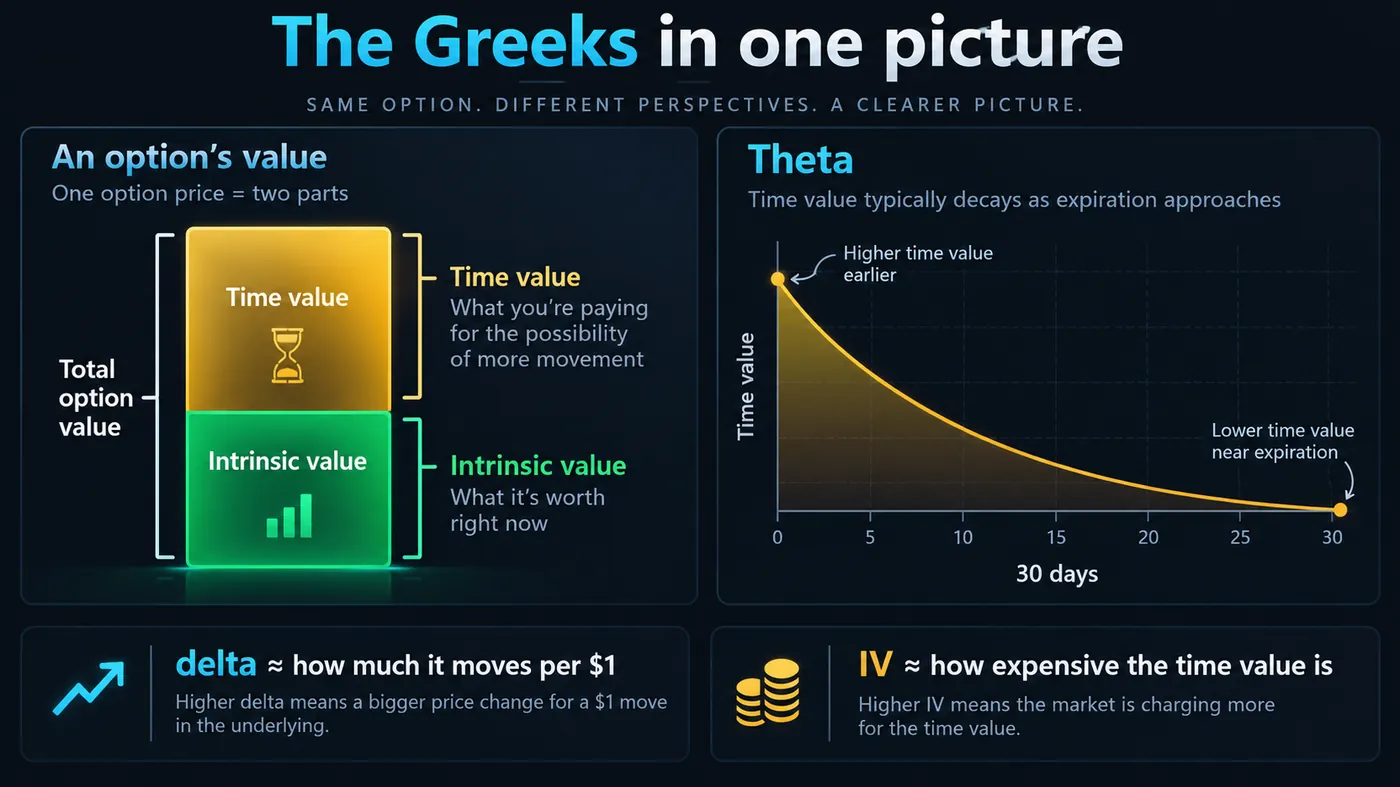
The curve beside the stack is theta: time value decays slowly at first and quickly in the last weeks, so an out-of-the-money option bought a month out loses a small amount a day at the start and most of its remaining value in the final ten days. That curve is the reason beginners lose money on options that "went the right way" — the stock moved, but not fast enough to outrun the decay.
Two more words, without formulas: delta is roughly how much the option moves for each $1 the stock moves (a delta of 0.50 means about 50 cents per dollar, and also roughly a 50% chance of finishing in the money); implied volatility (IV) is how expensive the time value is — high before earnings and news, collapsing after, which is why a call can lose money after a good earnings report.
Options versus stocks
| Stock | Option | |
|---|---|---|
| What you own | Shares, indefinitely | A contract that expires |
| Cost | Full price (or margin) | Premium, a fraction of the price |
| Maximum loss (long) | The whole position | The premium |
| Effect of time | None | Works against buyers every day |
| Effect of volatility | Indirect | Direct — the premium is priced on it |
| Leverage | 2:1 on margin | Built in: 100 shares per contract |
| Day-trading rules | PDT rule applies | PDT rule applies — options are securities |
The leverage is the attraction and the trap. A $250 call controls $18,000 of stock; a 3% move in the stock can be a 50% move in the option — in either direction — and a flat week can be a 30% loss with the stock unchanged.
How to start trading options
- Learn the stock first. Direction is the only one of the three price drivers you can have an edge on; if you cannot read the chart, an option only adds two more ways to be wrong. Our how-to-start-trading roadmap applies before any options ticket.
- Get approved. Brokers assign options levels; level 1–2 (buying calls and puts, covered calls) is where a beginner should stay.
- Paper trade with a real chain. An options simulator on an options-first broker shows bid/ask per strike, expiry and assignment mechanics; a generic stock simulator does not. Our paper-trading platforms guide lists the ones with real chains.
- Buy only, at least 30 days out, near the money. Delta 0.50 or higher, expiry a month or more away, on liquid names with tight option spreads (SPY, QQQ, the largest stocks). This is the least leveraged, most forgiving way to learn.
- Size by premium. The premium is the maximum loss; risk 1% of the account per trade means the premium of everything you buy that day is at most 1%. Never "average down" on a losing option.
- Exit before the last week. Sell the option before theta's steep part; do not hold to expiry hoping.
- Journal in R. Same standard as every other market: fifty logged trades before you trust the number.
Mistakes that define the first year
- Buying cheap, far out-of-the-money options because "the premium is small". Cheap is cheap because it almost never pays.
- Buying before earnings and losing on the IV collapse after the announcement.
- Holding through the last week, when the decay is fastest.
- Selling options for "income" without understanding that the income is payment for taking the open-ended side.
- Trading illiquid strikes with $0.30 spreads on a $1.00 option.
- Forgetting the pattern day trader rule: four same-day round trips in five days under $25,000 in a margin account, and the account is restricted.
Options trading simulator
A simulator only teaches options if it has a real chain — bid and ask per strike, real expiries, and the mechanics of exercise and assignment. Broker paper accounts on options-first platforms have it; TradingView's paper trading and most generic simulators do not. Practise the buy-only plan above for fifty trades, subtract the spread by hand on every entry, and go live with one contract on a liquid name. Our paper-trading platforms guide ranks the simulators on exactly this.
Where options fit a Smart Money workflow
The chart does the work; the option is just the instrument. Zeno marks the structure on SPY, QQQ and the large stocks — the sweep, the order block, the entry, the stop, the targets — and the option is chosen to express that read: a delta-0.50-plus call or put, expiry beyond the expected hold, position sized by premium. The stop on the chart becomes a stop on the premium (sell if the option loses 40–50% of its value, which usually coincides with the chart level failing). What options add is capped risk for a directional idea; what they cost is time and volatility, which the structure read cannot help with.
An option is a right for a premium; the buyer's loss is the premium and the seller's is open, so beginners buy only. The premium is intrinsic plus time value, and time value decays — which is why options that "went the right way" lose. Start near the money, a month out, on liquid names, sized by premium, and let the chart decide direction; the option only adds time and volatility to it.
◆ Interactive check
Do you know what you are buying?
Questions beginners ask about options
A call is the right to buy the stock at the strike; a put is the right to sell it. Buy a call to profit from a rise, a put to profit from a fall or to protect shares you own.
A single contract on a liquid name costs from a few dollars (far out of the money — avoid) to several hundred (near the money — the right place to start). A $2,000–5,000 account can trade one near-the-money contract at 1–2% risk; a smaller account cannot size correctly.
Not as a buyer — the premium is the maximum loss. As a seller, yes: a short call has unlimited loss and a short put loses down to zero on the stock. Beginners should only buy.
Out-of-the-money options do, at expiry. Most options are closed before expiry rather than exercised, which is why exiting before the last week is the rule.
Buying calls and puts near the money, a month or more out, at premium-based sizing, on liquid names — yes, as a way to express a chart read with capped risk. Selling options, buying weeklies, or trading before earnings — no.
Yes. Options are securities, so four same-day round trips in five business days in a margin account under $25,000 triggers the restriction. Our PDT guide covers it.
Zeno and the free indicators read structure on the underlying — SPY, QQQ, individual stocks — and the option is the instrument you choose to trade that read. See the best-indicator-for-options page for the specifics.
The price of the contract, quoted per share and multiplied by 100 — a $2.50 premium costs $250. It is intrinsic value (what exercising is worth now) plus time value (the price of the remaining possibility), and the time value decays to zero at expiry.
A call is in the money when the stock is above the strike; a put when the stock is below it. In-the-money options have intrinsic value and move more like the stock; out-of-the-money options are all time value.
Whichever the chart read calls for — calls to express a rise, puts a fall or to protect shares. The instrument follows the analysis; the mistake is choosing the option first.
References & Related Guides
Read next
- Day Trading Options
- Best Indicator for Options Trading
- Futures Trading for Beginners
- Pattern Day Trader Rule
- Best Paper Trading Platforms
- How to Start Trading: 90-Day Roadmap
- What Is Margin Trading?
- Unusual Whales Review
Authoritative sources
- OCC Options Industry Council: options education
- Cboe: options education
- FINRA: options — what investors should know
- SEC: characteristics and risks of standardized options
- SEC Investor.gov: options