Quasimodo Pattern (QM): The Over-and-Under Reversal, Explained
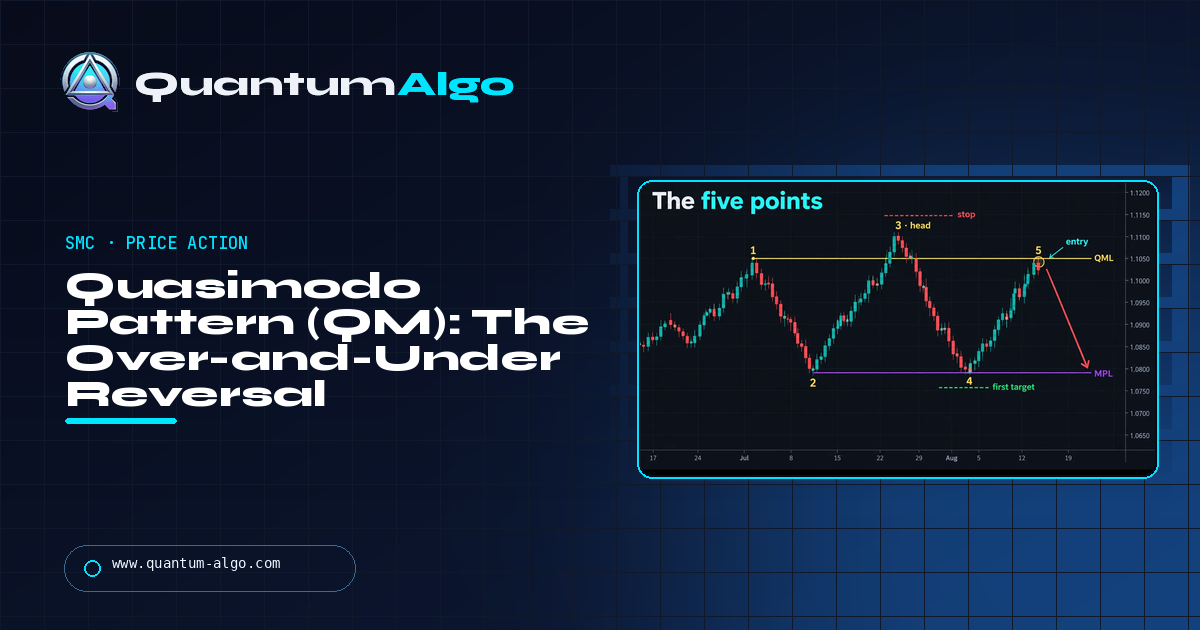
The Quasimodo pattern (QM) is a five-point reversal: a high, a low, a higher high that sweeps the first high, a lower low that breaks the first low, and then a return to the level of the first high — the Quasimodo Level (QML) — where you sell. The stop goes above the higher high (the head); the first target is the first low (the Maximum Pain Line), then the lower low. It is a head and shoulders whose neckline breaks before the right shoulder forms, which is why the entry is earlier and higher. Bullish is the mirror.
The Quasimodo was the first pattern that made structure click for me, years before I had the SMC words for it. Sweep, break, return — three events, one level, a stop that is never in doubt. This page is the five points and the two lines they define, the entry step by step, a EURUSD 1-hour example worked to the pip, the comparison with head and shoulders, double tops and the SFP, and the five ways the pattern fails. The calculator turns four swing points into a plan.
Indicators that prove themselves in public.
One engine, four precision tools — the Gold (XAU) Scalper, the institutional Gravity Zone, the Zeno momentum Oscillator, and Zeno Stocks for equities.
What is the Quasimodo pattern?
The Quasimodo pattern — QM, or QML for the Quasimodo Level — is a five-point reversal structure. In the bearish version price makes a high, a low, a higher high, a lower low, and then returns to the level of the first high. That return is the entry. The higher high is the head that sweeps the buy-side liquidity above the first high; the lower low is the break that tells you the trend has changed; the return to the first high is the market coming back to the last place it found sellers before the head. The stop sits above the head. The bullish version is the mirror image.
The name is a joke about a lopsided head-and-shoulders — one shoulder high, the other missing — and it stuck because the shape is genuinely that. What distinguishes it from a head and shoulders is the sequence: in a QM the neckline breaks before the right shoulder forms, so the entry is the return to the left shoulder, not the break of the neckline. That makes the QM entry earlier and higher, with a tighter stop, and it is the reason price-action traders adopted it around 2010 and Smart Money traders kept it: the five points are a liquidity sweep, a change of character and a retest of the origin, in the older vocabulary.
What the QM does not do: it does not tell you the size of the move after the return, it does not guarantee the return happens at all (many breaks simply keep going), and it is not a pattern you can identify before point 4 prints. Anything that looks like a QM on three points is a range.
The five points
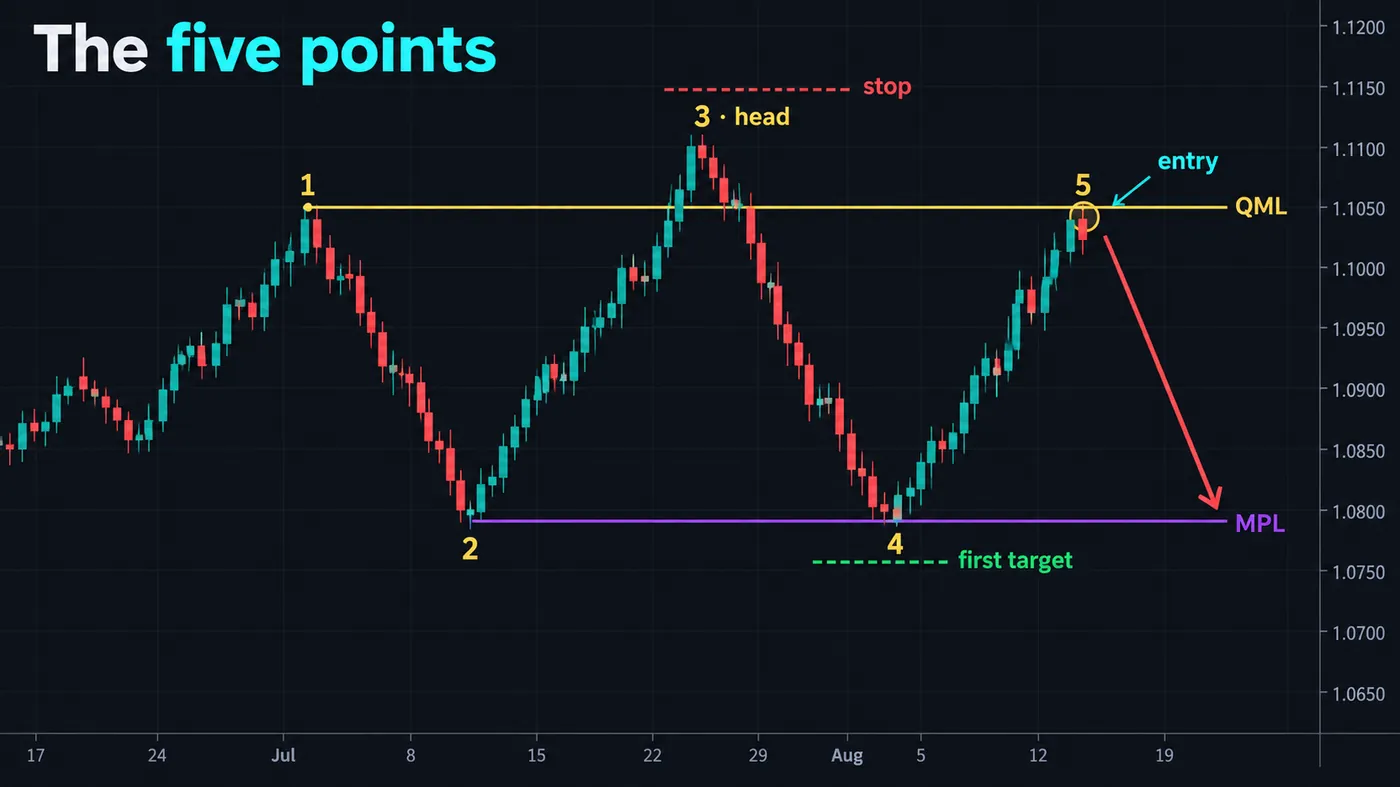
| Point | Bearish QM | Bullish QM | What it means in SMC terms |
|---|---|---|---|
| 1 | A swing high | A swing low | The origin — the last place the trend found resistance (support). Its level is the QML. |
| 2 | The low after point 1 | The high after point 1 | The last higher low (lower high) of the old trend. Its level is the Maximum Pain Line, the first partial. |
| 3 | A higher high above point 1 | A lower low below point 1 | The head: a sweep of the liquidity resting beyond point 1. In SMC, the stop hunt. |
| 4 | A lower low below point 2 | A higher high above point 2 | The break: structure has shifted. In SMC, the change of character or market structure shift. |
| 5 | A return to the level of point 1 | A return to the level of point 1 | The entry: price retests the origin from the other side. In SMC, the retest of the breaker or the order block at the origin. |
The QML. The Quasimodo Level is the price of point 1, drawn as a horizontal line. It is the entry, and it is also the line that separates a QM from a double top. In a double top price returns to the head; in a QM it returns to the shoulder below the head, because the head has already been proven to be a sweep. Traders who enter at the head are buying the level that has been used; the QML is the level that has not.
The MPL. The Maximum Pain Line is the price of point 2, the last higher low before the head. It is called that because it is where the most trapped longs — the ones who bought the higher-high breakout — are sitting underwater, and where their stops begin. It is the first target and, in a slow reversal, the level price often stalls at before continuing to point 4.
The stop. Above point 3, the head, with a small buffer. If price trades through the head, the sweep was not a sweep and the structure is a continuation. There is no QM stop tighter than the head; if the head is so far above the QML that the maths does not work, the pattern is too large for the entry and you wait for a lower-timeframe version at the QML.
How to trade a Quasimodo
- Wait for point 4. The pattern does not exist until the low after the head breaks the low before it (bearish). Three points is a range; four points is a shift; five is the trade. Most losing QM trades were entered at point 3 by traders who could see what was coming.
- Draw the QML at point 1. A horizontal line at the first high. Extend it right. If a breaker block or a bearish order block sits at the same price — the last up-candle before the move to point 3 usually does — the level is stronger, and the entry can be the block rather than the line.
- Wait for the return. Price comes back up from point 4 toward the QML. On the way it will retest point 2 from below; that is normal and not the entry. The entry is the touch of the QML, and only that.
- Enter with confirmation on the lower timeframe. A sell limit at the QML is the aggressive version. The confirmed version is a 5-minute (on a 1-hour pattern) close back below the QML after the touch, or a lower-timeframe structure shift at the level. Confirmation costs a few pips and removes the trades where the return is actually a continuation.
- Stop above the head. Point 3 plus a buffer for spread and wicks. Do not tighten it to the QML; the whole edge is that the head has already been swept and a wick above the QML is noise.
- Targets: MPL, then point 4, then the extension. Partial at point 2, the second partial at point 4, and if the reversal has displacement, the 0.618 extension of the head-to-point-4 leg. Trail under lower-timeframe highs once point 4 is taken.

Automate your trades. Let Quantum Algo trade for you.
Every signal executed on your own account — on your account, with the plan you define.
Quasimodo level calculator
Enter the four swing points. The tool checks the sequence is valid, returns the QML entry, the stop above the head, the MPL and point-4 targets with their R multiples, and flags a head too far from the level to be worth trading.
Reference data
| Item | Value |
|---|---|
| Points | 5: high, low, higher high, lower low, return to point 1 (bearish); mirror for bullish |
| Valid when | Point 3 beyond point 1 AND point 4 beyond point 2 — both, in that order |
| QML | The price of point 1; the entry |
| MPL | The price of point 2; the first target |
| Stop | Beyond point 3 (the head) |
| Targets | MPL → point 4 → 0.618 extension of the head-to-point-4 leg |
| Confirmation | Lower-timeframe close back through the QML after the touch, or a structure shift at the level |
| SMC equivalent | Sweep (3) + CHoCH/MSS (4) + retest of the breaker or origin order block (5) |
| Close cousins | Head and shoulders (neckline break entry), double top (return to the head), SFP (the head on its own) |
| Timeframes | Any; 1H patterns with 5M entries and 4H patterns with 15M entries are the usual pairs |
Worked example: EURUSD, 1-hour Quasimodo
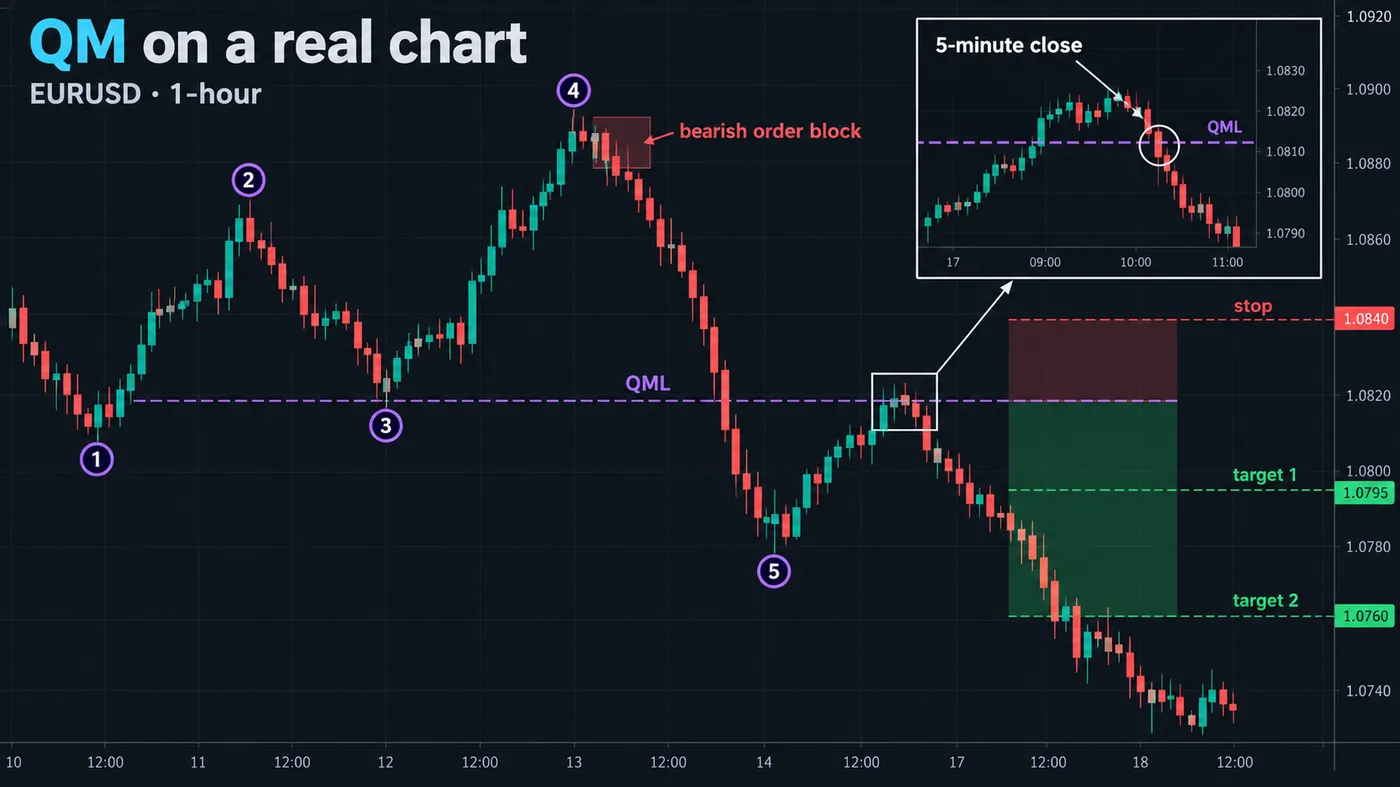
EURUSD, a Wednesday London session. Point 1 was the 06:00 high at 1.0862. Price pulled back to 1.0818 by 08:00 — point 2. The 09:00 candle, the first hour of the London–New York overlap approach, ran to 1.0881 on a weak German data print and closed at 1.0866 with a 15-pip upper wick: point 3, the head, nineteen pips through the first high. By 11:00 price was at 1.0796, twenty-two pips below point 2: point 4, the break. Four points, one clear shift.
The QML is 1.0862. The last up-candle before the run to the head was the 08:00 candle with a body from 1.0824 to 1.0847 — a bearish order block whose top sat fifteen pips under the QML, so the entry zone was 1.0847 to 1.0862. Price returned at 14:30 New York, touched 1.0859, and the 14:35 5-minute candle closed at 1.0850 below the block's top. Short at 1.0850, stop at 1.0886 above the head, thirty-six pips of risk.
The MPL at 1.0818 paid 32 pips, 0.9R, for the first partial at 16:10. Point 4 at 1.0796 paid 54 pips, 1.5R, filled the next morning at 03:40 London. The 0.618 extension of the head-to-point-4 leg was 1.0743; price reached 1.0751 on the Thursday afternoon before bouncing, and the remainder was closed there for 99 pips, 2.75R. Blended across the three exits, about 1.7R for a trade that was defined by four swings and confirmed by one 5-minute close.
The instructive part is what would have happened to the trader who sold the head. Short at 1.0881 with a stop above it would have been stopped by the 15-pip wick before the close; short at the 1.0866 close with a wider stop would have sat through the return to 1.0859 and been fine, but with double the risk for the same targets. The QM entry is later and smaller, and that is the point.
Quasimodo versus head and shoulders, double top and the SFP
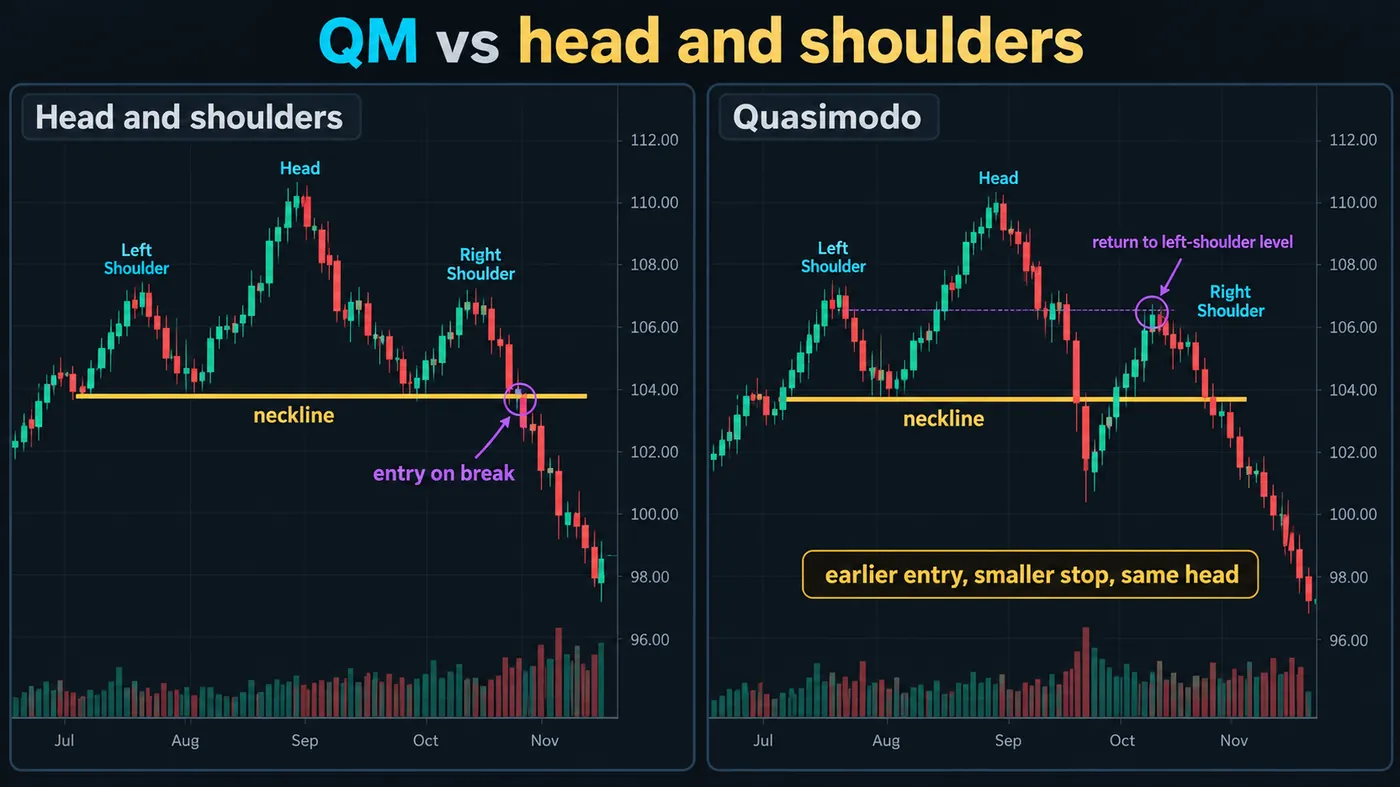
| Pattern | Entry | Stop | What has to happen first | Where it differs |
|---|---|---|---|---|
| Quasimodo | Return to point 1 (the left shoulder) after point 4 has broken point 2 | Above the head | The neckline breaks before the right shoulder forms | — |
| Head and shoulders | Break of the neckline after the right shoulder | Above the right shoulder or head | A symmetrical right shoulder | Later entry, larger stop-to-target distance already used up |
| Double top | Second test of the high, or the neckline break | Above the two highs | Two highs at the same level | Entry is at the head level, which a QM has already declared swept |
| Swing failure pattern | The close back below the swept high | Above the wick | A wick beyond a swing point | The SFP is point 3 alone; the QM waits for point 4 and enters at point 1 |
| Breaker block | Retest of the failed order block after the shift | Beyond the block | An order block that failed | The breaker is the candle at point 1; the QML is its price |
In practice the QM, the breaker retest and the CHoCH-plus-retest are the same trade seen through three vocabularies. The QM version has the advantage of a precise entry line and a precise stop; the SMC version has the advantage of a candle to enter on rather than a line. Use whichever makes you wait for point 4.
Where the Quasimodo fails
No return. The most common outcome after point 4 is that price does not come back. It continues, the QML is never touched, and the trader who sat at the level has missed the move. That is not a failed QM; it is a QM that never completed. The fix is to have a second plan — the continuation entry on the retest of point 2 from below — for the days the return does not happen.
The return is a continuation. Price comes back to the QML and goes straight through it, because the break at point 4 was itself a sweep of the low before the real move up. This is the trap the confirmation step exists for. A limit order at the QML is filled and stopped; a 5-minute close back below the level after the touch is never triggered.
The head is too far. When point 3 is a long way above the QML — a news spike, a stop run into a round number — the stop distance swallows the reward. The calculator flags anything under 1.5R to point 4. In that case the pattern is right but the entry has to be found on a lower timeframe near the head, or not at all.
Ranges. In a range every swing is a sweep of the last one, and the five points print constantly. A QM inside a 4-hour range is a range trade with a fancy name; the targets are the other side of the box and the stop is the box edge, whatever the pattern says.
Higher-timeframe trend. A bearish 1-hour QM inside a daily uptrend gets the MPL and sometimes point 4, and then the daily trend resumes. Take the partials, do not hold for the extension, and do not add.
Mistakes traders make with the Quasimodo
- Selling the head. Point 3 is where the pattern is being built, not where it is traded. Wait for point 4.
- Drawing the QML at the head. The line is point 1, the shoulder, not point 3. Entering at the head is a double top trade with a QM stop, which is the worst of both.
- Skipping confirmation because the level "looks strong". The return that continues through the QML looks exactly like the one that rejects until it closes.
- Tightening the stop below the head. A wick above the QML and below the head is the market testing the level; the stop belongs above the sweep.
- Counting a three-point structure as a QM in progress and positioning early. There is no such thing as a QM in progress.
- Ignoring the MPL. The first partial at point 2 is what makes the pattern pay when the return stalls, which it does more often than it runs to point 4.
The Quasimodo and the free indicators
The Smart Money Concepts Engine marks the sweep at point 3 and the change of character at point 4 on any timeframe, so the QM announces itself as a labelled CHoCH after a sweep; the Order Blocks with Volume script draws the origin candle at point 1, which is the entry zone with the QML as its top edge. Run both, draw the QML by hand, and wait for the return. Zeno, the premium engine, prints its signals with a stop and targets; a sell signal that prints on the return to a QML is one of the higher-quality contexts for it.
Five points, one line. The head sweeps the first high, the lower low breaks the first low, and the entry is the return to the first high with the stop above the head. Wait for point 4 — three points is a range — confirm the return with a lower-timeframe close, partial at the MPL, and skip patterns where the head sits so far above the level that point 4 pays under 1.5R.
◆ Interactive check
Do you know the five points?
Questions traders ask about the Quasimodo pattern
A five-point reversal: high, low, higher high, lower low, then a return to the level of the first high, where you sell with the stop above the higher high. The bullish version is the mirror. The higher high is a liquidity sweep, the lower low is a structure shift, and the return is a retest of the origin.
The Quasimodo Level — the price of point 1, the first high (bearish) or first low (bullish). It is the entry line. It is deliberately not the head, because the head has already been proven to be a sweep.
The price of point 2, the last higher low before the head. It is where the traders who bought the higher-high breakout are most underwater and where their stops start, which is why it is the first target and often a stall.
No. In a head and shoulders the right shoulder forms and then the neckline breaks; in a Quasimodo the neckline breaks first and price returns to the left-shoulder level. The QM entry is earlier and higher with a smaller stop, at the cost of a pattern that sometimes never completes.
At the return to the QML after point 4 has printed. The aggressive version is a limit order at the line; the safer version waits for a lower-timeframe close back through the level after the touch, which removes most of the returns that turn out to be continuations.
Above the head (point 3) with a small buffer, for a bearish QM. Not at the QML — a wick above the level and below the head is the market testing it, and the stop belongs above the sweep.
Point 2 (the MPL) for the first partial, point 4 for the second, and the 0.618 extension of the head-to-point-4 leg if the reversal shows displacement. Trail under lower-timeframe highs once point 4 is taken.
Yes, and it is common on the 1-hour and 4-hour charts of Bitcoin and Ethereum because their trends end with a stop run above the last high followed by a fast break. The head tends to be larger relative to the pattern in crypto, so check the R multiple to point 4 before entering; the calculator does that.
Point 3 is the liquidity sweep, point 4 is the change of character or market structure shift, and point 5 is the retest of the breaker block or the origin order block at point 1. Same trade, older vocabulary; the QM adds a precise entry line and stop.
Not by name. The free Smart Money Concepts Engine labels the sweep and the change of character that form points 3 and 4, and Order Blocks with Volume draws the origin candle at point 1. The QML is a line you draw at point 1 yourself; Zeno, the premium engine, prints signals with stops and targets and does not draw patterns.
References & Related Guides
Read next
- Head and Shoulders Pattern
- Breaker Block Trading
- What Is a Market Structure Shift?
- BOS & CHoCH: Market Structure Guide
- Swing Failure Pattern (SFP)
- Liquidity Sweep Trading
- Order Blocks: Complete Guide
- Double Top Pattern
- Change of Character — glossary
- Smart Money Concepts Engine (free indicator)
- Order Blocks with Volume (free indicator)
- Zeno — the premium engine