Forex Market Hours: When the Forex Market Opens, Closes and Actually Moves
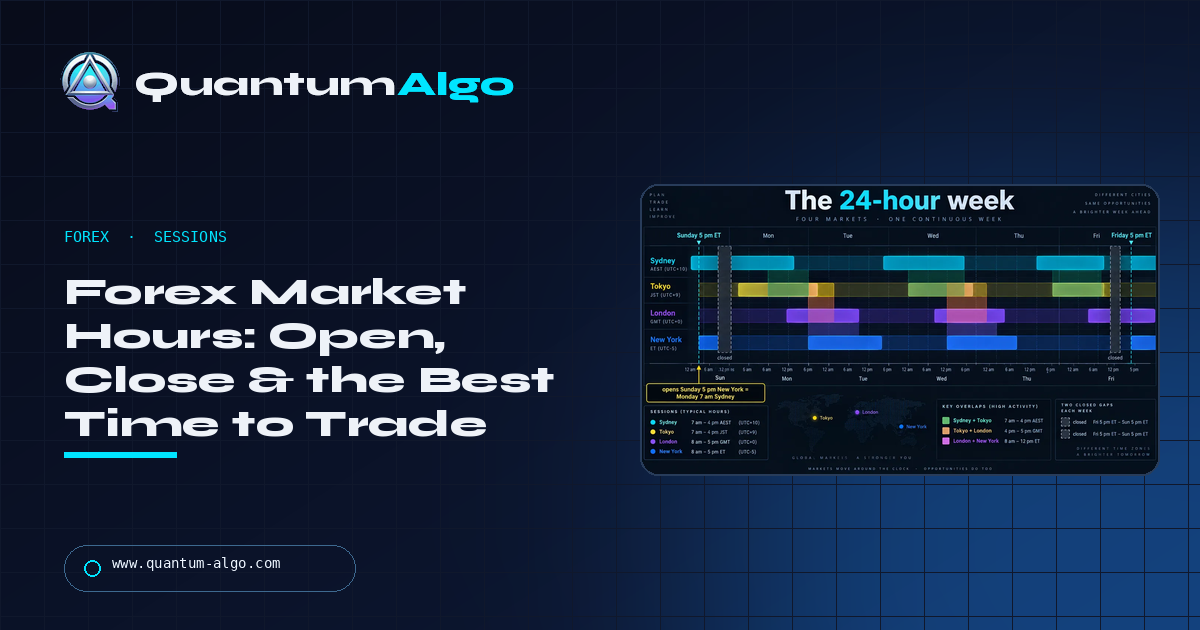
The forex market opens at 5:00 pm New York time on Sunday (7:00 am Monday in Sydney) and runs continuously until 5:00 pm New York time on Friday; it is closed at weekends. Four sessions overlap through the day — Sydney, Tokyo, London, New York — and the best time to trade is the London–New York overlap, 13:00–17:00 UTC, when spreads are tightest and volume peaks. Open and liquid are different things; the sessions are most of the edge.
The forex market being open and the forex market moving are different things, and this page is about the second: which session trades which pairs, when liquidity is deep enough for the spread to be tight, why the same session has three clock times depending on the month, and when you should not be trading at all. The live clock below shows what is open right now in your own timezone, with the next open counted down.
Indicators that prove themselves in public.
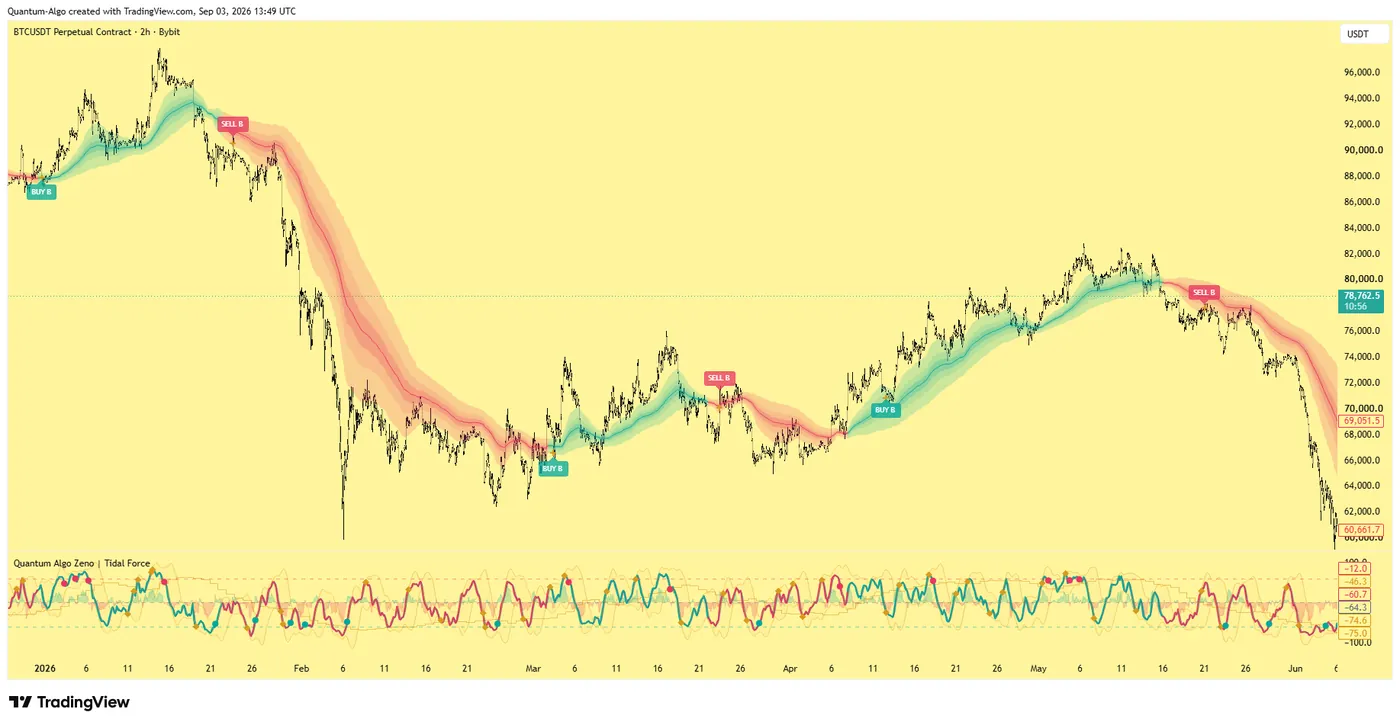
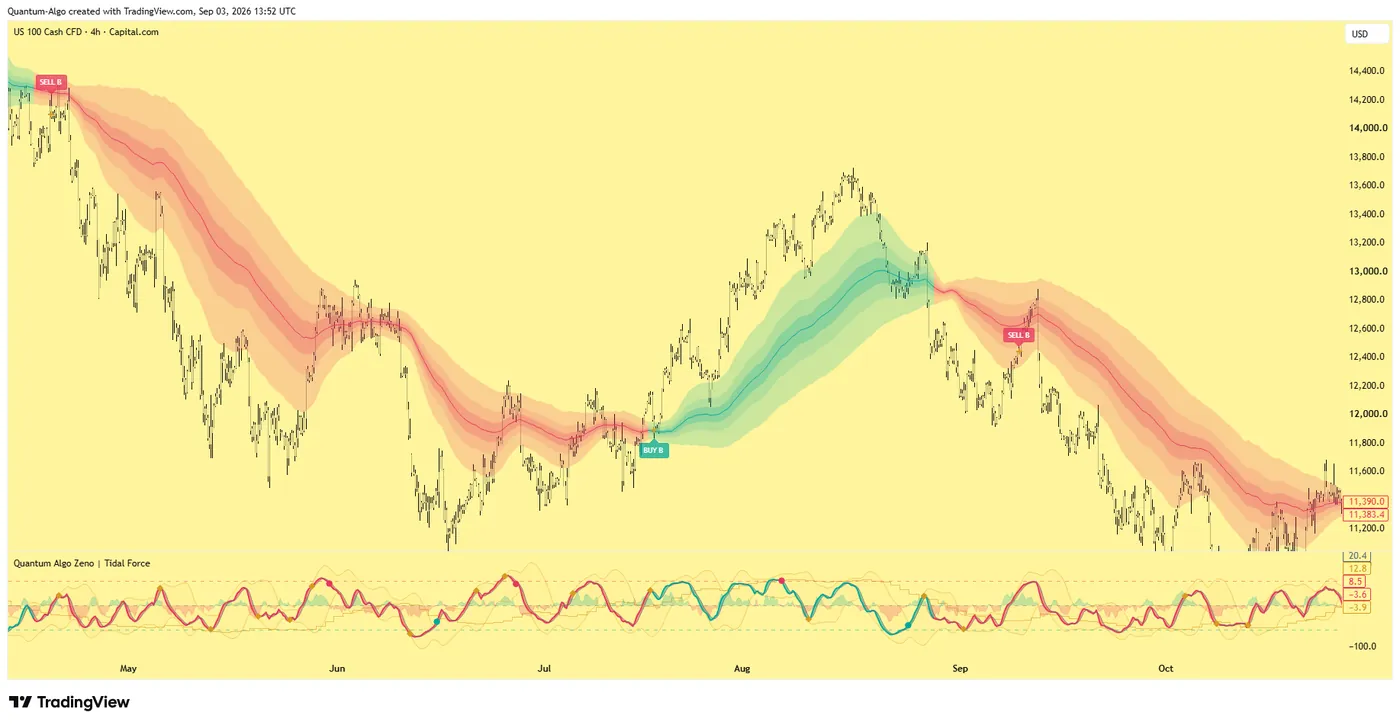
One engine, four precision tools — the Gold (XAU) Scalper, the institutional Gravity Zone, the Zeno momentum Oscillator, and Zeno Stocks for equities.
What time does the forex market open?
The forex market opens at 5:00 pm New York time on Sunday — which is 7:00 am Monday in Sydney, where the trading week begins — and runs continuously until 5:00 pm New York time on Friday. There is no opening bell: it is a network of banks and dealers across time zones, so "open" means that somewhere a major financial centre is trading. In UTC that is roughly Sunday 21:00 (22:00 in winter) to Friday 21:00 (22:00 in winter); in London, Sunday 10 pm to Friday 10 pm. The market is closed on weekends and, in practice, thin on major public holidays in the US and UK even though it is technically open.
That is the answer to the question as asked. The more useful answer is that the forex market being open and the forex market moving are different things, and this page is about the second: which session trades which pairs, when the liquidity is deep enough for the spread to be tight, why the same session has three different clock times depending on the month, and when you should not be trading at all. The live clock below shows what is open right now in your own timezone.
The forex trading week, hour by hour
The 24-hour-week illustration in this guide lays out the whole week as four overlapping session bands from Sunday 5 pm ET to Friday 5 pm ET:
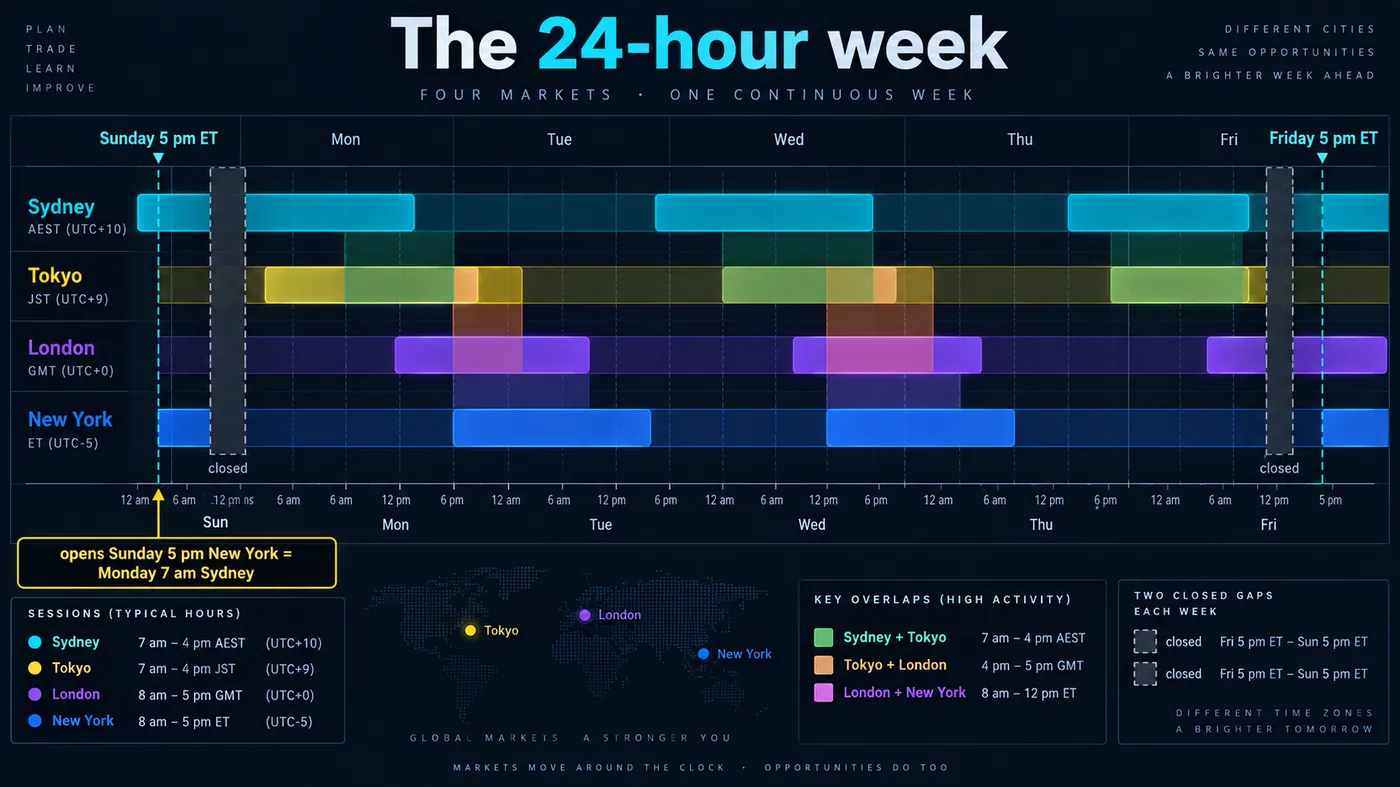
- Sydney — opens first each day, 5:00 pm–2:00 am ET (10:00 pm–7:00 am UTC in winter). Thin, AUD and NZD pairs only, wide spreads on everything else.
- Tokyo — 7:00 pm–4:00 am ET (00:00–09:00 UTC). Yen pairs and the Asian crosses; EUR/USD often ranges 20–30 pips for the whole session.
- London — 3:00 am–12:00 pm ET (08:00–17:00 UTC). The largest share of daily volume, around 38% by the BIS survey; EUR, GBP and CHF pairs come alive; the London open is where the Asian range gets swept.
- New York — 8:00 am–5:00 pm ET (13:00–22:00 UTC). USD/CAD, the US data releases at 8:30 am ET, and the overlap with London.
The two shaded gaps in the illustration are the only times the market is closed: Friday 5 pm to Sunday 5 pm New York, and — depending on your broker — a one- to five-minute daily settlement break at 5 pm ET when swaps are charged and spreads spike.
What time does forex open on Sunday?
5:00 pm Eastern Time. Most brokers open their platforms a few minutes after that; some quote from 5:05 pm; a few open at 5:00 pm sharp with spreads two to five times their weekday width for the first half hour. The Sunday open is the moment weekend news is priced, so gaps are common — a gap of 20–50 pips on a major after a weekend event is ordinary, and stop orders left over the weekend fill at the gap, not at the level.
Three practical rules for the Sunday open: do not hold weekend positions without a stop you can afford to see gapped; do not trade the first thirty minutes unless the spread has normalised; and if your broker shows "market closed" on Sunday afternoon, check the timezone of the platform clock before assuming it is broken — it is almost always displaying UTC or the broker's local time.
When does the forex market close on Friday?
5:00 pm Eastern Time. Liquidity thins from around 12:00 pm ET as London closes and traders flatten ahead of the weekend; the last two hours of Friday are among the least liquid of the week, with the exception of a data release. Swing traders should decide by Friday noon whether they are holding through the weekend; day traders should have no reason to be in a position after London closes.

Automate your trades. Let Quantum Algo trade for you.
Every signal executed on your own account — on your account, with the plan you define.
Session times in EST, GMT and UTC
The three-clocks illustration in this guide shows the same four sessions in Eastern Time, GMT and UTC, and the reason there are three columns is the reason most session tables online are wrong: daylight saving. New York moves its clocks in March and November; London in March and October; Sydney in October and April, in the opposite direction. UTC never moves. So the London session is 08:00–17:00 UTC in summer and 08:00–17:00 local all year but 08:00–17:00 GMT only in winter; and the overlap with New York shifts by an hour for a few weeks each spring and autumn when the two countries have changed at different dates.
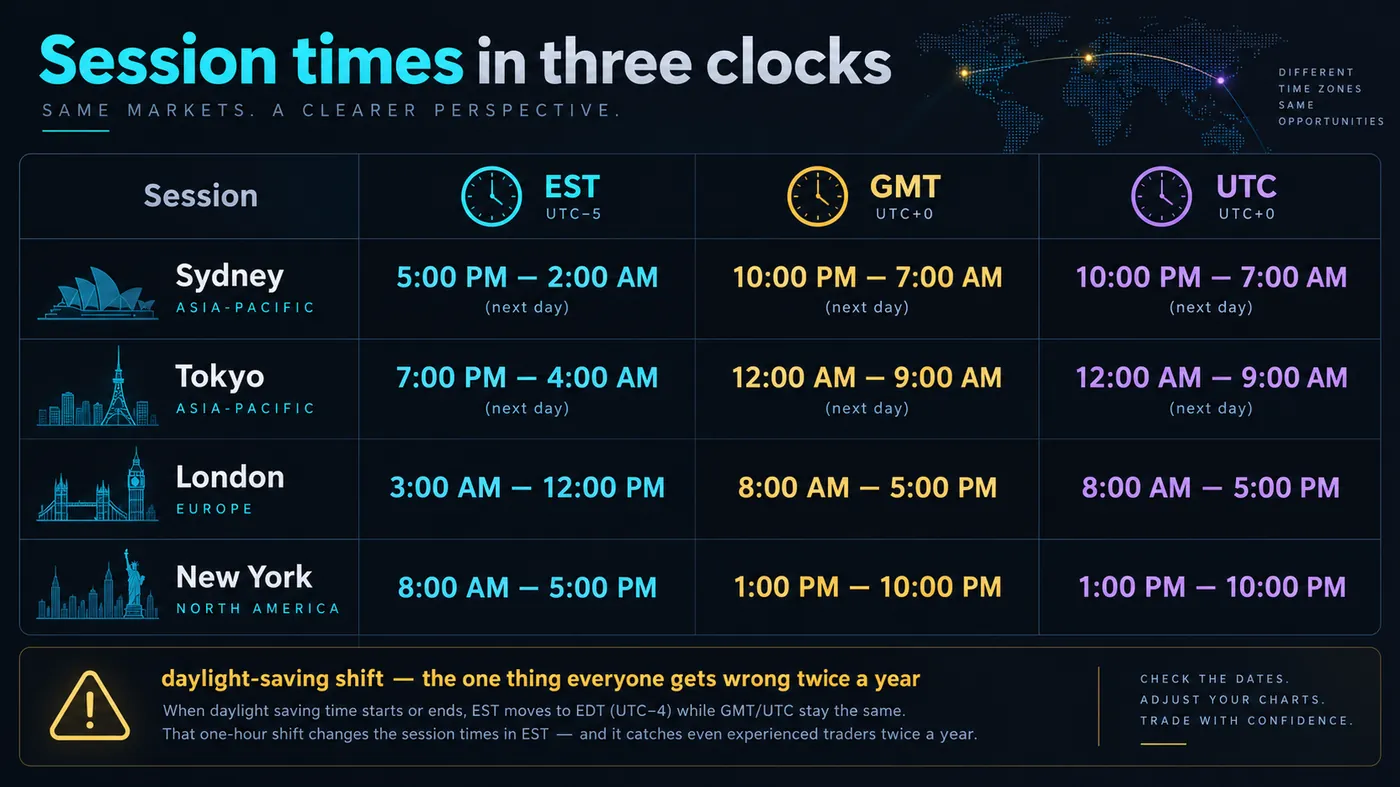
The rule that keeps you right: write your sessions down in UTC once, and convert to your local time with the live clock rather than a memorised table.
| Session | Local | UTC (summer) | UTC (winter) |
|---|---|---|---|
| Sydney | 7:00 am–4:00 pm AEST/AEDT | 21:00–06:00 | 22:00–07:00 |
| Tokyo | 9:00 am–6:00 pm JST | 00:00–09:00 | 00:00–09:00 |
| London | 8:00 am–5:00 pm BST/GMT | 07:00–16:00 | 08:00–17:00 |
| New York | 8:00 am–5:00 pm EDT/EST | 12:00–21:00 | 13:00–22:00 |
Japan does not observe daylight saving, so Tokyo is the only session whose UTC times never change.
Best time to trade forex
The liquidity-by-hour illustration in this guide is the honest answer: relative volume is low through Sydney, rises through Tokyo, steps up sharply at the London open, peaks in the London–New York overlap between 13:00 and 17:00 UTC, and fades after London closes at 17:00 UTC. The shaded window is the best time to trade forex for almost everyone: tightest spreads, deepest order books, the most institutional participation and — for structure traders — the most reliable sweeps of the ranges built in the quieter hours.
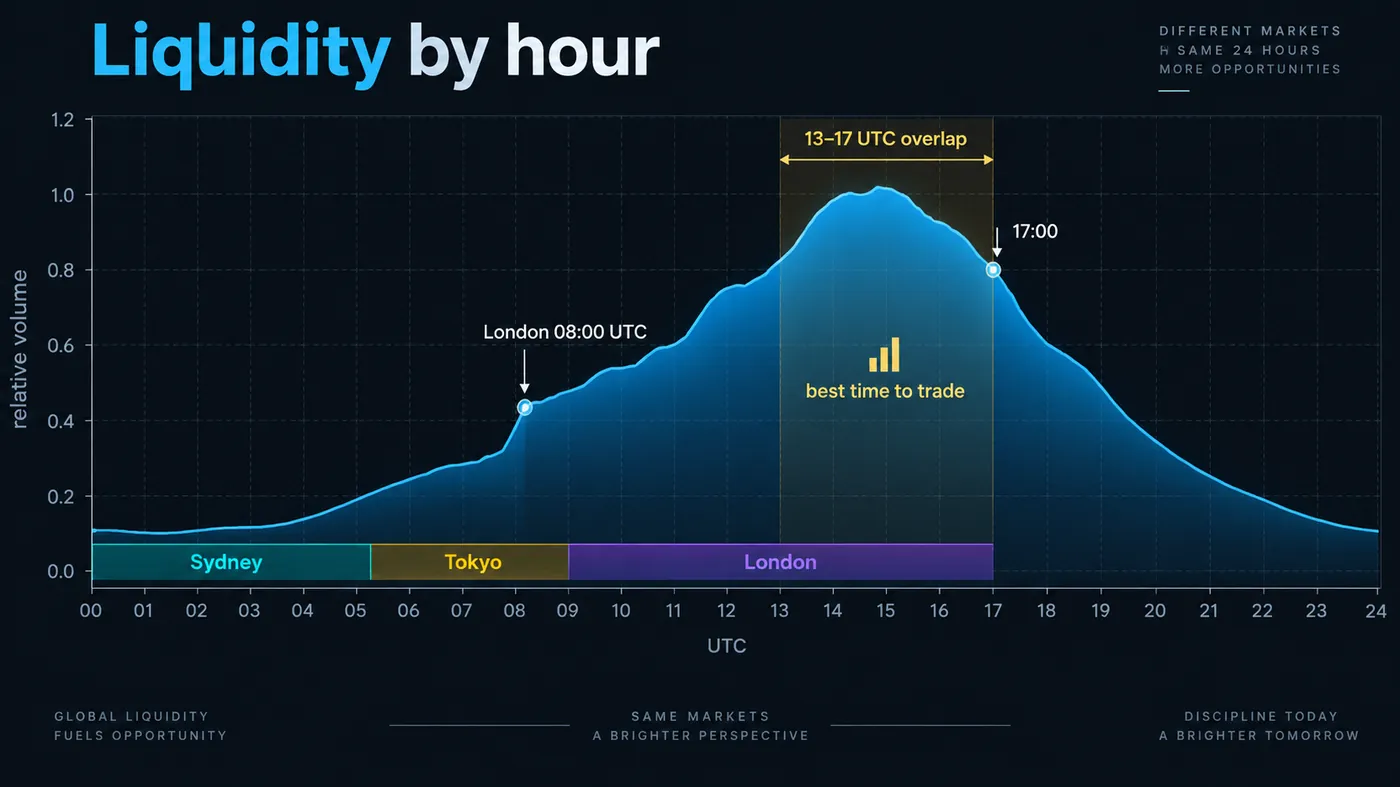
Within that, by pair: EUR/USD and GBP/USD from the London open through the overlap; USD/JPY in Tokyo and again in the overlap; AUD/USD and NZD/USD in Tokyo; USD/CAD in New York, especially around the 8:30 am ET data. Gold, quoted at most forex brokers, follows the London–New York pattern almost exactly, which is why our gold engine runs in that window.
The worst times: the Friday afternoon fade, the Sunday open, the daily 5 pm ET settlement, the Tokyo lunch hour, and the minutes around a scheduled release.
Is the forex market open today?
If it is between Sunday 5 pm and Friday 5 pm New York time, yes. Public holidays do not close the interbank market, but they do empty it: on US holidays such as Thanksgiving and Independence Day, and UK bank holidays, the affected session trades at a fraction of normal volume with wider spreads, and some brokers restrict trading on specific instruments. The two days most brokers treat as closed are Christmas Day and New Year's Day. The live clock on this page shows the current state and the next open; for holiday schedules, your broker's calendar is the source, because policies differ.
Forex hours versus other markets
| Market | Hours | What that means for you |
|---|---|---|
| Forex | 24/5, Sunday 5 pm–Friday 5 pm ET | Sessions matter more than open/closed |
| Gold (spot at forex brokers) | ~23/5, daily break around 5 pm ET | Follows London and New York |
| Index futures (CME) | ~23/5, daily break 5–6 pm ET | Overnight range prices news before the cash open |
| US stocks | 9:30 am–4:00 pm ET, plus thin extended hours | Everything happens in 6.5 hours |
| Crypto | 24/7 | No sessions; thinner at weekends |
The comparison matters because a trader used to stocks assumes "open" means liquid, and a trader used to crypto assumes the clock does not matter. Forex is the market where the clock is most of the edge.
How we trade the sessions
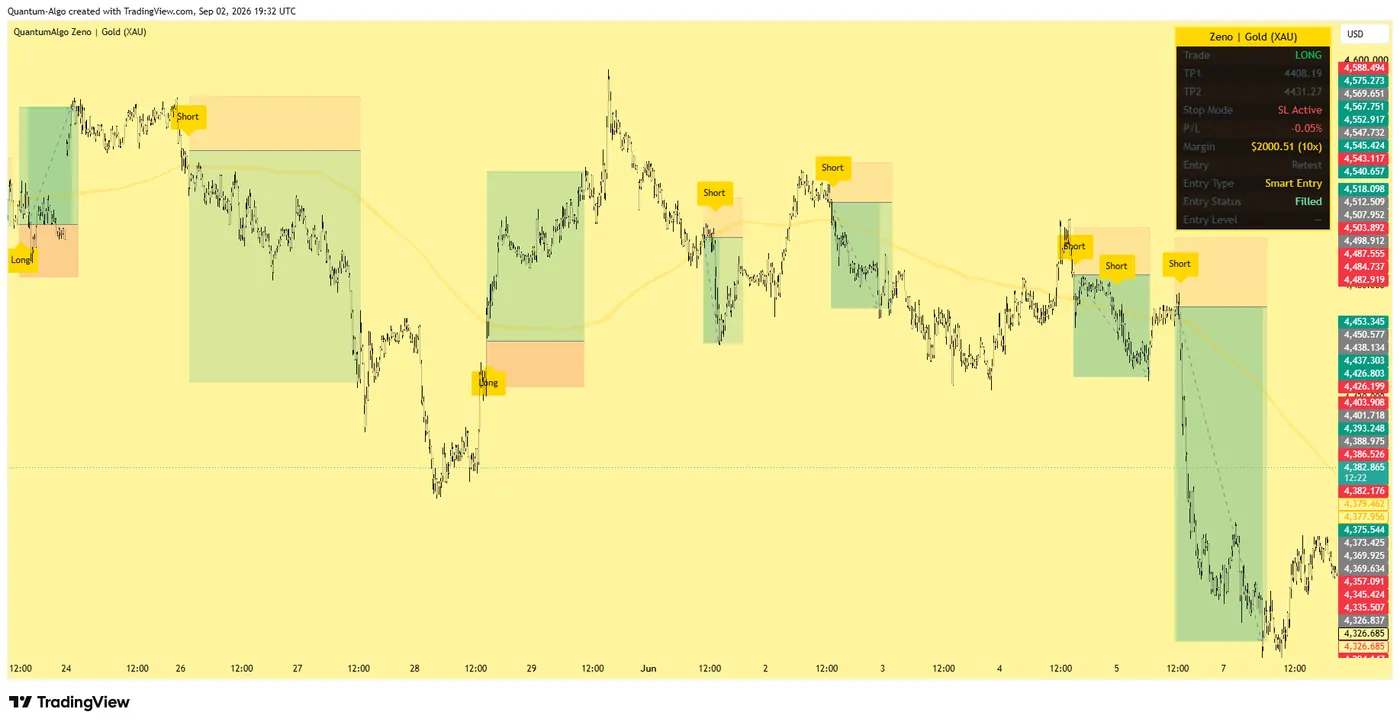
Every forex and gold call on our public track record was posted in the London session or the London–New York overlap, and none in Sydney hours. Zeno's Gravity Zone engine reads structure on any timeframe, but the setups it prints in the overlap are the ones with the fills to match. If your available hours are outside that window, the honest advice is on our forex pairs page: trade the pair whose home session overlaps your day, or consider a market without sessions.
Open from Sunday 5 pm to Friday 5 pm New York time, but liquid only where the sessions overlap. Note your sessions in UTC, trade the pair whose home session matches your hours, prefer the London–New York overlap, and stay out of the Sunday open, the Friday fade and the 5 pm settlement. Open is not the same as moving.
◆ Interactive check
Do you know the clock?
Questions people ask about forex hours
Twenty-four hours a day from Sunday 5 pm to Friday 5 pm New York time, because at least one major centre is always trading. It is not open at weekends, and "open" is not the same as liquid.
Sunday 10 pm London time (winter) or 10 pm BST (summer), which is the Sunday 5 pm New York open. The London session itself runs 8 am to 5 pm local time all year.
Sunday 5:00 pm to Friday 5:00 pm EST/EDT. Sydney 5 pm–2 am, Tokyo 7 pm–4 am, London 3 am–12 pm, New York 8 am–5 pm, with the London–New York overlap 8 am–12 pm.
No — the market is closed from Friday 5 pm to Sunday 5 pm New York time. Some brokers offer weekend trading on a handful of crypto or synthetic instruments; that is not forex.
Most platforms display UTC or the broker's server time, not yours. Convert once with the clock on this page and note your sessions in UTC.
The London–New York overlap, on EUR/USD or GBP/USD, because the spread is tightest and the structure cleanest. If your day does not include 13:00–17:00 UTC, choose the pair that moves in the session you can be present for.
The indicators run around the clock; the public calls are in London and New York because that is where the fills match the chart. Sydney-session signals on majors are treated as provisional.
It has already been open since Sunday 5 pm New York time — Monday 7 am in Sydney, which is where the trading week begins. Tokyo joins at 7 pm ET Sunday, London at 3 am ET Monday.
5:00 pm New York time. Liquidity thins from noon ET as London closes; the last two hours of Friday are among the thinnest of the week.
Most brokers close forex on 25 December and 1 January; the interbank market is nominally open but effectively empty. Other holidays keep the market open with reduced liquidity — check your broker's calendar.
References & Related Guides
Read next
- Forex Chart Patterns: The Six That Actually Print, and the Structure Behind Them
- Best Forex Pairs to Trade
- What Is After-Hours Trading?
- How Many Trading Days in a Year?
- Best Forex Brokers
- Best Forex Indicator
- Best Indicator for XAUUSD (Gold)
- Scalping Strategy
Authoritative sources
- BIS Triennial Survey: FX turnover by centre and currency
- CME Group: FX futures trading hours
- NYSE: holiday calendar (US session liquidity)
- Bank of England: London FX Joint Standing Committee
- timeanddate: daylight saving dates by country