Best Forex Pairs to Trade: By Session, Spread, Volatility and Style

The best forex pairs to trade are the ones with the lowest spread relative to their daily range during the session you are awake for — EUR/USD, GBP/USD and USD/JPY in London and New York, AUD/USD in Tokyo, USD/CAD in New York, and gold (XAU/USD) if your broker offers it. Rank pairs by range ÷ spread: above 100 is tradable intraday, 30–100 is a swing pair, below 30 the spread eats the edge — which rules out exotics for anyone still learning.
Choosing pairs is a cost decision before it is a style decision: a pair that moves 1,200 pips a day is worthless if it costs 40 pips to enter, and a pair that moves 60 costs 0.2. This page ranks the majors, crosses and exotics by that ratio, shows which pair moves in which session so your watchlist fits your hours, profiles the pairs we trade and post publicly, lists the events that move each one, and answers "best forex signal provider" with the checklist that separates a record from a sales page. The pair picker below builds a watchlist from your session, style and account currency.
Indicators that prove themselves in public.
One engine, four precision tools — the Gold (XAU) Scalper, the institutional Gravity Zone, the Zeno momentum Oscillator, and Zeno Stocks for equities.
What are the best forex pairs to trade?
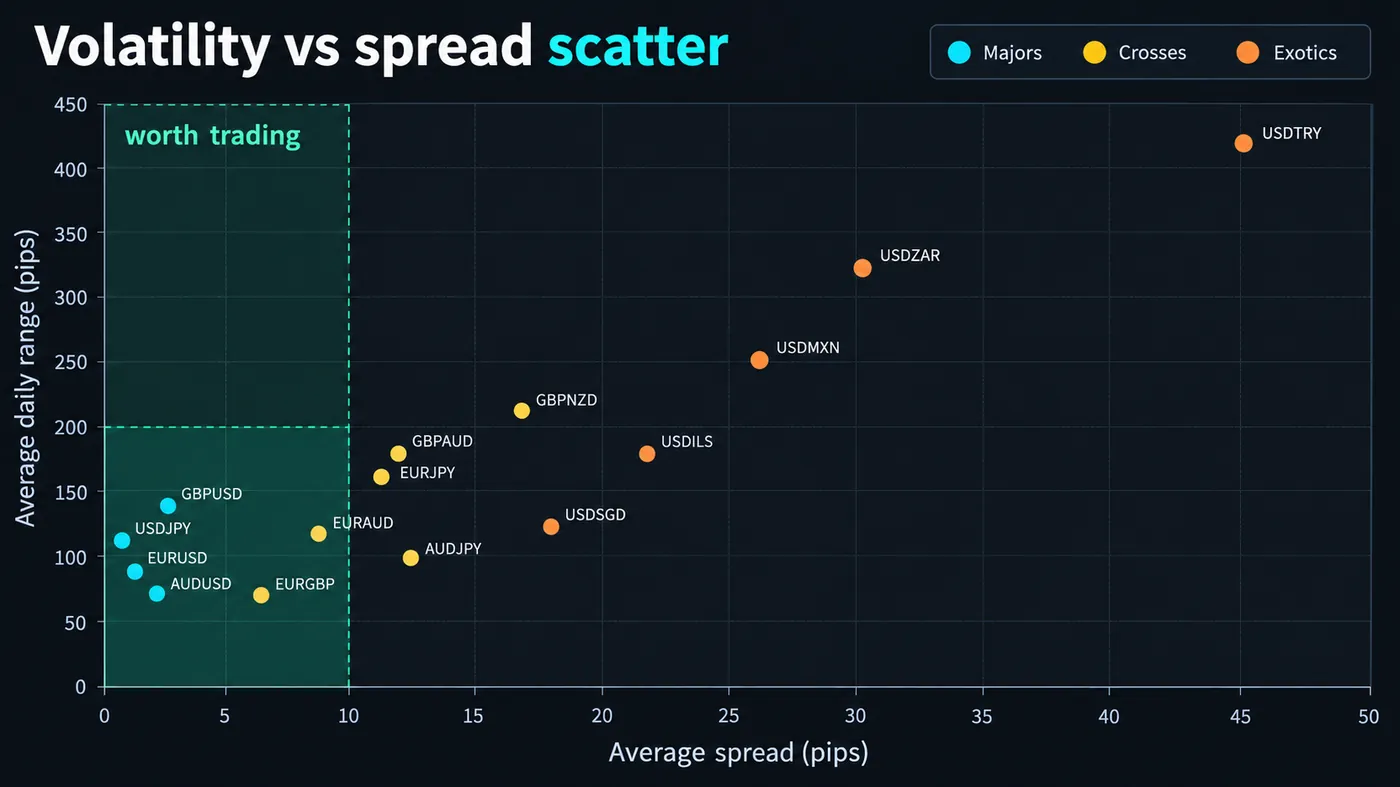
The best forex pairs to trade are the ones with the lowest spread relative to their daily range, during the session you are actually awake for — which for most traders means EUR/USD, GBP/USD and USD/JPY in the London and New York sessions, gold (XAU/USD) if your broker offers it, and AUD/USD and USD/CAD for the Asian and North American sessions respectively. The worst pairs to trade are the exotics that look exciting on a chart and cost twenty times the spread to enter. The scatter illustration in this guide puts fifteen pairs on a spread-versus-range chart, and the "worth trading" zone in the bottom right is where a beginner's entire universe should sit for the first year.
This page is about choosing the pairs, not the setups: which pairs move when, what they cost, how they behave, and which ones our own engine is built for. The last section covers "best forex signal provider", a query that lands here because the honest answer to it is a checklist rather than a list of vendors.
Majors, minors and exotics
The rings illustration in this guide shows the three tiers with USD as the common leg of the centre ring:
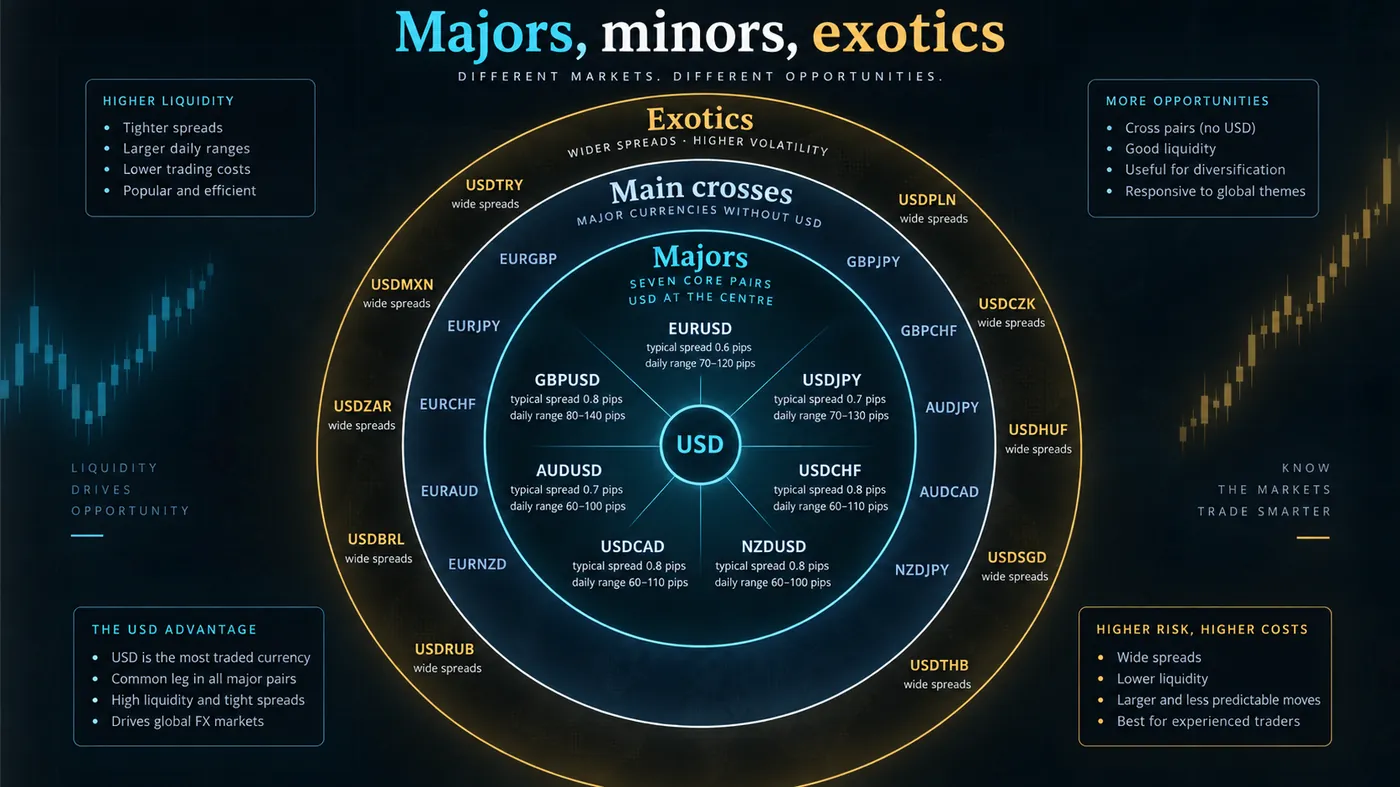
- Majors — the seven pairs with USD on one side: EUR/USD, GBP/USD, USD/JPY, USD/CHF, AUD/USD, USD/CAD, NZD/USD. Tightest spreads (0.1–1.5 pips depending on account type), deepest liquidity, most session coverage. Daily ranges from roughly 50 pips (USD/CHF) to 100+ (GBP/USD).
- Minors / crosses — non-USD pairs between major currencies: EUR/GBP, EUR/JPY, GBP/JPY, AUD/JPY, EUR/AUD, GBP/AUD, EUR/CHF, CAD/JPY, NZD/CAD and so on. Spreads of 1–4 pips, wider ranges on the yen and pound crosses (GBP/JPY can move 150–200 pips a day), liquidity concentrated in the relevant sessions.
- Exotics — a major against an emerging or small currency: USD/ZAR, USD/TRY, USD/MXN, USD/PLN, USD/SGD, USD/HKD. Spreads from 10 pips to hundreds, gaps on local news, swap rates that can be brutal, and daily ranges that look attractive until you price the spread.
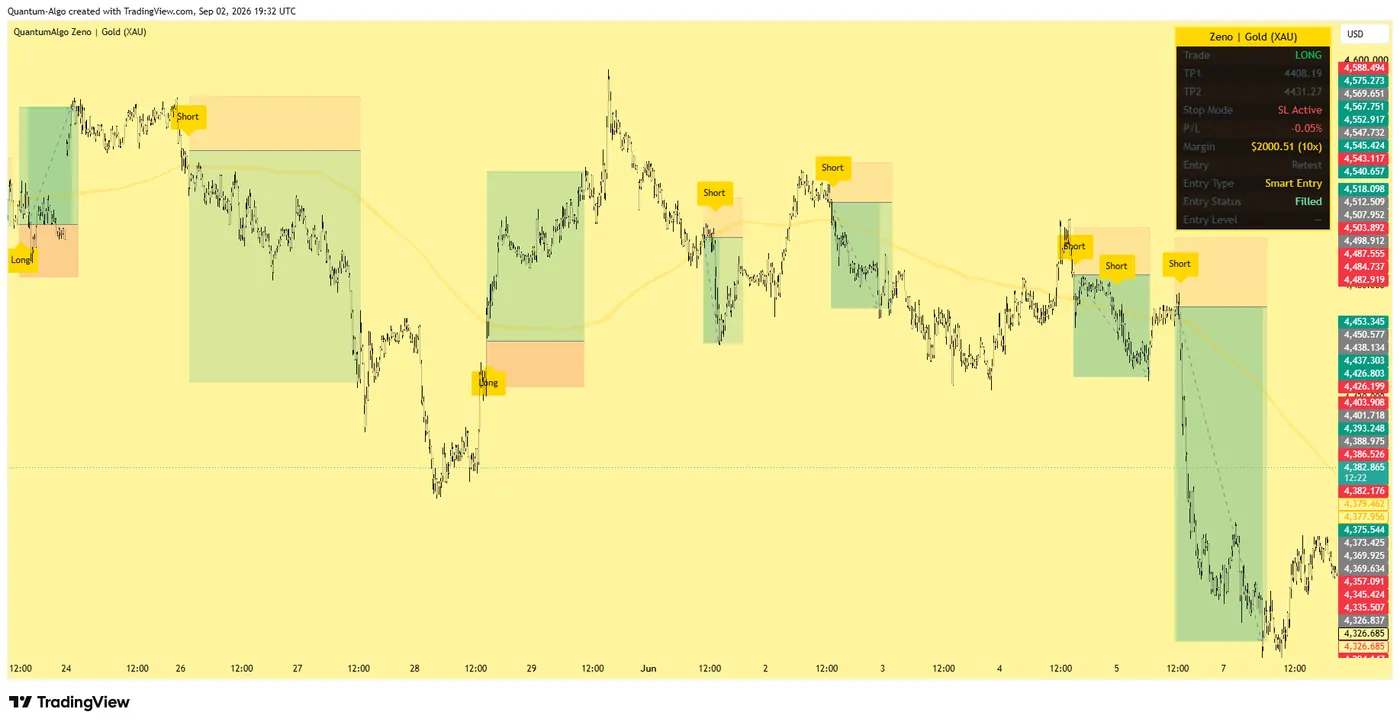
Gold (XAU/USD) is not a currency pair but trades like one at most forex brokers, with a large daily range ($20–40) and a spread of $0.20–0.40 on raw accounts — the reason it is the market Zeno was first built for.
Which pair moves in which session
The session timeline illustration in this guide shows the daily range of five pairs distributed across Sydney, Tokyo, London and New York. The pattern is the one to memorise:
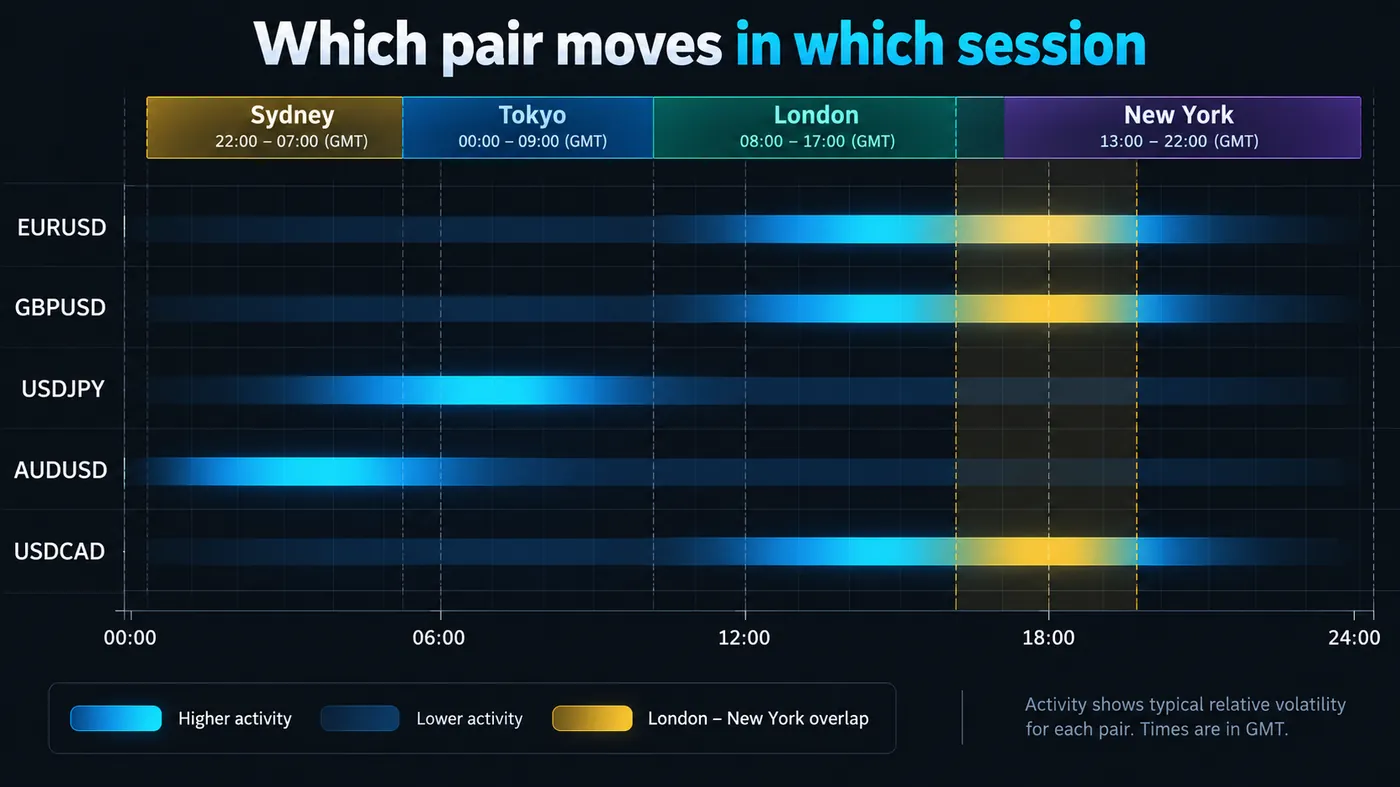
- Tokyo (00:00–09:00 UTC): USD/JPY, AUD/USD, AUD/JPY, NZD/USD; the yen pairs get their first move here and often their day's direction.
- London (08:00–17:00 UTC): EUR/USD, GBP/USD and the European crosses come alive; the largest share of daily volume; the London open is where the Asian range gets swept.
- London–New York overlap (13:00–17:00 UTC): the deepest liquidity of the day on every major, and the window where most of our gold and forex calls print.
- New York (13:00–22:00 UTC): USD/CAD gets its move with North American data; EUR/USD and GBP/USD continue; the afternoon thins out after London closes.
- Sydney (22:00–07:00 UTC): thinnest liquidity, widest spreads, AUD and NZD only.
The practical rule: trade the pair whose home session overlaps your available hours. A trader in Europe with an evening free is a USD/CAD and gold trader in the New York session; a trader in Asia with a morning free is a USD/JPY and AUD/USD trader; someone who can only trade at Sydney hours should think hard about crypto instead, where the session problem does not exist.
Volatility versus spread: the number that ranks them
The scatter illustration in this guide plots average spread against average daily range. What matters is the ratio: how many pips of movement you get for each pip of spread you pay.
| Pair | Typical raw spread (pips) | Typical daily range (pips) | Range ÷ spread | Verdict |
|---|---|---|---|---|
| EUR/USD | 0.1–0.3 | 60–80 | 250–600 | Best all-round |
| USD/JPY | 0.2–0.4 | 60–90 | 200–400 | Best in Tokyo and New York |
| GBP/USD | 0.3–0.6 | 90–120 | 200–300 | Best range among majors; more slippage |
| AUD/USD | 0.2–0.4 | 50–70 | 150–300 | Best in Tokyo |
| USD/CAD | 0.3–0.6 | 60–80 | 120–250 | Best in New York; oil-sensitive |
| USD/CHF | 0.3–0.6 | 40–60 | 80–200 | Quiet; a hedge pair |
| NZD/USD | 0.4–0.8 | 50–70 | 70–170 | Tokyo; lower liquidity |
| EUR/JPY | 0.5–1.0 | 80–110 | 90–200 | Good cross |
| GBP/JPY | 0.8–1.5 | 120–200 | 100–200 | Biggest range, biggest stops needed |
| EUR/GBP | 0.5–1.0 | 40–60 | 40–100 | Slow; range trader's pair |
| USD/ZAR | 20–60 | 800–1,500 | 20–50 | Exotic; only for wide swing setups |
| USD/TRY | 100+ | huge | <20 | Avoid |
Above about 100 the pair is tradable intraday; between 30 and 100 it is a swing-trading pair; below 30 the spread eats the edge. The pair picker on this page applies this with your session, style and account currency.
Pair profiles
Short descriptions of the pairs you are most likely to trade, written the way we brief a subscriber moving to a new pair:
- EUR/USD. The most liquid instrument in the world; spread of a fraction of a pip on raw accounts; moves on ECB and Fed policy, US data at 13:30 UTC, and risk sentiment. Cleanest structure in London and the overlap; dies after 17:00 UTC. The default first pair.
- GBP/USD. Larger range and more slippage than EUR/USD; sensitive to UK data at 07:00 UTC and Bank of England decisions; sweeps the Asian range at the London open more reliably than any other major. A pair that rewards structure traders and punishes tight stops.
- USD/JPY. Driven by the rate differential and risk appetite; moves in Tokyo and again in New York; respects round numbers and intervention levels. Pip value in yen, which is why the pip value calculator exists. Trending pair; ranges are rare and long.
- USD/CHF. The mirror of EUR/USD with a smaller range; a hedge pair rather than a trading pair; occasional Swiss National Bank surprises.
- AUD/USD. The Asia-session major; driven by Chinese data, commodities, and RBA policy; trends slowly, respects levels, good for swing setups on the 4-hour.
- USD/CAD. The New York major; moves with oil and with US and Canadian data released at the same minute (13:30 UTC); ranges more than trends; the pair behind several of our public calls.
- NZD/USD. AUD/USD's smaller sibling with wider spreads and lower liquidity; Tokyo session; sensitive to dairy prices and RBNZ.
- EUR/JPY and GBP/JPY. The yen crosses: risk-on/risk-off barometers with big ranges — GBP/JPY especially — and stops that need to be sized accordingly. Move in London and New York.
- EUR/GBP. Slow, range-bound most of the time, moves on relative ECB/BoE policy; a pair for range traders and for hedging EUR/USD against GBP/USD.
- USD/ZAR, USD/MXN, USD/PLN, USD/SGD. The exotics we have occasionally posted swing calls on: wide spreads, gap risk on local news, high swaps; only on the 4-hour and daily, only with stops that respect the gaps, never for scalping.
Economic events that move each pair
| Event | Time (UTC) | Pairs most affected |
|---|---|---|
| US non-farm payrolls (first Friday) | 13:30 | Every USD pair, gold |
| US CPI | 13:30 | Every USD pair, gold, USD/JPY especially |
| FOMC decision and press conference | 19:00 / 19:30 | Everything; gold and USD/JPY most |
| ECB decision | 13:15 / 13:45 | EUR/USD, EUR/GBP, EUR/JPY |
| Bank of England decision | 12:00 | GBP/USD, EUR/GBP, GBP/JPY |
| Bank of Japan decision | ~03:00 | USD/JPY and all yen crosses |
| RBA decision | 04:30 | AUD/USD, AUD/JPY |
| Bank of Canada decision; Canadian CPI and jobs | 13:30–14:45 | USD/CAD |
| UK CPI and jobs | 07:00 | GBP pairs |
| Chinese data (PMI, trade) | 01:30–03:00 | AUD/USD, NZD/USD |
Structure stops working for the minutes around these; flatten or widen stops before them, and treat the reaction after them as the technical event to trade.

Automate your trades. Let Quantum Algo trade for you.
Every signal executed on your own account — on your account, with the plan you define.
Building a watchlist that fits your life
- Write down the hours you can actually trade, in UTC.
- From the session timeline, pick the two majors whose range concentrates in those hours.
- Add gold if your session includes London or New York.
- Add one cross that shares a leg with your majors (EUR/JPY if you trade USD/JPY; GBP/JPY if you trade GBP/USD) once the majors have a fifty-trade record.
- Leave exotics off the list until you have a swing setup and a reason.
Five instruments is the ceiling for a discretionary trader; three is better. The free indicators mark the same structure on all of them, so adding a pair costs attention, not analysis.
Best pairs by trading style
- Scalping (1–5 minute): EUR/USD and USD/JPY only, on a raw-spread account, in London or the overlap. Nothing else survives the spread at that frequency.
- Day trading (15-minute to 1-hour): the majors plus EUR/JPY and GBP/JPY for range, plus gold. Pick two; know their sessions.
- Swing trading (4-hour to daily): any major or cross; spread becomes irrelevant, swap rates become relevant — check the carry on the side you hold.
- Position trading (weekly): the pairs with the clearest macro driver: USD/JPY (rate differentials), AUD/USD (commodities and China), USD/CAD (oil). Exotics only with a specific thesis and a stop that respects the gaps.
Gold versus the majors
Gold sits in every forex trader's watchlist and behaves like none of the pairs. Its daily range in dollars ($20–40, roughly 0.8–1.5%) is two to three times the percentage range of EUR/USD; its spread on a raw account ($0.20–0.40, about 1–2 basis points) is comparable in relative terms; and its structure — the London sweep of the Asian range, the New York expansion — is the most repeatable of any instrument we trade, which is why Zeno Gold runs on the 15-minute chart. The costs to know: 1:20 leverage under ESMA/FCA rules rather than 1:30; swaps usually against longs; contract size that must be checked (100 oz at most brokers); and a habit of moving $10 in a minute on US data. For a trader whose session includes 13:00–17:00 UTC, gold is the first instrument to add after EUR/USD — and for many of our subscribers it becomes the only one.
Account currency and the pairs you trade
Your P&L is in the quote currency of the pair and your account is in whatever you funded; every trade on a pair whose quote currency is not your account currency is converted at the current rate. A USD account trading EUR/USD, GBP/USD and gold has no conversion; the same account trading USD/JPY, EUR/JPY or USD/CAD converts every trade's result. It is a small cost per trade and a real one over a year, and it is the reason the pair picker on this page asks for your account currency: it prefers pairs quoted in it.
Measuring spread and range yourself
Do not trust a table, including this one, for the pair and broker you will actually trade. Two measurements, ten minutes each:
- Spread: open the broker's quote panel during your session and note the bid-ask difference every fifteen minutes for a session; the median is your spread, the maximum is what you pay around news.
- Range: put a 14-period ATR on the daily chart; the reading in pips is the typical daily range. Divide by the median spread; the ratio ranks the pair for you.
Do it for five pairs and the watchlist writes itself. Repeat quarterly — spreads change with volatility and with the broker's pricing.
Correlations to know before you double up
EUR/USD and GBP/USD move together most of the time; long both is one bet at double size. USD/CHF is the near-mirror of EUR/USD. AUD/USD and NZD/USD track each other. USD/CAD tracks oil inversely. Gold and USD/JPY often move against the dollar together. The point is position sizing: two correlated positions at 1% risk each is a 2% bet, and our SMT divergence guide covers the one useful thing correlation gives a structure trader — a failure to confirm.
The pairs our engine is built for
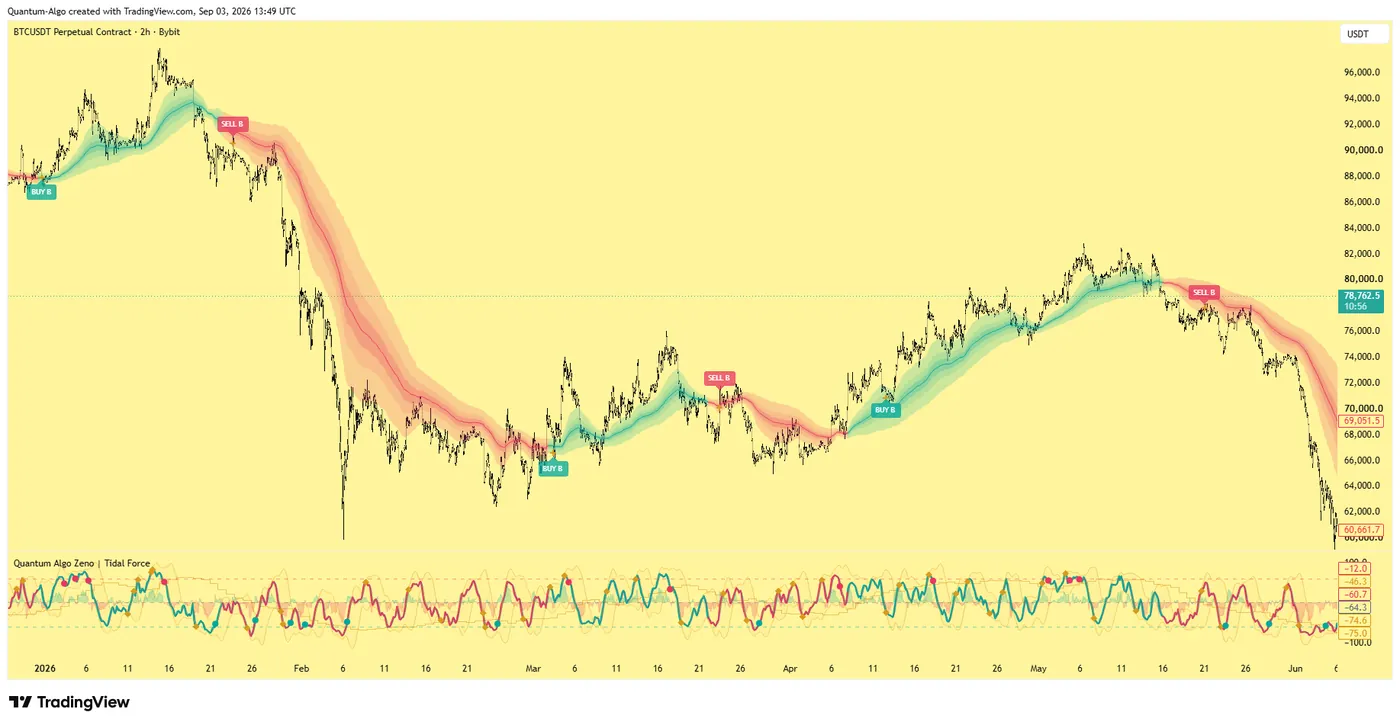
Zeno's Gravity Zone engine was tuned on the majors and the liquid crosses on the 2-hour chart, and the forex calls on the public track record are on exactly that set — GBP/USD, USD/CAD, NZD/CHF, NZD/CAD, GBP/AUD, EUR/JPY, AUD/USD, USD/SGD, USD/PLN and USD/ZAR. The exotics in that list were swing setups with stops sized for their gaps; the day-trading calls are on the majors and gold. If you run the free indicators, start on EUR/USD and gold and add pairs only once the first two have fifty logged trades.
"Best forex signal provider": the honest answer
The query is popular and the industry that serves it is mostly a bad one, so here is the checklist instead of a list:
- A public, timestamped record on a third-party platform that cannot be edited — TradingView ideas, for example — with the losses kept.
- Every signal with a stop and targets stated before the outcome, so the record can be checked at the stated levels.
- Fees that are not a share of your deposit and no broker referral requirement.
- A method you can understand, so you can decide whether a signal fits your session and your risk.
- No guaranteed returns, no screenshots of account balances, no "VIP" tiers with private results.
Any provider that fails the first two is selling hope. Quantum Algo's version of the answer is the track record page: 160 posted trades, 120 wins and 40 losses at the stated levels, on TradingView where the timestamp cannot be changed — and the free indicators, so you can see the method before paying for anything.
Rank pairs by range divided by spread, trade the ones whose session overlaps your hours, keep the watchlist to three, and treat correlation as a sizing rule. EUR/USD first, gold or USD/JPY second, crosses after fifty trades, exotics only with a swing thesis. And judge any signal provider by its public record, not its screenshots.
◆ Interactive check
Do you know your pairs?
Questions people ask about forex pairs
There is no most profitable pair; there is the pair with the best range-to-spread ratio in your session. For most traders that is EUR/USD, with GBP/USD and USD/JPY close behind. Profitability comes from the method and the sizing, not the pair.
EUR/USD: the tightest spread, the deepest liquidity, the most predictable session behaviour and the most educational material. Add gold or USD/JPY once EUR/USD has a fifty-trade record.
Depends on where "night" is. In Europe, night is the Sydney and Tokyo sessions: USD/JPY and AUD/USD. In the Americas, night is London: EUR/USD and GBP/USD. Sydney hours alone are thin for everything.
No. Spreads of 20–100+ pips, gaps on local news and heavy swap rates make exotics a swing instrument for experienced traders with a thesis, not a learning ground.
Not technically, but XAU/USD trades at most forex brokers like a pair, with a large daily range and a spread that makes it excellent for intraday structure trading — which is why it is the market Zeno was first built for.
Zeno prints signals on TradingView for forex, gold, indices and crypto, with stop and targets on the chart, and the public track record on the site shows the forex calls. The free indicators mark the same structure without a subscription.
GBP/JPY, GBP/USD and the exotics (USD/ZAR, USD/TRY, USD/MXN) have the largest daily ranges. Volatility alone is not the criterion — range divided by spread is — which keeps GBP/JPY and GBP/USD on the list and drops most exotics.
EUR/USD in micro lots, sized at 1% risk from the stop; then gold or USD/JPY once EUR/USD has a fifty-trade record. Small accounts cannot afford wide-spread pairs or correlated doubles.
USD/CAD (North American data), EUR/USD and GBP/USD through the overlap, and gold; the afternoon thins after London closes at 17:00 UTC.
Three is a good ceiling for a discretionary trader; five at most. Every added pair costs attention, not analysis — the free indicators mark the same structure on all of them.
References & Related Guides
Read next
- Forex Chart Patterns: The Six That Actually Print, and the Structure Behind Them
- Is Forex Trading Legit? The Market Is Real — Most of What Retail Traders Meet Isn't
- Forex Market Hours: When the Forex Market Opens, Closes and Actually Moves
- Best Forex Brokers
- Best Forex Indicator
- Pip Value Calculator
- Lot Size Calculator for Forex and Gold
- Best Indicator for XAUUSD (Gold)
- SMT Divergence
- How Many Trading Days in a Year?
- Quantum Algo Track Record
Authoritative sources
- BIS Triennial Survey: FX turnover by currency pair
- Federal Reserve: FOMC calendar
- ECB: meeting calendar
- Bank of England: MPC dates
- BLS: employment situation release schedule (NFP)