Best Forex Brokers: How to Choose One That Protects Your Money (US, UK/EU/AU and Everywhere Else)
The best forex broker is a regulated entity — FCA, ASIC, CySEC or, for US residents, an NFA-registered forex dealer — that segregates client funds, provides negative balance protection where required, quotes raw spreads with a transparent commission, executes without requotes and connects to the chart you trade on. It is a description rather than a name because the same brand runs different entities with different protections, and pricing changes faster than any review.
The single most useful question to ask a forex broker is "which legal entity will my account be with, and who regulates it?" — because three entities of the same brand can sit under the FCA, ASIC and an offshore regulator with completely different protections. This page gives you that map, the pricing arithmetic for standard, raw and "zero spread" accounts at your volume, the execution models, the swap cost swing traders forget, the account types to refuse, and the red flags. The calculator below prices any broker at your size and checks eligibility by residence.
Indicators that prove themselves in public.
One engine, four precision tools — the Gold (XAU) Scalper, the institutional Gravity Zone, the Zeno momentum Oscillator, and Zeno Stocks for equities.
What is the best forex broker?
The best forex broker is a regulated entity — FCA, ASIC, CySEC or, for US residents, a CFTC/NFA-registered forex dealer — that segregates client funds, provides negative balance protection where the law requires it, quotes raw spreads with a transparent commission, executes without requotes, and connects to the chart you actually trade on. That is a description, not a name, because the same brand can be a well-protected FCA entity for one client and an unprotected offshore entity for the next, and because pricing changes faster than any review is updated. This page gives you the criteria, the arithmetic, and the regulatory map so you can identify the best forex broker for your country and your style yourself — and recognise the ones to avoid.
A note on names. We do not receive payment from any broker and do not rank brands here. Where a broker type is described, it is because the description is verifiable on regulators' registers and the brokers' own pricing pages.
Where your money actually sits
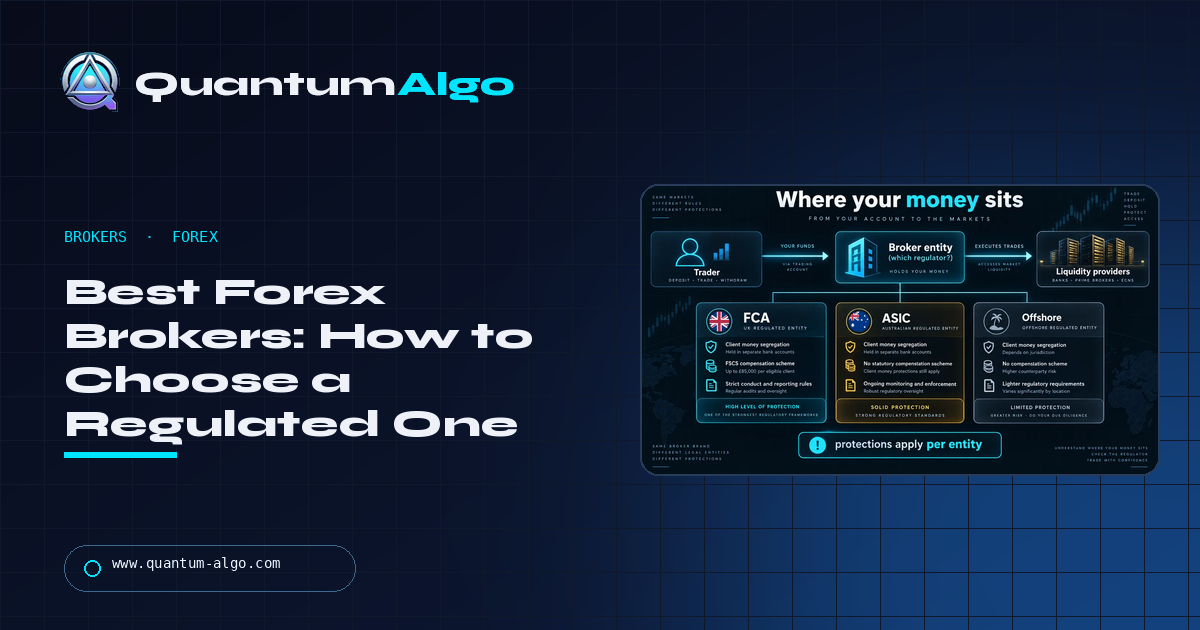
The custody illustration in this guide is the first thing to understand. Your money goes to a broker entity, not to a brand; the entity has a regulator; the entity routes your orders to liquidity providers. Three entities of the same brand are shown side by side — FCA, ASIC, offshore — and the protections differ on every row:
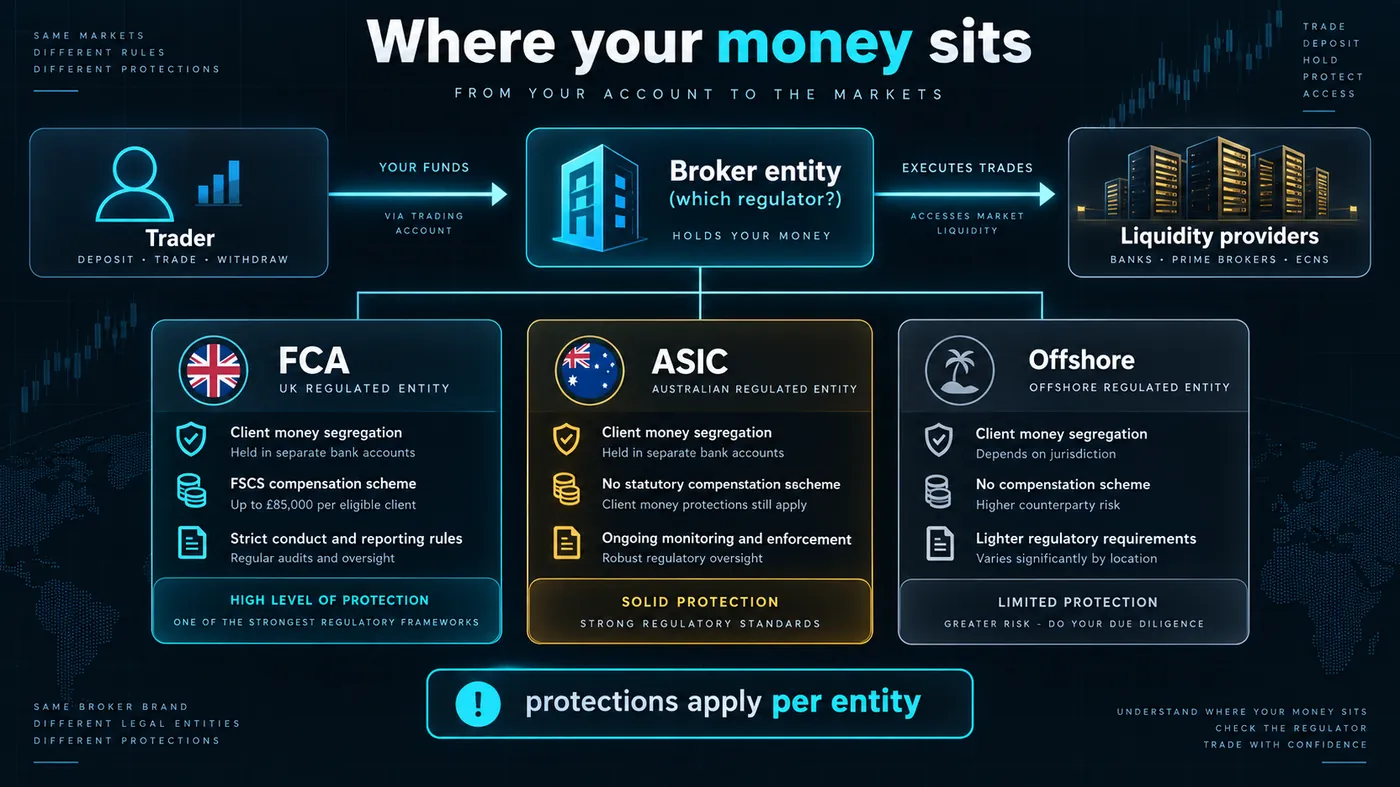
- FCA (UK): client money segregation under CASS rules, negative balance protection, FSCS compensation up to £85,000 if the firm fails, leverage capped at 1:30 on majors.
- ASIC (Australia): segregation, negative balance protection, leverage capped at 1:30, no compensation scheme of the FSCS type.
- CySEC (EU): segregation, negative balance protection, ICF compensation up to €20,000, ESMA leverage caps.
- Offshore (Seychelles, St Vincent, Vanuatu, Mauritius and similar): often no segregation requirement, no negative balance protection, no compensation, leverage up to 1:500 or more. This is the entity most non-EU/UK/AU clients are opened with by default when they sign up through an ad.
The single most useful question to ask any forex broker: which legal entity will my account be with, and who regulates it? The answer is on the account agreement, and it decides everything below.
The criteria that decide a forex broker
- Regulated entity for your residence — see the map below.
- Segregated funds and negative balance protection — mandatory under FCA/ESMA/ASIC; check offshore entities individually and assume no.
- Pricing model — standard (spread only), raw/ECN (near-zero spread plus commission), or marketing accounts that shift the cost between the two. The arithmetic below.
- Execution — market execution without requotes, slippage statistics if published, order rejection rate. Test with a small live account; demos do not show it.
- Platform — TradingView integration, cTrader, or MetaTrader; the broker's own app is usually the weakest option for chart-based trading.
- Overnight financing — swap rates on positions held past 5 pm New York, on both sides; the cost that decides the choice for swing traders.
- Minimum deposit, micro lots, and funding — micro lots (0.01) for correct sizing; deposit and withdrawal methods and fees; withdrawal speed.
- Instrument range — majors, minors, gold, indices; exotics if you need them; the spreads on the instruments you actually trade, not the EUR/USD headline.
- Support and account management — reachable, in your language, without a sales agenda.
Spread and commission: the arithmetic
The three-account illustration in this guide compares the pricing models on the same pair and the same volume:
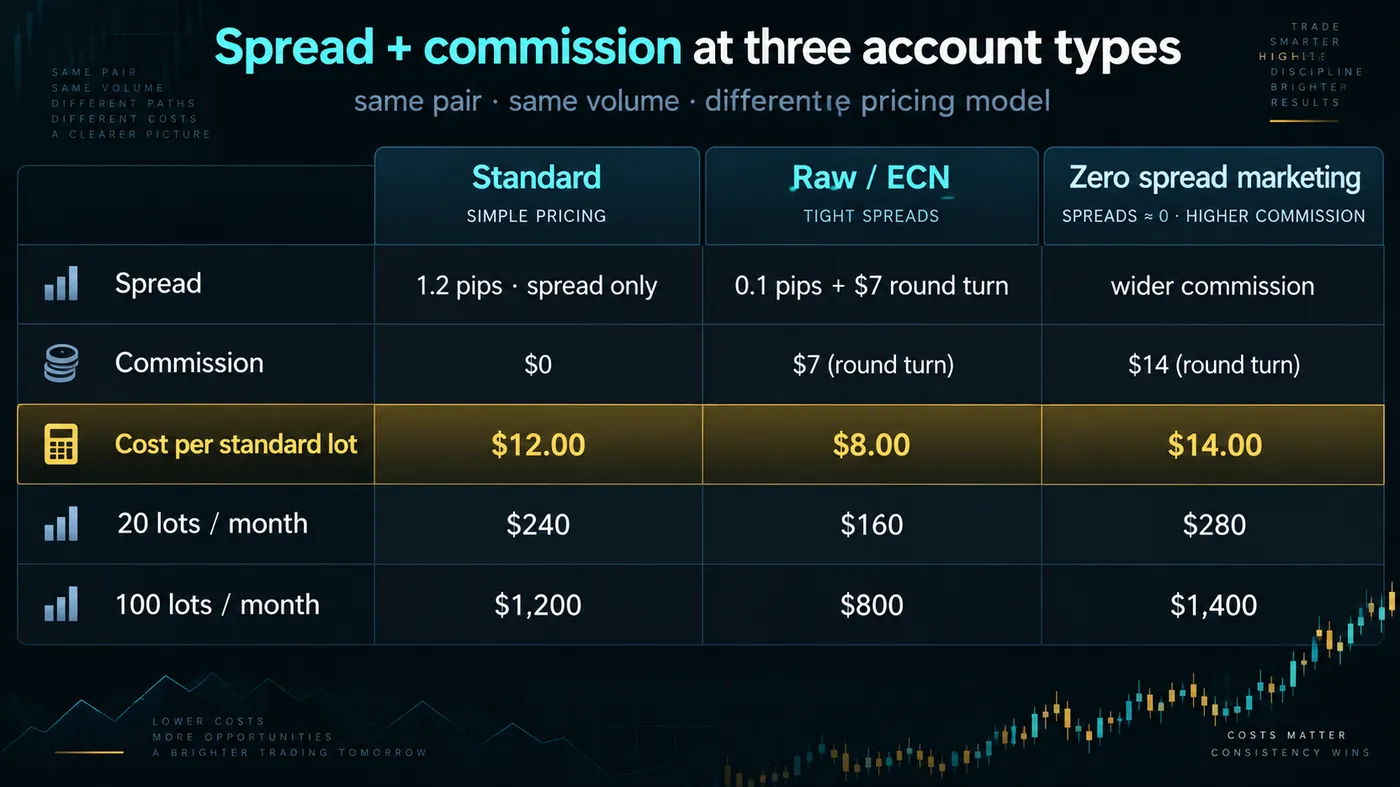
| Account type | Spread | Commission | Cost per standard lot | 20 lots / month | 100 lots / month |
|---|---|---|---|---|---|
| Standard | 1.2 pips | $0 | $12.00 | $240 | $1,200 |
| Raw / ECN | 0.1 pip | $7 round turn | $8.00 | $160 | $800 |
| "Zero spread" marketing | 0.0 pips | $14 round turn | $14.00 | $280 | $1,400 |
Three points from the table. Raw plus commission is usually cheapest for an active trader — but only if the raw spread is genuinely 0.1–0.3 pips during your session, which it is on majors in London and New York and is not on exotics or at 3 am. "Zero spread" accounts recover the cost through commission and are often the most expensive on the page. And for a trader placing four trades a month, the difference between models is $16 — irrelevant next to the regulator question.
The broker cost calculator on this page runs your lot size and trades per month against each model, and checks eligibility by residence.
US versus the rest of the world
The three-panel illustration in this guide is the regulatory map, and it explains why "best forex broker in the USA" is a separate search:
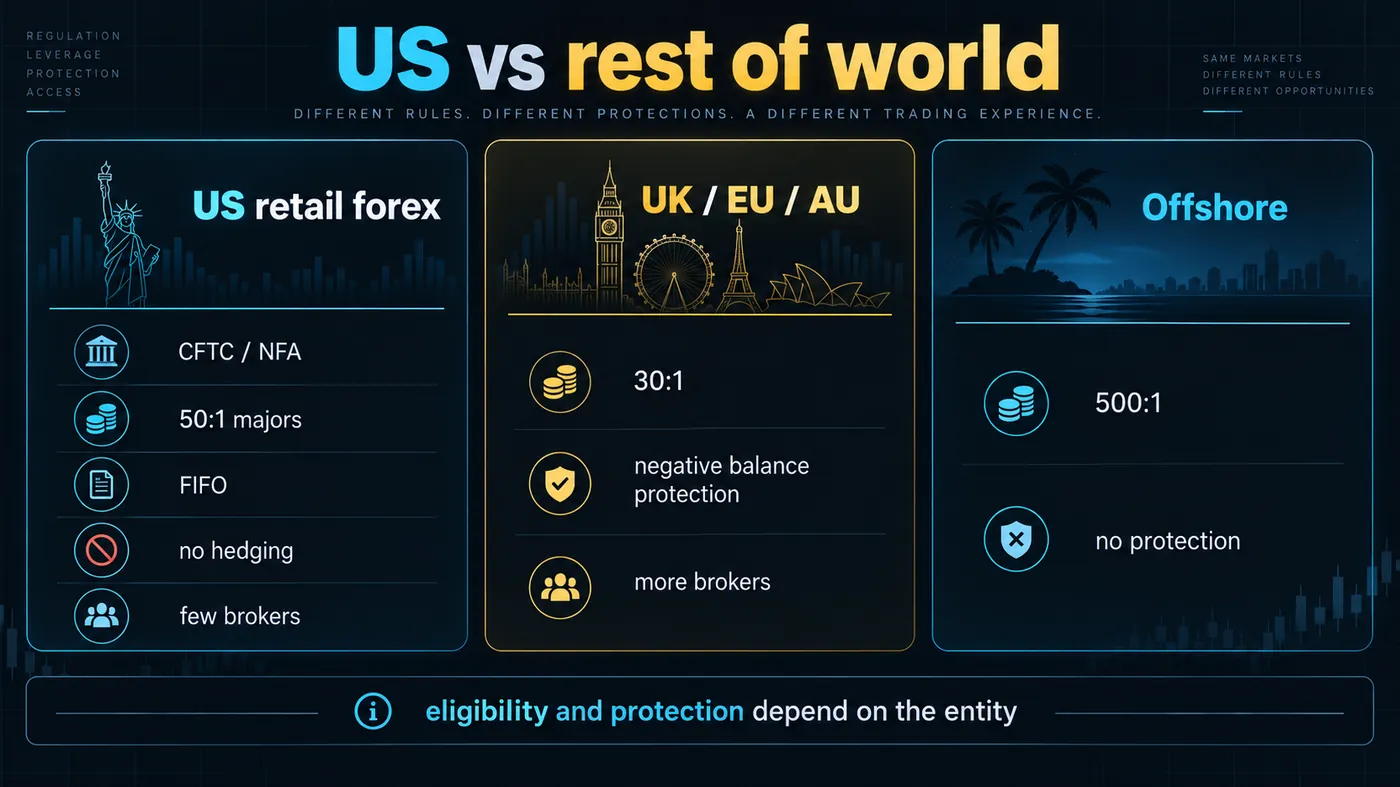
- United States (CFTC / NFA): retail forex only through NFA-registered forex dealer members. Leverage capped at 50:1 on majors, 20:1 on minors. FIFO rule (first in, first out on same-pair positions) and no hedging (no simultaneous long and short on one pair). High capital requirements for dealers mean very few brokers serve US residents — a handful — and CFDs are not available to US retail traders at all. The protections are real; the choice is narrow.
- UK / EU / Australia (FCA / ESMA-regulated / ASIC): leverage capped at 1:30 on majors, 1:20 on gold and indices; negative balance protection mandatory; segregation; FSCS or ICF compensation in the UK and EU. Wide choice of brokers; CFDs on everything.
- Offshore: leverage 1:500 and up, no caps, no protection, no compensation, and often no meaningful recourse. Available to almost anyone, which is the business model.
A US resident asking for the best forex broker has a short list defined by the NFA register; a UK resident has a long one defined by the FCA register; anyone else has to decide whether they want a regulated entity with 1:30 or an unregulated one with 1:500 — and should know that the second choice is the one the loss-rate disclosures are built on.
Execution models: market maker, STP, ECN
Forex brokers execute in one of three ways, and it matters for who is on the other side of your trade:
- Market maker (dealing desk). The broker takes the other side of your trade and manages its own book. Not inherently dishonest — every large bank does it — but the conflict is structural, and it is the model behind requotes and "last look". Common on standard accounts.
- STP (straight-through processing). Your order is passed to liquidity providers; the broker earns a mark-up on the spread. No dealing desk in principle, though the mark-up can be wide.
- ECN. Your order goes into an order book with other participants' orders and liquidity providers; the broker charges a commission and passes the raw spread. The model behind raw-spread accounts and cTrader DOMs.
The labels are marketing as much as mechanics, so verify with behaviour: does the broker publish execution statistics, does slippage go both ways (positive and negative), do requotes occur? A month at micro size answers all three.
Swap rates: the swing trader's real cost
Every position held past 5 pm New York is charged or credited the interest-rate differential between the two currencies, plus the broker's mark-up — the swap, or rollover. On a 1-lot EUR/USD long with the euro rate below the dollar rate, a typical swap is a few dollars a night against you; on an exotic like USD/TRY it can be tens of dollars a night either way; on Wednesday the charge is tripled to cover the weekend. A swing trader holding 5 lots for two weeks can pay more in swaps than in spread, which is why the comparison for swing traders is the swap table, not the EUR/USD headline spread. Islamic (swap-free) accounts exist at some regulated brokers with an admin fee instead; check the fee.

Automate your trades. Let Quantum Algo trade for you.
Every signal executed on your own account — on your account, with the plan you define.
Leverage: what 1:30 actually means for your account
Leverage is the maximum notional the broker will let you control per unit of margin; it is not a target. At 1:30 a $3,000 account can hold $90,000 of EUR/USD — 0.9 lots — but a 25-pip stop on 0.9 lots is $225, or 7.5% of the account, which is not a trade a beginner should take. The right way round: fix the risk (1% = $30), measure the stop (25 pips = $250 per lot), and the size follows (0.12 lots, $12,960 notional, using a fraction of the available leverage). Our lot size calculator does the arithmetic; the leverage cap only becomes relevant when it stops you, which at correct sizing it rarely does.
Checking a broker on the regulator's register
- UK: the FCA Financial Services Register — search the firm name, confirm the entity, permissions ("dealing in investments as principal"), and that client money is covered.
- Australia: ASIC Connect professional registers — AFS licence number and conditions.
- Cyprus / EU: the CySEC list of regulated entities, cross-checked with the passporting notification for your country.
- United States: NFA BASIC — registration as a Forex Dealer Member, disciplinary history, financial data.
Match the entity name on the register to the one on your account agreement, not to the brand on the website. A mismatch is the offshore entity.
Gold at a forex broker
XAU/USD is quoted at almost every forex broker and behaves differently from a currency pair: larger daily range ($20–40), a raw spread of $0.20–0.40 on good accounts and $0.50–1.00 on standard, 1:20 leverage under ESMA/FCA rules, and swaps that are usually against longs. Since gold is the market our engine was first built for, it is the instrument we check first on any broker: spread during the London–New York overlap, the contract size (100 oz per lot at most brokers, but not all), and whether the broker widens the spread around US data. A broker that is excellent on EUR/USD can be poor on gold.
Deposits, withdrawals and the account currency
Fund in the currency you will trade in — usually USD — to avoid a conversion on every trade's P&L. Prefer bank transfer or card for the first deposit so the withdrawal route is the same as the deposit route (regulated brokers must return funds by the method they arrived by). Test a withdrawal early; the time it takes and the fees it carries are the broker telling you how it treats clients on the way out.
The broker types, ranked for a chart-based trader
- Raw-spread ECN broker with an FCA / ASIC / CySEC entity, on cTrader or TradingView. Lowest all-in cost for active traders, real DOM on cTrader, regulated. Best for day traders and scalpers.
- TradingView-integrated regulated broker. Execution from the chart you analyse on, with every script and alert. Best for structure traders and for anyone running Zeno on forex and gold. Spreads are sometimes slightly wider on the integrated route; check your pair in your session.
- Regulated broker on MetaTrader 5. Universal, automation via Expert Advisors, weaker charting. Best if your strategy is an EA.
- NFA-registered US forex dealer. The only legal route for US residents; 50:1, FIFO, no hedging, few instruments beyond currencies. Best because it is the only option, and genuinely safe.
- Spread-betting firm (UK). Same products, different tax treatment for UK residents; FCA-regulated. Best for UK swing traders holding weeks.
- Broker's proprietary app only. Fine for beginners who will never load an indicator; add TradingView on day two.
- Offshore high-leverage broker. Not a category to choose; a category to recognise.
Account types beyond standard and raw
- Cent / micro accounts. Balances in cents with lot sizes a hundredth of standard; a legitimate way to trade live with real fills at $1 of risk. Better than a demo for the first live month.
- Pro / professional accounts. Under FCA/ESMA rules a client who meets two of three tests (trading frequency, portfolio size, financial-sector experience) can elect professional status and receive higher leverage — and lose negative balance protection and compensation cover in the process. Brokers push this; most retail traders should refuse it.
- Islamic / swap-free accounts. No overnight interest, usually replaced by an administration fee after a few days; check the fee schedule before assuming it is free.
- VIP tiers and "managed" accounts. A tier that comes with an account manager suggesting trades is a sales channel, not a service. A broker that offers to manage the account is not a broker; it is asking for a licence it should have.
Platform integration, specifically
If you analyse on TradingView, the broker question narrows to three shapes. A broker in TradingView's Trading Panel lets you execute from the chart — check which order types and symbols the integration exposes, and the spread on the integrated symbol versus the broker's own app. A cTrader broker gives you cTrader's charting and DOM natively and an "Open in TradingView"-style workflow via alerts. An MT5-only broker means analysis on TradingView and execution on MT5, with alerts to the phone as the bridge; workable, and the reason MT5 brokers should be chosen on regulation and swaps rather than on the platform.
Red flags
- Leverage of 1:500 or more offered without asking your residence.
- A "bonus" on deposit with withdrawal conditions attached.
- No regulator named on the website footer, or a regulator named that is not the one for your entity.
- Requotes on market orders during normal hours.
- Withdrawal requests that take longer than deposits by more than a few days, or fees that appear only at withdrawal.
- An account manager who calls to suggest trades.
- Reviews that mention "withdrawal" more often than "spread".
How we trade forex, and what we use
Quantum Algo's Gravity Zone engine runs on TradingView on forex majors and crosses, and our forex calls on the public track record — USD/CAD, GBP/USD, NZD/CHF, USD/ZAR and the rest — were posted from TradingView charts and executed through a regulated integrated broker. The broker is not named on this page because the point of the page is that you should be able to choose your own from the criteria, and because a name that is right today is a review that is wrong next year.
Choosing yours in five steps
- Find your regulator's register (NFA BASIC, FCA register, ASIC connect, CySEC's list) and shortlist only entities on it that accept your residence.
- Read the pricing page for the pairs you trade — raw spread plus commission, or standard spread — and run the calculator at your volume.
- Check the swap rates if you hold overnight.
- Confirm platform: TradingView integration, cTrader or MT5.
- Open at the minimum, trade micro lots for a month, withdraw part of the balance, and only then fund properly.
Choose the entity, not the brand: a regulated one for your residence, with segregation and negative balance protection, on a register you checked yourself. Then price it at your volume — raw plus commission for active traders, swaps for swing traders — and test it for a month at micro size, including a withdrawal. Refuse the bonus, the professional election and the account manager's trade ideas.
◆ Interactive check
Which entity, which protection?
Questions people ask about forex brokers
A regulated entity for your residence (FCA, ASIC, CySEC, or NFA in the US) with micro lots, a demo account on the live platform, transparent standard-account pricing, and TradingView or cTrader charting. Beginners should not be choosing on spread; they should be choosing on protection.
One of the NFA-registered forex dealer members that accept retail clients — the list is short and public on NFA BASIC. Expect 50:1 leverage, FIFO and no hedging; that is the regulation, not the broker.
For active traders, usually: raw spread plus commission is cheaper per lot than a standard spread on majors during liquid sessions. For a few trades a month, the difference is small; choose on regulation and platform instead.
If the broker is in TradingView's Trading Panel, yes — analysis and execution on one chart. If not, analyse on TradingView and execute on the broker's platform, taking alerts to your phone.
The high leverage they advertise exists because they are outside the rules that require segregation, negative balance protection and compensation. Treat funds there as at risk from the broker, not only from the market.
A regulated TradingView-integrated broker for forex, gold and indices; we do not name or promote it because the criteria on this page are what you should choose on. Zeno and Gravity Zone run on any broker you can chart on TradingView.
Raw-spread ECN accounts at regulated brokers quote 0.0–0.3 pips on EUR/USD during London and New York plus a commission; the all-in cost is what matters, and it is lowest at your volume on the calculator above, not on the marketing page.
No — a platform licensed by many brokers. The broker holds the money; MT5 is the front end. Choose the broker on regulation and swaps, then use MT5 if it is the only platform offered.
Regulated brokers commonly start from $0–100 for standard accounts and $200–500 for raw accounts; cent accounts allow live trading from a few dollars. The minimum is less important than micro lots and correct sizing.
Search the entity name — not the brand — on the FCA register, ASIC Connect, CySEC's list or NFA BASIC, and match it to your account agreement. A mismatch means you are with a different entity than the one advertised.
References & Related Guides
Read next
- Scammed by a Trading Platform? What to Do in the First 72 Hours, Where to Report, and the Second Scam to Avoid
- Is Forex Trading Legit? The Market Is Real — Most of What Retail Traders Meet Isn't
- Forex Market Hours: When the Forex Market Opens, Closes and Actually Moves
- Best Forex Pairs to Trade
- Best Trading Platforms
- Best Forex Indicator
- Lot Size Calculator for Forex and Gold
- Pip Value Calculator
- Best CFD Trading Platforms With Charting
- What Is Margin Trading?
- Leverage Trading: Complete Guide
Authoritative sources
- FCA: Financial Services Register
- NFA BASIC: forex dealer members
- ASIC: professional registers
- CySEC: regulated Cyprus investment firms
- ESMA: leverage caps and negative balance protection
- CFTC: retail forex advisories