Swing Trading Strategies: The Complete Multi-Day Position Trading Guide
| Signal type | Trading style |
| Directional bias | Both directions |
| Best context | 4H/Daily structure, holding days to weeks |
| Confirmation | HTF level plus LTF confirmation entry |
| Invalidation | Swing structure break against the position |
Swing trading holds positions for several days to several weeks to capture the moves between short-term noise and long-term trends, taking bias from the daily chart and entries from the 4-hour. It suits traders with full-time jobs: 4–8 trades a month, 1–2% risk per trade, 6–8% maximum portfolio heat, and a tested edge of at least 50% wins at 3:1.
1. What Is Swing Trading?
Swing trading is a trading style where positions are held from several days to several weeks, with the goal of capturing the meaningful price moves ("swings") that develop between short-term noise and long-term trends. Unlike day trading where all positions close within a single session, swing traders hold through overnight gaps and weekend market closures. Unlike position trading where holdings span months or years, swing traders cycle through positions on a multi-day-to-multi-week cadence.
Swing trading occupies the sweet spot for many serious traders. It captures larger moves than day trading while requiring far less screen time — most swing setups can be analyzed in 30-60 minutes of weekend preparation followed by daily check-ins of 15-30 minutes. Swing trading's compatibility with full-time employment makes it the dominant style for traders who maintain other careers. Industry surveys consistently show 40-50% of active retail traders identify primarily as swing traders.
The mathematical edge of swing trading comes from holding through the noise. Day trading captures small moves but requires constant decision-making — each trade is a fresh opportunity to make execution mistakes. Swing trading captures larger proportional moves while making far fewer decisions. A successful swing trader might take 4-8 trades per month versus a day trader's 40-80, with the swing trader often producing comparable or superior risk-adjusted returns due to less execution friction.
Swing trading works across all liquid markets — equities, forex, crypto, commodities, futures. The strategies that work in one market generally work in others with appropriate adjustments for volatility and trading hours. The dominant timeframes for swing analysis are Daily and 4-hour charts, with weekly charts providing higher context and 1-hour charts providing entry refinement. For contrast with shorter-term approaches, see our Day Trading Strategies Guide.
2. What are the 4 foundations of successful swing trading?
Strategies fail without foundation. Four foundational elements separate profitable swing traders from the majority who lose. Skipping any one of these is why most fail regardless of strategy choice.
Foundation 1: Adequate Capital. Swing trading has lower capital barriers than day trading. The Pattern Day Trader rule (replaced by FINRA on 4 June 2026, though brokers may apply it until 20 October 2027) never covered swing positions held overnight. Practical minimums: $5,000 to start (allows meaningful position sizes with 1% risk), $15,000-$25,000 ideal (enables full diversification across 5-10 concurrent positions). Below $5,000, position sizes become so small that even profitable strategies struggle to overcome commissions and produce meaningful returns.
Foundation 2: Validated Edge. An "edge" is a tested strategy with positive expectancy across many trades. Swing trading's edge thresholds are slightly different from day trading because of the longer hold times and larger move targets. Minimum threshold: 50% win rate at 3:1 risk-reward, or 40% win rate at 4:1 risk-reward. Below these levels, the math doesn't support long-term profitability. Edge must be proven through backtesting on at least 100 trades and forward-tested in real markets before scaling.
Foundation 3: Risk Control Discipline. Swing trading risk control follows the same principles as day trading but with slightly different application. Risk per trade: 1-2% (slightly higher than day trading's 1% due to wider stops needed for multi-day holds). Portfolio heat (total open risk across all positions): 6-8% maximum. Hard stops on every position. Honor the stops mechanically — discretion under emotional pressure is where swing traders blow up. The biggest swing trading failures come from holding losers "hoping they'll come back" rather than honoring stops.
Foundation 4: Trading Psychology. Swing trading psychology has two dimensions absent from day trading: overnight hold tolerance and the patience required for setups to develop. Overnight tolerance: can you sleep peacefully holding a 5-day position through after-hours news? If overnight stress consistently impacts sleep, scaling position sizes down may be necessary regardless of mathematical risk management. Patience: swing setups develop over days or weeks. Forcing trades during low-quality periods is the single most common swing trading failure mode. The discipline to wait for A+ setups is a learnable skill.
The compound effect: All four foundations multiply together. Strong strategy with weak risk control = blow-up. Weak strategy with strong risk control = slow decline. Strong on three but weak on one = inevitable failure. All four = the rare combination that produces sustained profitability. Most failed swing traders focus exclusively on Foundation 2 (strategy hunting) while ignoring the other three.

Automate your trades. Let Quantum Algo trade for you.
Every signal executed on your own account — 24/7, hands-off.
3. What Are the Best Swing Trading Strategies? Five Core Approaches
The following five strategies have produced consistent edge across markets and decades. Each works in specific conditions — understanding when each applies is as important as the mechanics.
Strategy 1: How do you trade a trend pullback?
The foundational swing trading strategy. Identify a clear uptrend on the Daily chart (higher highs and higher lows, price above 20 and 50 EMAs). Wait for a pullback to the 20 EMA or recent structural support. Enter long on the first daily candle that closes higher after the pullback completes. Stop below the pullback low + 0.5 ATR. Target the next swing high or measured continuation of the prior leg.
Best markets: Trending equities (especially during earnings season catalysts), trending forex pairs, crypto during sustained bull/bear cycles. Avoid in choppy markets where pullbacks fail to find clean support.
Expected metrics: Win rate 55-65% in confirmed trends. R:R 2:1 to 4:1. The most accessible swing trading strategy for beginners.
Strategy 2: How do you trade a breakout continuation?
The momentum swing trading strategy. Identify a clear consolidation pattern on the Daily chart — typically a flag, triangle, rectangle, or cup and handle. Wait for a decisive close beyond the consolidation's boundary on elevated volume. Enter on the breakout candle close or the next day's open. Stop just inside the broken consolidation + 0.5 ATR. Target the measured move (consolidation height projected from breakout). See our Flag Pattern Guide and Triangle Pattern Guide.
Expected metrics: Win rate 60-70% on validated breakouts. R:R 3:1 to 6:1 — among the highest R:R in swing trading. Requires patience for proper setups to develop.
Strategy 3: How do you trade a reversal at major levels?
The counter-trend swing strategy. Identify exhausted trends approaching major higher-timeframe support or resistance — weekly swing highs/lows, major Fibonacci retracements, monthly pivot levels. Wait for reversal signals: bullish/bearish engulfing candles, morning/evening star patterns, RSI divergence at extremes. Enter on confirmation candle close. Stop beyond the extreme + 1 ATR (slightly wider than trend strategies). Target the next opposing structural level.
Best markets: All liquid markets at major weekly/monthly levels. Particularly effective in forex and indices at round-number psychological levels.
Expected metrics: Win rate 50-60% (lower than trend strategies due to counter-trend nature). R:R 3:1 to 5:1. Lower win rate compensated by exceptional R:R when correctly identified.
Strategy 4: How does the SMC swing setup work?
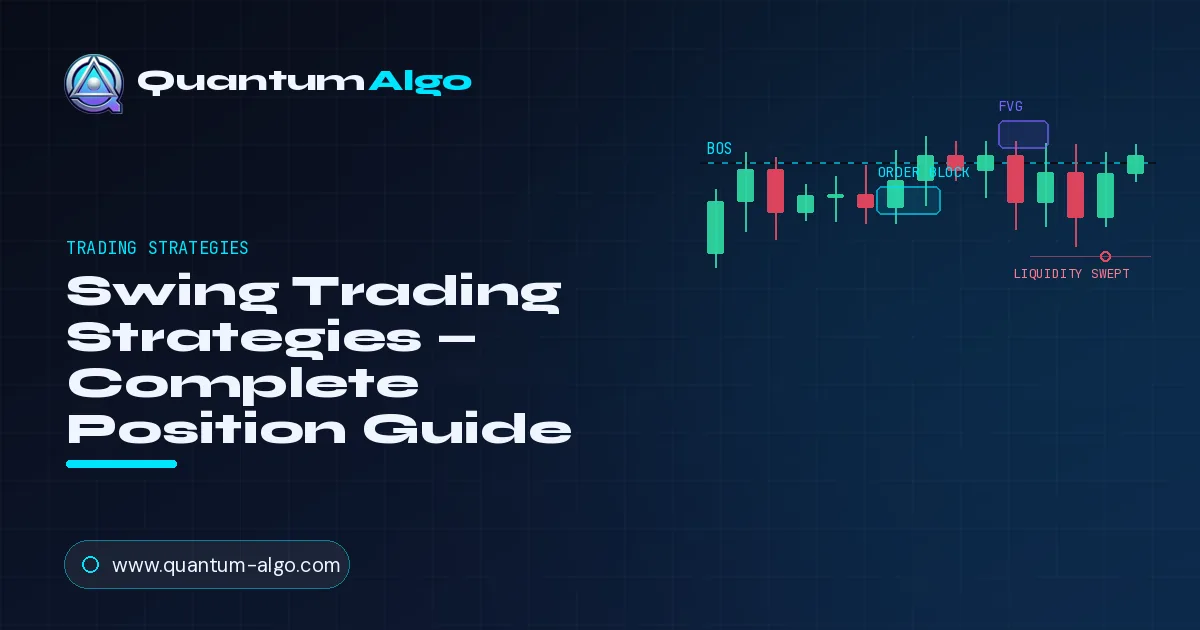
The Smart Money Concepts swing strategy. Identify higher-timeframe order blocks (Weekly or Daily). Wait for price to return to the order block from the breakout side. Enter on rejection confirmation candle inside the order block. Stop just beyond the order block + 0.5 ATR. Target the next opposing structural level (typically 3:1 to 5:1 R:R).
Why this works: Order blocks mark where institutions positioned on the higher timeframe. Their return to the level represents reactivation of that institutional positioning. Win rates 65-75% on properly identified setups with multi-timeframe confluence. See our Order Block Trading Guide.
Strategy 5: How does multi-timeframe confluence work?
The institutional-grade synthesis. Identify the higher-timeframe trend on Weekly chart. Identify the medium-timeframe structure on Daily chart. Wait for entry confirmation on 4H or 1H chart at a structural level. The triple-timeframe alignment produces the cleanest swing setups available. Win rates 70%+ when all three timeframes confirm.
Example sequence: Weekly = clear uptrend. Daily = pullback to 50 EMA approaching weekly demand zone. 4H = bullish engulfing candle confirming the pullback ending. Enter on 4H close. Stop below the 4H swing low. Target next weekly resistance. This sequence captures both directional context (weekly) and precise timing (4H).
4. How should swing traders manage risk?
Strategy edge alone produces nothing without disciplined risk management. The framework below is non-negotiable for serious swing traders.
Rule 1: 1-2% risk per trade. Calculate position size such that the distance from entry to stop equals 1-2% of account equity. Most professional swing traders use exactly 1%. Slightly higher (1.5-2%) is acceptable for highest-conviction setups with multi-timeframe confluence — but only after consistent profitability has been established at 1%. Never override this rule "just this once."
Rule 2: Portfolio heat cap of 6-8%. Total open risk across all concurrent positions should not exceed 6-8% of account equity. If holding 5 positions at 1% risk each, you're at 5% heat. Adding a 6th position at 2% would push heat to 7% — manageable. Adding two more 2% trades would push to 11% — exceeds the cap, force a wait until existing positions close.
Rule 3: Hard stops on every position. Set the stop-loss order at the moment of entry. Never trade without a defined invalidation level. "Mental stops" fail under emotional pressure, particularly the multi-day pressure swing traders experience. Hard stops execute mechanically and remove the most common failure mode.
Rule 4: Minimum 3:1 risk-reward. Never take swing trades with worse than 3:1 risk-reward. Below this threshold, even high-win-rate strategies struggle to overcome commissions, slippage, and the inevitable losing streaks. Most successful swing traders target 3:1 minimum, with 4:1 to 6:1 on the best setups.
Rule 5: Scale out at 2:1, trail to runner. When the trade moves favorably to 2:1 risk-reward, close 50% of the position and move stop to breakeven on the remainder. Let the remaining 50% run to full target with a trailing stop (typically 3-day swing low for longs, 3-day swing high for shorts). This approach captures the math advantage — largest size on closest targets, smallest size for runners.
Rule 6: Maximum 5-10 concurrent positions. Practical limit on attention and analysis. With more than 10 simultaneous positions, you cannot maintain quality analysis on each. Most successful swing traders run 5-8 positions concurrently — enough for diversification, few enough for proper attention.
5. What does a weekly swing trading routine look like?
Strategy edge plus risk framework still fails without consistent execution. The weekly routine separates successful swing traders from those who improvise.
Sunday Evening Preparation (60-90 minutes): Review the week ahead — economic calendar, earnings releases, central bank meetings, geopolitical events. For your watchlist (typically 30-50 assets), check higher-timeframe charts and identify which setups are forming. Mark structural levels: weekly swing highs/lows, daily order blocks, key Fibonacci retracements. Plan the week's candidates — typically 5-10 assets with developing setups.
Daily Check-In (15-30 minutes): Each morning before work (or at market open if available), check the daily candle close from yesterday on watchlist assets. Note which setups have completed (entry signals fired), which have invalidated (stop levels broken), which remain pending. Set price alerts at entry triggers for pending setups. Adjust stops on existing positions per strategy rules (typically trailing stops based on swing lows/highs).
Trade Execution (5-10 minutes per trade): When entry triggers fire, execute mechanically. Calculate position size based on the strategy's defined stop. Place the entry order (typically a limit order at the trigger price or a market order if confirmation requires). Place the stop-loss simultaneously. Note the trade in your journal.
Weekly Review (Friday Evening, 30-60 minutes): After Friday close, review every trade from the week — entries, exits, results, journal notes. Aggregate metrics: total trades, win rate, average R:R, net P&L, drawdown. Compare to the strategy's expected metrics. Identify any deviation patterns (taking marginal setups, exiting too early, moving stops). Plan adjustments for next week.
Monthly Deep Review: First weekend of each month, review the prior month's trades in detail. Identify the most profitable setup type and the least profitable. Identify behavioral patterns — which mistakes recur? Which improvements have stuck? Strategic adjustments — should I add another strategy? Should I drop a strategy that isn't producing? Should I adjust position sizing or portfolio heat?
Quarterly System Review: Every quarter, conduct a full system review. Re-examine your strategies against current market conditions. Some strategies that work in trending environments fail in choppy ones — or vice versa. Adapt to current regime while maintaining the core risk framework. Most professional swing traders make strategy adjustments quarterly, not constantly.
6. What are the most common swing trading mistakes?
Mistake 1: Holding losers past stop levels. The single most destructive swing trading mistake. The multi-day hold creates emotional attachment to positions. When stops are hit, the temptation is to "give it one more day" — often turning small planned losses into account-blowing disasters. Stops are non-negotiable; honor them mechanically.
Mistake 2: Overtrading during low-quality periods. Some weeks produce many A+ setups; some weeks produce none. Forcing trades during low-quality periods is how successful swing traders go from profitable to unprofitable. The discipline to do nothing when no setups exist is one of the highest-edge skills in the field.
Mistake 3: Wrong position sizing. Either too small (not meaningful enough to produce returns) or too large (single trade can produce account-damaging losses). The 1-2% per trade rule combined with portfolio heat caps must be enforced consistently. Sizing inconsistency is one of the most common failure modes.
Mistake 4: Strategy hopping. Trying a new strategy after 10 trades, switching to another after 20. Strategies need 50-100+ trades to evaluate properly. Switching prematurely prevents learning whether the strategy works for you specifically. Commit to one strategy for at least 100 trades before evaluating.
Mistake 5: Ignoring higher-timeframe context. Daily-chart swing setups that conflict with weekly trends frequently fail. Always check the higher timeframe before taking any swing entry. Setups aligned with both daily and weekly trends produce significantly higher win rates than isolated daily setups.
Mistake 6: News-driven trading. Reacting to news headlines, social media posts, or analyst calls. By the time information reaches retail traders, institutional flow has typically already adjusted. Trade your defined setups regardless of news; let your strategy do the analysis, not headlines.
7. Test Your Knowledge
Seven questions on swing trading strategies.
8. Swing Trading with Smart Money Concepts
The SMC Swing strategy — combining higher-timeframe order blocks with multi-timeframe confluence — produces the most consistent edge in swing trading. Identifying these setups manually across 30-50 watchlist assets requires hours of analysis. Algorithmic detection transforms swing trading from labor-intensive to systematic.
• Order block detection on Daily and Weekly — institutional zones for swing entries
• FVG identification — multi-day gap-fill setups
• Liquidity sweep alerts — sweep continuation setups across timeframes
• Multi-timeframe context — weekly trend with daily entry alignment
• Smart alerts — notified the moment confluence setups appear
Frequently Asked Questions
Swing trading strategies are systematic approaches for holding positions several days to several weeks to capture meaningful price moves. The five most effective: Trend Pullback, Breakout Continuation, Reversal at Major Levels, SMC Swing, and Multi-Timeframe Confluence. Each works in specific market conditions.
Practical minimum is $5,000 to start (allows meaningful position sizes with 1% risk). Ideal is $15,000-$25,000 (enables full diversification across 5-10 concurrent positions). Swing trading was never subject to the Pattern Day Trader rule (which FINRA replaced with intraday margin standards on 4 June 2026), so US equity swing trading is accessible at lower capital levels.
Trend Pullback is the most accessible. Identify a clear uptrend, wait for a pullback to the 20 EMA or structural support, enter on the first daily candle that closes higher after pullback completes. Stop below pullback low. Target the next swing high. Win rates 55-65% in confirmed trends.
Swing trades typically last 2 days to 3 weeks, with most resolving in 3-10 days. Trades that haven't hit targets or stops within 3 weeks often signal that the original thesis has invalidated — consider exiting flat regardless of P&L. The "right" duration depends on the setup type and timeframe.
Day trading: positions opened and closed within a single session. Swing trading: positions held days to weeks. Day trading captures small moves at high frequency; swing trading captures larger moves at lower frequency. Swing trading requires less screen time and was never subject to the PDT rule (replaced by FINRA on 4 June 2026), making it more accessible to traders with full-time jobs.
Most successful swing traders take 4-12 trades per month — quality over quantity. Forcing more trades during low-quality periods is one of the most destructive mistakes. Some months produce many A+ setups; some months produce few. Trade only when setups meet your defined criteria.
Yes — swing trading is the most popular trading style among traders with full-time employment. Total time commitment: 60-90 minutes Sunday prep + 15-30 minutes daily check-in + 30-60 minutes Friday review = roughly 5-7 hours per week. This fits comfortably alongside most full-time careers.
Primary analysis: Daily chart. Higher-timeframe context: Weekly chart. Entry refinement: 4H or 1H chart. The triple-timeframe approach (Weekly + Daily + 4H/1H) produces the highest-edge swing setups. Avoid analysis on 15M or lower — too noisy for multi-day holds.
More guides
References & Related Guides
More in this topic
- Intraday vs End-of-Day Trading: Which Is Better, and Which Fits Your Life
- Swing Trading vs Buy-and-Hold: Can Swing Trading Beat the S&P 500? The Honest Arithmetic
- Backtesting Trading Strategies — Complete Guide
- What Are the Best Indicators for Day Trading?
- What Are the Best Indicators for Scalping?
- What Are the Best Indicators for Swing Trading?
- Best TradingView Strategy — The Definitive Guide
- Breakout Probability: Complete Trading Guide
- Breakout Trading Strategy: Complete Guide
- Day Trading Strategies — The Complete Profitable Guide
- Gap Trading Strategy: Complete Guide
- Grid Trading Strategy: The Complete Guide
- Institutional Trading Strategy: Trade Like Banks
- Position Sizing: The Complete Guide
Core reading
- BOS & CHoCH: Complete Market Structure Guide
- Order Blocks Trading: Complete Guide
- Best TradingView Indicators — Complete Guide
- Risk Management in Trading — Complete Guide
- Candlestick Patterns Guide — Engulfing, Pinbar & More
- All Premium Guides
- Quantum Algo on TradingView
- Public Track Record