Premium and Discount Zones
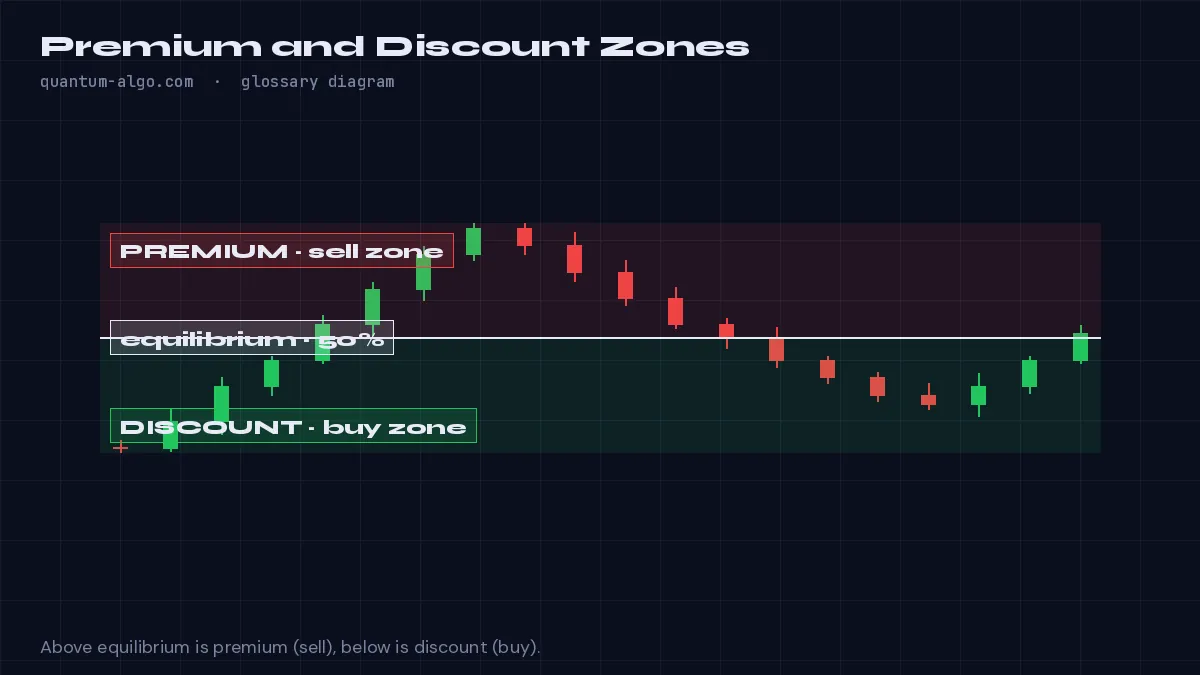
The upper half (premium) and lower half (discount) of a price range, divided by the 50% equilibrium line, used to determine institutional entry quality.
What it means
Premium and discount zones are the two halves of a price range divided by the 50% equilibrium line. The premium zone is the upper half (above 50%); the discount zone is the lower half (below 50%). Institutional buyers prefer to enter long positions in the discount zone (cheaper relative to the recent range), and institutional sellers prefer to enter short positions in the premium zone (more expensive relative to the recent range).
The framework is simple but powerful: longs in discount, shorts in premium. Entries that violate this rule (longs in premium, shorts in discount) are 'chasing' — entering against the optimal institutional positioning level. The rule does not prohibit such trades, but it does suggest reduced position size or skipping unless extraordinary confluence is present.
The 50% midpoint of the range is the equilibrium level. It functions as a directional bias indicator: price above equilibrium = bullish bias for the range; price below = bearish bias. Many institutional execution algorithms reference the equilibrium of the prior session, day, or week as their default 'fair value' anchor.
Practical application: identify the most recent significant range (between the most recent major swing high and major swing low). Mark the 50% line. Only take long entries when price retraces into the discount zone (with valid SMC confluence — OB, FVG, liquidity sweep). Only take short entries when price rallies into the premium zone with similar confluence. This filter alone improves win rates 4–7 percentage points across most SMC strategies.
How to identify it on a chart
- Define the dealing range: the last significant swing low to swing high.
- The 50% level is equilibrium.
- Look for longs only below it and shorts only above it, at order blocks or gaps.
Worked example
The range runs 2,400–2,600; equilibrium is 2,500. A bullish order block at 2,440 sits in the discount — a valid long location; the same block at 2,560 would be ignored.
See it on the chart, read it in depth
Frequently asked questions
How do I draw premium and discount zones correctly?
Use the most recent major swing high to swing low (or vice versa) on your trading timeframe. Draw a Fibonacci from low to high. The 50% level is equilibrium. Above 50% is premium; below is discount. Use the 4H or daily for swing trades; 1H or 15m for intraday.
What if price is at exactly 50%?
Avoid entries at equilibrium. The zone offers no risk-to-reward advantage. Wait for price to move into clear premium (for shorts) or clear discount (for longs) before considering entries.
Should I scale into trades from premium to discount?
Some traders do, especially on swing-trade timeframes. Enter a small position when price first touches the favorable zone (e.g., the upper edge of discount for longs), then add as price drops deeper into the discount zone with continued confluence. This averages your entry into the deep discount level.
Related terms
See Premium and Discount Zones on your TradingView chart
Zeno reads Smart Money structure across timeframes and prints the entry, stop and targets — with a public record of every posted trade. The free indicators draw the concepts this page defines.