Turtle Soup
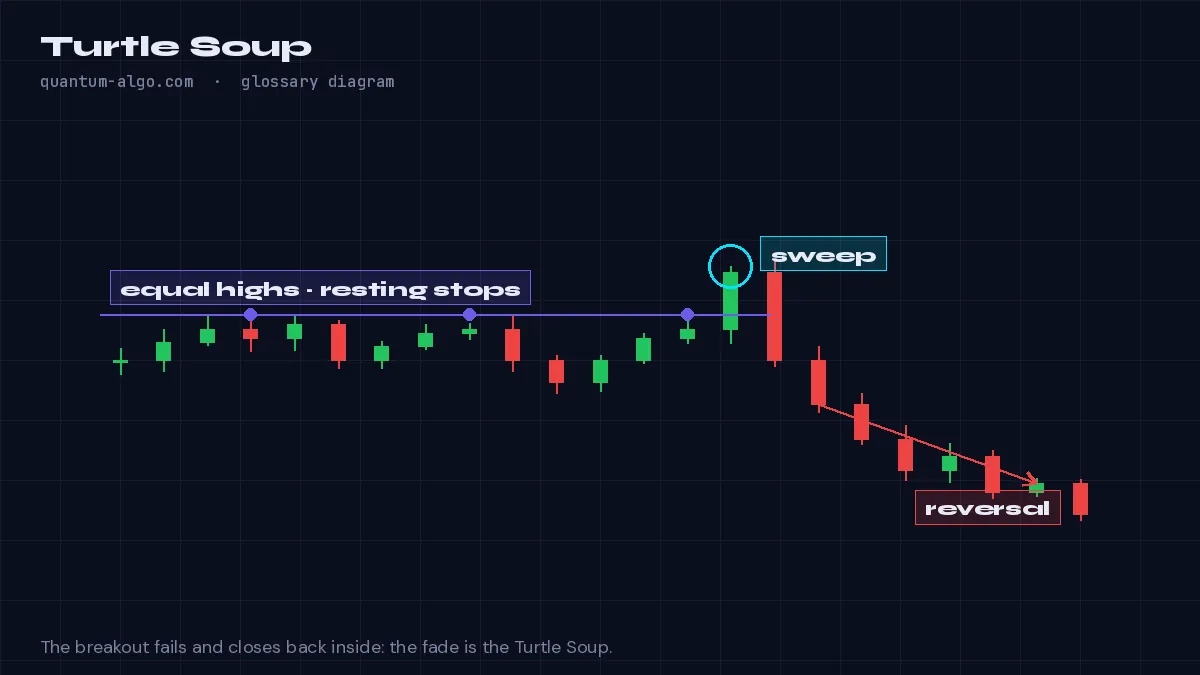
Turtle Soup is a reversal setup that fades a false breakout: when price breaks a prior 20-day high or low and fails to hold, the trade enters against the break, with the stop beyond the failed extreme — in SMC terms, a traded liquidity sweep.
What it means
Turtle Soup, named by Linda Raschke and Laurence Connors after the Turtle traders' breakout system it exploits, sells a new 20-day high that immediately fails and buys a new 20-day low that immediately reverses. The breakout traders become the liquidity for the fade — which is exactly the Smart Money reading of a liquidity sweep.
ICT adopted the name for sweeps of old highs and lows on any timeframe: price runs a level where stops rest, cannot hold beyond it, and reverses. The trigger is the failure — a close back inside — not the break itself; the stop goes beyond the sweep extreme and the target is the opposite side of the range.
The setup works because a genuine breakout does not need to return inside the range. A return within a few bars says the break had no real demand behind it, only stop orders.
How to identify it on a chart
- Mark the prior high or low that the market is approaching (the 20-day extreme in the original rules; any liquidity level in SMC).
- Price breaks it, then closes back inside within a few bars.
- Enter against the break on that close; stop beyond the extreme; target the range's other side.
Worked example
Gold makes a new 20-day high at 2,412, trades there for 40 minutes and closes the hour at 2,398. The Turtle Soup short enters at 2,398 with the stop at 2,416 and targets the 20-day range midpoint.
See it on the chart, read it in depth
Frequently asked questions
Why is it called Turtle Soup?
It fades the Turtle traders' 20-day breakout rule — "making soup out of the turtles."
Is Turtle Soup the same as a liquidity sweep?
It is the classic trading setup built on one: the sweep is the event, Turtle Soup is one way to trade it.
What is Turtle Soup Plus One?
A variation where the reversal comes the day after the breakout rather than the same day, with the entry on the following bar.
Does it work intraday?
Yes — ICT applies the same logic to session highs and lows on 5–15 minute charts.
Related terms
See Turtle Soup on your TradingView chart
Zeno reads Smart Money structure across timeframes and prints the entry, stop and targets — with a public record of every posted trade. The free indicators draw the concepts this page defines.