Internal vs External Liquidity
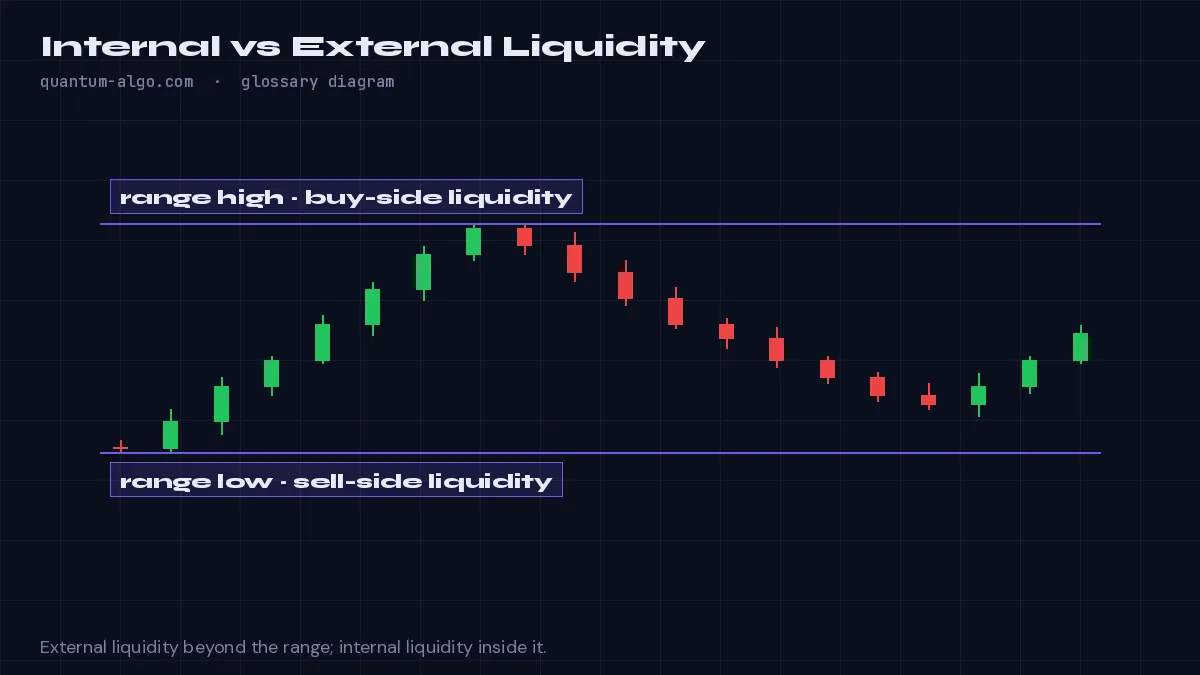
External liquidity is the stops resting beyond a dealing range's high and low; internal liquidity is the imbalances and order blocks inside the range. Price alternates between the two: it runs external liquidity, then returns to internal liquidity, then runs external again.
What it means
Every dealing range holds two kinds of targets. External range liquidity sits beyond the range extremes — buy stops above the high, sell stops below the low. Internal range liquidity is inside the range: fair value gaps, order blocks and voids that price returns to fill. The ICT model of price delivery is a pendulum between them: from external to internal and back.
This gives a directional rule. After price runs external liquidity (a sweep of the range high), expect it to come back to internal liquidity (the nearest gap or block inside the range). After it fills internal liquidity, expect it to seek the opposite external pool. Knowing which leg you are in tells you the next target.
The concept explains why a sweep of a high is followed by a return into the range, and why a filled gap inside a range is followed by an expansion — and it is the basis for target selection in the free Smart Money scripts.
How to identify it on a chart
- Draw the dealing range and mark the liquidity beyond both extremes (external).
- Mark the gaps and blocks inside it (internal).
- Ask which was taken last; the next target is the other kind.
Worked example
Price sweeps the range high (external) and rejects. The nearest internal liquidity is a bullish FVG at 40% of the range — the short targets that gap. Once it fills, the long from the gap targets the range low's external liquidity next.
See it on the chart, read it in depth
Frequently asked questions
Which comes first, internal or external?
Either — the sequence is a pendulum. Identify what was just taken and target the other.
Is an order block internal liquidity?
Yes — order blocks and gaps inside the range are internal liquidity; the range extremes hold the external liquidity.
How does this set targets?
After an external sweep, target the nearest internal gap; after an internal fill, target the opposite external pool.
Does it apply on every timeframe?
Yes; a 15-minute range has its own internal and external liquidity nested inside the 4-hour's.
Related terms
See Internal vs External Liquidity on your TradingView chart
Zeno reads Smart Money structure across timeframes and prints the entry, stop and targets — with a public record of every posted trade. The free indicators draw the concepts this page defines.