What Is Institutional Trading? How Big Orders Move Markets (and Leave Footprints)
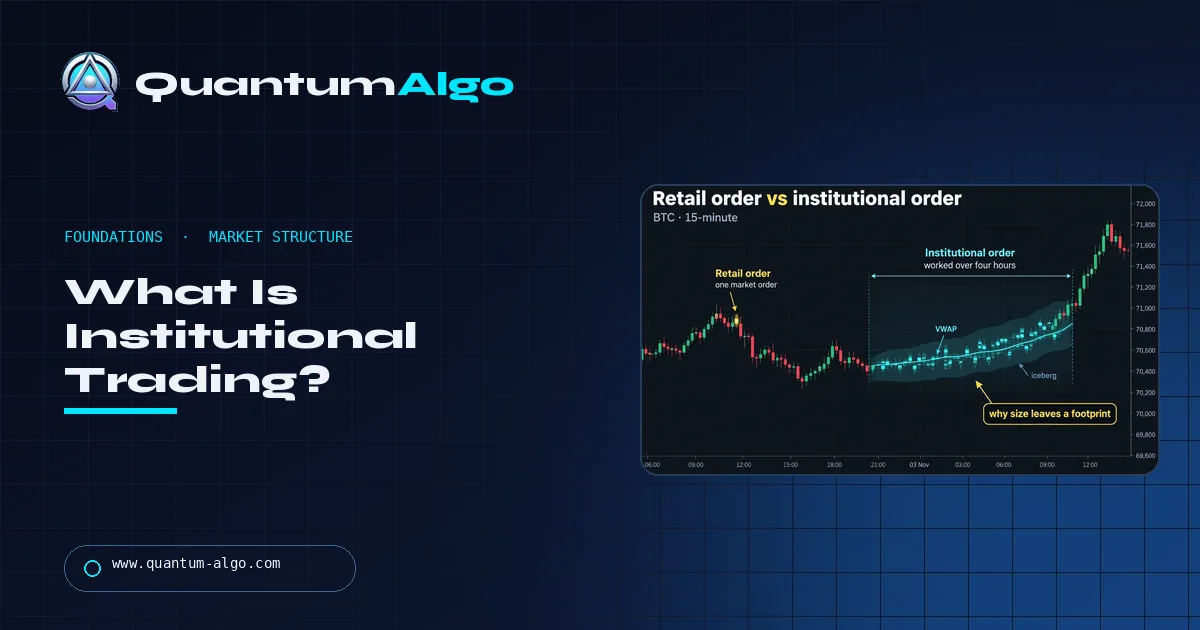
Institutional trading is trading by organizations (banks, funds, asset managers, market makers) whose defining problem is size relative to liquidity. A $200 million order cannot be clicked once; it is worked over hours with execution algorithms, split across lit exchanges and dark pools, and financed by a prime broker. That leaves chart footprints: order block, displacement, imbalance, swept liquidity.
The phrase "institutional trading" is used two ways: by people who want to know how a desk actually works, and by people wondering whether the platforms institutions use are available to them. This page answers both honestly — the plumbing (OMS, algos, dark pools, prime brokers), why size cannot hide on a chart, which retail beliefs about institutions are myths, and the three things an individual can genuinely copy. It is also the bridge to the Smart Money Concepts the rest of this Academy teaches.
Indicators that prove themselves in public.
One engine, four precision tools — the Gold (XAU) Scalper, the institutional Gravity Zone, the Zeno momentum Oscillator, and Zeno Stocks for equities.
What is institutional trading?
Institutional trading is trading done by organisations — banks, hedge funds, pension funds, asset managers, market makers and sovereign funds — rather than by individuals. The defining feature is size: an institution moving $200 million into a stock cannot click "buy" once. It has to work the order over hours or days, split it into pieces, route it through algorithms and venues built for that purpose, and try not to move the price against itself while doing so.
That effort is what this site's method is built around. The footprints an institution leaves — the block where the order was filled, the displacement when it finished, the imbalance left behind, the liquidity it took above the highs — are visible on an ordinary chart, and Smart Money Concepts is the practice of reading them. This page is what institutional trading actually is, how the plumbing works, and where the retail reading of it is accurate and where it is myth.
Who are the institutional traders?
- Market makers quote both sides continuously and earn the spread; they hold inventory for seconds to hours and are often the counterparty to retail orders.
- Hedge funds run strategies from days to months — long/short equity, macro, stat-arb, trend following.
- Asset managers and pension funds buy and hold; their trades are large, slow and often executed at the closing auction or via VWAP algorithms.
- Banks' dealing desks run the interbank forex market and handle client flow in currencies, rates and commodities.
- Sovereign wealth funds and central banks move currencies and gold on timescales of years.
Their goals differ; their problem is the same: size relative to available liquidity.
How does a large order get executed?
The retail-vs-institutional illustration in this guide shows the difference on one BTC chart. A retail order is a single market order that fills in one tick. An institutional order is worked over four hours along a VWAP line, in small slices, often as an iceberg that shows only part of its size on the book.
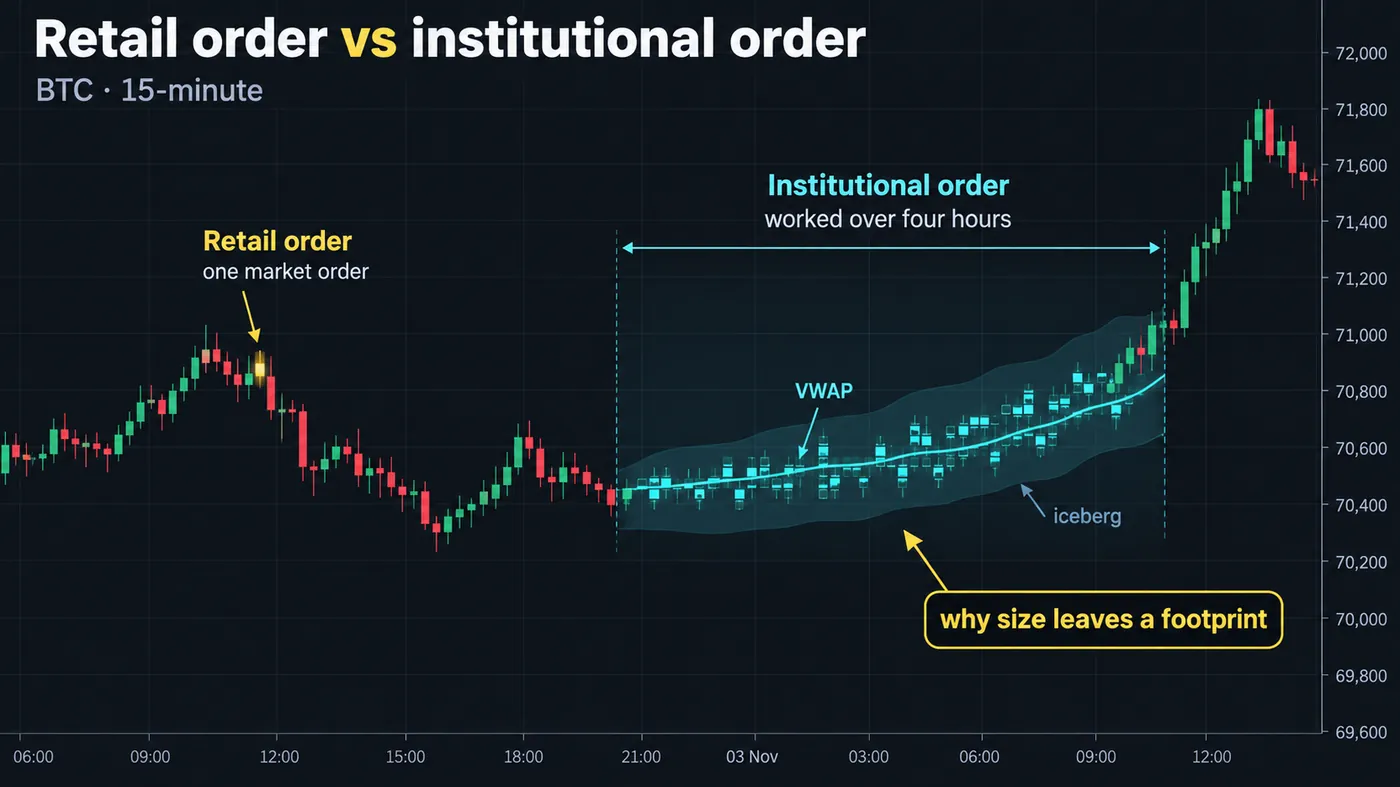
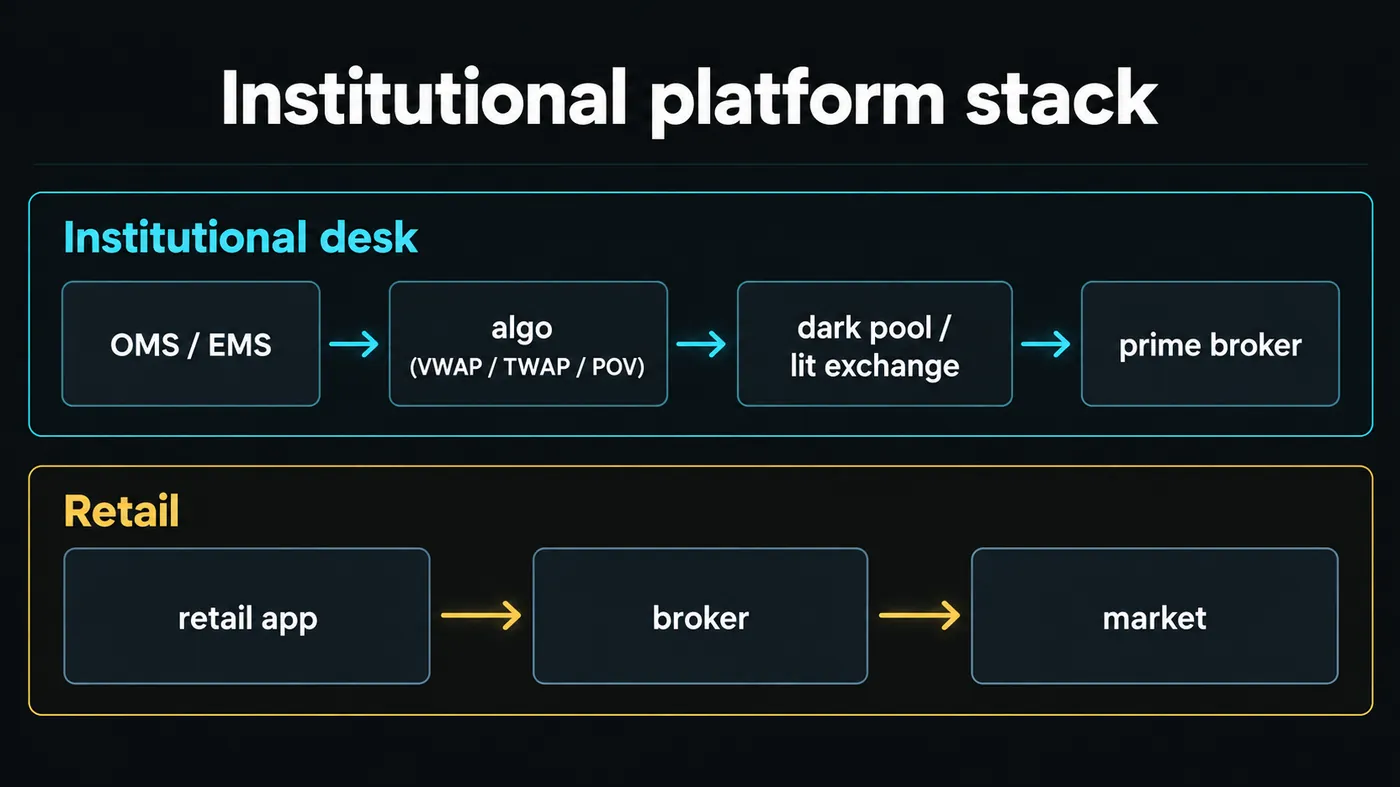
The tools have names you will see in job adverts and never in retail apps: an order management system holds the parent order; an execution management system routes it; execution algorithms — VWAP, TWAP, POV (percentage of volume), implementation shortfall — decide how to slice it; the slices go to lit exchanges or dark pools where large blocks cross without displaying; a prime broker finances and clears the whole thing. The platform-stack illustration in this guide puts that chain next to the retail one — app → broker → market — which is three boxes because none of the problems above exist at retail size.
Retail vs institutional order at a glance
| Aspect | Retail trader | Institution |
|---|---|---|
| Order size | Fills in one tick | Too large to fill without moving price |
| Execution | One market order | Worked over hours in small slices |
| Systems | App and broker | Order and execution management systems |
| Algorithms | None needed | VWAP, TWAP, POV, implementation shortfall |
| Venues | Broker routes to the market | Lit exchanges and dark pools |
| Financing and clearing | Broker account | Prime broker |
Why does size leave a footprint on the chart?
A worked order still consumes liquidity. Buying steadily for four hours lifts the offers, creates a run of candles with more buying than selling, and often ends in a burst when the algorithm finishes or when other participants notice. On the chart that shows up as:
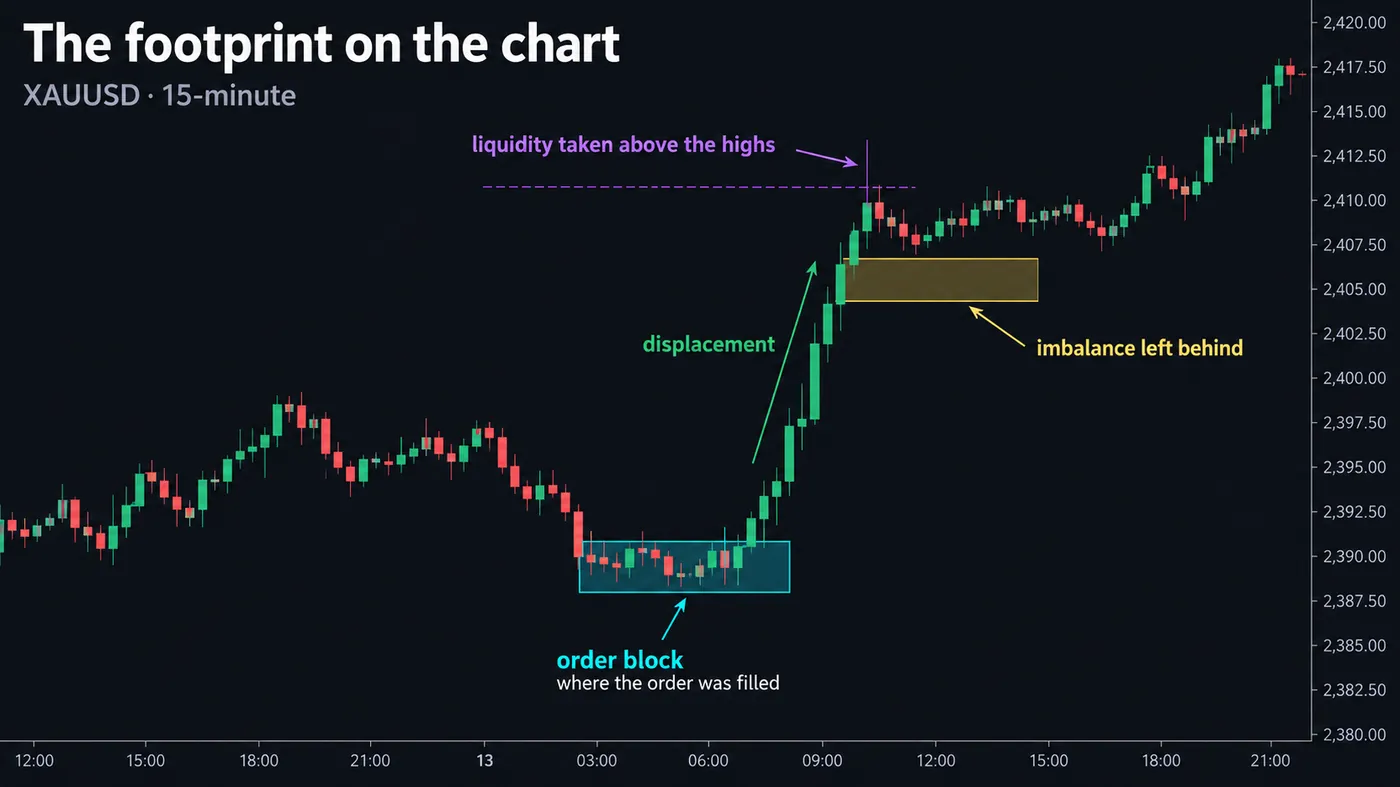
- an order block — the last consolidation before the move, where the bulk of the order was filled;
- displacement — the fast candles as remaining liquidity is taken;
- an imbalance or fair value gap — the range price skipped through with no two-sided trading;
- liquidity taken — the sweep of obvious highs or lows where stops and breakout orders were resting.
The footprint illustration in this guide labels all four on an XAUUSD 15-minute chart. The claim of Smart Money Concepts is not that you can see the institution's order — you cannot — but that this pattern is the reliable residue of size, and that price tends to return to the block where the order was filled.
Do institutions hunt stops or use secret indicators?
Two ideas circulate in retail communities that do not survive contact with how desks work. The first is that institutions "hunt" retail stops: they do not target you; they need liquidity, stops are liquidity, and the algorithm goes where liquidity is. The second is that institutions trade with secret indicators: they use execution algorithms and risk systems, not chart signals, and the "institutional-grade" label on a retail indicator is a marketing word. What institutions do have is size, information and patience, and only the last one is available to you.
Can retail traders use institutional trading platforms?
Search traffic for "institutional trading platform" is mostly people wondering whether they can use one. The honest answer: Bloomberg terminals, EMS/OMS suites and prime-broker portals are licensed to firms at five and six figures a year and require regulatory status you do not have as an individual. What you can access is the market data they see (with delay), the same order types at your broker, and charting that reads their footprints — which is where Quantum Algo's free indicators and Zeno sit.
What can retail traders learn from institutional trading?
Three things, and they are enough:
- Trade the footprint, not the rumour. Order blocks, displacement, imbalances and sweeps are observable; "institutions are buying" is a guess.
- Copy the patience. Institutions wait for their price; the retest of a block is exactly that behaviour on a smaller scale.
- Copy the risk process. Every desk has a maximum loss per position and a risk manager who can close it. Your stop and your position-sizing rule are the retail version.
Institutions are defined by size, not by secret tools. A large order is worked over time through algorithms, lit venues and dark pools, and the working leaves a reliable residue on the chart — order block, displacement, imbalance, swept liquidity. Ignore the myths about stop hunts and secret indicators; copy the patience and the risk process, and learn to read the footprint.
◆ Interactive check
Do you know how size trades?
Questions people ask about institutional trading
Size, tools and cost. Institutions execute large orders over time with algorithms and dark venues at wholesale costs; retail traders execute small orders instantly through a broker at retail costs. The price both pay is the same market.
Not directly. Order-book depth shows resting orders, and footprint charts show executed volume at each price, but a worked institutional order is deliberately hidden. What you can see is the pattern it leaves on price.
Yes in the sense that it reads the footprints of large orders. It does not require knowing who placed them, only recognising the structure they leave and trading the return to it.
A private trading venue where large orders match without displaying on the public book, so the institution can trade size without moving the visible price. Dark-pool prints appear in consolidated volume after the fact.
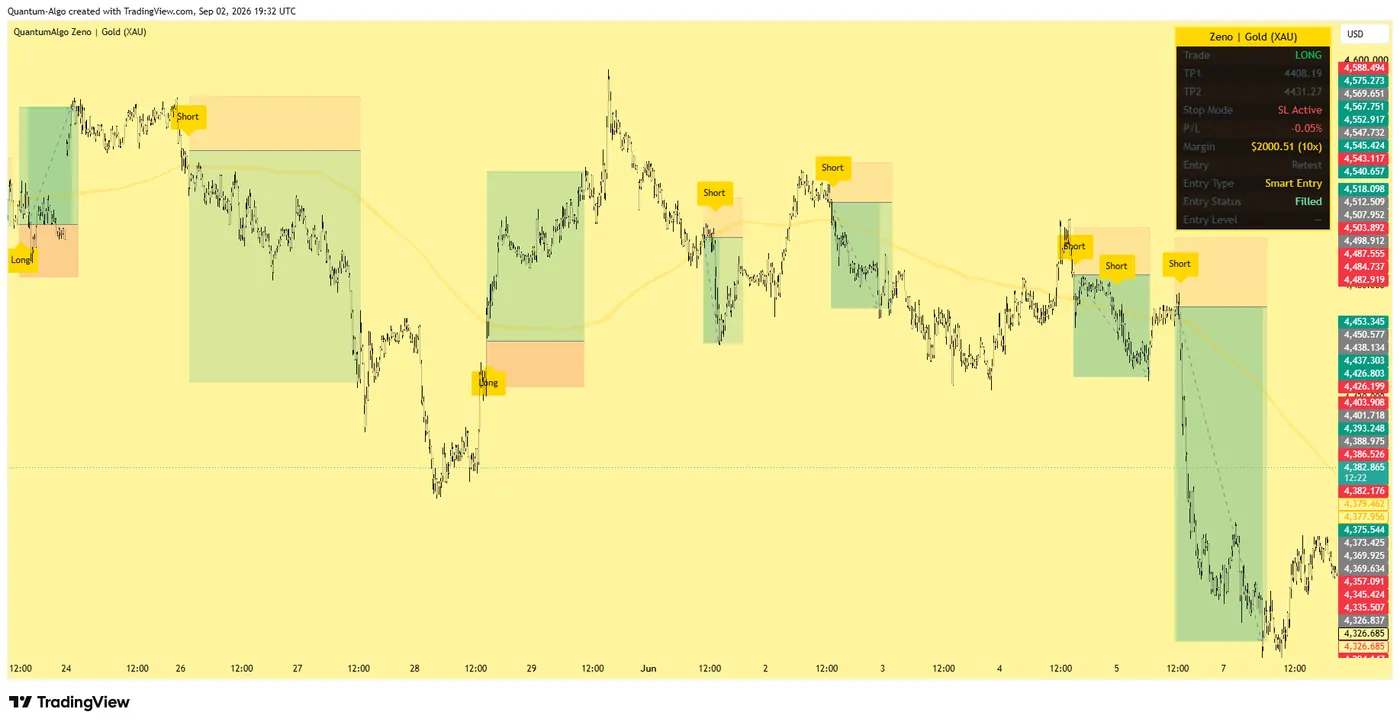
It reads like one. Zeno marks the block, the entry on the retest, the stop under the block and the targets at the next liquidity — the structure an institutional order creates — and publishes every call on TradingView before the outcome is known.
Software licensed to firms — order and execution management systems, Bloomberg terminals, prime-broker portals — that route large orders through algorithms and venues. They are not sold to individuals; what retail can access is the same market data (with delay), the same order types at a broker, and charting that reads the footprints.
Size, tools and cost. Institutions execute large orders over time with algorithms at wholesale costs; retail executes small orders instantly through a broker at retail costs. Both trade the same price.
Execution desks use VWAP and volume profiles constantly, because their job is to trade around them. Portfolio decisions are mostly fundamental or quantitative. The "institutional-grade indicator" label on retail tools is marketing.
A retail term for institutional order flow. Smart Money Concepts is the practice of reading where that flow filled — order blocks, sweeps, imbalances — and trading the return to those levels.
Zeno reads the footprints a worked order leaves and prints the entry on the retest, the stop under the block and the targets at the next liquidity — the structure this page describes, published on TradingView before the outcome is known.
References & Related Guides
Read next
- Bookmap Review: The Order-Book Heatmap, and What It Actually Shows a Smart Money Trader
- Koyfin Review: A Bloomberg-Lite for Fundamentals — and Where Traders Should Still Use TradingView
- Unusual Whales Review: Options Flow, Dark Pools and Congress Trades — What the Data Can and Can't Tell You
- Fundamental vs Technical Analysis: Which Answers Your Question (and Where Smart Money Concepts Sits)
- What Is a Commodity Trading Advisor (CTA)? Registration, Managed Futures, Fees and How to Tell a Real One
- Smart Money Concepts Guide
- Order Blocks & Fair Value Gaps Explained
- Liquidity Sweep Trading
- Institutional Order Flow on TradingView
- Best VWAP Settings
- What Is Quantitative Trading?
- Who Is ICT?
- What Is Trading?
Authoritative sources
- SEC: alternative trading systems and dark pools
- FINRA: dark pools and ATSs explained
- CME Group: order types
- BIS: foreign exchange market participants and turnover
- Investopedia: institutional investor