What Is a Commodity Trading Advisor (CTA)? Registration, Managed Futures, Fees and How to Tell a Real One
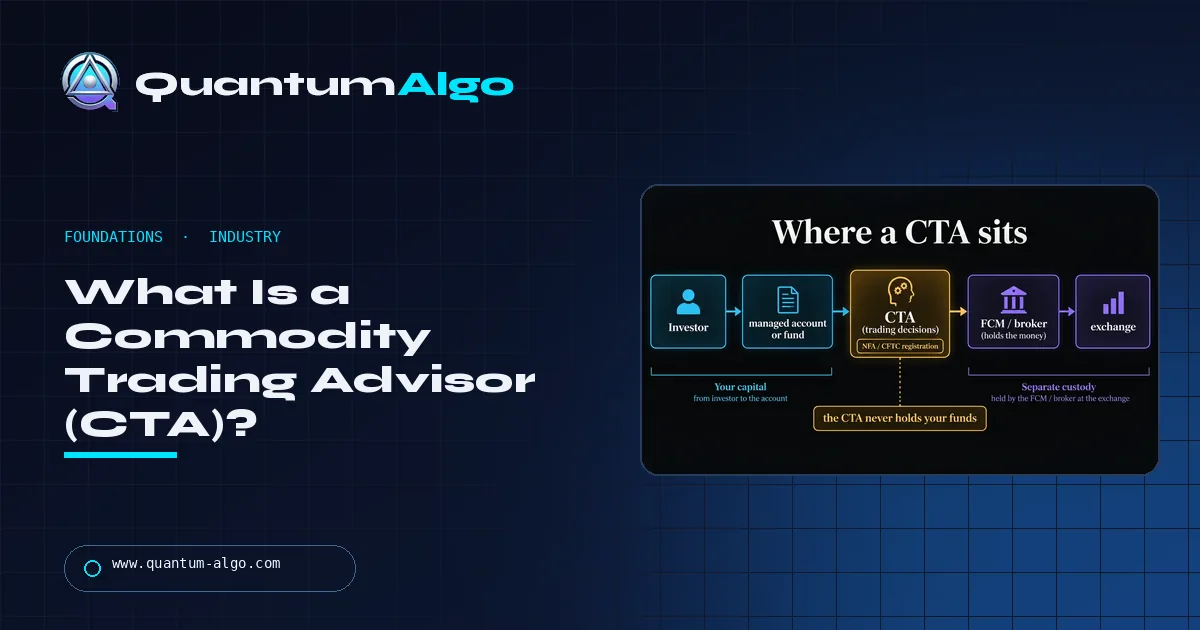
A commodity trading advisor (CTA) is a CFTC-registered person or firm and NFA member that advises on or trades futures for clients, via client-owned managed accounts or pooled funds. The CTA decides the trades; a futures commission merchant holds the money. Most large CTAs are systematic trend followers: many small losses, a few large wins, low correlation to stocks.
"CTA" is two things at once: a regulatory category you can look up in the NFA's database, and a strategy style that made its name in 2008 and 2022 by going up while everything else went down. This page separates them — what registration requires and protects, what a trend-following program actually does on a chart, what it costs, and how to tell a registered advisor from a signal seller borrowing the letters. It also says plainly what Quantum Algo is and is not.
Indicators that prove themselves in public.
One engine, four precision tools — the Gold (XAU) Scalper, the institutional Gravity Zone, the Zeno momentum Oscillator, and Zeno Stocks for equities.
What is a commodity trading advisor?
A commodity trading advisor is a person or firm registered with the CFTC and a member of the NFA that gives advice on, or trades, futures and options on futures for clients — either through managed accounts the client owns or through pooled funds. The defining features are the registration and the separation of roles: the CTA makes the trading decisions, a futures commission merchant holds the money, and the client can see every trade in an account in their own name. The diagram in this guide shows the chain: investor → managed account or fund → CTA → FCM → exchange.
In practice "CTA" also names a strategy style, because the largest CTAs — Man AHL, Winton, Transtrend, Aspect and the rest — are systematic trend followers, and "CTA performance" in the financial press means the performance of that style. This page covers both meanings: what the registration is, what the strategy does, and how to tell a real CTA from a signal seller using the letters.
Why does CTA registration matter?
Anyone who advises on futures for compensation, or manages more than fifteen accounts, must register as a CTA with the CFTC and join the NFA unless exempt. Registration means fingerprinting, a background check, the Series 3 exam for principals, a disclosure document that must be filed and updated, and NFA audits. The NFA's BASIC database lists every registered CTA, its principals and any disciplinary history — it is public, and it is the first thing to check about anyone using the label.
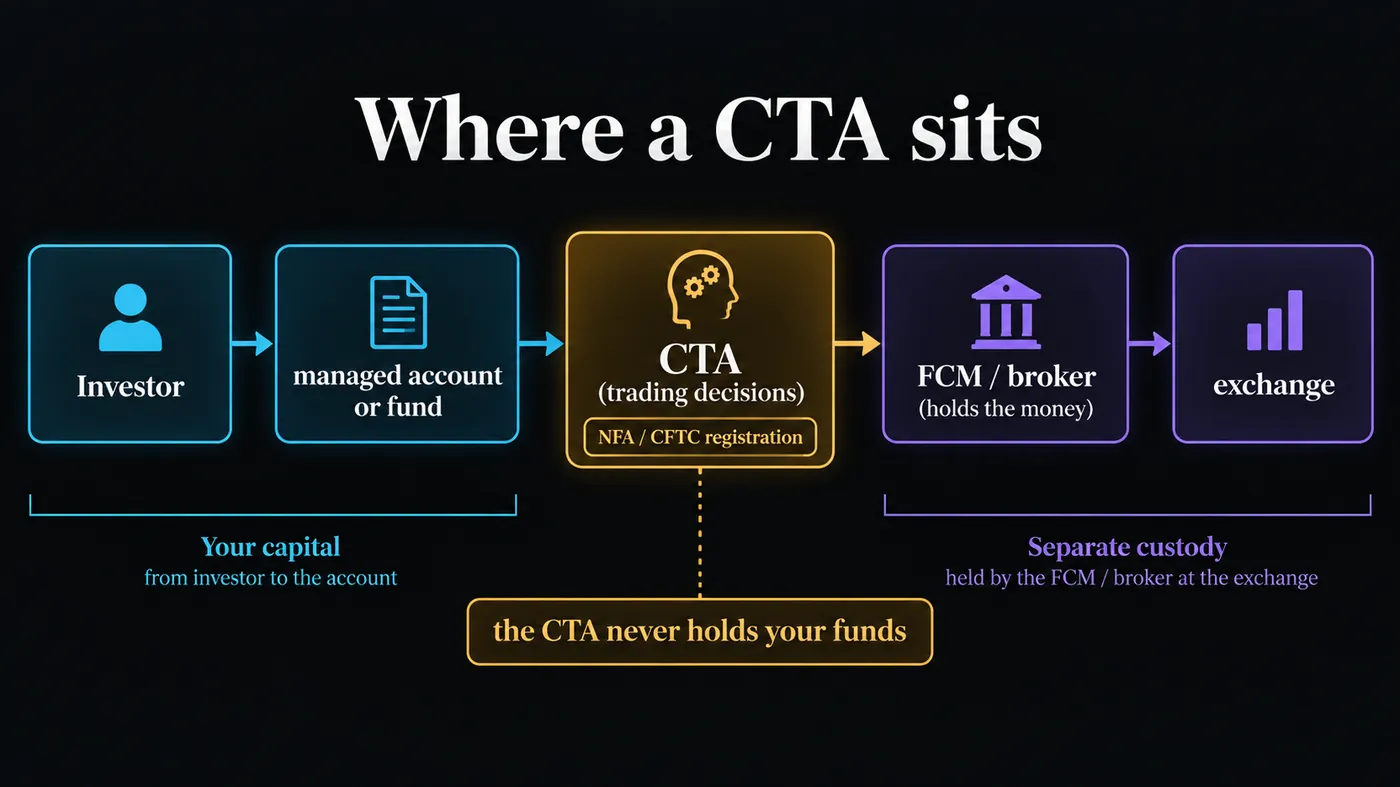
The structural protection is custody. A CTA trades your account through a power of attorney limited to trading; the money sits at an FCM in your name. The CTA cannot withdraw it. If the CTA disappears, your positions and cash are still at the FCM. That is the difference between a managed account and sending money to someone who "trades for you", and it is the line the "CTA never holds your funds" callout in the diagram is drawing.
What do CTAs actually do?
The trend-following chart in this guide is the archetype: a long-term trend model on crude oil, flipping long and short at crossovers, losing a little in every chop and winning a lot in the one sustained move. The equity curve inset goes sideways for months, then jumps. Managed-futures returns have looked like that for forty years — many small losses, a few large wins, and a low or negative correlation to stocks that made the strategy famous in 2008 and again in 2022.
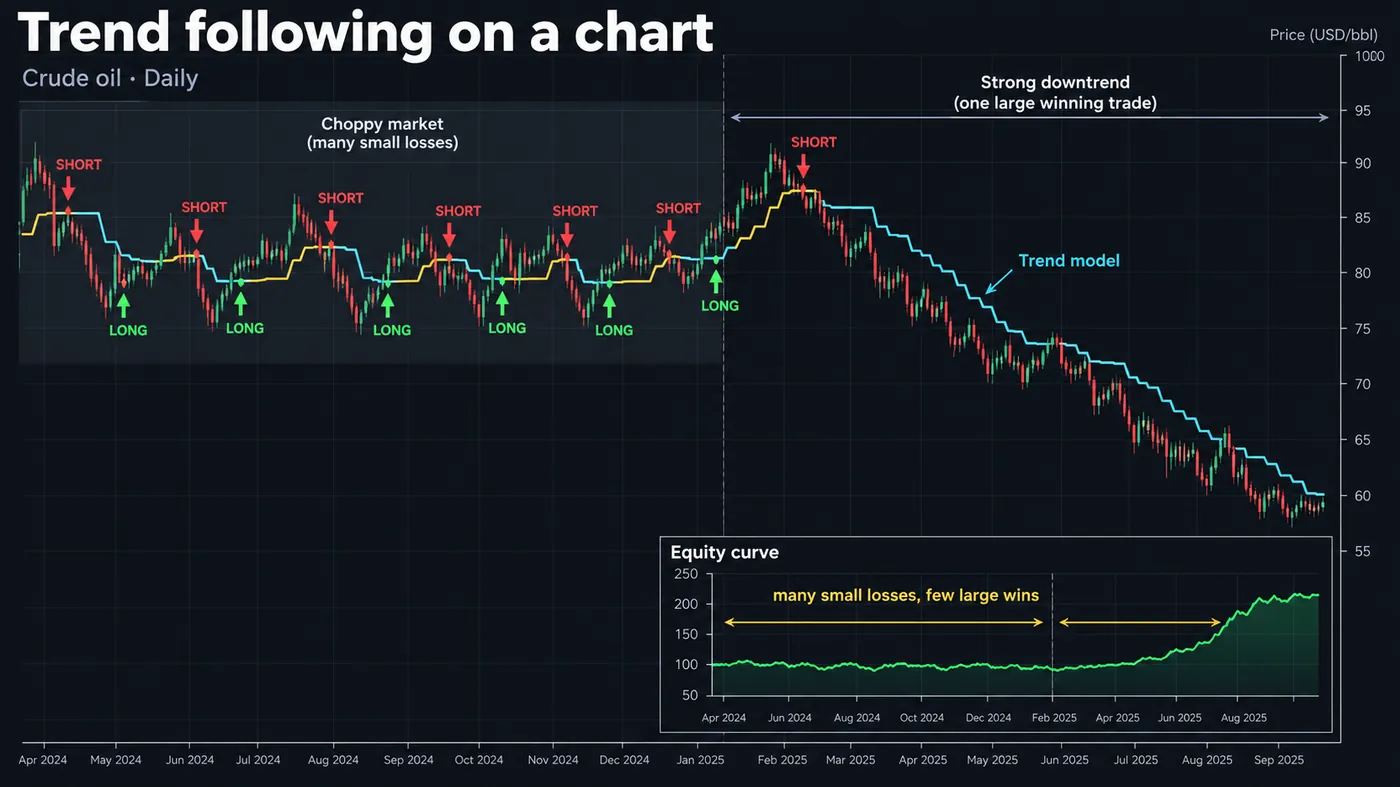
Not all CTAs are trend followers. Discretionary macro traders, spread traders, short-term systematic traders and options sellers register as CTAs too. But the diversified systematic trend program, traded across sixty or more futures markets, is the core of the industry and the reason institutional allocators use the label as a strategy name.
What fees and minimums do CTAs have?
The traditional CTA fee is management plus incentive — historically 2% of assets and 20% of profits, now more often 1% and 15% or lower for large allocations, with the incentive fee charged only on new net profits above a high-water mark. Minimums for individually managed accounts often start around $100,000 to $250,000 because futures positions are lumpy; pooled funds and the CTA mutual funds and ETFs that appeared after 2010 have much lower entry points. The fee calculator on this page shows what a 2/20 and a 1/15 structure each cost on the same three-year return.
How does a CTA differ from signal services and robo-advisors?
The comparison table in this guide is the part most readers need. A CTA managed account: the CTA decides, the FCM holds the money, CFTC/NFA regulation, management plus incentive fees, higher minimums. A retail signal service: you decide (or a bot does), your broker holds the money, regulation varies from none to some, subscription fee, minimum whatever your broker requires. A robo-advisor: an algorithm decides, a custodian holds the money, SEC-registered as an investment adviser, asset-based fee, low minimums.
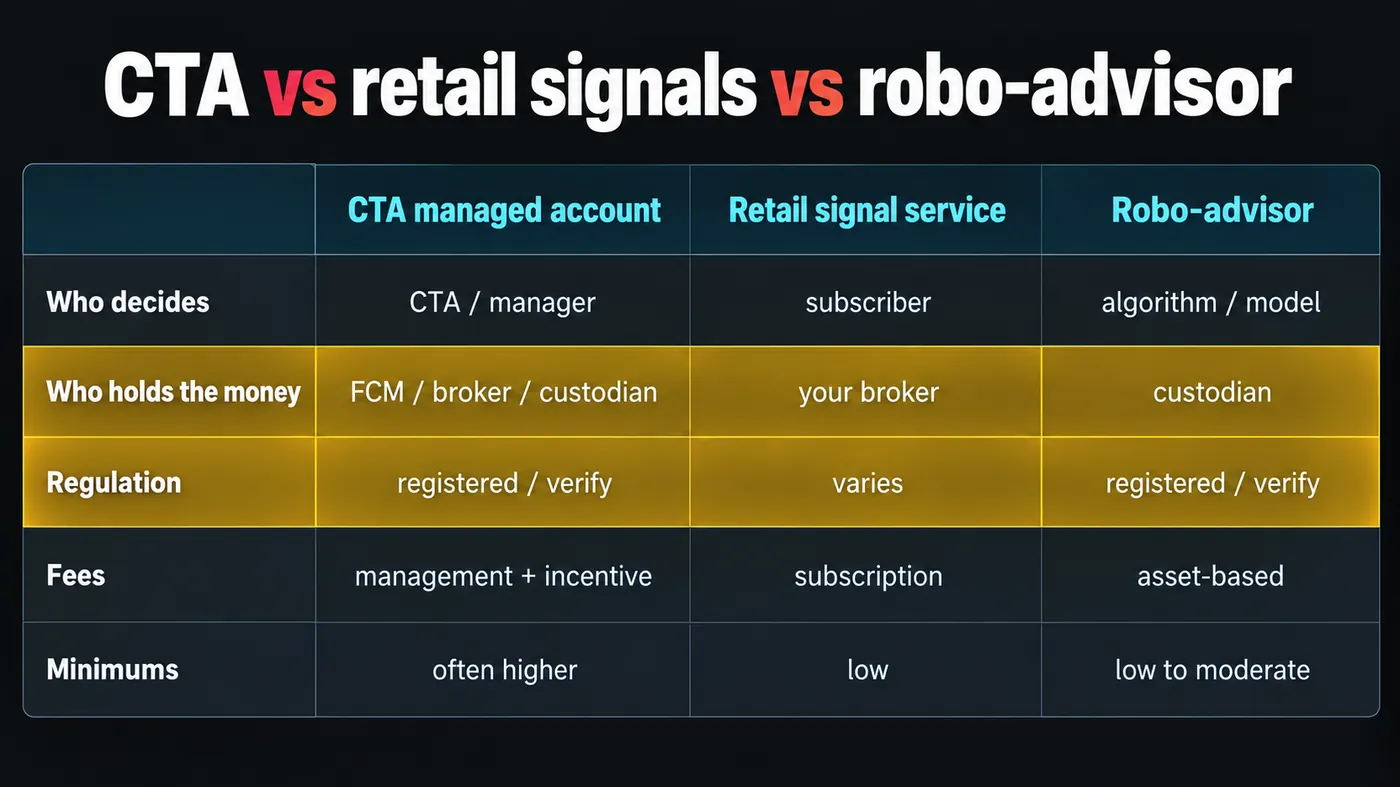
Quantum Algo is in the middle column and says so. Zeno is software that prints signals; QuantumBot executes them on your own exchange account under your rules; nobody at Quantum Algo trades for you or holds your funds, and we are not a CTA. The reason to be clear about it is that the letters get borrowed — "CTA-grade signals" is a phrase that should send you to the NFA database, where it will not be found.
CTA vs retail signals vs robo-advisor at a glance
| Feature | CTA managed account | Retail signal service | Robo-advisor |
|---|---|---|---|
| Who decides trades | The CTA, with trading authority only | You, or a bot you configure | An algorithm |
| Who holds the money | A futures commission merchant, in your name | Your broker or exchange | A custodian |
| Regulation | CFTC registration and NFA membership | Varies from none to some | SEC-registered investment adviser |
| Typical fees | Management plus incentive fee | Subscription fee | Asset-based fee |
| Minimums | Often $100,000 to $250,000 | Whatever your broker requires | Low |
◆Check anyone using the CTA label in NFA BASIC before sending money.
How do you evaluate a CTA?
- Verify registration in NFA BASIC, including the principals and any disciplinary history.
- Read the disclosure document — the D-Doc — for the strategy description, fees, and the performance table with its drawdowns.
- Look at the drawdown, not the return. A trend follower with a 35% max drawdown and a 12% annual return is normal; ask whether you can hold through the drawdown.
- Understand the correlation. The value of managed futures in a portfolio is what they do when stocks fall; a CTA that is long equities most of the time is not diversifying anything.
- Confirm custody. Your account, your name, at a registered FCM, with statements from the FCM — not from the CTA.
What can retail traders learn from CTAs?
Three things, all of which are in the rest of this Academy. Systematic rules that do not change with mood. Position sizing by volatility so that every market contributes the same risk. And the willingness to take many small losses for a few large wins — the exact opposite of the retail instinct to take small profits and let losses run. The trend-following equity curve in this guide is what disciplined mediocrity looks like on a good day; it is also what has outlasted almost every other strategy.
A CTA is a registration first and a strategy second. Registration means CFTC/NFA oversight, a disclosure document and — the part that matters — your money at an FCM in your name with the CTA holding trading authority only. The strategy the industry is known for is systematic trend following: small losses, large wins, low correlation. Verify the registration before the returns, and know that Quantum Algo is software, not a CTA.
◆ Interactive check
Real CTA or borrowed letters?
Questions people ask about commodity trading advisors
No. A CTA is a registration category for trading futures on behalf of clients; a hedge fund is a private pooled vehicle. Many managed-futures hedge funds are run by registered CTAs, and many CTAs run only separate accounts.
Typically a management fee of 1–2% of assets and an incentive fee of 15–20% of new net profits above a high-water mark; large allocations negotiate lower.
Yes, by registering with the CFTC through the NFA: background check, Series 3 for principals, a disclosure document and NFA membership. Advising fewer than fifteen clients without holding out to the public may qualify for an exemption.
Yes — by the CFTC, with the NFA as the self-regulatory body that registers, audits and disciplines them. Registration can be checked in NFA BASIC.
No. Quantum Algo publishes indicators and educational content and offers QuantumBot, which executes your configured rules on your own exchange account. We do not trade client accounts or hold client funds.
A commodity pool operator (CPO) runs a pooled fund that trades futures; a CTA advises or trades for clients, often in separate accounts. Many firms are both, and both register with the CFTC through the NFA.
The asset class CTAs trade: professionally managed futures and options-on-futures programs, mostly systematic and trend-following, held for their low correlation to stocks and bonds.
Trend followers are short markets that are falling and long markets that are rising, across equities, bonds, currencies and commodities at once. In a crisis the trends are large and persistent, which is when the strategy earns most of its return.
Large. Twenty to forty percent peak-to-trough drawdowns are normal for a diversified trend program, followed by long flat periods. The return comes in bursts; the investor's job is to hold through the rest.
No. Zeno is software; QuantumBot executes your own rules on your own exchange account; nobody at Quantum Algo trades for clients or holds client funds, and we are not registered as a CTA.
References & Related Guides
Read next
- What Is Quantitative Trading?
- What Is Institutional Trading?
- Best Indicators for Futures Trading
- Best Trading Bots
- Backtesting Trading Strategies
- Monte Carlo Simulation for Trading
- QuantumBot
Authoritative sources
- CFTC: commodity trading advisors
- NFA BASIC: registration and disciplinary database
- NFA: who has to register as a CTA
- CME Group: introduction to futures
- Investopedia: commodity trading advisor