What Is Quantitative Trading? The Strategies, the Workflow, and What a Retail Trader Can Actually Use
Quantitative trading is trading decided by rules derived from data and tested statistically, rather than by a person's judgment on each trade. A quant strategy states exactly when to buy, sell and size, and its worth is measured on out-of-sample data before money is risked. Hedge funds and retail rule-based systems share one workflow: hypothesis, backtest, out-of-sample, paper, live, monitoring.
The full treatment: what quant trading is and is not, the strategy families from trend following to market making, the workflow loop with the two points where most strategies die, how to read a backtest's statistics, quant versus systematic versus discretionary in one table, a worked example turning a Smart Money setup into a testable rule, the seven ways backtests fool you, the tools, the careers, and what a retail trader can actually use. The backtest-statistics checker below scores any report you paste in.
Indicators that prove themselves in public.
One engine, four precision tools — the Gold (XAU) Scalper, the institutional Gravity Zone, the Zeno momentum Oscillator, and Zeno Stocks for equities.
What is quantitative trading?
Quantitative trading is trading decided by rules derived from data and tested statistically, rather than by a person's judgement on each trade. A quant strategy states exactly when to buy, sell and size — as code or as a rule set a computer can follow — and its worth is measured on out-of-sample data before any money is risked. That definition covers everything from a hedge fund's high-frequency market-making to a retail trader's rule-based trend system; what unites them is the workflow, not the maths. This guide is the full treatment: what quant trading is and is not, the strategy families, the workflow that separates a strategy from a curve-fit, how to read a backtest, quant versus systematic versus discretionary, the tools and the jobs, and what a retail trader can realistically borrow from the discipline.
How does quant trading work, in plain words?
A discretionary trader looks at a chart and decides. A systematic trader follows written rules but may execute them by hand. A quant trader derives the rules from data, proves them statistically, and usually lets a machine execute them. The quant's edge is rarely a secret signal; it is process — a hypothesis tested honestly, sized by the statistics, monitored for decay, and retired when the data says so. That is also why quant trading is less about being right and more about not fooling yourself, and why most of this page is about the ways of being fooled.
What are the main quantitative trading strategy families?
- Trend following / momentum — buy what has been rising, sell what has been falling, on rules; the backbone of managed futures and the CTA industry, with fifty years of data behind it. Many small losses, few large wins, low correlation to stocks.
- Mean reversion — bet that a stretched price returns toward an average: pairs trading, statistical arbitrage, short-term reversal in equities. Many small wins, occasional large losses; regime-sensitive.
- Market making — quote both sides and earn the spread, managing inventory; requires speed and infrastructure; the domain of firms, not retail.
- Arbitrage — price the same thing in two places and trade the difference: index arbitrage, cross-exchange crypto arbitrage, futures basis. Edges are small and disappear as they are found.
- Factor / cross-sectional — rank a universe on characteristics (value, momentum, quality, volatility) and hold the top against the bottom; the quant investing that runs much of the world's institutional money.
- Event-driven and alternative data — earnings, announcements, flows, sentiment, positioning; increasingly machine-learned.
- Execution algorithms — VWAP, TWAP, POV: not strategies for profit but for placing large orders cheaply; the quant work most retail traders benefit from without knowing it.
Retail quant trading lives almost entirely in the first two families and in rule-based versions of price-action setups — including Smart Money structure, once its rules are written precisely enough to test.
What does the quant trading workflow look like?
The loop illustration in this guide is the discipline: hypothesis → data → backtest → out-of-sample test → paper trading → live → monitoring → back to hypothesis. Two points on the loop are marked "most strategies die here", and both are where they should.
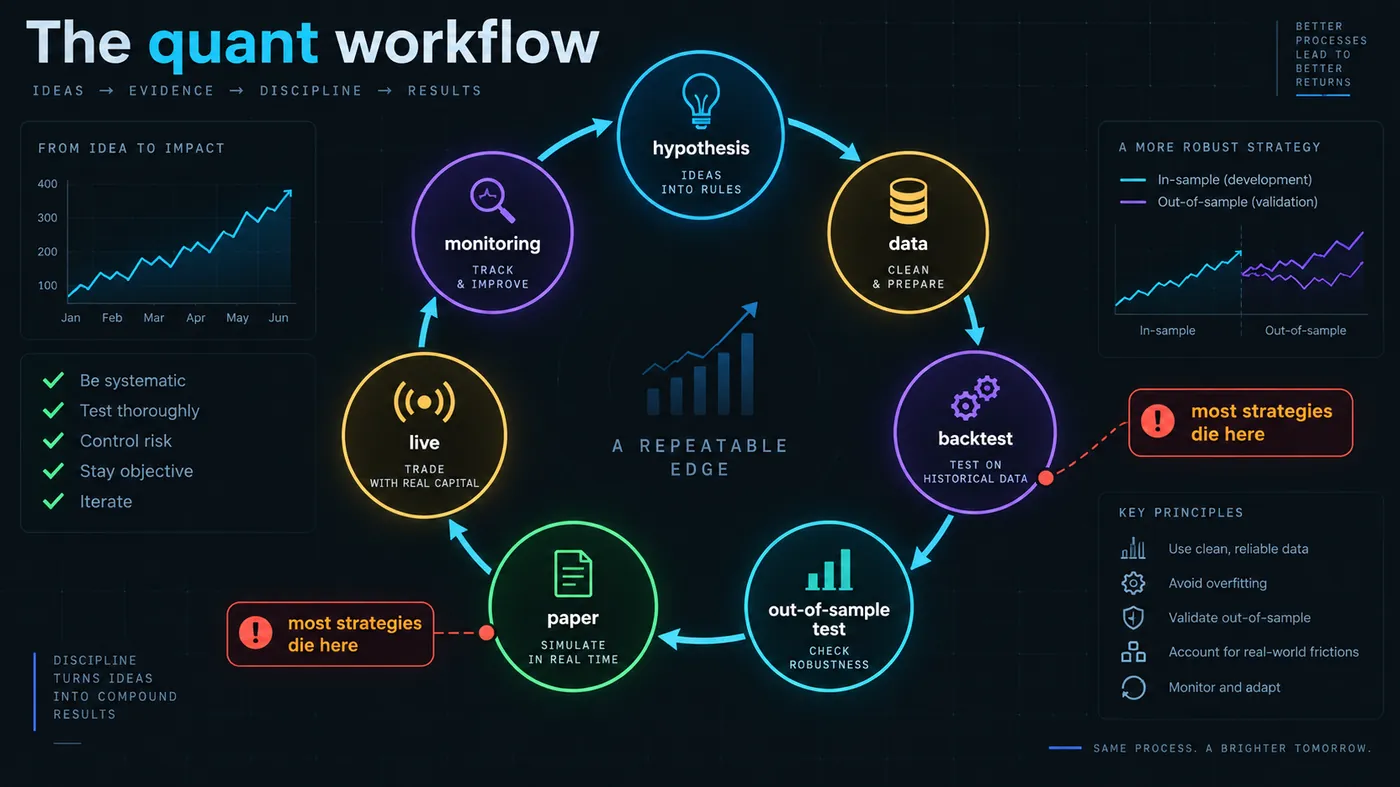
The first is between the backtest and the out-of-sample test. A backtest optimised on the data it is measured on will look good — that is what optimisation does. Holding back a period the strategy has never seen and testing on it is the only check against having fitted noise; most strategies that looked excellent in-sample fall apart there, and that is the process working.
The second is between paper trading and live. Fills, slippage, latency and the trader's own hands appear for the first time; a strategy that survived out-of-sample on perfect fills can lose its entire edge to execution. The paper stage — or a live stage at minimum size — measures that gap before it costs money.
Monitoring closes the loop: edges decay as markets change and as others find them, and a quant strategy carries a rule for when to switch it off.
How do you read a backtest report?
The equity-curve illustration in this guide is what a strategy's report looks like, and how to read it:
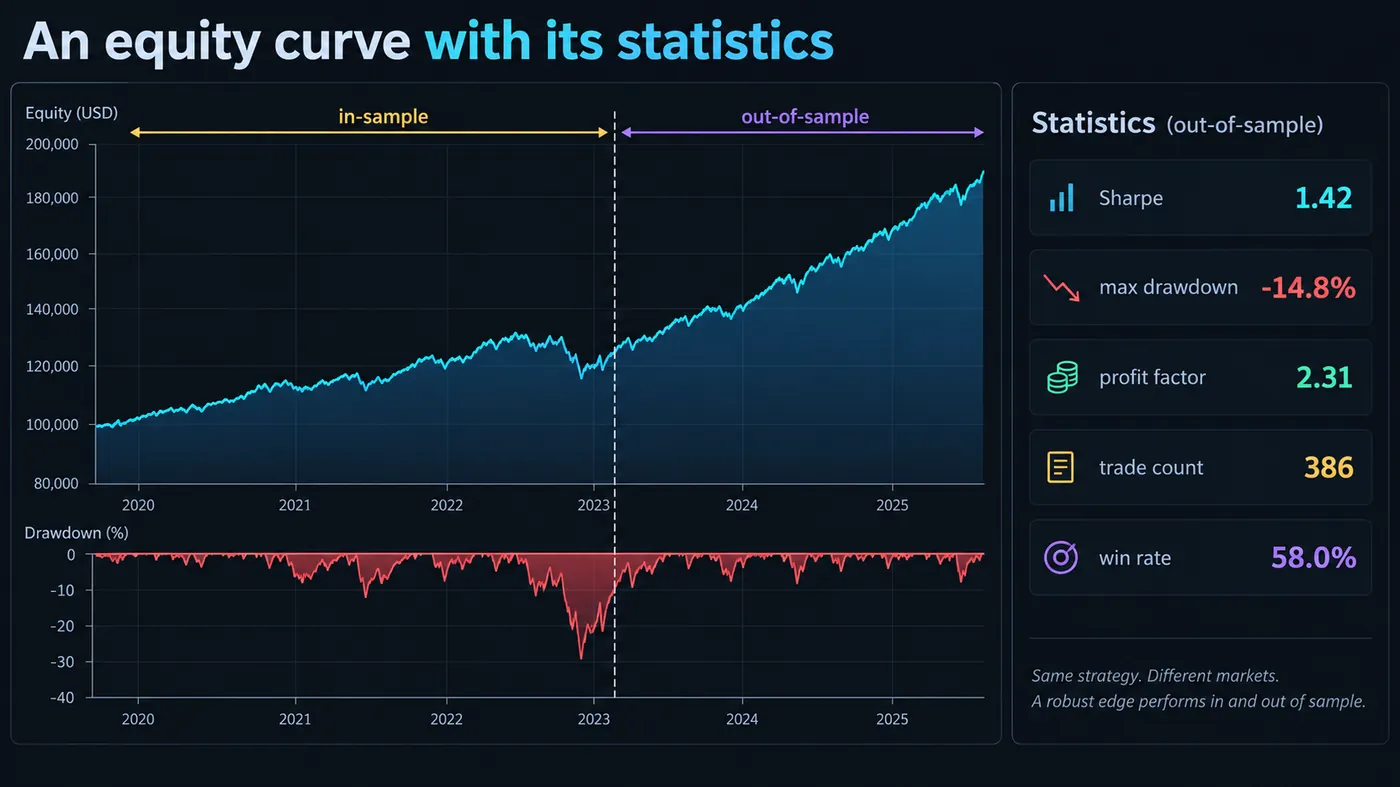
- The curve itself — smoothness matters less than whether the out-of-sample section (marked) looks like the in-sample section. A curve that flattens or breaks exactly at the split has been fitted.
- Drawdowns (shaded) — the largest is the number you will have to sit through; assume the live one will be worse.
- Sharpe ratio — return per unit of volatility; above 1 is respectable for a retail strategy, above 2 is suspicious unless the trade count is large.
- Maximum drawdown — as above; compare it with the return, not in isolation.
- Profit factor — gross profit divided by gross loss; 1.5–2 is healthy, above 3 on a small sample is a warning.
- Trade count — under a hundred trades, none of the other statistics mean much; the Monte Carlo guide explains why.
- Win rate — only meaningful with the average win and loss; a 35% win rate with 3R winners beats a 70% win rate with 0.4R winners.
The statistics panel on the illustration reads: Sharpe 1.42, max drawdown −14.8%, profit factor 2.31, 386 trades, 58% win rate, out-of-sample marked. That is a strategy worth paper trading; it is not a strategy worth funding yet.
How do discretionary, systematic and quant trading differ?
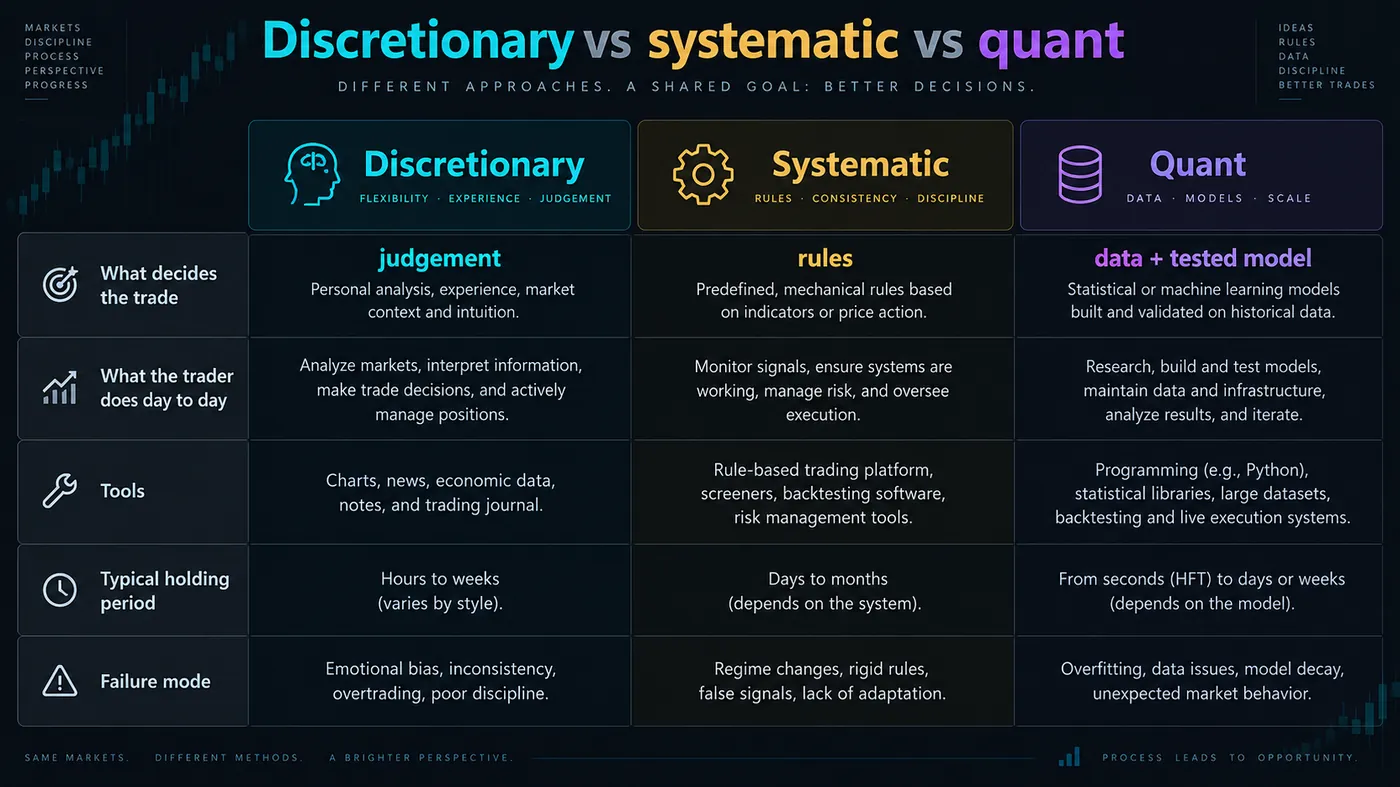
The three-column illustration in this guide separates what people conflate:
| Discretionary | Systematic | Quant | |
|---|---|---|---|
| What decides the trade | The trader's judgement, with rules as guidance | Written rules, followed by the trader | Rules derived from data, tested statistically, usually executed by code |
| What the trader does | Reads charts, decides, executes | Follows the checklist, executes, journals | Researches, tests, monitors, retires strategies |
| Tools | Charts, indicators, a journal | Charts, alerts, a checklist, a journal | Data, backtester, code, execution API |
| Holding period | Any | Any | Any — from microseconds to years |
| Failure mode | Emotion, inconsistency, overtrading | Rules that were never tested | Overfitting, regime change, execution gap |
Smart Money Concepts as taught on this site is systematic: written rules, followed by a person or by QuantumBot. It becomes quant when the rules are coded and tested out of sample — which is exactly what Zeno's engine is, and why its public record exists.
What can a retail trader use from quant trading?
Not the infrastructure — no retail trader competes with a market-making firm on speed. What transfers is the workflow and three habits:
- Write the rules precisely enough to test. "Buy the retest of the order block after a sweep" is a systematic rule; "buy when the last down-close before a displacement of at least 2 ATR is retested within 20 bars, stop 0.5 ATR beyond it, target the prior swing" is a quant rule.
- Test out of sample. TradingView's Strategy Tester, Python, or bar replay with a held-back period; our backtesting and TradingView-backtesting guides show how.
- Size by the statistics, and monitor. Fixed fractional risk from the measured expectancy and drawdown; a rule for when the strategy is switched off. The Monte Carlo guide covers the arithmetic.
A worked example: turning a Smart Money setup into a quant rule
The setup, as a discretionary trader would describe it: "after a sweep of a recent low, wait for a change of character, then buy the retest of the order block with a stop under the sweep and a target at the range high."
The same setup as a quant rule, precise enough to test:
- Universe and timeframe: EURUSD, GBPUSD, XAUUSD; 15-minute bars; London and New York sessions only (07:00–20:00 UTC).
- Sweep: a bar whose low is below the lowest low of the prior 20 bars by at least 0.1 ATR(14) and whose close is back above that prior low.
- Change of character: within the next 12 bars, a close above the highest high of the 6 bars preceding the sweep bar.
- Order block: the last bar with a close below its open in the 8 bars before the change-of-character bar.
- Entry: a limit at the order block's high, valid for 20 bars; cancelled if untouched.
- Stop: 0.5 ATR(14) below the sweep bar's low. Target: the highest high of the 20 bars before the sweep. Risk: 1% of equity per trade, position sized from the stop distance.
- Filters: no entries within 30 minutes of scheduled high-impact releases; maximum one open position per symbol.
Every clause is a decision the discretionary version left to judgement, and every one can be varied and measured. Backtested on 2019–2023 in-sample and 2024–2025 out-of-sample, a rule set like this either holds its statistics across the split or it does not — and if it does not, the honest conclusion is that the discretionary trader's judgement was doing work the rule set has not captured, which is itself a finding. That is the loop: the rule is the hypothesis; the out-of-sample split is the experiment.
What are the seven ways quant traders fool themselves?
Quant trading's literature is mostly about these, because they are where the money goes:
- Overfitting — tuning parameters until the past looks perfect. The cure is fewer parameters and an untouched out-of-sample period.
- Look-ahead bias — using information in the test that was not available at the time (a close before the bar closed, a revised data series). Subtle and common in hand-built backtests.
- Survivorship bias — testing on today's index constituents or today's listed coins, which excludes everything that failed. The results are flattered by the dead.
- Ignoring costs — spread, commission, slippage, funding, financing. A strategy that trades often can lose its whole edge here; the test must charge realistic costs per trade.
- Small samples — statistics from forty trades are noise. Hundreds are a start; the Monte Carlo guide shows how wide the confidence bands are.
- Regime dependence — a strategy tested only on a bull market, or only on the post-2020 crypto cycle, has been tested on one regime. Cover at least one of each.
- Multiple testing — try a hundred ideas and one will look brilliant by chance. Keep a count of what was tried; discount the winner accordingly.
Every one of these makes a backtest look better than the strategy is. None of them makes it look worse, which is why the direction of the error is always the same and why live results disappoint.
How do quants handle risk, sizing and strategy portfolios?
A single quant strategy is a bet on one edge holding; a portfolio of uncorrelated strategies is the institutional answer to regime change. Retail traders can do a version of it: a trend rule and a mean-reversion rule on different markets, sized so that each contributes similar risk, and monitored separately. Sizing within a strategy is fixed-fractional from the measured expectancy — never more than the Kelly fraction and usually a quarter to a half of it — and a strategy is switched off when its live drawdown exceeds what the backtest's Monte Carlo distribution made plausible. Those two rules — size from the statistics, retire on statistical evidence — are the whole of quant risk management at retail scale, and they are the two rules discretionary traders most often skip.
Which tools do you need for quant trading?
- TradingView Pine Script — strategies with a built-in tester; the fastest route from a chart idea to a tested rule.
- Python — pandas, backtesting frameworks (Backtrader, vectorbt, Zipline-class), broker and exchange APIs; the standard for anything beyond Pine.
- QuantConnect / LEAN — cloud research and live deployment with institutional data; reviewed among the platforms on this site.
- NinjaTrader (C#), MetaTrader (MQL), cTrader (C#) — platform-native strategy environments with their own testers.
- Data — the exchange's own history for crypto, CME data for futures, vendor data for equities; the quality of the data bounds the quality of the test.
How do you build a career in quant trading?
Quant roles — quantitative researcher, quant developer, quant trader — sit at hedge funds, prop trading firms, banks and asset managers, and they hire for mathematics, statistics, programming and, increasingly, machine learning rather than for trading experience. The path is a quantitative degree, demonstrable coding, and projects that show the workflow above done honestly. It is a different career from retail trading and most of what this site teaches; the overlap is the discipline, not the job.
Where Quantum Algo sits
Zeno is a coded, tested, monitored rule set — the quant version of Smart Money Concepts — and the track record is its out-of-sample evidence in public: public calls posted with stop and targets before the outcome, and 160 closed signals counted: 120 wins, 40 losses. QuantumBot is the execution layer that removes the paper-to-live gap for subscribers who want the rules run without their hands on the ticket. Neither predicts; both execute a tested edge and report it, which is what quant trading has always been.
Quant trading is a workflow more than a formula: state the rules so they can be tested, test them on data they have never seen, size from the statistics, monitor for decay, and retire on evidence. Most strategies die at the two honest checkpoints, and the seven ways to fool yourself all point the same direction. A retail trader can borrow the habits without the infrastructure — and Zeno's public record is what the out-of-sample stage looks like in the open.
◆ Interactive check
Strategy or curve-fit?
Questions people ask about quantitative trading
As profitable as the tested edge, and the workflow is what keeps it honest. Institutional quant funds are among the most consistently profitable in finance; retail quant strategies are profitable when they survive out-of-sample testing and are sized by their statistics, and unprofitable when they are curve-fits.
For institutional quant work, yes — Python at least. For retail, Pine Script on TradingView gets a long way, and bar replay with a held-back period is a manual out-of-sample test that needs no code.
Algorithmic trading is any trading executed by a program; quantitative trading is trading whose rules were derived and validated from data. Most quant trading is algorithmic; not all algorithmic trading is quant — an algorithm can execute an untested rule.
Above 1 is respectable for a retail strategy, 1.5–2 is strong, and above 2–3 on a small sample usually means overfitting. Judge it together with the drawdown and the trade count.
No more than for any trading — the workflow costs time, not capital. Institutional strategies need scale because their edges are tiny; a retail trend or structure strategy at 1% risk works on any account that can size correctly.
Zeno is a coded, tested rule set with a public out-of-sample record, executed by QuantumBot for subscribers who want it automated. It does not predict; it applies tested rules and reports every result.
Research: forming hypotheses, cleaning data, running backtests and out-of-sample tests, reading statistics, monitoring live strategies for decay and retiring them. Very little of it is watching a chart.
No. High-frequency trading is one quant strategy family (market making and latency arbitrage) that needs speed and infrastructure; most quant trading — trend, mean reversion, factor investing — holds for hours to months.
The workflow, yes: Pine Script or Python, a backtester, a held-back period and the discipline to respect it. Institutional quant work needs a quantitative degree and real coding; retail quant work needs the habits.
Rule-based trend following and structure setups on liquid markets — the families with the longest evidence and costs a retail account can bear. Market making and arbitrage are for firms.
References & Related Guides
Read next
- Backtesting Trading Strategies
- TradingView Backtesting Guide
- Monte Carlo Simulation for Trading
- Algorithmic Trading for Beginners
- What Is a Trading Bot?
- What Is Institutional Trading?
- What Is a CTA?
- Can AI Predict the Stock Market?
Authoritative sources
- CFA Institute: backtesting and simulation
- QuantConnect: LEAN documentation
- TradingView: Pine Script strategies
- SEC: automated trading systems
- CME Group: introduction to futures (managed-futures context)
- Bailey, Borwein, López de Prado & Zhu: "Pseudo-Mathematics and Financial Charlatanism" (backtest overfitting)