What Is the ICT Unicorn Model in Trading?
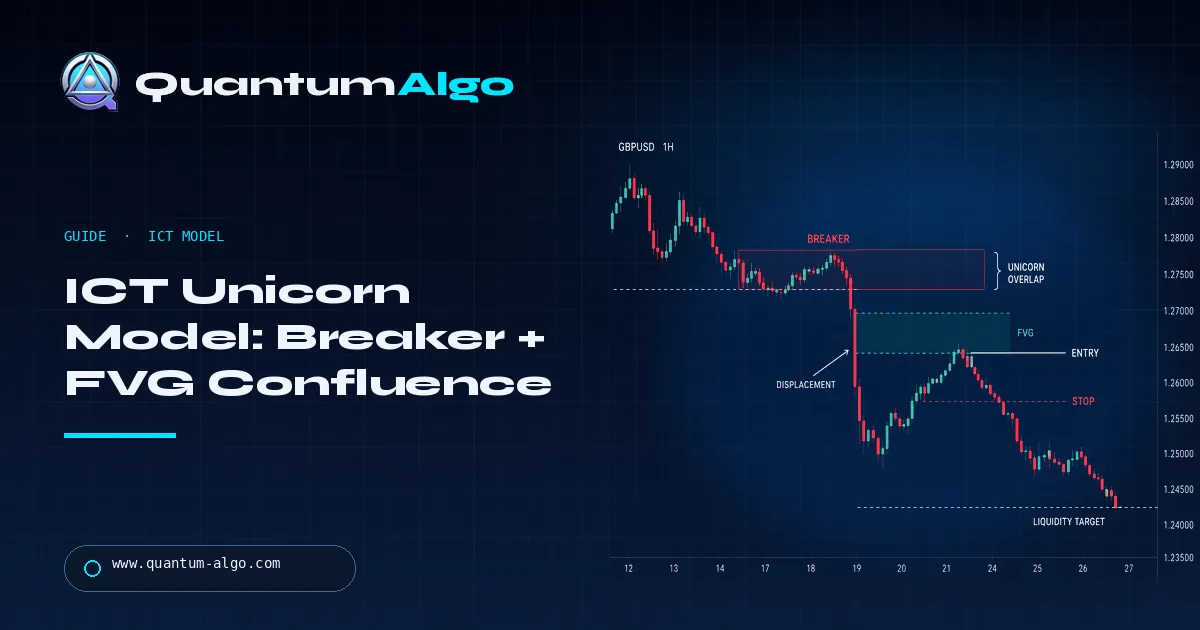
The ICT Unicorn model is the overlap of a valid breaker block and a fair value gap, usually read as a high-interest execution zone after displacement. The overlap is the setup location, not a guarantee, and Quantum Algo's Zeno signals do not draw Unicorn structures. Confirm delivery, define invalidation and keep the trade size tied to the stop.
The Unicorn model is popular because it compresses two pieces of ICT language into one visual idea: a breaker shows a failed order-block reaction that can change role, while an FVG shows fast delivery that left imbalance behind. When those areas overlap, the market has given you a tighter location to study. The hard part is deciding whether the overlap is still valid when price returns.
Indicators that prove themselves in public.
One engine, four precision tools — the Gold (XAU) Scalper, the institutional Gravity Zone, the Zeno momentum Oscillator, and Zeno Stocks for equities.
Use the guide as a decision filter, not as a collection of labels. The market, the session and the invalidation still decide whether an idea deserves risk.
What is the ICT Unicorn model?
The ICT Unicorn model describes a breaker block overlapping a fair value gap. The breaker supplies the failed-order-block context; the FVG supplies the imbalance created by displacement. The shared band is the area traders monitor for a reaction.
That definition matters because a breaker by itself is not a Unicorn, and an FVG by itself is not a Unicorn. I need both ingredients, a coherent sequence and a reason for price to revisit the zone.
| Item | Value / rule | Why it matters |
|---|---|---|
| Definition | A breaker block that overlaps a fair value gap (FVG) | Two ICT structures agreeing on the same prices |
| Sequence | Liquidity sweep → displacement / market-structure shift → breaker forms → FVG inside or over the breaker | Skipping the sweep is the most common mislabel |
| Entry zone | The overlap between the breaker body and the FVG | Not the whole breaker, not the whole gap |
| Stop placement | Beyond the breaker (past the candle that created it) | A full body close through the breaker invalidates the model |
| Targets | Nearest opposing liquidity (prior high/low, equal highs/lows) | Draw on liquidity gives the reason for the move |
| Timeframes | Locate on 1H–4H, refine on 5m–15m; kill-zone timing improves fills | Lower-timeframe unicorns without HTF context fail more |
How does a breaker block overlap an FVG?
A breaker begins as an order-block idea that fails, after price runs through it and later uses the area from the other side. The FVG is created by the sharp delivery that often accompanies that failure. If the two price ranges share a band, the overlap becomes the Unicorn area.
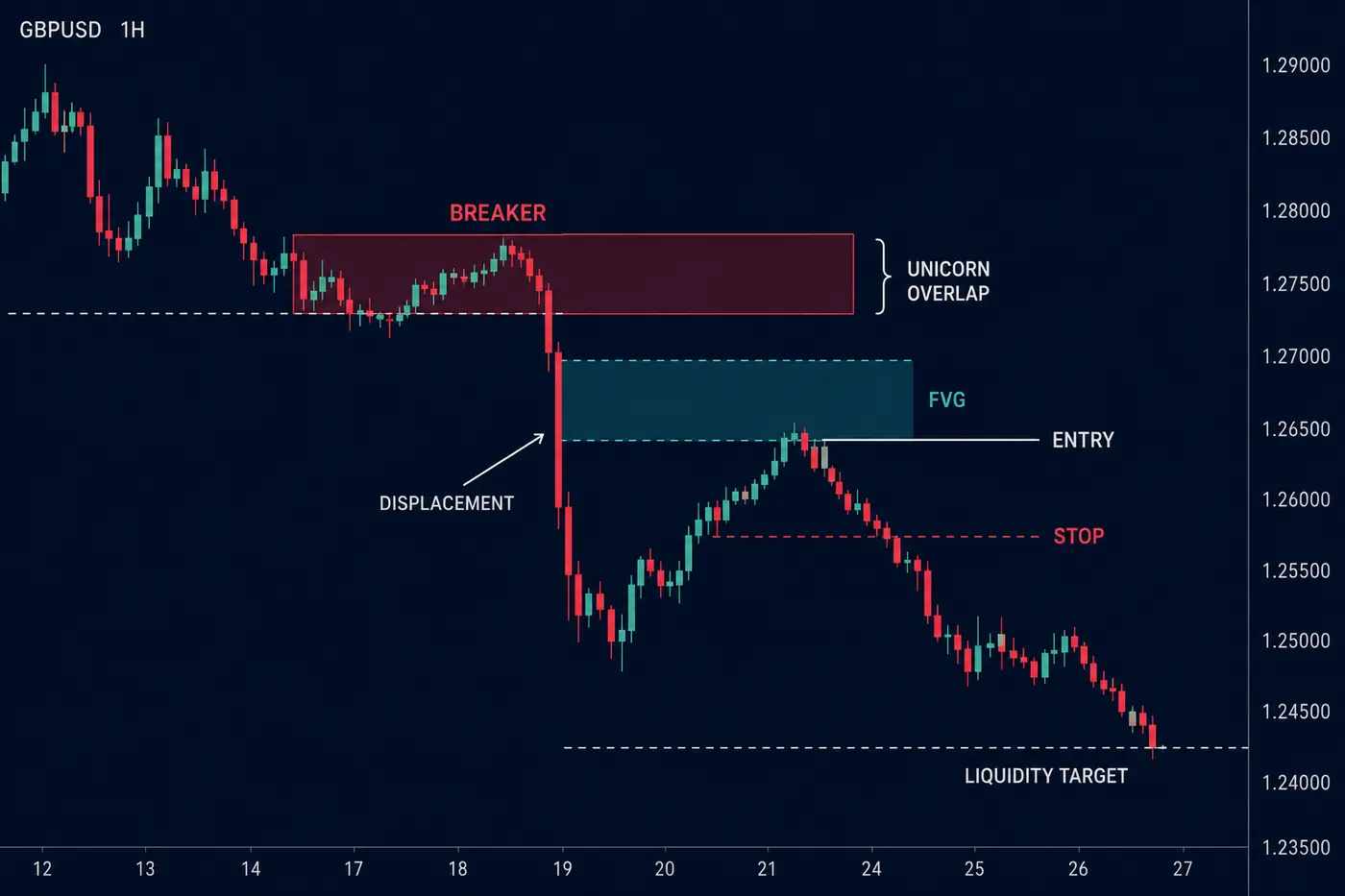
Draw the smallest valid overlap. A giant rectangle that includes every nearby candle makes the model look cleaner while removing the actual invalidation.
Why does the overlap matter more than either zone alone?
Confluence is useful only when the ingredients are independent enough to add information. The breaker tells me that an earlier area failed and may have changed role. The FVG tells me that the new move was delivered with urgency. Where they overlap, I can test both ideas at one location.
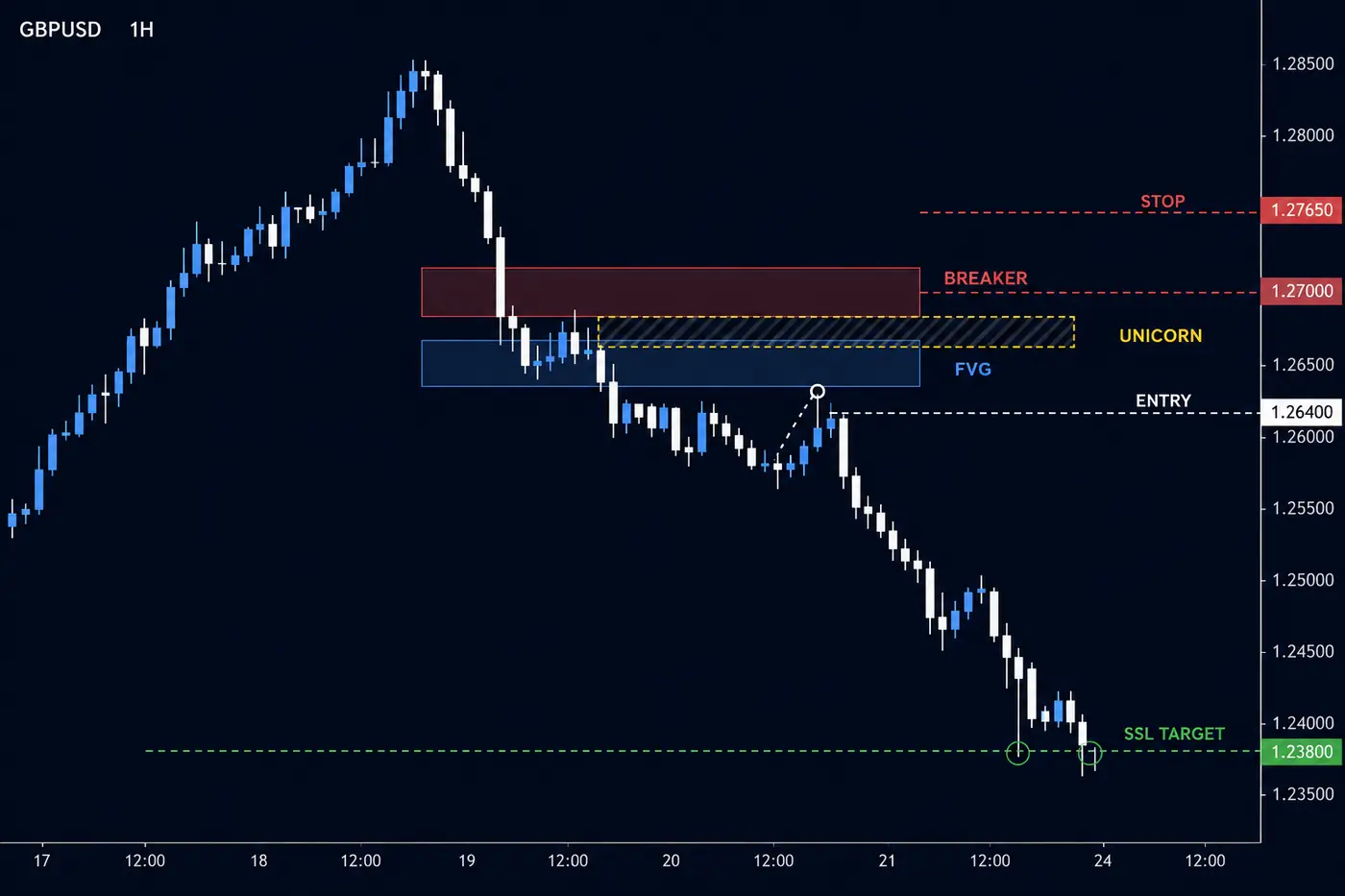
Do not turn confluence into a score-chasing exercise. If the higher-timeframe direction contradicts the zone, two labels do not rescue it.
What confirms an ICT Unicorn entry?
I want a sweep, displacement, reclaim or clear acceptance on the return. A simple first touch is weaker because the zone has not yet shown that the intended side can defend it. The trigger can be a lower-timeframe market-structure shift, but the stop must still respect the higher-timeframe invalidation.
On GBPUSD, I also pay attention to the London and New York overlap. A zone created in one session may be tested when a different pool of liquidity arrives. The clock changes the quality of the reaction.
Where does the Unicorn stop belong?
The stop belongs beyond the level that invalidates the breaker/FVG thesis. If price closes decisively through the overlap and accepts beyond the zone, the model has failed. A stop placed inside the overlap can create a small-looking loss but leaves the idea untested.
Risk size comes after the stop. A 22-pip stop on GBPUSD and a 55-point stop on NAS100 are not comparable without point value and contract details. Keep account risk fixed and let the position size change.
How do you trade a Unicorn in a trend?
In a clean trend, I prefer Unicorns that align with the higher-timeframe delivery. A bullish zone below a sequence of higher highs has a different job from a bullish zone trying to reverse a four-hour downtrend. Continuation zones can offer a precise return; reversal zones demand more proof.
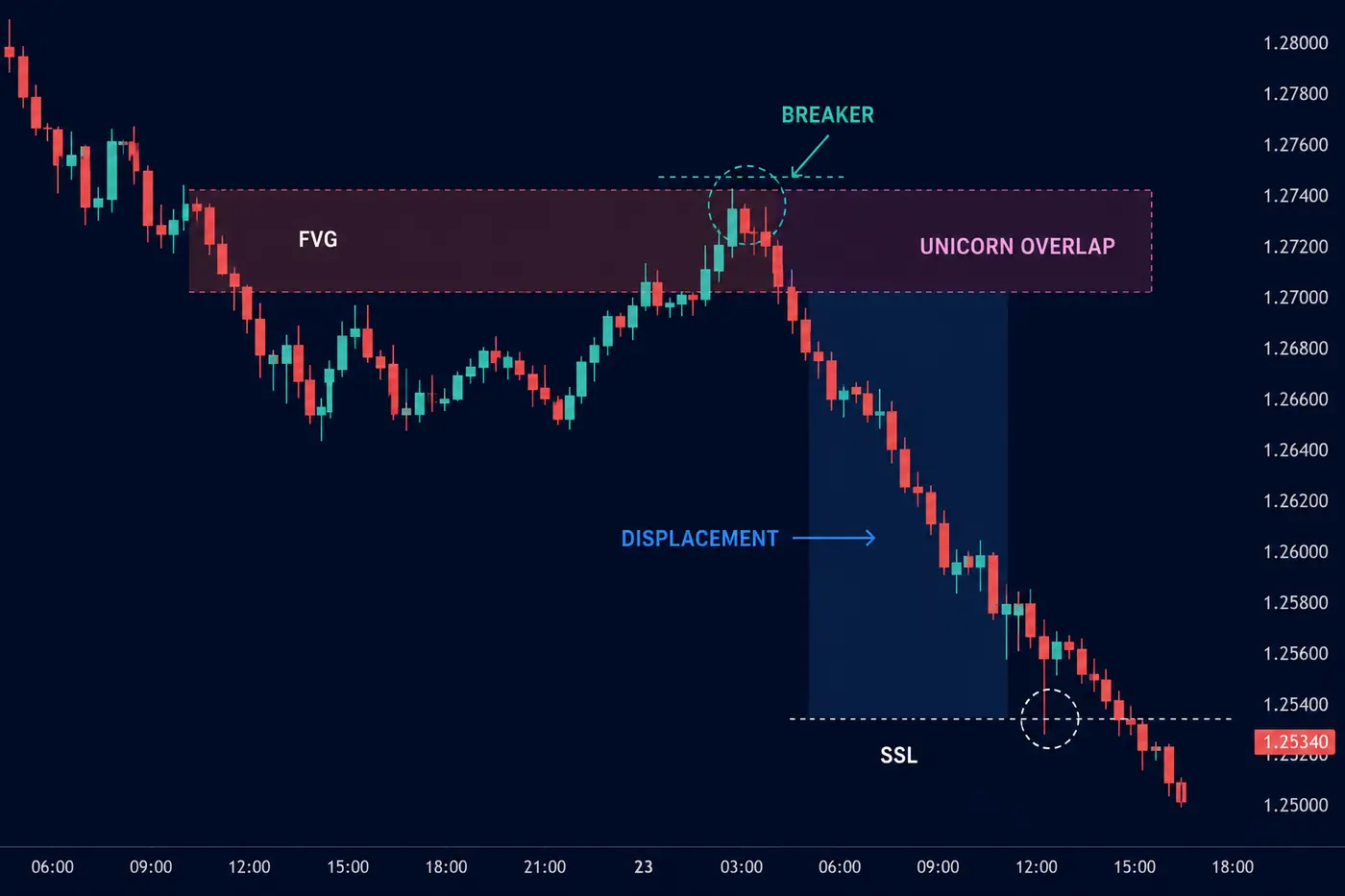
For the structure vocabulary around the model, compare the breaker block guide with the FVG guide. They are the components; this guide is the overlap workflow.
When should you ignore a Unicorn zone?
Ignore it when one ingredient is unclear, when price has crossed the zone repeatedly, or when the return occurs after the original delivery has been fully retraced. I also ignore a zone that sits in the middle of a broad range without nearby liquidity or a clear target.
A zone that needs a paragraph of excuses is not a zone I want to trade. The model should reduce ambiguity, not create a new vocabulary for avoiding a stop.
Does Quantum Algo mark ICT Unicorn structures?
No. The free public Quantum Algo indicators mark order blocks, fair value gaps and other SMC structures. Zeno provides confirmed Buy/Sell signals with SL/TP and built-in risk management; it does not label a Unicorn model or draw the breaker/FVG overlap for you.
That distinction is part of the product promise. Use the public structure tools to study the idea, and evaluate any paid signal as a separate, risk-defined output. Quantum Algo’s free public indicators mark order blocks and fair value gaps; Zeno provides confirmed Buy/Sell signals with stop-loss, take-profit and built-in risk management. QuantumBot is the $199/mo automated execution service. Plans are $19, $39 and $79 per month; cancel anytime.
Can a bot execute an ICT Unicorn plan?
A bot can execute the plan if the overlap, trigger, stop, target and expiry are explicit. “Trade the Unicorn” is not a machine rule until you define how the breaker is validated, how much of the FVG must overlap and what candle confirms the return.
For risk context, use the risk-management guide and verify your broker’s GBPUSD pip value. The setup quality never replaces the cash-risk calculation.
| Tool | What it measures | Its job in the plan |
|---|---|---|
| ICT Unicorn | Valid breaker + FVG overlap | Selective confluence zone |
| Breaker only | Failed order-block role reversal | Wider structure location |
| FVG only | Fast-delivery imbalance | Return-to-imbalance context |
| Label without sequence | Box drawn after the move | Hindsight, not a model |
Why is the ICT Unicorn model easy to mislabel?
The model combines two ideas that traders often study separately: a breaker block and a fair value gap. That combination is useful because it compresses a failed area and an imbalance into one decision zone. It is also easy to over-label. A breaker without the role reversal is not automatically a breaker, and an FVG without meaningful displacement is not automatically evidence of institutional delivery.
On a 15-minute GBPUSD chart, I mark the swing that failed first. If price broke through a prior bearish order block, displaced higher and left an imbalance, the old zone may now act as a bullish breaker while the FVG overlaps it. The model is the overlap plus the story of failure and delivery. I then wait for price to revisit the overlap. Drawing the box before the failure is confirmed creates hindsight.
The return is the test. A wick into the zone followed by acceptance through it is not the same as a rejection that closes back in the direction of the displacement. I want to know what the market did after touching the overlap, not merely that the candle touched it. That is why the entry model in this guide uses a reclaim or displacement confirmation rather than a blind limit order on every box.
How do you distinguish a Unicorn from a breaker-only setup?
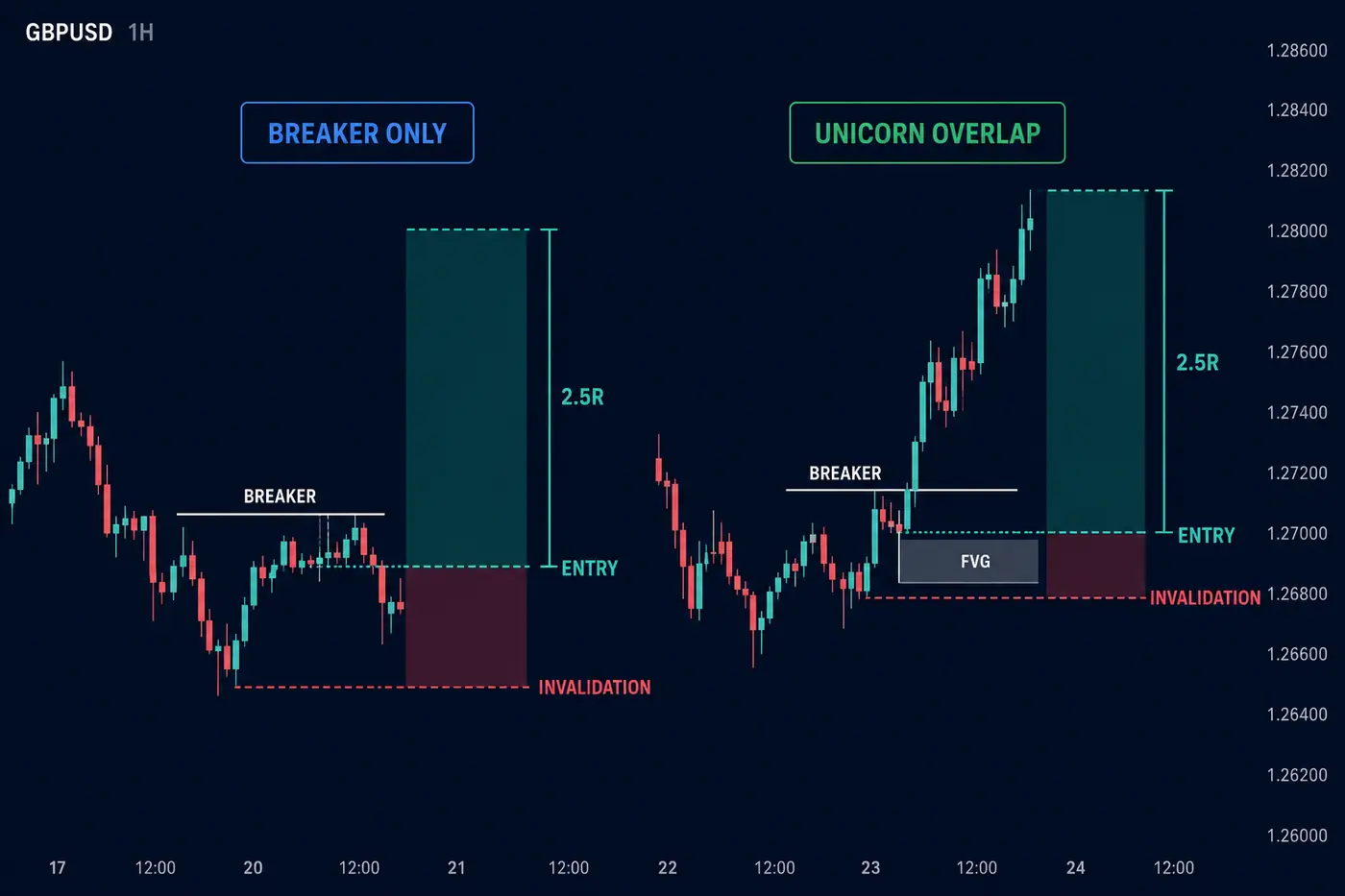
Put the two charts side by side. A breaker-only setup explains the failed order block and its possible role reversal. A Unicorn adds an FVG that overlaps the breaker, giving the zone a narrower shared band. The narrower band can improve location, but it can also make the trade more fragile if the overlap is too small or if the two structures were created by unrelated price legs.
I ask four questions before marking it valid. Did the breaker actually fail? Did the displacement leave a clear FVG? Is there a meaningful overlap rather than a one-tick intersection? Is there nearby liquidity that makes the target plausible? If any answer is unclear, I keep the components on the chart without calling the combination a Unicorn.
This is also where product accuracy matters. Quantum Algo’s free public indicators can mark order blocks and fair value gaps for study. They do not label an ICT Unicorn as a proprietary structure. Zeno provides confirmed Buy/Sell signals with SL/TP and built-in risk management; it does not draw the breaker/FVG overlap. The manual concept and the paid signal product remain separate.
What makes a Unicorn tradeable instead of merely interesting?
A tradeable zone has a defined invalidation and a clean path to target. If a bullish overlap sits under current price but the next opposing high is only 0.7R away, the visual quality does not rescue the expectancy. If the stop must sit through a wide breaker and the account risk becomes too large, the correct decision is to skip or reduce size.
I also distinguish continuation from reversal. A Unicorn aligned with a higher-timeframe trend can use the overlap as a pullback location. A reversal Unicorn has to overcome the higher-timeframe delivery that produced the opposing move. Reversal attempts need more evidence, not a more dramatic label. I write the classification in the journal so the sample does not mix two different trade types.
How do you avoid hindsight when drawing an ICT Unicorn?
Use a bar-by-bar process. First mark the swing and the order block that failed. Then wait for the displacement to complete before drawing the FVG. Finally mark only the shared band and record the time it became visible. If the box requires future candles to explain why it exists, it was not available at the decision point.
On a 5-minute chart, this process can feel slow because the overlap may form in the middle of a fast move. That is useful information. A model that forms after the entry has already travelled may be a map for a later return, not a reason to enter immediately. I would rather miss the first leg and trade a confirmed retest than invent a limit order from a pattern that was still developing.
Keep the risk model independent from the label. A Unicorn is not allowed a larger risk percentage because the zone looks precise. Fixed account risk, a stop beyond invalidation and a realistic target still decide whether the trade is acceptable. If the zone is too wide for the account, the answer is smaller size or no trade. A smaller visual box is not a substitute for correct position sizing.
For a review sample, separate continuation, reversal and news-day Unicorns. These environments have different failure modes. A continuation zone can fail because the trend accelerates without a pullback. A reversal zone can fail because higher-timeframe delivery remains dominant. A news-day zone can fail because spreads and slippage overwhelm the apparent risk. Combining all three hides the reason the model worked or failed.
What should the Unicorn chart show before the entry?
Before entry, I want to see the failed zone, the displacement leg, the FVG boundaries and the common overlap on the same chart. I also want the higher-timeframe direction written in plain language. “Bullish” is not enough; “four-hour price is above the prior weekly low and the 15-minute breaker sits below the London high” is a usable context note.
On XAUUSD, a fast move can leave several nearby gaps. The closest overlap is not automatically the right one. Choose the zone created by the delivery that changed the local narrative, then test whether the return has room to reach liquidity. A cluster of boxes is a sign to simplify, not an invitation to stack them.
Save the original markup before the return. If the overlap is widened, narrowed or shifted after the reaction, keep both versions and record why. That preserves the difference between a rule and a chart illustration.
What is the Unicorn rule I would actually trade?
I would require a confirmed breaker, a meaningful FVG from the same delivery and a real overlap before watching the return. The entry needs a reaction or reclaim, the stop belongs beyond invalidation and the target must be visible before risk is taken. If the FVG or breaker is debatable, I keep it as a component study instead of calling it a Unicorn.
That standard is intentionally stricter than a label search. It keeps the model useful for chart review and prevents the name from turning every order block and imbalance into a trade.
What should the Unicorn checklist leave out?
It should leave out a model drawn only because the trade worked, a breaker that never failed and an FVG that was unrelated to the delivery. A precise-looking overlap still needs a target and invalidation. The label is earned by sequence, not by colour.
When the chart is ambiguous, keep the breaker and FVG as separate reference points. That preserves useful information without claiming that the combined model exists.
How does session context change an ICT Unicorn?
A London-created overlap may be tested during New York after a second liquidity pool is taken. I mark the session in the journal because the same breaker/FVG geometry can behave differently at a quiet rollover and at a cash-market opening. The model is structural; the execution conditions are not.
On XAUUSD and indices, a return can be violent enough to touch the zone and leave before a limit order would be sensible. Wait for the reaction you defined, keep the stop beyond invalidation and do not widen it because the session became active.
How should a Unicorn target be chosen?
Choose the target from visible liquidity or a pre-defined R multiple before the order. A breaker/FVG overlap does not guarantee a return to the prior high. If the path is crowded with opposing structure, lower the size or reject the setup. The model narrows location; it does not create open space. I write the exit level before the zone is retested.
The ICT Unicorn is a breaker/FVG overlap with a delivery test. Validate both ingredients, wait for a reaction, place the stop beyond invalidation and do not imply that Zeno draws the model. The overlap narrows location; it does not remove uncertainty.
◆ Interactive check
Can you validate the Unicorn before trading it?
Questions traders ask about smc / ict models
The ICT Unicorn model is the overlap of a valid breaker block and a fair value gap. Traders use the shared area as a focused location after displacement, then wait for a reaction and define invalidation.
No. A breaker is one ingredient; the Unicorn model requires the breaker to overlap an FVG. A breaker without the overlap is a different setup.
No. An FVG is the imbalance component. The Unicorn is the confluence of that FVG with a breaker block.
Wait for a sweep, displacement, reclaim or clear acceptance when price returns to the overlap. A first touch without a reaction is weaker than a defined delivery event.
Place it beyond the price action that invalidates the breaker/FVG thesis. Do not put the stop inside the overlap simply to make the position larger.
No. The ingredients need a valid sequence, a meaningful overlap and a reason for price to revisit the zone. Repeatedly crossed or context-free overlaps are lower quality.
It can be studied on forex, indices, gold and crypto, but the session, spread and volatility differ. Test the exact symbol and use a stop based on its own invalidation structure.
The free public indicators mark order blocks and fair value gaps. Zeno provides confirmed Buy/Sell signals with SL/TP and built-in risk management; it does not draw Unicorn labels.
QuantumBot can execute a fully specified plan where a supported connection is available. The automation rule must define the overlap, trigger, stop, target, expiry and risk.
Map the breaker and FVG on a higher timeframe, then use a lower timeframe only to refine a qualified return. A 1-minute chart should not redefine the higher-timeframe invalidation.
Quantum Algo publishes a ledger showing 75% across 160 closed signals, with 120 wins and 40 losses. It is a record to verify, not a promise for an ICT Unicorn setup.
References & Related Guides
Read next
- Breaker Block Trading Guide
- Fair Value Gaps Guide
- ICT Trading Strategy Guide
- Order Blocks Trading Guide
Authoritative sources
- TradingView: chart context reference
- CME Group: support and resistance education
- ICT concepts: breaker block reference