Dark Cloud Cover
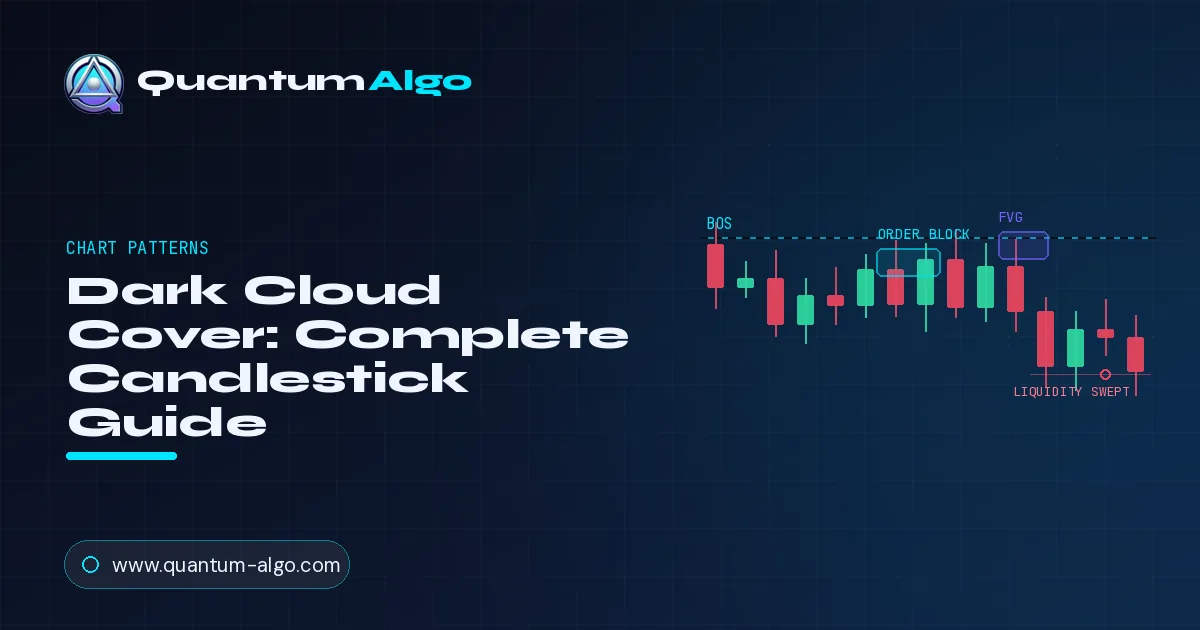
Dark cloud cover is a two-candle bearish reversal pattern at the top of an uptrend. The first candle is a strong up candle; the second gaps open above its high and closes below the midpoint of its real body. That shows sellers overwhelming buyers; the deeper the close, the stronger the signal. It is the bearish counterpart of the piercing pattern.
What is dark cloud cover?
Dark cloud cover is a classic two-candle bearish reversal pattern in candlestick analysis, signalling that an uptrend may be running out of steam and turning lower. As the evocative name suggests, it represents a “dark cloud” of selling pressure rolling over a previously sunny, bullish market — the moment optimism is overtaken by a wave of supply.
It is one of the most reliable and widely-taught reversal patterns, particularly valued because its structure encodes a clear and meaningful shift in the balance of power.
The pattern forms at the top of an uptrend and consists of two candles. The first is a strong bullish candle that fits the prevailing uptrend, reinforcing the impression that buyers are firmly in control.
The second is a bearish candle that begins with a burst of optimism — it opens with a gap up, above the prior candle’s high — but then reverses hard, with sellers driving price down to close deep within the first candle’s body, specifically below its midpoint.
This dramatic intraday reversal, from a gap-up open to a close more than halfway down the previous candle, is the heart of the pattern: it shows that a strong bullish session was decisively rejected, and that sellers have seized the initiative at what may be a market top.
What are the rules for a valid dark cloud cover?
For a valid dark cloud cover, several specific conditions must be met. Recognising them precisely is what separates a genuine pattern from a vague bearish candle, and each condition reflects part of the psychology.
- A prior uptrend. The pattern must appear after a clear up-move; as a reversal signal it needs an uptrend to reverse.
- A strong bullish first candle. The first candle is a solid up candle with a decent-sized real body, in keeping with the uptrend.
- A gap-up open on the second candle. The bearish second candle opens above the high of the first — a show of initial bullish strength that is about to be rejected.
- A close below the first candle’s midpoint. This is the defining condition: the second candle must close below the 50% level of the first candle’s real body, deep into bullish territory. The deeper the close, the stronger the signal.
The crucial element is the combination of the gap-up open and the close below the midpoint. The gap up shows that the session began with buyers still apparently in command — sentiment was bullish. But by the close, sellers had not only erased that opening optimism, they had pushed price down through more than half of the previous up candle.
This reflects a sharp, decisive intraday rejection: the further the second candle closes into the first candle’s body, the more emphatic the takeover by sellers and the stronger the reversal signal. A close that only dips slightly into the body is weak and ambiguous; a close near the first candle’s open is a powerful bearish statement bordering on a bearish engulfing.
What does dark cloud cover reveal about market psychology?
Dark cloud cover tells a vivid story of sentiment flipping from greed to fear at a market top. Heading into the pattern, the uptrend has buyers feeling confident, and the strong first bullish candle confirms that mood. When the second candle gaps up at the open, that confidence appears to peak — price opens above the prior high, and bullish traders feel vindicated, perhaps adding to positions, expecting the trend to continue.
Then the trap springs. Instead of following through, price stalls and begins to fall. Sellers — which may include large players distributing into the eager buying, or simply a wave of profit-taking and fresh shorting — overwhelm the buyers and drive price relentlessly lower through the session, erasing the gap and pushing the close deep into the previous candle’s body.
The psychological damage is significant: the traders who bought the gap-up open are now sitting in losses, the bullish momentum has been visibly broken, and the failure to hold new highs signals that demand has been exhausted. The pattern captures the precise moment that bullish conviction is overtaken by selling pressure — the “dark cloud” passing over the trend.
Those trapped longs become future sellers as they look to exit, adding fuel to the potential reversal, which is why dark cloud cover so often marks the start of a move lower.
How to trade the dark cloud cover reversal
Dark cloud cover is traded as a bearish reversal signal — an opportunity to short the market or exit longs as an uptrend potentially tops out. The pattern itself defines the setup, but disciplined execution requires waiting for confirmation rather than shorting blindly the instant the second candle closes.
- Identify a valid pattern at a top. Confirm the prior uptrend, the strong bullish candle, the gap-up open, and the close below the first candle’s midpoint — ideally at a logical resistance area.
- Wait for confirmation. The highest-probability approach is to wait for a third candle that closes lower, confirming sellers have followed through, rather than acting on the two-candle pattern alone.
- Enter the short. Aggressive traders enter on the close of the dark cloud cover candle; conservative traders enter on the break of its low or on the confirming third candle.
- Place your stop. Above the high of the pattern (the gap-up high), the point that would invalidate the reversal.
- Define your target. A prior support level, a measured move, or a key structure point below, where you take profit or trail your stop.
The single most important discipline is confirmation. A dark cloud cover is a warning that momentum has shifted, but in a strong uptrend it can fail and price can resume higher. Waiting for a lower close after the pattern, or for a break of the pattern’s low, filters out many failures at the cost of a slightly later entry — a worthwhile trade-off.
As with all candlestick patterns, the dark cloud cover is a high-probability setup only when it is confirmed and supported by context, never as a mechanical short on the candle alone.
How do you grade a dark cloud cover's quality?
The reliability of a dark cloud cover varies enormously depending on its quality and context, and learning to grade it keeps you out of weak signals. Several factors strengthen the pattern. The depth of the close matters most: the further the second candle closes into the first candle’s body — the deeper below the 50% midpoint — the stronger the rejection and the more reliable the reversal.
A close near the very bottom of the first candle is close to a bearish engulfing and carries similar weight.
Other strengthening factors include the size of the candles (large, decisive bodies are more meaningful than small ones), elevated volume on the bearish second candle (confirming real selling participation), and especially the location of the pattern. A dark cloud cover that forms at a significant resistance level, a prior high, or after an extended, overstretched rally is far more trustworthy than one appearing mid-trend in open space.
Conversely, the pattern is weakened by a shallow close just below the midpoint, small candle bodies, low volume, or a location with no nearby resistance. The single most reliable habit is to require confirmation from the following candle — a lower close after the pattern dramatically improves the odds, because it shows sellers genuinely followed through rather than the pattern being a one-session blip.
Grading each dark cloud cover by depth, volume, location and confirmation turns a binary “is it a pattern?” into a nuanced read of how much to trust it.
Where does dark cloud cover work best?
Like every candlestick pattern, dark cloud cover is dramatically more powerful when it forms at a meaningful location and is supported by other evidence — confluence. The pattern in isolation is a momentary shift in sentiment; the same pattern at a key level, confirmed by multiple tools, is a high-conviction reversal setup. Stacking confluence is the difference between a coin-flip and an edge.
The most important confluence is resistance. A dark cloud cover that prints right at a established resistance level, a prior swing high, or a supply zone is far more reliable, because the level provides an independent reason for the reversal and the candle confirms it is happening. Fibonacci retracement levels, a key retracement of a prior down-move, add further weight.
A momentum read aligns nicely too: if a momentum oscillator like the RSI is overbought or showing bearish divergence as the dark cloud cover forms, momentum and price action agree that the top is in.
Finally, the broader trend and structure matter — a dark cloud cover that also coincides with a failure to make a new high, or forms at the top of an extended rally, carries more weight than one against a powerful, healthy uptrend.
The practical rule: trade dark cloud cover with the wind at your back, where location, momentum and structure all point the same way, and treat the pattern as the precise trigger that confirms the reversal those other factors were already suggesting.

Automate your trades. Let Quantum Algo trade for you.
Every signal executed on your own account — 24/7, hands-off.
How does dark cloud cover compare with other bearish reversals?
Dark cloud cover is one of several two- and three-candle bearish reversal patterns, and distinguishing them clarifies what each requires and how strong it is.
| Pattern | Structure | Strength |
|---|---|---|
| Dark cloud cover | Up candle, then gap-up candle closing below its midpoint | Strong |
| Bearish engulfing | Up candle, then bigger down candle engulfing it fully | Stronger |
| Evening star | Up candle, small indecision candle, then down candle | Strong (3-candle) |
| Shooting star | Single candle, long upper wick, small body | Moderate |
The patterns sit on a spectrum of how completely sellers overtake buyers. Dark cloud cover requires the bearish candle to close below the midpoint of the prior up candle — a strong but partial takeover. The bearish engulfing is its more powerful cousin: the down candle engulfs the entire body of the prior up candle, a complete reversal that is generally considered the stronger signal.
In fact, you can think of dark cloud cover as a slightly milder bearish engulfing — if the second candle had closed all the way below the first candle’s open instead of just past its midpoint, it would be an engulfing. The evening star is a three-candle version that adds an indecision candle at the top, while the shooting star is a single-candle rejection.
The practical takeaway is that all signal the same thing — bullish exhaustion and a likely top — and the choice is less about which is “best” than about recognising whichever forms and grading its strength: deeper closes and fuller engulfing mean a stronger reversal signal.
The piercing pattern: the bullish mirror
Every bearish candlestick pattern has a bullish mirror, and for dark cloud cover that mirror is the piercing pattern (or piercing line). Understanding it rounds out your grasp of the concept and gives you the bullish reversal signal to watch for at market bottoms. The piercing pattern is, in essence, dark cloud cover flipped upside down.
The piercing pattern forms at the bottom of a downtrend and consists of two candles. The first is a strong bearish (down) candle in keeping with the downtrend. The second is a bullish (up) candle that opens with a gap down, below the prior candle’s low, and then reverses to close above the midpoint of the first candle’s body.
Just as dark cloud cover shows sellers overwhelming a gap-up, the piercing pattern shows buyers overwhelming a gap-down: the session opens with apparent bearish strength, but buyers seize control and push price more than halfway back up the previous down candle, signalling that selling is exhausted and a bullish reversal may be starting.
The same rules of quality apply in reverse — the higher the second candle closes into the first candle’s body the stronger the signal, location at support adds confluence, and confirmation from a following higher close improves reliability. And just as dark cloud cover relates to bearish engulfing, the piercing pattern relates to the bullish engulfing, which is its more complete and powerful counterpart.
Learning the two as a mirrored pair makes both easier to spot and trade.
Dark cloud cover and Smart Money Concepts
Dark cloud cover becomes far more powerful when read through a Smart Money Concepts lens, which explains why the pattern forms where it does and helps you distinguish a genuine top from a trap. SMC reframes the pattern from a mere candlestick into a footprint of institutional distribution.
Consider the gap-up open that defines the pattern. In SMC terms, that push to a new high often serves to sweep the liquidity resting above the prior swing high — triggering breakout buy-stops and trapping eager longs — before price reverses.
A dark cloud cover that forms immediately after such a liquidity sweep, at a higher-timeframe supply zone or order block, is a textbook institutional distribution signal: smart money sold into the buying that the gap-up induced, and the deep bearish close is the visible result. This is the highest-conviction version of the pattern.
The confirmation an SMC trader looks for next is a change of character — a break of the most recent higher low — which signals the structure has actually shifted bearish rather than merely pausing. Used together, the sequence is compelling: price sweeps liquidity into a supply zone (location), a dark cloud cover prints (the candle-level rejection), and a change of character confirms the reversal (structure).
The candle tells you sellers won this battle; SMC tells you it happened exactly where institutions wanted it to.
A complete dark cloud cover trade, step by step
Walk through a textbook dark cloud cover short. On the four-hour chart, a forex pair has rallied strongly for several sessions and is now approaching a well-established resistance level that also marks a prior swing high. Your higher-timeframe read is that price is extended into resistance, so you are alert for a reversal rather than chasing the rally.
Price pushes into the resistance. A strong bullish candle prints, and then the next candle gaps up above its high, briefly making a new high that sweeps the liquidity above the prior swing — and then it reverses hard, sellers driving it down to close well below the midpoint of the previous candle’s body. That is a clean dark cloud cover, formed at resistance, right after a liquidity sweep, with the RSI showing bearish divergence.
The confluence is excellent, but you wait for confirmation.
The following candle closes lower, breaking the low of the dark cloud cover and confirming sellers have followed through — and that lower close also breaks the most recent higher low, a change of character. You enter short on that confirmation, placing your stop above the gap-up high of the pattern, the level that would prove the reversal wrong.
Your target is the prior support shelf below, where you bank partials and trail the remainder as price rolls over into a new downtrend. Resistance, liquidity sweep, dark cloud cover, divergence, change of character, confirmed entry: every layer agreed, and the candle was the trigger that timed the top.
What dark cloud cover mistakes should you avoid?
- Shorting without confirmation. The pattern is a warning, not a guaranteed reversal. Wait for a lower close or a break of the pattern’s low before entering.
- Accepting a shallow close. The second candle must close below the first candle’s midpoint. A shallow dip into the body is weak and unreliable.
- Ignoring location. A dark cloud cover mid-trend in open space is far weaker than one at resistance, a supply zone, or after an extended rally.
- Forgetting the gap-up condition. A valid pattern opens above the prior high. Without the gap-up open and deep close, it is not a true dark cloud cover.
- No stop above the high. Always place your stop above the pattern’s high; if price reclaims it, the reversal has failed.
- Trading it in isolation. Combine the pattern with trend, level, momentum and structure rather than shorting every dark cloud cover you see.
📝 Test Your Knowledge
Dark Cloud Cover with Quantum Algo
Dark cloud cover marks a potential top, but a candle alone does not tell you whether smart money is actually distributing. Quantum Algo’s Smart Money Concepts indicators reveal whether the pattern forms at a supply zone, after a liquidity sweep, or with a shift in structure — turning a two-candle signal into a location-aware, high-probability short.
Related guides
❓ Frequently Asked Questions
Dark cloud cover is a two-candle bearish reversal pattern at the top of an uptrend. The first candle is bullish, and the second opens above the first candle's high (gaps up) then closes below the midpoint of the first candle's body, signalling sellers have overtaken buyers.
Dark cloud cover is a bearish reversal pattern. It appears at the top of an uptrend and signals that bullish momentum has been overwhelmed by selling pressure, suggesting a potential move lower.
Identify a valid pattern at a resistance area, then wait for confirmation such as a lower third candle or a break of the pattern's low before entering short. Place your stop above the pattern's high and target a prior support level or key structure below.
In dark cloud cover the bearish candle closes below the midpoint of the prior up candle, a partial takeover. In a bearish engulfing the down candle engulfs the entire body of the up candle, a complete takeover, which is generally the stronger signal.
Its reliability depends on quality and context. It is more reliable when the second candle closes deep into the first candle's body, on high volume, at a key resistance level, and when confirmed by a lower close on the following candle. It is weak mid-trend with a shallow close.
The piercing pattern is the bullish mirror of dark cloud cover. It forms at the bottom of a downtrend: a bearish candle followed by a bullish candle that gaps down then closes above the midpoint of the first candle's body, signalling a potential bullish reversal.
Classically yes, the second candle should open above the prior candle's high. In 24-hour markets like forex and crypto, true gaps are rare, so traders often accept an open at or near the prior high, with the key condition being the close below the midpoint.
Place your stop just above the high of the pattern, which is usually the gap-up high of the second candle. If price trades back above that high, the bearish reversal has failed and the trade should be exited.
Confluence such as a key resistance level or supply zone, a Fibonacci retracement, an overbought or bearish-diverging momentum oscillator, and a location at the top of an extended rally all strengthen the pattern and improve the odds of the reversal.
The gap-up open often sweeps liquidity above a prior high, trapping breakout buyers, while institutions distribute into that buying. A dark cloud cover at a supply zone after a liquidity sweep, confirmed by a change of character, is a textbook institutional distribution signal.
References & Related Guides
More in this topic
- Ascending Triangle Pattern: Complete Guide
- Bear Flag Pattern — Complete Bearish Continuation Guide
- Bullish Harami Pattern: Complete Trading Guide
- Candlestick Patterns Guide — Engulfing, Pinbar & More
- Chart Patterns: The Complete Guide
- Cup and Handle Pattern — Complete Trading Guide
- Doji Candlestick — Complete Indecision Pattern Guide
- Double Bottom Pattern — Complete Bullish Reversal Guide
- Double Top Pattern — Complete Bearish Reversal Guide
- Engulfing Candle — Complete Reversal Pattern Guide
- Evening Star Pattern: Complete Trading Guide
- Falling Wedge Pattern — Complete Bullish Reversal Guide
Core reading
- BOS & CHoCH: Complete Market Structure Guide
- Order Blocks Trading: Complete Guide
- Best TradingView Indicators — Complete Guide
- Risk Management in Trading — Complete Guide
- All Premium Guides
- Quantum Algo on TradingView
- Public Track Record