Evening Star Pattern
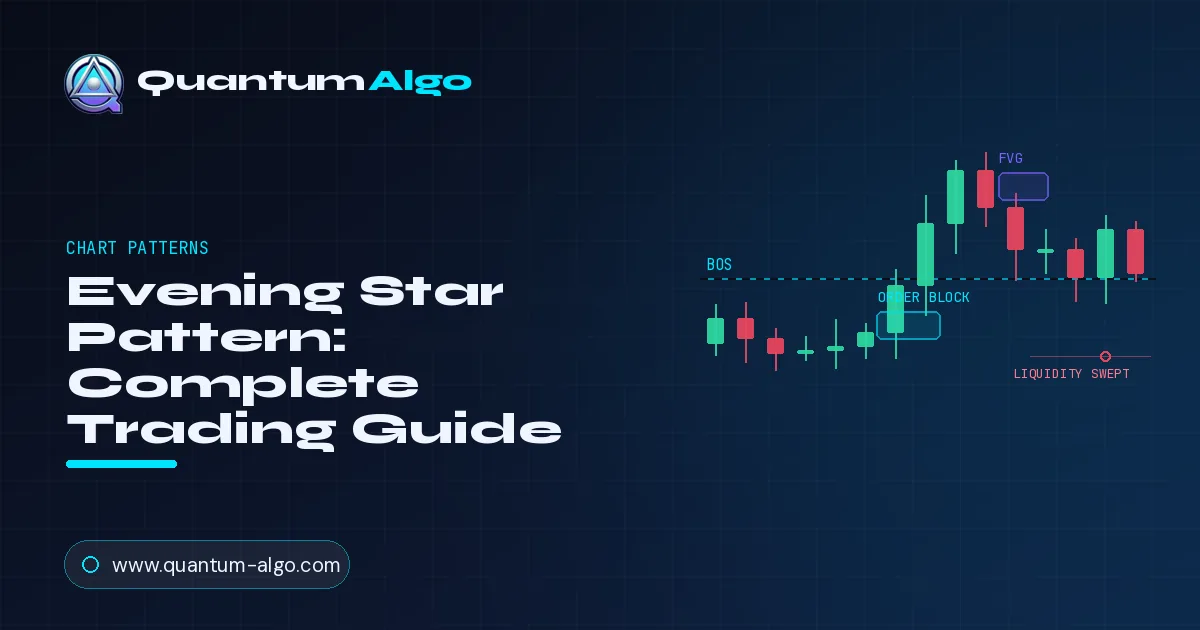
The evening star is a three-candle bearish reversal at the top of an uptrend: a large bullish candle, a small-bodied star that gaps or stalls, then a strong bearish candle closing deep into the first body, ideally below its midpoint. Wait for the third candle to close, enter on the close or retest, and put the stop above the star.
What is the evening star pattern?
The evening star is one of the most reliable three-candle reversal patterns in technical analysis, marking the transition from an uptrend to a potential downtrend. Its name is poetic but precise: just as the evening star (the planet Venus) appears in the sky as the sun sets, this pattern appears as a rally’s “day” comes to an end and darkness — selling — sets in.
The pattern tells a clear three-act story. First, a strong bullish candle shows buyers firmly in control, extending the uptrend. Second, a small-bodied candle — the “star” — forms near the top, often gapping up, revealing that the buying has stalled and indecision has crept in. Third, a strong bearish candle closes deep into the body of the first candle, confirming that sellers have seized control and the rally is over.
Because it requires this full sequence to complete, the evening star is considered a higher-conviction signal than a single-candle reversal — the market has visibly shifted from strength to indecision to weakness, step by step.
What are the three candles of an evening star?
The evening star is defined by the relationship between its three candles, and each one plays a specific role. Getting the structure right is what separates a valid evening star from a random cluster of candles.
- Candle one — the strong bull. A large bullish (green) candle that continues the existing uptrend, showing buyers in full control.
- Candle two — the star. A small-bodied candle (bullish, bearish, or a doji) that opens at or above the first candle’s close, often with a small gap up. Its small body is the key — it shows momentum has stalled.
- Candle three — the strong bear. A large bearish (red) candle that opens lower and closes well into the body of the first candle, ideally below its midpoint. This is the confirmation that sellers have taken over.
The deeper the third candle closes into the first candle’s body, the stronger the signal. An evening star whose third candle erases most of the first candle’s gains is far more convincing than one that only dips slightly. The small star in the middle is the hinge on which the whole reversal turns.
What is the psychology behind the evening star?
The evening star is a three-day map of a sentiment shift from greed to fear. On the first day, the uptrend is healthy and buyers are confident, driving price up with a strong green candle. The mood is optimistic, and many traders assume the rally will simply continue.
On the second day, price often gaps higher at the open — a final burst of enthusiasm — but then fails to make progress, closing with only a small body. This stalling is the critical psychological tell: the buyers who have been in control all rally are no longer able to push price higher, even after a strong open. The indecision of the star reveals that demand is exhausted.
On the third day, the sellers, sensing the buyers’ weakness, step in aggressively and drive price down through the body of the first candle. The traders who bought the top two days are now trapped and begin to sell, accelerating the decline. The evening star captures the exact moment optimism curdles into fear — which is why it so often marks a genuine top.
How to trade the evening star
Trading the evening star is a disciplined, confirmation-based process. The pattern gives you a clear structure for entry, stop and target, but patience and context separate the winning trades from the false alarms.
- Confirm the context. The pattern only matters at the top of an uptrend, ideally into established resistance or a supply zone. An evening star mid-range is noise.
- Wait for the third candle to close. The pattern is not complete until the bearish third candle confirms it. Acting on the first two candles is guessing.
- Enter on the close or the retest. Enter as the third candle closes, or wait for a small pullback toward the broken structure for a tighter entry.
- Place the stop above the star. Your stop sits just above the high of the star (candle two) — the point that would invalidate the reversal.
- Target the next support. Aim for the nearest support level or demand zone below, scaling out partials along the way.
Because the stop sits just above the star’s high and the target is a full structural level away, a well-placed evening star trade offers an attractive, asymmetric reward-to-risk.
How do you confirm an evening star?
An evening star in isolation is a decent signal; an evening star with confirmation is a strong one. The single most important confirmation is location: the pattern must form at the top of an uptrend, and it is dramatically more reliable when it appears at a level that already matters — a prior resistance, a round number, a supply zone, or a Fibonacci extension.
Volume is the second pillar. The ideal evening star shows declining volume on the star candle (confirming the stall in buying) and a surge of volume on the bearish third candle (confirming sellers are committing). When the down candle prints on heavy volume, the reversal carries far more weight.
Finally, look for confluence with other tools: a bearish reading on the RSI or a momentum divergence, a rejection from a moving average, or a break of a short-term trendline all reinforce the signal. The more independent reasons converge on the same top, the more confident you can be that the evening star marks a real reversal rather than a brief pause.
Evening star versus morning star
The evening star and the morning star are perfect mirror images of each other — same three-candle logic, opposite direction. Understanding both means you can spot reversals at tops and bottoms with the same skill.
| Feature | Evening Star | Morning Star |
|---|---|---|
| Trend before | Uptrend | Downtrend |
| Signal | Bearish reversal (top) | Bullish reversal (bottom) |
| Candle one | Strong bullish | Strong bearish |
| Candle two | Small star (gaps up) | Small star (gaps down) |
| Candle three | Strong bearish into body one | Strong bullish into body one |
| Action | Sell / go short | Buy / go long |
If the star candle is a true doji, the patterns are called an evening doji star and a morning doji star respectively, and the doji’s pure indecision makes them slightly stronger signals. The practical takeaway is symmetry: master the three-act structure once, and you can read it at both ends of a trend simply by flipping the colours.
Is the evening doji star a stronger signal?
A special and especially potent version of the pattern is the evening doji star, in which the middle candle is a doji — a candle with virtually no body, where the open and close are nearly equal. Because a doji represents perfect equilibrium between buyers and sellers, its appearance at the top of an uptrend is the purest possible expression of the indecision the evening star is built on.
The evening doji star is generally considered a stronger reversal signal than a standard evening star for exactly this reason: the buying pressure has not merely slowed, it has stalled completely. When that doji is followed by a decisive bearish candle closing into the first candle’s body, the contrast is stark — from full control, to total balance, to outright selling in just three sessions.
If the doji also gaps above the prior close and the bearish candle gaps below it, the pattern is sometimes called an abandoned baby top, one of the rarest and most reliable reversal signals in candlestick analysis. As always, the doji variant still demands the same contextual confirmation: it earns its strength only at a level that matters.

Automate your trades. Let Quantum Algo trade for you.
Every signal executed on your own account — 24/7, hands-off.
Is the evening star more reliable on higher timeframes?
Like every candlestick pattern, the evening star is more reliable on higher timeframes. An evening star on the daily or weekly chart represents three full sessions of shifting sentiment and the participation of serious capital, so it carries real weight. The same pattern on a one-minute chart represents three minutes of noise and should be treated with far more scepticism.
This does not mean the pattern is useless intraday — it can be a valuable timing tool on the lower timeframes — but its signals there must be filtered by the higher-timeframe trend and context.
A daily evening star that aligns with a weekly resistance is a major event worth acting on; a five-minute evening star that forms against a powerful daily uptrend is far more likely to fail, because the dominant trend will often simply absorb it and continue.
The reliable approach is the same top-down logic that governs all of technical analysis: let the higher timeframe define the bias and the key levels, and use the evening star to time entries when price reaches those levels from the right direction.
The evening star and Smart Money Concepts
Smart Money Concepts explain why an evening star works and tell you where to expect the best ones. In SMC terms, the strong first candle and the gap-up star often represent price pushing into a higher-timeframe supply zone or reaching for the liquidity resting above an obvious high.
The star’s stall is the moment that buy-side liquidity gets absorbed, and the bearish third candle is the institutional response — a sharp move down that frequently coincides with a change of character.
This is why the highest-probability evening stars form at the exact spots SMC flags in advance: into a supply zone, above a swept high, or at a premium price within the range.
When an evening star prints right after price grabs the liquidity above a prior high and then a change of character confirms the shift, you are no longer trading a textbook candlestick — you are trading an institutional reversal that just happens to look like an evening star. The pattern becomes the visible signature of smart money distributing into the last of the retail buying.
A complete evening star trade, step by step
Walk through a textbook evening star at resistance. On the daily chart, a stock has rallied for several weeks and is now pressing into a horizontal level that capped two previous advances — a clear resistance that also lines up with a round number. Price is in an obvious uptrend approaching a place that matters, which is exactly the context the pattern needs.
Day one prints a strong green candle as the rally pushes into the level. Day two gaps slightly higher but stalls, closing with a small body right at resistance — the star, and a clear sign buyers have run out of room. Day three opens lower and falls hard, closing well below the midpoint of the first candle on a visible surge in volume. The evening star is complete, at resistance, on heavy down-volume.
You enter short on the close of the third candle, or wait for a small pullback toward the broken structure for a tighter fill. Your stop sits just above the high of the star — the level that would prove the reversal wrong. Your first target is the nearest support below, where you bank partials and move to break-even; your runner trails toward the next major level.
Tight risk above the star, a full structural move to target: the asymmetric reward the pattern is built to deliver.
Which indicators pair well with the evening star?
The evening star becomes far more powerful when it is confirmed by independent tools rather than traded in isolation. The most natural partner is momentum. A RSI reading in overbought territory as the star forms, or better yet a bearish divergence where price makes a higher high but the RSI makes a lower high, dramatically strengthens the case that the rally is exhausted.
The same logic applies to the MACD rolling over or printing a bearish cross as the third candle closes.
Moving averages add another layer.
An evening star that forms right as price taps a falling 50 or 200 EMA from below — using the average as dynamic resistance — is a high-conviction setup, because two independent signals agree on the same top. Fibonacci levels work the same way: an evening star at the 61.8% retracement of a prior decline, or at a Fibonacci extension target, marks a zone where a reversal was already statistically likely.
The principle is confluence: the pattern tells you sellers have stepped in, and each additional tool that agrees raises the probability that this is a genuine top rather than a brief pause before the uptrend resumes.
Does the evening star work in stocks, forex and crypto?
The evening star appears in every market that produces candlestick charts, but its character shifts slightly from one to another. In stocks, the classic gap on the star candle is common because equities trade in sessions and can open away from the prior close, so you often see the textbook version with a clean gap up into the star. The pattern is especially reliable on daily stock charts near earnings-driven highs.
In forex and crypto, which trade continuously, true gaps are rare, so the star usually forms as a small-bodied candle rather than a gapped one — and that is perfectly valid. Crypto’s high volatility means evening stars can be sharp and fast, making confirmation and sensible stops especially important, since a violent reversal can also reverse again quickly.
In forex, the pattern works well on the higher timeframes where institutional flow dominates and the daily close carries weight. Across all of them, the underlying logic is identical: a strong advance, a stall, and a decisive rejection. What changes is the cosmetic detail of the gap, not the meaning. Adjust your expectation of the star’s appearance to the market, but judge the pattern by the same structural rules everywhere.
What evening star mistakes should you avoid?
- Trading it without an uptrend. An evening star is a reversal pattern; it only means something at the top of a rally, not in a range or a downtrend.
- Acting before the third candle closes. The pattern is not confirmed until the bearish candle completes. Jumping in on the first two candles is guessing.
- Ignoring location. The same three candles are powerful at resistance and meaningless mid-trend. Always demand a level that matters.
- A weak third candle. If the bearish candle barely dips into the first candle’s body, the signal is weak. Favour a deep close below the midpoint.
- Forgetting volume. A reversal on rising down-volume is far more trustworthy than one on thin, drifting volume.
- Trusting low-timeframe stars. A one-minute evening star against a strong daily uptrend will usually fail. Respect the higher-timeframe trend.
📝 Test Your Knowledge
Evening Star Pattern with Quantum Algo
An evening star is most reliable when it forms at a level that already matters. Quantum Algo’s Smart Money Concepts indicators map the supply zones, order blocks and liquidity that turn a three-candle reversal into a high-probability short — so you take the evening stars that appear at real resistance and skip the ones floating in the middle of a trend.
Related guides
❓ Frequently Asked Questions
The evening star is a three-candle bearish reversal pattern that forms at the top of an uptrend. It consists of a strong bullish candle, a small-bodied star showing indecision, and a strong bearish candle that closes well into the body of the first, signalling sellers have taken control.
The evening star is a bearish reversal pattern. It marks the potential end of an uptrend and the start of a decline, which is why traders use it as a signal to consider selling or shorting.
It is one of the more reliable candlestick reversal patterns, especially on higher timeframes and when it forms at established resistance with rising volume on the bearish candle. Reliability drops sharply when it appears mid-trend or on very low timeframes without confirmation.
They are mirror images. The evening star forms at the top of an uptrend and signals a bearish reversal, while the morning star forms at the bottom of a downtrend and signals a bullish reversal. The candle structure is identical but the direction and colours are reversed.
Confirm it forms at the top of an uptrend into resistance, wait for the bearish third candle to close, then enter short on the close or a retest. Place the stop just above the high of the middle star candle and target the next support level below.
The stop is placed just above the high of the middle star candle, since a move above that high would invalidate the reversal and suggest the uptrend is resuming.
An evening doji star is a stronger variant where the middle candle is a doji, showing complete indecision rather than just a slowdown. Because the buying has stalled entirely, it is generally considered a more powerful reversal signal than a standard evening star.
A classic evening star has a small gap up on the star candle, but in markets that trade continuously, like crypto and forex, true gaps are rare. The pattern is still valid as long as the middle candle has a small body that stalls near the top of the first candle.
Higher timeframes such as the daily and weekly produce the most reliable evening stars because each candle represents a full session of sentiment. Lower-timeframe stars can be used for timing but should be filtered by the higher-timeframe trend.
An evening star often forms as price pushes into a supply zone or sweeps the liquidity above a prior high. The star marks where that buy-side liquidity is absorbed, and the bearish candle is the institutional reversal, frequently coinciding with a change of character.
References & Related Guides
More in this topic
- Ascending Triangle Pattern: Complete Guide
- Bear Flag Pattern — Complete Bearish Continuation Guide
- Bullish Harami Pattern: Complete Trading Guide
- Candlestick Patterns Guide — Engulfing, Pinbar & More
- Chart Patterns: The Complete Guide
- Cup and Handle Pattern — Complete Trading Guide
- Dark Cloud Cover: Complete Candlestick Guide
- Doji Candlestick — Complete Indecision Pattern Guide
- Double Bottom Pattern — Complete Bullish Reversal Guide
- Double Top Pattern — Complete Bearish Reversal Guide
- Engulfing Candle — Complete Reversal Pattern Guide
- Falling Wedge Pattern — Complete Bullish Reversal Guide
Core reading
- BOS & CHoCH: Complete Market Structure Guide
- Order Blocks Trading: Complete Guide
- Best TradingView Indicators — Complete Guide
- Risk Management in Trading — Complete Guide
- All Premium Guides
- Quantum Algo on TradingView
- Public Track Record