Gold Trading (XAUUSD)
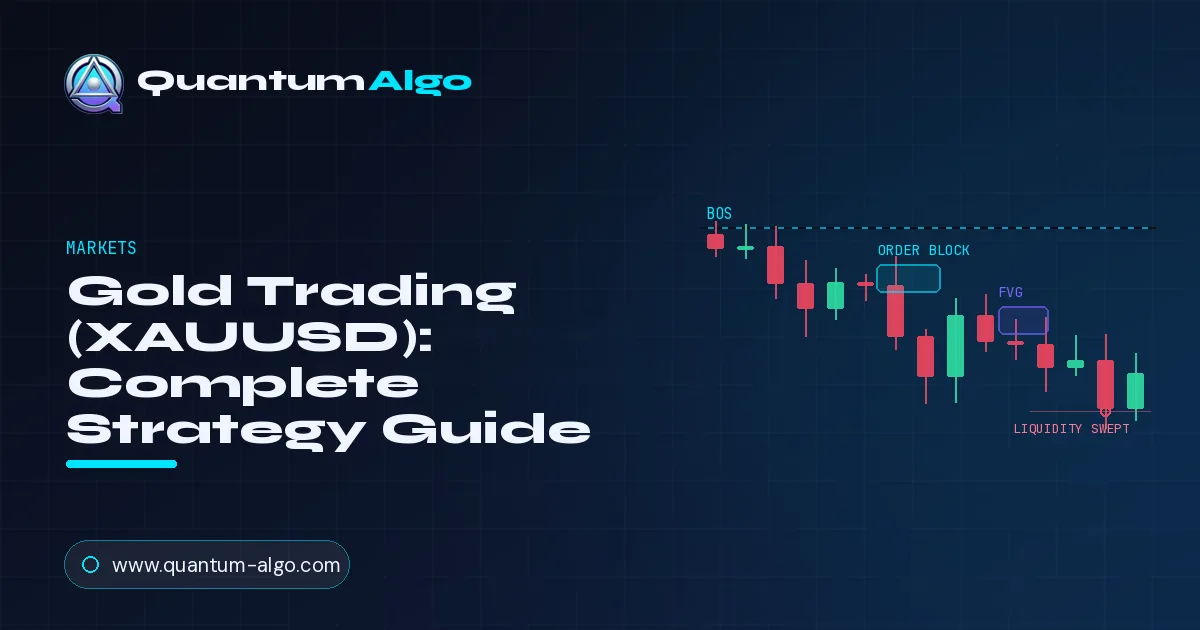
Gold trading means speculating on the price of one troy ounce of gold against the US dollar, quoted as XAUUSD. Its price is driven mainly by real interest rates, the US dollar, inflation expectations and geopolitical risk, making it a safe-haven, anti-dollar asset. It trades best during the London and New York sessions and their overlap.
What is gold trading (XAUUSD)?
Gold trading is the practice of speculating on the movement of the gold price, most commonly through the XAUUSD pair — the price of one troy ounce of gold (ticker XAU) quoted in US dollars. It is one of the oldest stores of value in human history and, today, one of the most heavily traded instruments in the world, accessible to retail traders through forex brokers, CFDs, futures, spot markets and ETFs.
Related: gold and the dollar (DXY) correlation.
When traders talk about “trading gold,” they usually mean speculating on XAUUSD’s price swings rather than taking delivery of physical metal.
Gold occupies a unique place in markets because it is simultaneously a commodity, a currency-like asset, and a barometer of fear. It is the classic safe-haven — capital tends to flow into gold during uncertainty, market stress and crisis — and a traditional inflation hedge, since it holds value when fiat currencies are being debased.
Because it is priced in dollars and behaves partly like an anti-currency, it has a deep, well-established relationship with the US dollar and interest rates. For traders, gold’s appeal is its combination of excellent liquidity, high volatility, and a tendency to produce strong, sustained trends and clean technical reactions.
That volatility cuts both ways — gold can move fast and far — so while it offers substantial opportunity, it demands respect, tight risk control and an understanding of the specific forces that drive it.
What drives the gold price
To trade gold well you must understand what actually moves it, because XAUUSD is a macro-driven market that responds to a specific set of fundamental forces. Unlike a company stock, gold has no earnings; its value is driven by its role as a safe haven and store of value, which ties it to the following drivers.
- Real interest rates. The single most important driver. Gold pays no yield, so when real (inflation-adjusted) rates rise, holding gold becomes relatively less attractive and its price tends to fall; when real rates fall, gold tends to rise.
- The US dollar. Because gold is priced in dollars, it usually moves inversely to the dollar — a stronger dollar makes gold more expensive for other currencies and tends to push XAUUSD down, and vice versa.
- Inflation expectations. As a classic inflation hedge, gold tends to attract demand when investors expect rising inflation to erode the value of cash.
- Geopolitical and financial risk. Wars, crises, and market panic drive safe-haven flows into gold, often producing sharp rallies.
- Central bank policy and demand. The stance of the Federal Reserve (hawkish or dovish) and physical buying by central banks both meaningfully influence the price.
The unifying theme is that gold is fundamentally an anti-dollar, anti-real-yield, pro-fear asset. When you see gold moving strongly, it is usually reacting to one of these drivers — a shift in Fed expectations, a move in the dollar, a spike in geopolitical tension. This is why major economic events, especially US inflation data, jobs reports and Federal Reserve decisions, are the highest-impact moments for XAUUSD and can produce explosive volatility.
You do not need to trade the fundamentals directly, but you must respect them: knowing that a Fed decision is imminent tells you to expect violent moves and manage risk accordingly, and understanding the dollar and rate backdrop gives context to whether gold’s technical picture is likely to be supported or fought by the macro tide.
The best sessions to trade XAUUSD
Gold trades nearly around the clock, but its liquidity and volatility are not evenly distributed across the day, and knowing when to trade XAUUSD is as important as knowing how. Trading gold during its most active windows means tighter spreads, cleaner moves and more reliable technical reactions; trading it in the dead hours often means choppy, low-conviction price action.
The two most important windows are the London session and the New York session, and especially their overlap. London brings the first surge of major liquidity and volatility to gold, often setting the tone and direction for the day.
New York adds the second wave, and because most of gold’s key fundamental catalysts — US economic data, Fed communications — are released during US hours, the New York session frequently produces gold’s biggest moves. The London–New York overlap, when both financial centres are active simultaneously, is typically the most liquid and volatile period of the day and a favourite window for gold traders.
The Asian session, by contrast, tends to be quieter for gold, often ranging or consolidating — which can suit range strategies but is generally less productive for trend and breakout trading.
The practical takeaway is to concentrate your XAUUSD trading on the London and New York sessions and their overlap, treat the scheduled US data releases as both opportunity and danger, and be cautious during the low-liquidity hours where gold’s moves are more erratic and spreads wider.
The best indicators and levels for gold
Gold responds beautifully to technical analysis because it is a highly liquid, heavily-traded market where key levels attract real participation. No single indicator is a magic bullet — and our dedicated best indicator for XAUUSD analysis goes deeper — but a focused toolkit suits gold particularly well.
The foundation is horizontal support and resistance. Gold has a strong tendency to respect major round numbers and prior swing highs and lows, reacting cleanly at well-defined levels, which makes level-based trading the backbone of most gold strategies. Fibonacci retracement works notably well on gold’s trending swings, with the golden-pocket zone often marking high-probability reversal areas.
For gauging volatility — essential on a market this fast — the Average True Range is invaluable for sizing stops sensibly around gold’s large ranges. VWAP is popular with intraday gold traders as a dynamic mean and institutional reference. And a momentum oscillator like the RSI helps read overbought and oversold conditions and, importantly, divergence at gold’s turning points.
The key principle for gold specifically is that levels lead and indicators confirm: identify the key support, resistance and Fibonacci zones first, then use an oscillator or VWAP to time your entry and an ATR-based stop to survive the volatility. Cluttering the chart with many overlapping indicators tends to hurt more than help on a clean, level-respecting market like XAUUSD.
How do you build a structured XAUUSD strategy?
A robust gold strategy combines the market’s tendencies — strong trends, clean level reactions, session-driven volatility — into a repeatable process. Here is a structured, level-based swing approach that suits XAUUSD’s character.
- Establish the higher-timeframe bias. On the daily and four-hour charts, determine gold’s trend and mark the major support, resistance and Fibonacci levels. Note the macro backdrop — is the dollar and rate picture supporting or fighting this direction?
- Wait for price at a key level. Do not chase gold in open space. Wait for price to reach one of your marked levels — a support in an uptrend, a resistance in a downtrend, a Fibonacci golden pocket.
- Demand confirmation. At the level, wait for a signal — a bullish or bearish reversal candle, an RSI divergence, a reclaim after a spike — that the level is holding, ideally during the London or New York session.
- Enter with an ATR-based stop. Enter on confirmation, placing your stop beyond the level at a distance informed by the ATR so gold’s normal volatility does not stop you out prematurely.
- Target the next level and manage. Take partial profit at the next significant level, move to break-even, and trail the remainder to capture gold’s tendency to trend.
The essence of this approach is patience and location. Gold rewards traders who wait for price to come to a pre-marked, high-probability level and then confirm, rather than those who react to every fast move.
The ATR-based stop is especially important on gold: because the market moves in large ranges, a stop that is too tight will be stopped out by noise, while an ATR-informed stop is placed at a distance that respects gold’s volatility. Combined with trading during the active sessions and respecting the fundamental backdrop, this level-based, confirmation-driven process turns gold’s volatility from a threat into a source of well-defined, favourable risk-to-reward opportunities.

Automate your trades. Let Quantum Algo trade for you.
Every signal executed on your own account — 24/7, hands-off.
Why do Smart Money Concepts suit gold so well?
Gold is one of the best markets for Smart Money Concepts, and many of the traders searching for gold setups specifically want an institutional, liquidity-based read of XAUUSD. This is no accident: gold’s deep liquidity and heavy institutional participation make it fertile ground for the order-block, liquidity and structure framework that SMC provides.
Gold’s clean, well-defined swings tend to leave textbook SMC footprints. Its obvious swing highs and lows — and the round numbers traders cluster around — accumulate pools of liquidity (resting stop orders) that price is repeatedly drawn to sweep.
A classic gold setup is a liquidity sweep: price spikes beyond an obvious high or low, grabbing the stops, then sharply reverses — a move that traps breakout traders and offers a high-probability entry to those who read it. Gold also respects order blocks — the zones from which its strong moves originate — and frequently returns to mitigate them before continuing.
The most reliable XAUUSD setups often combine these: price sweeps the liquidity above a high, taps a higher-timeframe supply zone, prints a bearish reversal and a change of character, and rolls over. Because gold moves with such conviction once a genuine institutional level is respected, SMC on gold can produce clean trends with excellent risk-to-reward.
The framework also helps you avoid gold’s notorious fake-outs: by recognising a spike as a liquidity grab rather than a breakout, you sidestep the traps that gold’s volatility sets for reactive traders. For XAUUSD, reading the market as a map of liquidity and structure is arguably the single most powerful analytical approach.
Managing risk on a volatile market
Gold’s greatest attraction — its volatility — is also its greatest danger, and risk management is non-negotiable when trading XAUUSD. Gold can move hundreds of dollars in a session and produce violent spikes around news, so an approach that works on a slow-moving market can be ruinous on gold if risk is not adapted to its character.
The first adaptation is volatility-aware position sizing and stops. Because gold’s ranges are large, stops must be placed at a sensible distance — guided by the ATR — so they are not triggered by normal noise; and because a wider stop means more dollars at risk per lot, your position size must be reduced accordingly to keep the percentage of capital risked constant.
Sizing gold trades the same way you would a slow-moving pair is a classic route to oversized losses. The second adaptation is respecting news: gold’s biggest and most erratic moves come around US inflation data, jobs reports and Fed decisions, where spreads widen and slippage is real. Many gold traders avoid holding through these releases or drastically reduce size around them.
The third is discipline with the fast moves — gold’s speed tempts traders to chase and to abandon their stops, both of which are fatal.
The unifying principle is that gold demands you respect its volatility rather than fear or ignore it: size for it, place stops that account for it, stay clear of the moments it becomes uncontrollable, and never risk more than a small, fixed percentage of your account on any single XAUUSD trade. Handled with this discipline, gold’s volatility becomes an opportunity; handled carelessly, it is the fastest way to blow an account.
What are the different ways to trade gold?
There are several instruments through which you can trade gold, and understanding them helps you choose the vehicle that fits your style, capital and market. They all track the gold price but differ in mechanics, cost and accessibility.
| Instrument | What it is | Best for |
|---|---|---|
| Spot / CFD (XAUUSD) | Direct speculation on the spot price via a broker | Active retail traders; flexible size and leverage |
| Gold futures | Exchange-traded contracts for future delivery | Larger, professional traders; deep liquidity |
| Gold ETFs | Funds that hold gold and trade like a stock | Investors and swing traders using a stock account |
| Physical gold | Coins and bars you actually own | Long-term store of value, not active trading |
For most active traders, spot gold / XAUUSD CFDs through a forex broker are the standard route, because they offer flexible position sizing, leverage, and the ability to go long or short easily on both intraday and swing timeframes — which is why “XAUUSD” is the ticker most gold traders live on. Futures offer deep, centralised liquidity and are favoured by larger and professional traders, though contract sizes are bigger. ETFs let investors gain gold exposure through an ordinary brokerage account and suit longer-horizon, less active participation. Physical gold is a store of value rather than a trading vehicle.
The technical analysis and strategy in this guide apply across all of these — gold’s levels, sessions and drivers are the same whatever instrument you use — but the leverage and volatility of spot/CFD trading make risk management especially critical, which loops back to the central lesson: whatever vehicle you choose, respect gold’s volatility and manage your risk with discipline.
What does a complete XAUUSD trade look like?
Walk through a textbook level-based gold short. On the daily chart, XAUUSD is in a short-term uptrend but pushing into a major horizontal resistance that also aligns with the 0.618 Fibonacci of the last down-swing — a strong confluence zone. Your higher-timeframe read is that price is stretched into significant resistance, so you are watching for a reversal rather than chasing the rally.
You wait for the New York session, when gold’s liquidity and the day’s US catalysts come online. Price pushes up into the resistance and briefly spikes above the prior swing high, sweeping the liquidity resting there — trapping breakout buyers — before snapping back below the level. On that spike, the RSI prints a clear bearish divergence, and a bearish engulfing candle forms right at the resistance.
Level, Fibonacci, liquidity sweep, divergence and a reversal candle all align.
You wait for confirmation: price breaks the most recent higher low, a change of character. You enter short on that break, placing your stop above the sweep high — at a distance informed by the ATR so gold’s volatility does not shake you out — and sizing the position so that this wider stop still risks only a small, fixed percentage of your account.
Your first target is the next support level below, where you bank partials and move to break-even, trailing the remainder as gold rolls into a clean down-move. Resistance plus Fibonacci confluence, a New-York-session liquidity sweep, divergence, a change of character, an ATR-based stop and volatility-adjusted size: the disciplined XAUUSD trade from analysis to exit.
What gold trading mistakes should you avoid?
- Using stops that are too tight. Gold’s large ranges will trigger a tight stop on noise alone. Size stops with the ATR and reduce position size to compensate.
- Trading through major US news blindly. Inflation data, jobs reports and Fed decisions cause violent, slippage-prone moves. Reduce size or stand aside around them.
- Chasing fast moves. Gold’s speed tempts you to jump in mid-move. Wait for price to reach a pre-marked level and confirm instead.
- Ignoring the macro backdrop. Fighting a strong dollar or rate trend with a technical setup lowers your odds. Know whether the fundamentals support your direction.
- Over-sizing because gold moves a lot. Big moves do not justify big size. Risk the same small, fixed percentage per trade as on any market.
- Cluttering the chart. Gold respects clean levels. Lead with support, resistance and Fibonacci; use one or two indicators to confirm, not ten.
◆ Test Your Knowledge
Gold Trading (XAUUSD) with Quantum Algo
Gold moves in clean, liquidity-driven swings that suit a structural approach, which is exactly what Quantum Algo is built for. By mapping XAUUSD’s order blocks, liquidity pools and market-structure shifts, the suite turns gold’s volatility from a hazard into a set of defined, high-probability levels — so you trade the reaction at a zone that matters rather than chasing every spike.
Related guides
◇ Frequently Asked Questions
XAUUSD is the ticker for gold priced in US dollars, representing the value of one troy ounce of gold (XAU) in dollars (USD). It is the most common way traders speculate on the gold price through forex brokers, CFDs and spot markets.
Gold is driven mainly by real interest rates (it falls when real rates rise), the US dollar (it usually moves inversely), inflation expectations, geopolitical and financial risk that fuels safe-haven demand, and central bank policy and buying. It has no yield, so it is an anti-dollar, anti-real-yield, pro-fear asset.
The London and New York sessions, and especially their overlap, offer the most liquidity and volatility for XAUUSD. Because most of gold's fundamental catalysts are US data releases, the New York session often produces the biggest moves. The Asian session is typically quieter.
No single indicator is best, but gold responds well to horizontal support and resistance, Fibonacci retracement (especially the golden pocket), the ATR for volatility-based stops, VWAP for intraday reference, and RSI for momentum and divergence. Levels lead and indicators confirm.
Gold is liquid and offers clean technical reactions, but its high volatility makes it risky for beginners who do not manage risk carefully. Its large ranges require volatility-based stops, reduced position size, and caution around US news. With strict risk control it can be traded by newer traders.
Use ATR-informed stops so gold's large ranges do not trigger you on noise, and reduce your position size so the wider stop still risks only a small fixed percentage of your account. Avoid or reduce size around major US news, and never chase fast moves or abandon your stop.
Gold is highly volatile and can move hundreds of dollars in a single session, with especially violent spikes around US inflation data, jobs reports and Federal Reserve decisions. This volatility creates opportunity but demands strict, volatility-adjusted risk management.
Because gold is priced in US dollars, a stronger dollar makes gold more expensive for holders of other currencies, dampening demand and pushing XAUUSD down, while a weaker dollar makes gold cheaper and tends to lift it. This inverse relationship is one of gold's most reliable tendencies.
Yes, gold is one of the best markets for SMC. Its deep liquidity and institutional participation produce clean liquidity sweeps, respected order blocks and clear structure shifts, so reading XAUUSD as a map of liquidity and structure is a powerful approach that also helps avoid gold's fake-outs.
Spot gold (XAUUSD) is direct speculation on the current price via a broker, with flexible sizing and leverage, favoured by active retail traders. Gold futures are exchange-traded contracts for future delivery with deep liquidity and larger contract sizes, favoured by professional and larger traders.
References & Related Guides
More in this topic
- What Are the Best Indicators for Futures Trading?
- Crypto Trading for Beginners: Complete Guide
- Forex Trading for Beginners — Complete Starter Guide
- Golden Cross & Death Cross: Complete Trading Guide
- What Is the Golden Pocket in Trading? (Fib 0.618)
- How to Calculate Pips in XAUUSD
Core reading
- BOS & CHoCH: Complete Market Structure Guide
- Order Blocks Trading: Complete Guide
- Best TradingView Indicators — Complete Guide
- Risk Management in Trading — Complete Guide
- Candlestick Patterns Guide — Engulfing, Pinbar & More
- All Premium Guides
- Quantum Algo on TradingView
- Public Track Record