Lot Size Calculator for Forex and Gold: Size the Trade from the Stop, Not the Ticket
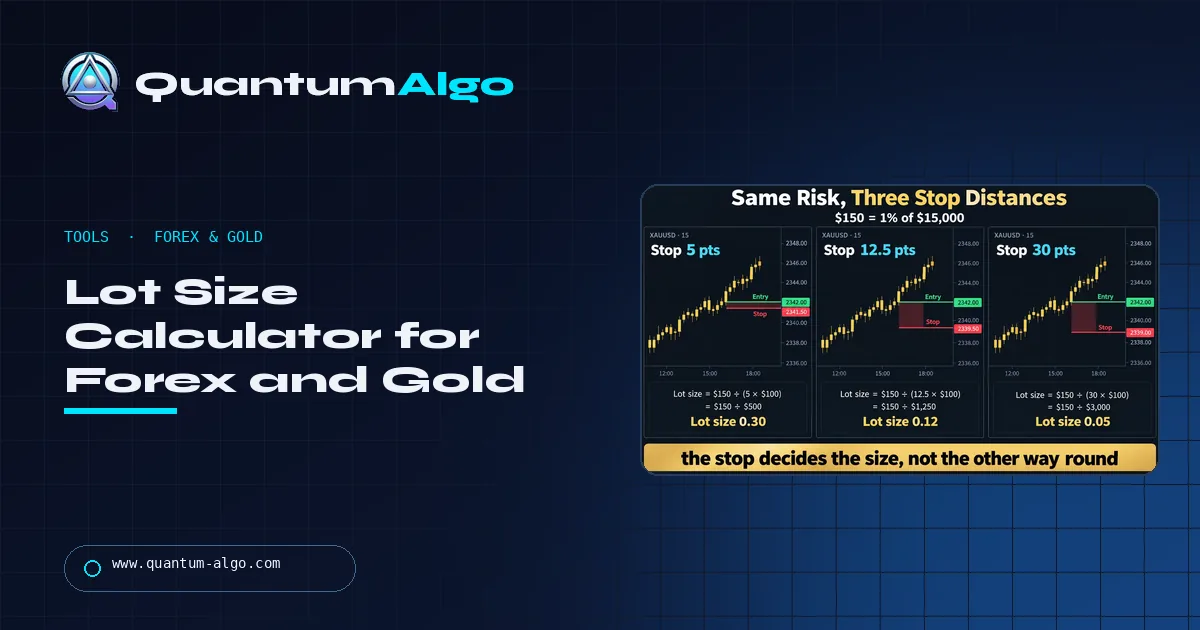
Lot size = cash risk ÷ (stop distance × value per lot per unit of distance). A $15,000 account risking 1% with a 25-pip EUR/USD stop gives 150 ÷ (25 × $10) = 0.60 lots; on gold with a $12.50 stop, 150 ÷ (12.5 × $100) = 0.12 lots. The stop decides the size; round down to your broker's step.
Almost every blown account I have reviewed typed a round lot size into the ticket before working out what it meant in dollars. This page reverses the order: cash risk first, stop distance second, and the lot size falls out of the division. The XAUUSD chart at the top shows the stop-loss zone the way Zeno draws it — as a price range in dollars — because that is the only unit that makes the gold arithmetic unambiguous.
Indicators that prove themselves in public.
One engine, four precision tools — the Gold (XAU) Scalper, the institutional Gravity Zone, the Zeno momentum Oscillator, and Zeno Stocks for equities.
What is a lot, and why does the size come last?
A lot is a broker's unit of quantity: one standard lot of EUR/USD is 100,000 euros, one lot of XAUUSD is 100 troy ounces. Mini and micro lots are a tenth and a hundredth of that. Every platform lets you type a lot size into the order ticket, and almost every losing account I have looked at typed a round number there before working out what it meant in dollars.
The order that works is the opposite of the ticket's layout. You decide the cash you are willing to lose, you measure the distance to the stop the chart gives you, and the lot size is whatever falls out of dividing one by the other. The stop decides the size, never the other way round — the three-panel illustration in this guide shows the same $150 risk producing 0.30, 0.12 and 0.05 lots as the stop widens from 5 to 12.5 to 30 points on gold.
What is the lot size formula?
lot size = risk in account currency ÷ (stop distance × value per lot per unit of distance)
For a USD account:
- EUR/USD, stop in pips: value per lot per pip is $10, so 1% of $15,000 with a 25-pip stop is 150 ÷ (25 × 10) = 0.60 lots.
- XAUUSD, stop in dollars: one lot is 100 oz, so a $1 move is $100 per lot. $150 risk with a 12.5-point stop is 150 ÷ (12.5 × 100) = 0.12 lots.
- USD/JPY, stop in pips: one lot is 1,000 JPY per pip, so at 156.00 that is about $6.41; 150 ÷ (25 × 6.41) = 0.94 lots.
When the account currency is not the quote currency, the value per pip has to be converted first — the pip value calculator does that step, and the calculator on this page carries the conversion through to the lot size.
Why do traders get gold lot size wrong?
XAUUSD trips people up because brokers quote it to two decimals and traders carry over the forex habit of counting "pips". On most brokers one lot is 100 oz, a $1.00 move is worth $100 per lot, and a 0.01 move is worth $1. A "20-pip stop" on gold therefore means $0.20 — which is a $20 risk per lot — while a 20-point stop means $20.00 and a $2,000 risk per lot. Traders who confuse the two are sizing a hundred times too large.
The rule I give subscribers: on gold, measure the stop in dollars, never in pips, and check the contract size in your broker's specification. A few brokers use 10 oz or 1 oz contracts, and CFD brokers can define "1 lot" any way they like. The XAUUSD chart at the top of this guide shows the stop-loss zone as Zeno draws it — a price range, in dollars — which is the only unit that makes the arithmetic unambiguous.
How do lots, units and pip values compare?
| Lot label | Units (forex) | EUR/USD per pip | Gold equivalent |
|---|---|---|---|
| Standard 1.00 | 100,000 | $10.00 | 100 oz → $100 per $1 |
| Mini 0.10 | 10,000 | $1.00 | 10 oz → $10 per $1 |
| Micro 0.01 | 1,000 | $0.10 | 1 oz → $1 per $1 |
| Nano 0.001 | 100 | $0.01 | not offered by most brokers |
Most brokers allow increments of 0.01, so a calculated 0.118 lots is entered as 0.11 — always round down. Rounding up makes the risk larger than you decided; rounding down makes it slightly smaller, which is the direction you can live with.
Worked example on a live chart
The Risk Triangle illustration walks through a real XAUUSD 15-minute setup: entry at 2,350, stop 12.5 points below at 2,337.50, account $15,000, risk 1% = $150.
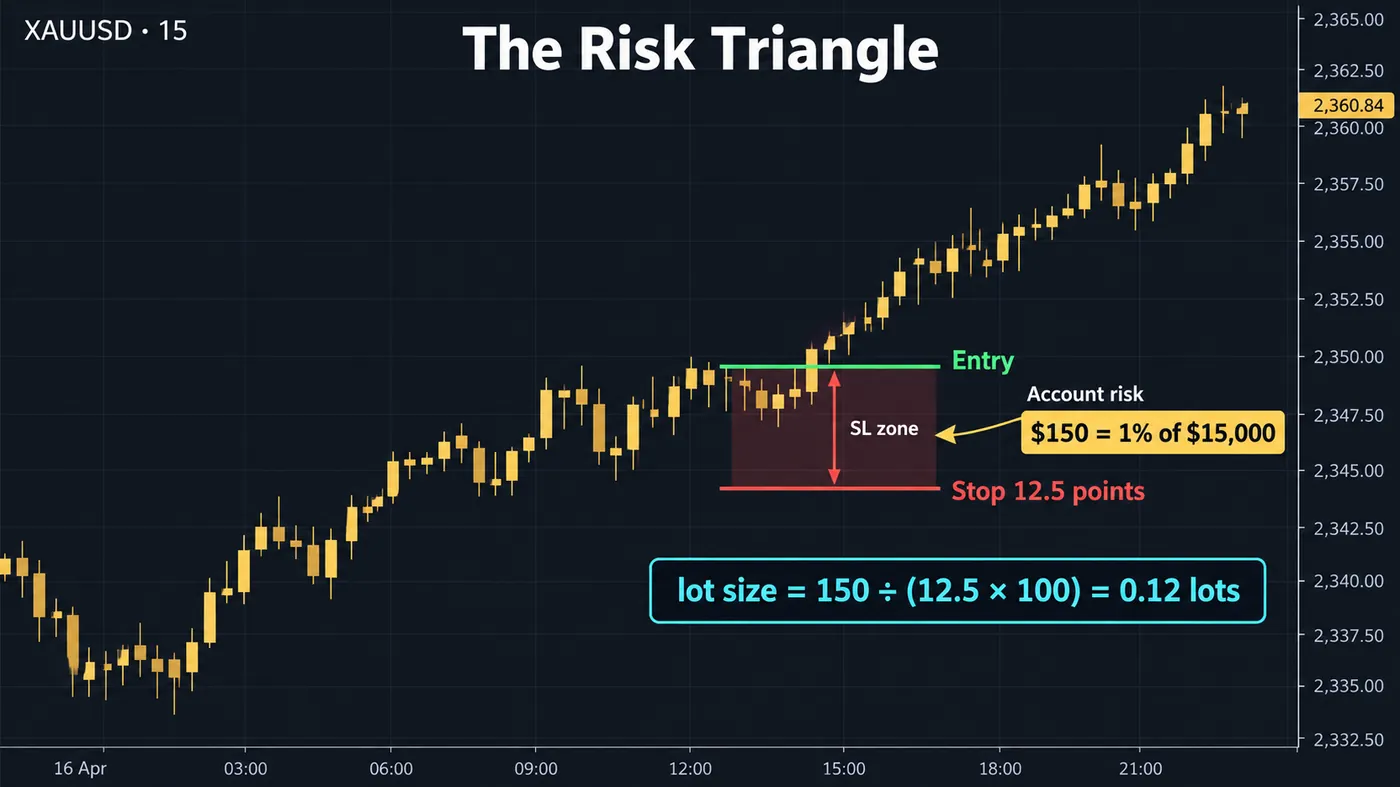
- Stop distance = 12.5 dollars.
- Value per lot per dollar = $100.
- Risk per lot = 12.5 × 100 = $1,250.
- Lot size = 150 ÷ 1,250 = 0.12 lots.
At 0.12 lots the notional is 0.12 × 100 oz × $2,350 = $28,200 — about 1.9× the account. That is normal for a gold scalp with a tight stop, and it is the number to compare against a per-position notional cap, not the margin the broker asks for. Notional value is its own subject; the short version is that the lot size calculator tells you the size that matches your risk, and the notional check tells you whether that size is more exposure than you want to carry.
Why does lot size change when the stop moves?
The three-stop illustration makes the point better than words: same account, same 1% risk, same entry on gold, and the stop at 5 points gives 0.30 lots, at 12.5 points 0.12 lots, at 30 points 0.05 lots. A tighter stop does not make the trade "safer" — it makes the position larger, and a larger position through a spread or a wick is how tight stops get hunted. A wider stop makes the position smaller, which is why swing traders survive volatility that scalpers do not.
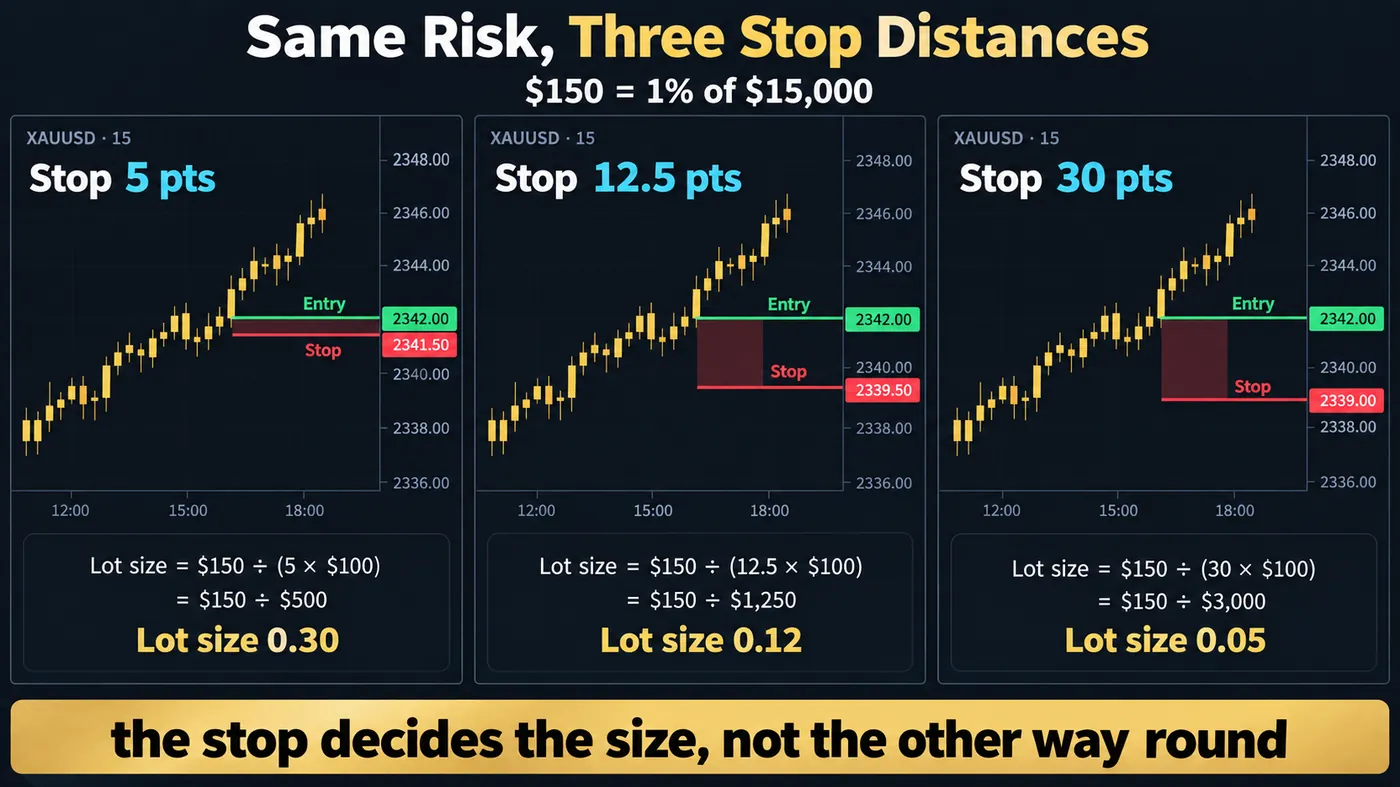
If you find yourself adjusting the stop to get a rounder lot size, stop. The stop is a market level; the lot size is a consequence of it.
Do prop-firm rules change the lot size formula?
Funded-account programmes usually cap daily loss at 4–5% and total drawdown at 8–10%, and some limit lot sizes outright. The formula does not change; the risk input does. Most traders on evaluations size to 0.25–0.5% per trade so that four losses in a day stay inside the daily limit, and the calculator's account field should hold the programme's balance, not your own.
The other prop-firm wrinkle is consistency rules: a 0.12-lot day followed by a 1.20-lot day looks like gambling to the risk desk. Sizing from the same risk percentage every trade fixes that automatically.
Using the calculator on this page
Pick the instrument, enter the account balance and the risk percentage, type the stop distance in the unit the row shows — pips for forex, dollars for gold — and the calculator returns the lot size rounded down to the broker increment, the cash risk, the value per pip or point at that size, and the notional. Change the stop and watch the size move; that is the whole lesson of this page in one control.
Cash risk first, stop distance second, lot size last — and round down to the broker step. On gold measure the stop in dollars and confirm the contract size, because a 100× error is one decimal away. Leverage never enters the formula; check the notional the lot size implies, then confirm the margin, in that order.
◆ Interactive check
Does the stop decide the size?
Questions traders ask about lot size
Measure the stop in dollars, multiply by $100 per lot (for a 100 oz contract) to get the risk per lot, then divide your cash risk by that number. $150 risk with a $12.50 stop is 0.12 lots.
At 1% risk you have $10 per trade. With a 20-pip stop on EUR/USD that is 0.05 lots; with a $5 stop on gold it is 0.02 lots. Micro lots exist so that small accounts can size correctly instead of over-trading.
Lot size is the quantity in the broker's unit; position size is often used to mean the cash exposure (notional) or the cash risk. The calculator shows all three so the words stop mattering.
No. Leverage changes the margin the broker holds, not the risk of the trade. Size from the stop and the risk percentage, then confirm the margin is available.
Either it is below the minimum (usually 0.01), not a multiple of the step (0.01), or above the maximum for the instrument. Round down to the nearest step; if the result is below the minimum, the stop is too wide for your account at that risk percentage.
On most brokers yes — a micro lot, 1,000 units of the base currency, worth about $0.10 per pip on EUR/USD. A few brokers offer nano lots (0.001) or cent accounts for smaller sizes.
Use the programme balance as the account, set risk to 0.25–0.5% so four losses stay inside the daily limit, and keep the percentage constant every trade to satisfy consistency rules. The formula is unchanged.
Because the value per pip differs: one lot of USD/JPY is 1,000 JPY per pip, about $6.41 at 156.00, against $10 for EUR/USD. Same pips, different dollars, different size.
Zeno draws the stop and both targets on the chart, which gives you the stop distance the formula needs; QuantumBot sizes and executes from the risk percentage you set. This calculator is the manual version of the same arithmetic.
Whatever the stop produces. With a $3 stop and $150 risk on a 100 oz contract that is 0.50 lots — large, which is why gold scalps through a spread or a wick get stopped so often. Wider stops, smaller lots, same risk.
References & Related Guides
Read next
- What Is a Stop Loss? How It Works, Where to Put It, and the Order Type That Actually Protects You
- Best Forex Pairs to Trade: By Session, Spread, Volatility and Style
- Best Forex Brokers: How to Choose One That Protects Your Money (US, UK/EU/AU and Everywhere Else)
- What Is Margin Trading? Initial vs Maintenance Margin, Margin Calls and a Calculator
- Pip Value Calculator for All Forex Pairs
- How to Calculate Pips in XAUUSD (Gold)
- What Is Notional Value in Trading?
- Position Sizing: The Complete Guide
- Trading Calculator: Position Size & Risk
- Best Indicator for XAUUSD (Gold)
- Best Forex Indicator
- Leverage Trading: Complete Guide
Authoritative sources
- CME Group: gold futures contract specifications (100 troy oz)
- Investopedia: lot (securities trading)
- OANDA: what is a pip
- LBMA: precious metal prices (troy ounce basis)
- ESMA: retail leverage limits (1:30 majors, 1:20 gold)