Range Trading
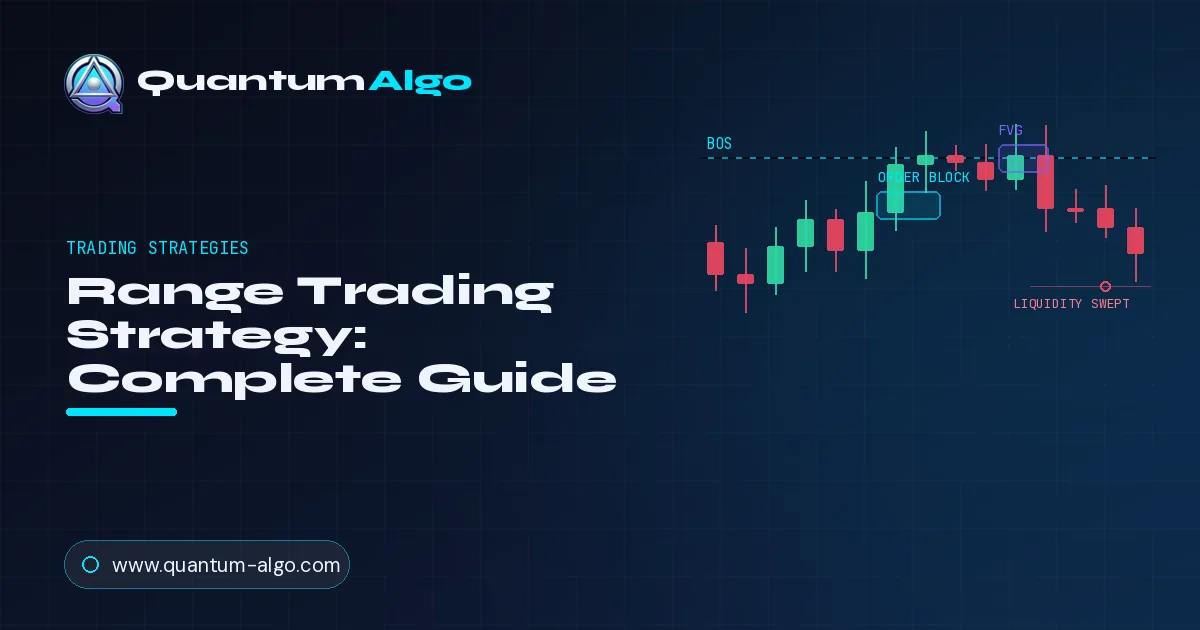
Range trading is a strategy for sideways markets where price oscillates between a horizontal support floor and resistance ceiling. Buy near support targeting resistance; sell or short near resistance targeting support. A valid range needs at least two touches of each level and no clear trend; every range eventually ends in a breakout.
What is range trading?
Range trading is a trading strategy built for markets that are moving sideways rather than trending — markets that are “range-bound,” bouncing back and forth between a defined floor and ceiling.
Instead of trying to ride a sustained directional move, the range trader profits from the repetitive oscillation within a horizontal channel, buying low near the bottom of the range and selling high near the top, over and over, for as long as the range holds.
Markets spend a great deal of their time ranging — some estimates suggest the majority of the time — consolidating after moves, waiting for a catalyst, or simply lacking the conviction to trend. Trend-following strategies struggle and produce whipsaw losses in these conditions, which is precisely the environment where range trading shines.
The core of the approach is identifying a clear support level where price has repeatedly bounced and a clear resistance level where it has repeatedly been rejected, then trading the swings between them: going long near support with a target at resistance, and going short (or taking profit) near resistance with a target back at support.
The defining skill of the range trader is twofold — recognising when a market is genuinely ranging (so the strategy applies) and respecting that every range eventually ends, which is the strategy’s central risk.
What makes a valid trading range?
Trading a range profitably begins with correctly identifying one, and the criteria are clear. A valid range has a few defining features that you should confirm before applying the strategy.
- A horizontal ceiling and floor. Price is repeatedly rejected at roughly the same resistance level and repeatedly bounces at roughly the same support level — at least two touches of each, ideally more.
- No clear trend. The market is moving sideways; price is not making consistent higher highs and higher lows (uptrend) or lower highs and lower lows (downtrend), but rather oscillating within the band.
- Multiple swings between the boundaries. The more times price has bounced between support and resistance, the more established and reliable the range.
- Defined width. The range should be wide enough that the swing from support to resistance offers a worthwhile profit relative to costs and risk.
A useful confirmation is that a flat moving average often accompanies a range — when a longer-term average goes sideways and price crisscrosses it repeatedly, the market is likely ranging rather than trending. The number of touches matters a great deal: a level tested and respected three or four times is far more reliable than one touched only once.
It is also important to distinguish a clean horizontal range from a sloppy, choppy mess — the best ranges have relatively well-defined, parallel boundaries that price respects, whereas erratic chop with no clear levels is not tradeable by this method. Taking the time to confirm a genuine, well-defined range before trading it is the foundation of the entire strategy.
Why do ranges form, and why does range trading work?
Ranges form because the market reaches a temporary equilibrium — a balance between buyers and sellers where neither side can establish control. This happens for several reasons: after a strong trend, the market pauses to consolidate and digest the move; before a major news event, participants hesitate and price drifts sideways; or a genuine agreement on value develops, with buyers consistently stepping in at one price (support) and sellers at another (resistance).
Whatever the cause, the result is the same recurring oscillation between two levels.
Range trading works because of the self-reinforcing nature of support and resistance within that equilibrium. Each time price bounces off support, it reinforces that level as a place where buyers are willing to act, and traders remember it — so the next time price approaches, more buyers step in, producing another bounce. The same dynamic strengthens resistance.
This creates a degree of predictability: within an established range, the probability of a reversal is higher near the edges than in the middle, giving the range trader high-probability, well-defined entry points with logical risk. The strategy is essentially a form of mean reversion — betting that price, having reached an extreme of its range, will revert back toward the middle and the opposite edge.
As long as the equilibrium holds and the boundaries are respected, fading the edges back toward the mean is a repeatable edge. The crucial caveat, of course, is that equilibria do not last forever — eventually a catalyst tips the balance and the range breaks — which is why risk management is inseparable from the strategy.
What is the core range trading strategy?
The mechanics of range trading are straightforward: buy near support, sell near resistance, and repeat. But executing it well requires precision at the edges and discipline about entries, stops and targets.
- At support (the floor): look to go long as price approaches and shows signs of bouncing. Enter near the support level, place a stop just below it, and target the resistance level (the opposite edge) or the range midpoint.
- At resistance (the ceiling): look to go short (or close longs) as price approaches and shows signs of rejecting. Enter near resistance, place a stop just above it, and target support.
- Avoid the middle. The high-probability trades are at the edges, where reversal odds are best and stops are tight. Entering in the middle of the range offers poor risk-to-reward and unclear risk.
- Wait for confirmation at the edge. Rather than catching a falling knife at support, wait for a sign the level is holding — a bullish reversal candle, a momentum turn — before entering.
The reason to trade only the edges is the favourable risk-to-reward they offer: near support, your stop is just below the level (small risk) and your target is the far edge (large reward), and vice versa at resistance. This is what makes range trading viable even though no individual bounce is guaranteed — a tight stop and a wide target mean you can be right less than half the time and still profit.
The discipline of buying only near support, selling only near resistance, and waiting for confirmation at each edge is the entire engine of the strategy.
Which oscillators confirm range trades best?
While support and resistance are the foundation, certain indicators are especially well-suited to confirming range-trading entries because they excel in non-trending conditions. The most valuable are oscillators, which are built to identify overbought and oversold extremes — exactly what you want at the edges of a range.
The RSI and Stochastic Oscillator are classic choices: in a range, an RSI reaching oversold as price hits support confirms the bounce setup, while an overbought RSI at resistance confirms the rejection.
These oscillators are at their best in ranges precisely because the overbought/oversold signals that fail in trends work well when price is genuinely mean-reverting between levels. Bollinger Bands are another excellent range tool — in a sideways market the bands act as dynamic range boundaries, and price tagging the upper band near resistance or the lower band near support reinforces the fade. The Williams %R serves the same purpose.
The key principle is that these tools should be used to confirm entries at the range edges, not as standalone signals — an oversold oscillator means far more at established support than in open space. It is also worth remembering the flip side: the moment these oscillators stop working (price stays overbought and keeps rising, for instance) is often the first clue that the range is breaking and the strategy no longer applies.
Used as edge-confirmation within a clearly identified range, oscillators meaningfully sharpen the timing of range entries.
How do you confirm entries at the range edges?
The single biggest improvement most range traders can make is to wait for confirmation at the edges rather than placing blind orders at the exact support or resistance price. While limit orders at the levels can work, the safer and more reliable approach is to let price reach the edge and then show you that the level is actually holding before you commit. This filters out the times the level is about to break.
Several forms of confirmation work well. Price-action signals are the most direct: a bullish reversal candle — a pin bar, a bullish engulfing, or a piercing pattern — forming right at support is strong evidence that buyers are defending the level and the bounce is beginning.
The mirror applies at resistance with bearish reversal candles like dark cloud cover. Oscillator confirmation adds weight: an oversold-and-turning RSI at support, or a bearish-diverging oscillator at resistance, confirms momentum is aligning with the expected reversal. A simple but effective method is to wait for price to touch the level and then for the current candle to close back inside the range, showing the edge rejected the probe.
The trade-off is the same as always — waiting for confirmation means a slightly later, slightly worse entry price, but a much higher probability that the level is genuinely holding. Given that the entire strategy depends on the edges holding, paying that small price for confirmation is almost always worthwhile and dramatically reduces the number of times you are caught long into a support break or short into a resistance break.

Automate your trades. Let Quantum Algo trade for you.
Every signal executed on your own account — 24/7, hands-off.
How does range trading compare with trend and breakout trading?
Range trading is one of three broad approaches to the market, and understanding how it differs from trend and breakout trading clarifies when to use each.
| Approach | Market condition | Core action |
|---|---|---|
| Range trading | Sideways / range-bound | Fade the edges (buy support, sell resistance) |
| Trend trading | Trending | Trade with the trend on pullbacks |
| Breakout trading | Range ending / volatility expanding | Trade the break of the range boundary |
The three are complementary because they suit different market conditions, and the key skill is matching the approach to the regime. Range trading fades the edges and works when the market is balanced and sideways. Trend trading does the opposite — it trades with directional moves, buying pullbacks in uptrends — and works when the market is trending; applying range logic in a strong trend (shorting resistance that keeps breaking) is a classic way to lose. Breakout trading sits at the transition: it trades the moment a range ends and price breaks out into a new trend, which is precisely the event that ends a range trade.
This relationship is important — range trading and breakout trading are two sides of the same coin, one betting the boundary holds and the other betting it breaks. The sophisticated trader reads the market regime first: range when it is balanced and the edges are holding, switch to breakout mode as the range matures and a break looks imminent, and trade with the trend once a new directional move is established.
No single approach works in all conditions; recognising which regime you are in is what tells you which to deploy.
What should you do when the range breaks?
Every range eventually ends, and the breakout — price decisively leaving the range — is simultaneously the range trader’s biggest risk and a potential opportunity. Managing this transition is what separates durable range traders from those who give back all their range profits in one bad trade.
The cardinal danger is being caught on the wrong side: long near support when it breaks down, or short near resistance when it breaks up, turning a small expected bounce into a large trending loss.
Protection comes first from the stops the strategy already mandates: by placing your stop just beyond the range edge on every trade, a breakout simply stops you out for a small, predefined loss rather than a catastrophe — which is exactly why those stops are non-negotiable.
Beyond protection, the savvy trader watches for signs the range is maturing or weakening: ranges that have persisted a long time, narrowing volatility (a squeeze), or price beginning to test one edge more insistently than the other all hint that a break is approaching, and the response is to trade the range more cautiously or stand aside.
Finally, a breakout can be flipped into opportunity: rather than fighting it, a range trader can switch hats and trade the breakout itself, entering in the breakout direction (ideally on a retest of the broken boundary) to ride the new trend that the range was coiling toward.
The mindset that makes range trading sustainable is accepting from the outset that the range will break, protecting against it with disciplined stops, and being ready to either step aside or pivot to the breakout when it comes — never marrying the assumption that the boundary will hold forever.
Risk management, markets and timeframes
Risk management is the backbone of range trading because the strategy’s defining risk — the inevitable breakout — is always present. The foundation is the stop-loss just beyond each edge: every long near support has a stop below support, every short near resistance has a stop above resistance, so a break costs only a small, fixed amount.
Combined with the wide target at the opposite edge, this produces the favourable risk-to-reward that makes the strategy profitable even with a moderate win rate. Standard position sizing — risking only a small, fixed percentage of capital per trade — ensures no single failed range trade or false bounce does serious damage.
On markets and timeframes, range trading can be applied almost anywhere price goes sideways, but it suits certain conditions best. It works on all timeframes — from intraday ranges on the 5- and 15-minute charts to multi-week ranges on the daily — with higher timeframes generally offering more reliable, better-defined ranges and lower timeframes offering more frequent but noisier opportunities.
Some markets and sessions are more prone to ranging: forex pairs often range during quiet sessions (such as the Asian session for certain pairs) and trend during active ones, and many markets range in the absence of a catalyst. Choosing liquid markets with clean, well-respected levels improves results, since the support and resistance the strategy depends on are more meaningful.
The unifying point is that range trading’s edge is real but modest per trade, so it must be protected by tight stops, sensible sizing, and selectivity about which ranges and conditions you trade.
Range trading and Smart Money Concepts
Range trading and Smart Money Concepts fit together remarkably well, because a trading range is, in SMC terms, a zone of accumulation or distribution — the very phases where institutions build or unload large positions. Viewing a range through this lens upgrades it from a simple box to a map of institutional intent and helps you fade the right edges and avoid the wrong ones.
The most valuable SMC insight concerns the range boundaries and liquidity. Below the obvious support and above the obvious resistance of a range sit clusters of stop orders — the protective stops of range traders and the breakout orders of others. Institutions frequently engineer a liquidity sweep: a sharp spike just beyond the range edge that grabs that liquidity before price snaps back into the range.
For the naive range trader, a stop placed exactly at the edge gets hunted; for the SMC-aware trader, that sweep-and-reclaim is actually the highest-probability range entry — you wait for price to poke below support, sweep the liquidity, and reclaim the level, then enter long with a stop below the sweep wick. This both protects against the stop-hunt and gives a superior entry.
The same logic, applied to range ends, helps you read the genuine breakout: a clean expansion away from the range with a shift in structure signals real institutional commitment (accumulation complete, markup beginning), whereas a spike that immediately reverses is just another liquidity grab. Reading the range as accumulation or distribution, with liquidity resting beyond its edges, turns ordinary support-and-resistance fading into an institutionally-aware strategy.
A complete range trade, step by step
Walk through a textbook range trade with an SMC twist. On the one-hour chart, a stock has been moving sideways for two weeks, bouncing repeatedly between support around 50 and resistance around 54 — a clean, well-defined range with four prior touches of each edge and a flat moving average crisscrossing the middle. You have identified the range and your plan is to fade the edges.
Price drifts down toward support at 50. Rather than placing a blind buy limit at 50, you watch for confirmation. Price briefly spikes below 50 to 49.6, sweeping the liquidity beneath the obvious support — the stop-hunt — and then sharply reclaims the level, closing back above 50, with the RSI now oversold and turning up and a bullish pin bar on the candle. That sweep-and-reclaim is your high-probability long trigger.
You enter long at 50.2, placing your stop below the sweep wick at 49.3 — tight risk, protected from the stop-hunt that just occurred. Your target is the opposite edge of the range at resistance, 54, giving a reward several times your risk. Price grinds back up across the range, and as it approaches 54 you take profit (and could look to short the resistance if it rejects).
One clean swing, from a liquidity-swept support entry to the resistance target, with risk defined just beyond the edge: the disciplined range trade, sharpened by reading the boundary as a liquidity zone rather than a simple line.
Common mistakes to avoid
- Range trading in a trend. The strategy only works in sideways markets. Fading resistance that keeps breaking in a strong uptrend is a fast way to lose. Confirm the market is genuinely ranging first.
- Trading the middle. The edges offer tight stops and wide targets; the middle offers poor risk-to-reward and unclear risk. Only trade near support and resistance.
- No stop beyond the edge. Every range ends in a breakout. Without a stop just beyond the boundary, one break can erase many bounces.
- Blind orders at the exact level. Waiting for confirmation — a reversal candle, an oscillator turn, a reclaim after a sweep — greatly improves reliability over blind limits.
- Ignoring the maturing range. Long-lived ranges and narrowing volatility warn a break is near. Trade more cautiously or stand aside as a range ages.
- Getting stop-hunted at the edge. Liquidity often rests just beyond the boundary. Reading the sweep-and-reclaim, rather than placing stops exactly at the level, protects and improves entries.
📝 Test Your Knowledge
Range Trading with Quantum Algo
Range trading lives and dies by the quality of the boundaries you fade. Quantum Algo’s Smart Money Concepts indicators reveal whether a range edge holds resting liquidity, sits at a supply or demand zone, and whether the eventual break is a genuine expansion or an engineered sweep — so you fade the edges that hold and step aside before the ones that break.
Related guides
❓ Frequently Asked Questions
Range trading is a strategy for sideways markets where price oscillates between a horizontal support floor and resistance ceiling. The trader buys near support and sells or shorts near resistance, profiting from the repeated swings while managing the risk of an eventual breakout.
Look for price repeatedly rejected at a horizontal resistance and bouncing at a horizontal support, with no clear trend (no consistent higher highs or lower lows). Multiple touches of each boundary and a flat moving average confirm a genuine, tradeable range.
Buy near support with a stop just below it and a target at resistance, and sell or short near resistance with a stop just above it and a target at support. Trade only the edges, not the middle, and wait for confirmation that the level is holding before entering.
Oscillators like the RSI, Stochastic and Williams %R are ideal because they flag overbought and oversold extremes at the range edges. Bollinger Bands also work well, acting as dynamic boundaries. Use them to confirm entries at support and resistance, not as standalone signals.
The biggest risk is the range ending in a breakout, which can catch you long into a support break or short into a resistance break. This is why a stop-loss placed just beyond each range edge on every trade is non-negotiable in range trading.
Range trading fades the edges of a sideways market, buying support and selling resistance, while trend trading trades with a directional move, buying pullbacks in an uptrend. Range logic fails in trends, so you must match the approach to the market condition.
Range trading works on all timeframes. Higher timeframes such as the four-hour and daily tend to offer more reliable, better-defined ranges, while lower timeframes like the 5- and 15-minute offer more frequent but noisier intraday ranges.
Protect yourself with stops just beyond each edge so a break costs only a small loss. Watch for signs a range is maturing, such as narrowing volatility, and either stand aside or switch to trading the breakout itself, ideally entering on a retest of the broken boundary.
It can be, because trading only the edges gives tight stops and wide targets, a favourable risk-to-reward that allows profitability even with a moderate win rate. Success depends on correctly identifying ranges, disciplined stops, and avoiding range trading in trends.
In SMC terms a range is an accumulation or distribution zone, and liquidity rests just beyond its edges. Institutions often sweep that liquidity with a spike beyond the boundary before reversing, so a sweep-and-reclaim at support or resistance is the highest-probability range entry.
References & Related Guides
More in this topic
- Backtesting Trading Strategies — Complete Guide
- What Are the Best Indicators for Day Trading?
- What Are the Best Indicators for Scalping?
- What Are the Best Indicators for Swing Trading?
- Best TradingView Strategy — The Definitive Guide
- Breakout Probability: Complete Trading Guide
- Breakout Trading Strategy: Complete Guide
- Day Trading Strategies — The Complete Profitable Guide
- Gap Trading Strategy: Complete Guide
- Grid Trading Strategy: The Complete Guide
- Institutional Trading Strategy: Trade Like Banks
- Position Sizing: The Complete Guide
- What Is ORB (Opening Range Breakout) in Trading?
- Momentum Trading Strategy: Complete Guide
Core reading
- BOS & CHoCH: Complete Market Structure Guide
- Order Blocks Trading: Complete Guide
- Best TradingView Indicators — Complete Guide
- Risk Management in Trading — Complete Guide
- Candlestick Patterns Guide — Engulfing, Pinbar & More
- All Premium Guides
- Quantum Algo on TradingView
- Public Track Record