What Are Premium, Discount & Equilibrium in SMC?
The short answer
Premium, discount, and equilibrium are how Smart Money Concepts traders describe where price sits within a range, to decide whether it is a good place to buy or sell.
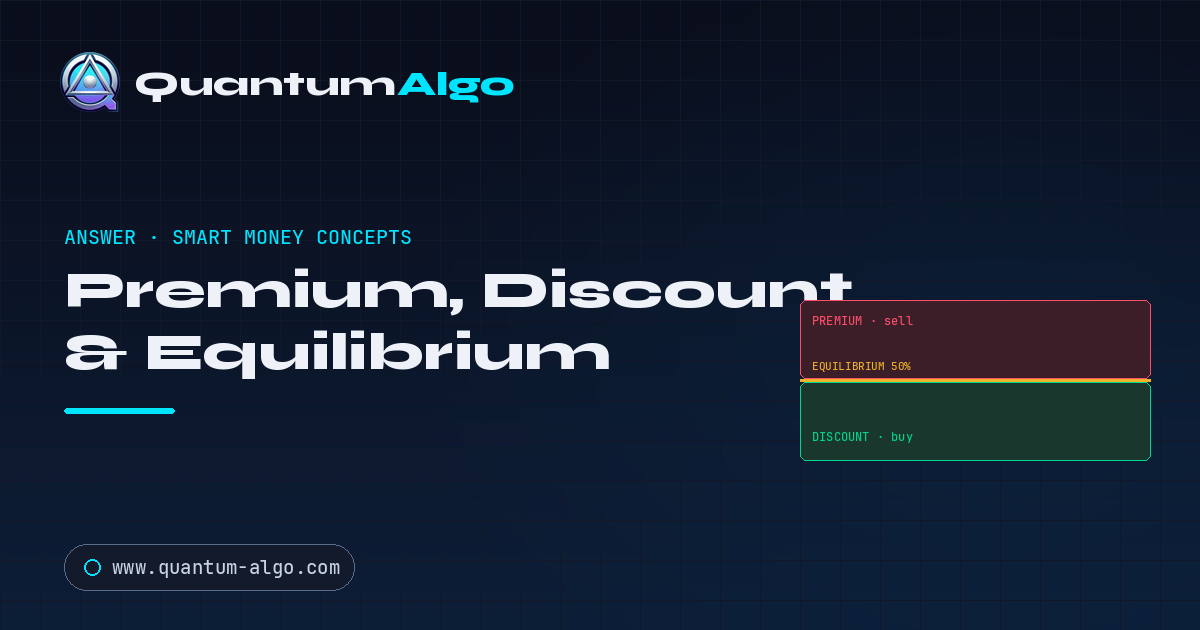
- Equilibrium is the 50% midpoint of the range — fair value, the dividing line.
- Premium is the upper half of the range (above equilibrium) — price is "expensive," so smart money looks to sell.
- Discount is the lower half (below equilibrium) — price is "cheap," so smart money looks to buy.
The whole idea distills to one rule: buy in the discount, sell in the premium. You take longs when price is below equilibrium and shorts when it is above, so you are always entering from a favorable price rather than chasing an extended move.
How to find premium and discount on a chart
The zones are defined relative to a specific range, so the first step is choosing the range. In SMC that usually means a clear swing — from a significant swing low to a significant swing high (or vice versa) that defines the current leg you are trading.
Once you have the range, drawing the zones is mechanical, and most traders use a Fibonacci retracement tool to do it:
- The 50% level is equilibrium — the exact midpoint.
- Everything above 50% is premium (often shaded red).
- Everything below 50% is discount (often shaded green).
This is why the concept overlaps so heavily with the Fibonacci golden pocket — both use retracement levels within a range to locate high-probability entry areas. The premium/discount framework is just the broadest version: a simple 50% split that tells you which side of fair value you are on.
Why smart money buys discount and sells premium
The logic mirrors how institutions actually operate. Large players cannot buy at any price — to build a position without moving the market against themselves, they need to accumulate where price is cheap relative to the range (the discount) and distribute where it is expensive (the premium). Buying in premium or selling in discount would mean entering at unfavorable prices and taking on poor risk-to-reward.
For a retail trader, aligning with this gives you two concrete edges. First, better reward-to-risk: entering longs in the discount means your stop (below the range) is closer and your target (the premium) is further, naturally producing favorable ratios. Second, you stop chasing — the framework forces patience, waiting for price to reach a favorable zone rather than buying tops and selling bottoms. It works best combined with market structure and a clear directional bias.
Combining premium/discount with bias and structure
Premium and discount are most powerful when filtered by a directional bias, because the zones tell you where to act but not which way. That direction comes from higher-timeframe context.
In a bullish bias, you wait for price to pull back into the discount and look for longs there — you do not short the premium against the trend. In a bearish bias, you wait for price to rally into the premium and look for shorts — you do not buy the discount against the trend. This is exactly where premium/discount plugs into higher-timeframe bias: the HTF decides direction, and premium/discount decides the entry zone.
Layer in confirmation — an order block, a fair value gap, or a market-structure shift inside the zone — and you have a complete SMC entry model: right direction (bias), right price (discount/premium), right trigger (structure). Pair it with order blocks or fair value gaps within the zone for precise, high-probability entries.
📝 Test Your Knowledge
What Are Premium, Discount & Equilibrium in SMC? with Quantum Algo
Finding equilibrium, premium and discount by hand on every range is slow and subjective. Quantum Algo's Smart Money Concepts tools plot market structure, order blocks, fair value gaps and liquidity automatically, so you can spot discount buys and premium sells at levels that actually matter — all backed by a verified public track record.
See the indicator → Verify the track record
Automate your trades. Let Quantum Algo trade for you.
Every signal executed on your own account — 24/7, hands-off.
❓ Frequently Asked Questions
In Smart Money Concepts, premium and discount describe where price sits within a range relative to its 50% midpoint (equilibrium). The premium is the upper half of the range, where price is considered expensive and smart money looks to sell. The discount is the lower half, where price is cheap and smart money looks to buy. The core rule is: buy in the discount, sell in the premium.
Equilibrium is the 50% midpoint of a defined range — the dividing line between premium (above) and discount (below). It represents fair value for that range: above it, price is relatively expensive; below it, relatively cheap. In SMC, equilibrium is the reference point that determines whether the current price offers a favorable place to buy or sell.
First define the range, usually from a significant swing low to a significant swing high. Then use a Fibonacci retracement tool: the 50% level is equilibrium, everything above it is the premium zone, and everything below is the discount zone. Many traders shade premium red and discount green. The zones are always relative to the specific range you choose.
Because large institutions need favorable prices to build positions without moving the market against themselves. They accumulate where price is cheap relative to the range (discount) and distribute where it is expensive (premium). Buying in premium or selling in discount would mean entering at poor prices with weak reward-to-risk. Retail traders who align with this get better ratios and stop chasing extended moves.
They are related but not identical. Both use Fibonacci levels within a range to find entries. Premium/discount is the broad 50% split telling you which side of fair value price is on. The golden pocket is a specific, narrower zone (around the 0.618–0.65 retracement) used as a precise entry area. The golden pocket typically sits within the discount (for longs) or premium (for shorts).
Combine them with a directional bias. In a bullish bias, wait for price to pull back into the discount and look for longs there. In a bearish bias, wait for a rally into the premium and look for shorts. Then confirm with an order block, fair value gap, or market-structure shift inside the zone, and enter with a defined stop and target. Direction from bias, price from the zone, trigger from structure.
Match the range to your trading style. Swing traders define the range on higher timeframes (daily, 4H) and enter on lower ones; day traders use intraday ranges. The key is that the range should reflect the leg you're actually trading. Higher-timeframe ranges carry more weight, which is why premium/discount pairs naturally with higher-timeframe bias.
In a bullish context, yes — buying in the discount gives favorable reward-to-risk and aligns with how smart money accumulates. But direction matters: in a bearish bias you look to sell the premium instead, not buy the discount against the trend. The rule 'buy discount, sell premium' always operates within your higher-timeframe directional bias, never against it.
A premium and discount range is any price range you've defined (from a swing low to a swing high) that you then split at its 50% equilibrium. The upper half becomes the premium range and the lower half the discount range. It's a framework for judging whether current price is expensive or cheap relative to that specific swing, so you can decide where to buy or sell.
Yes, the concept is market-agnostic — it works on forex, crypto, indices, stocks, and gold, because it's based purely on where price sits within a range, not on any market-specific feature. What matters is defining a meaningful range and applying a directional bias. As with all SMC tools, it works best combined with structure and sound risk management.
Equilibrium (the 50% level) often acts as a pivot: price frequently reacts around it, and how price behaves at equilibrium can signal whether the range is likely to continue or reverse. It's less a hard support/resistance and more a fair-value reference — a decision point where premium turns to discount. Reactions at equilibrium are worth watching, but the strongest entries are deeper in the discount or premium.
Marking equilibrium, premium, and discount by hand on every range is slow and subjective. Quantum Algo's Smart Money Concepts tools plot market structure, order blocks, fair value gaps, and liquidity automatically, so you can identify discount buys and premium sells at levels that actually matter, filtered by structure — backed by a verified public track record.
References & Related Guides
More in this topic
- Best TradingView Indicators 2026 — Complete Guide
- Divergence Trading: Complete Guide (2026)
- Elliott Wave Theory 2026 — Complete Trading Guide
- Fisher Transform Indicator: Complete Guide (2026)
- Harmonic Patterns: Complete Trading Guide (2026)
- Heikin Ashi 2026 — Complete Smoothed Candlestick Guide
- Inside Bar Trading: Complete Guide (2026)
- Leverage Trading: The Complete Guide (2026)
- Machine Learning Trading Indicators (Lorentzian): 2026 Guide
- Pin Bar Trading: Complete Guide (2026)
- Pivot Points 2026 — Complete Intraday Support & Resistance Guide
- Position Trading: Complete Guide (2026)