Gamma Squeeze Explained: How Call Buying and Dealer Hedging Push a Stock Higher, and How It Ends
A gamma squeeze is a fast rally caused by options hedging. When traders buy many short-dated call options, the market makers who sell those calls buy shares to stay hedged. As the stock rises, the calls' delta grows (that rate of change is gamma), so dealers must buy even more shares, which pushes the price higher still. The loop stops when call buying fades or the options expire, and the hedges are often unwound just as quickly.
Gamma squeezes became famous in 2021, but the mechanism runs every day in smaller form. It explains why some stocks go vertical around options expiry for no fundamental reason, and why the move often reverses just as fast. I'll walk through what dealers actually do, the numbers behind the loop, how it combines with a short squeeze, the signs to watch and why chasing one is so dangerous.
What is a gamma squeeze?
A gamma squeeze is a price rise driven by the hedging of options rather than by investors buying the stock for its own sake. It starts when demand for call options, usually cheap, short-dated and out of the money, grows faster than normal. The dealers and market makers who sell those calls do not want to bet on direction, so they buy the underlying shares to offset the risk.
That hedge buying is the fuel. If it is large compared with the stock's normal volume and float, it lifts the price, which makes the calls more valuable and more sensitive, which forces more hedging. If options basics are new, start with options trading for beginners.
What are delta and gamma?
Delta is how much an option's price moves for a $1 move in the stock; it is also roughly the number of shares needed to hedge one contract. A call with a delta of 0.30 behaves like 30 shares. Gamma is how fast delta changes as the stock moves. It is highest for at-the-money options close to expiry, and low for options far from the price or far from expiry.
So when a stock trades up toward a strike where many short-dated calls are open, the delta of those calls climbs fast. Dealers who are short those calls must buy more shares with every tick higher. Our guide to gamma exposure (GEX) shows how traders estimate this across the whole options market.
How does the gamma squeeze feedback loop work?
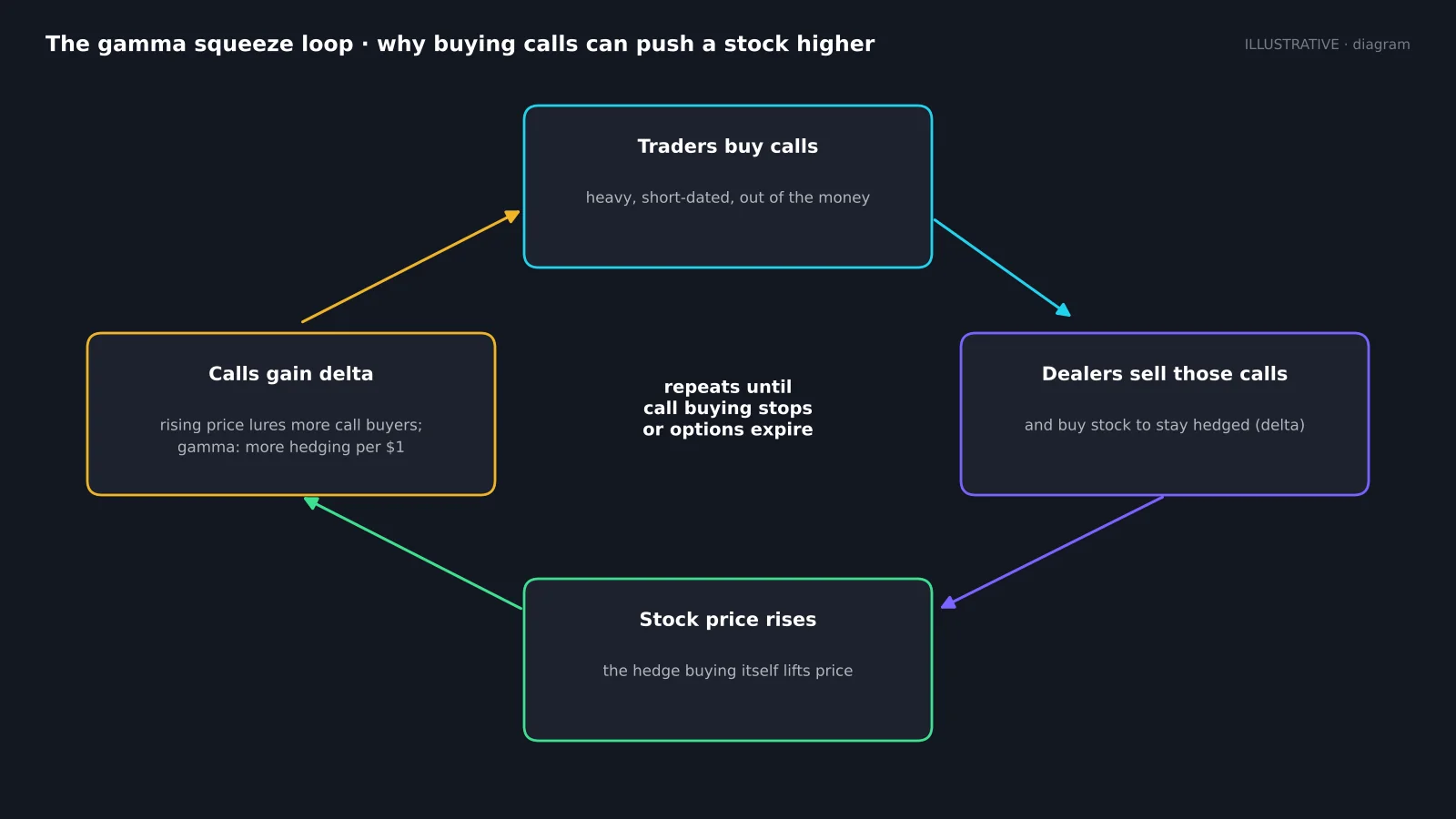
- Traders buy calls, often weeklies, above the current price.
- Dealers sell those calls and buy shares equal to the calls' delta to stay neutral.
- The stock rises, partly because of that hedge buying.
- Calls gain delta (gamma), so dealers buy more shares, and rising prices attract more call buyers.
The loop needs one thing to keep going: new call buying or a price already near heavy strikes. When either fades, the loop runs in reverse. Dealers sell shares as delta falls, and at expiry hedges on worthless calls are sold off entirely.
How much stock do dealers need to buy?
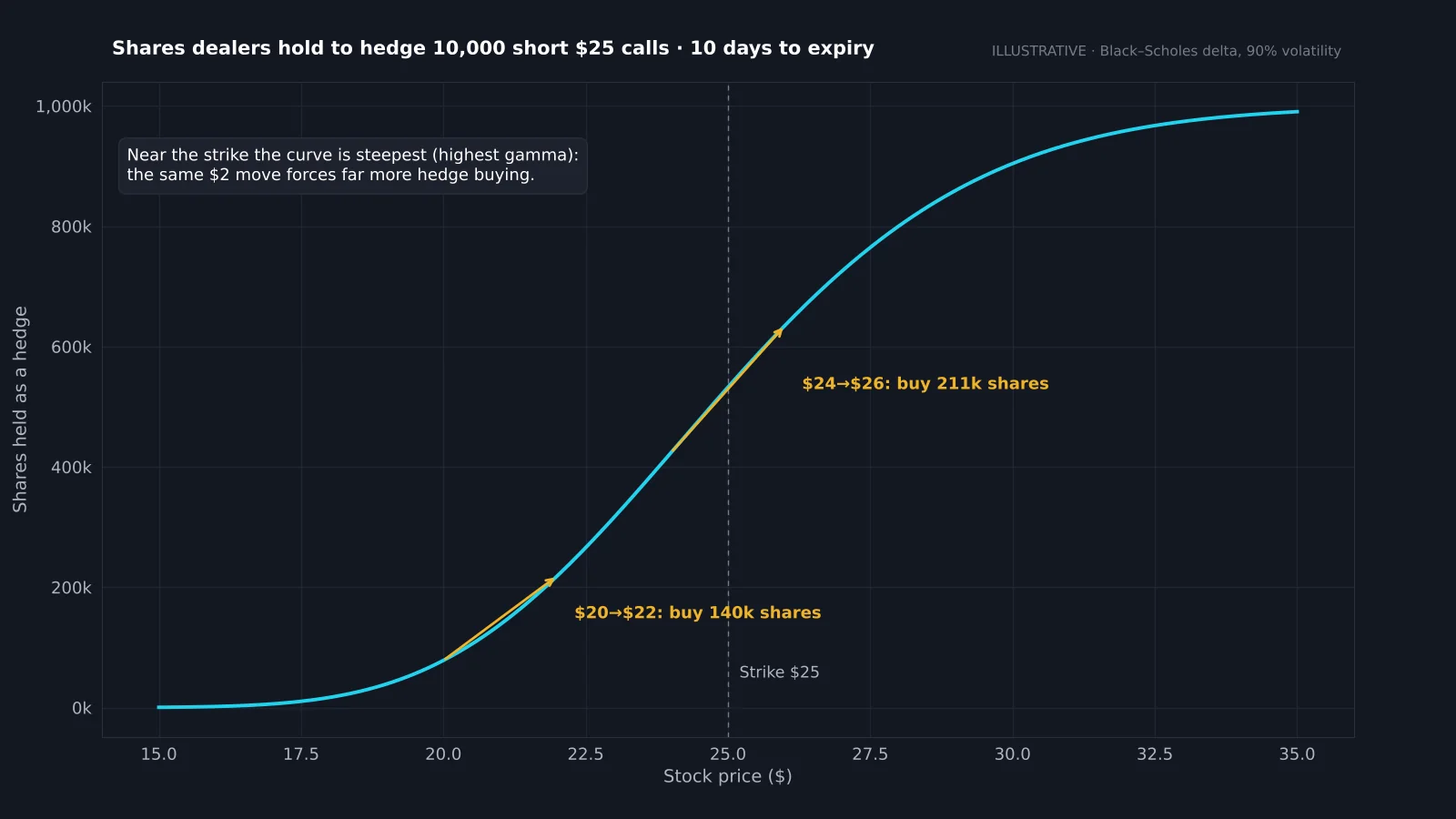
Take 10,000 short call contracts at a $25 strike with ten days to expiry. Each contract covers 100 shares, so full delta would mean one million shares. With the stock at $20, dealers hold well under 100,000 shares as a hedge. A move from $20 to $22 forces them to buy roughly 140,000 more; a move from $24 to $26, right around the strike, forces about 211,000 more for the same $2.
Compare those numbers with the stock's daily volume. In a large cap trading tens of millions of shares a day, the hedge flow is noise. In a small cap with a float of 20 million shares and volume of a few million, it can be most of the day's buying, which is why gamma squeezes happen in small and heavily traded retail names.
Gamma squeeze vs short squeeze: what is the difference?
A short squeeze is driven by short sellers buying back shares as the price rises against them. A gamma squeeze is driven by option dealers buying shares to hedge. They often happen together: a heavily shorted stock with cheap calls is the setup for both, and each feeds the other.
| Gamma squeeze | Short squeeze | |
|---|---|---|
| Who is forced to buy | Options dealers hedging calls | Short sellers covering |
| Fuel | Call open interest and volume | Short interest and days to cover |
| Timing | Clusters before options expiry | Any time; often after news |
| Data to watch | Call volume, open interest by strike, GEX | Short % of float, borrow fee, utilization |
| How it unwinds | Hedges sold as delta falls / at expiry | Covering finishes, buyers dry up |
Check short interest and days to cover alongside call open interest to see which fuel is present.
What does a gamma squeeze look like on a chart?
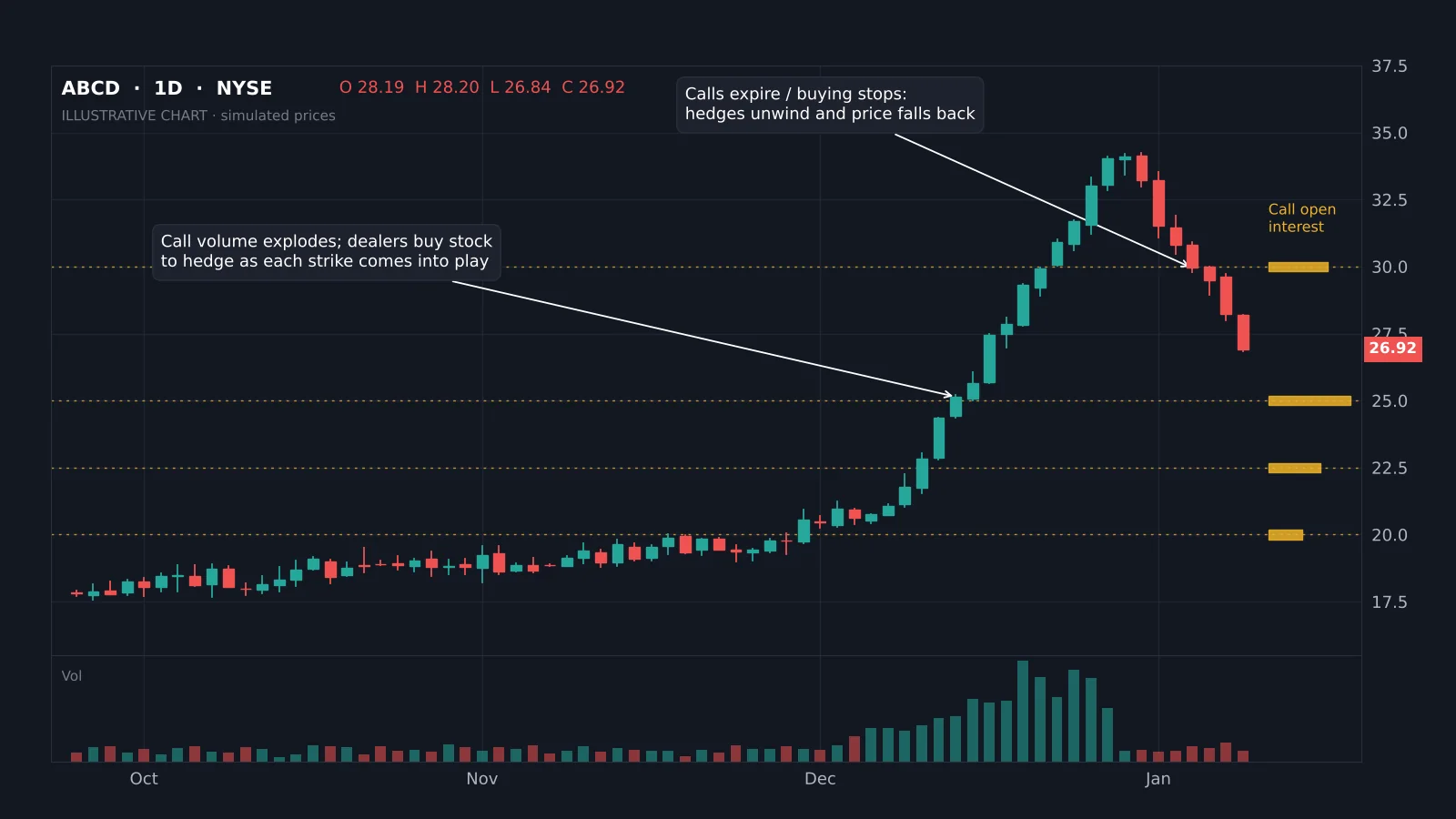
The typical pattern: a quiet base, then call volume jumps to many times normal. Price breaks out and climbs through the strikes with the most call open interest, often in a series of large green candles on rising volume. Near expiry, or once call buying stops, the move tops out and reverses sharply as hedges come off.
The reversal is often as violent as the rally. That asymmetry is why late buyers lose: they buy when hedge demand is highest, and they sell, or are stopped out, when it disappears.
What are the warning signs of a gamma squeeze?
- Call volume far above normal, concentrated in short-dated, out-of-the-money strikes.
- Call open interest building at strikes just above the price.
- Call volume large compared with share volume (contracts × 100 × delta against daily shares).
- Small float or high short interest, which magnify the effect.
- Rising implied volatility on calls and a call-heavy put/call ratio.
- Social media momentum pointing many small traders at the same strikes.
How does a gamma squeeze end?
Squeezes end when the hedging flow reverses. The common triggers are options expiry, when hedges on expired calls are no longer needed; a stall in price below the next large strike, which lowers delta; call buyers taking profits; brokers raising margin or restricting buying; and volatility falling, which lowers the calls' delta.
Because dealers sell into falling prices just as they bought into rising ones, the unwind can gap the stock down sharply. Expiry Fridays and the days after them are common turning points.
How do traders approach gamma squeezes?
- Do not chase late. By the time a squeeze is all over social media, most of the hedge buying is done.
- Size small. Moves of 20% or more in a day are common in both directions; risk only what a gap could take.
- Use the strikes. Heavy call strikes act as magnets on the way up and as cliffs near expiry.
- Watch expiry dates. Know which expiration holds the open interest.
- Avoid shorting the top early. Squeezes can run far beyond reason before reversing.
Track the setups you take in a trading journal with the expiry dates noted; patterns around expiry become clear quickly.
Reference data
| Item | Value |
|---|---|
| Shares per US equity option | 100 |
| Hedge shares | contracts × 100 × delta |
| Highest gamma | At the money, close to expiry |
| Standard monthly expiry | Third Friday of the month |
| Common squeeze fuel | Short-dated OTM calls, small float, high short interest |
| SEC staff report on Jan 2021 | Published October 2021 |
Dealer hedge calculator
Enter the number of call contracts dealers are short, their strike, days to expiry, implied volatility and two stock prices. The calculator estimates how many shares dealers must buy to stay hedged as price moves between them, and compares it with daily volume.
What are famous examples of gamma squeezes?
The best-known case is GameStop in January 2021, where record short interest met enormous retail call buying, combining a short squeeze and a gamma squeeze. AMC followed the same pattern. In mid-2020, very large call purchases in big technology stocks were widely reported to have fed hedging flows that pushed those shares higher before a sharp September pullback.
The SEC's staff report on the January 2021 events found that short covering was a smaller part of the GameStop rally than popularly believed, and that broad buying and options activity mattered too. It is a reminder that squeezes are rarely a single mechanism.
Should you trade gamma squeezes?
Understanding gamma squeezes is useful for every stock and options trader, because it explains sudden moves around expiry and helps you avoid being on the wrong side of them. Trading them is a different matter: the edge belongs to those who spot the open-interest build early and leave before expiry, and the losses fall on late buyers and early shorts.
If you do trade them, treat them as momentum trades with strict size limits and a planned exit before the main expiry, not as investments.
A gamma squeeze happens when heavy short-dated call buying forces dealers to buy stock to hedge, and rising prices increase the calls' delta so they must buy more. It is strongest near heavy strikes and before expiry, and in small-float or heavily shorted stocks. It often combines with a short squeeze. It ends when call buying fades or options expire, usually with a sharp reversal. Do not chase late, size small and know the expiry dates.
◆ Interactive check
Do you understand the gamma squeeze?
Questions traders ask about gamma squeezes
Heavy buying of short-dated call options that forces dealers to buy shares to hedge, with the buying accelerating as the stock rises toward the strikes.
No. A gamma squeeze is driven by options dealers hedging; a short squeeze by short sellers covering. They often happen together.
Usually days, often ending at or soon after the options expiry that holds most of the call open interest.
It is much harder, because hedge flows are small compared with volume, but very large call buying can still move large caps.
The same loop in reverse: heavy put buying forces dealers to sell stock as the price falls, accelerating the decline.
Watch for unusual short-dated call volume and open interest building at strikes just above the price, relative to share volume.
When call buying stops or options expire, dealers sell the shares they bought as hedges, removing the buying that lifted the price.
Yes. Moves are fast in both directions and late buyers often take large losses when hedges unwind.
References & Related Guides
Read next
- Gamma Exposure (GEX)
- Short Interest
- What Is Short Selling?
- Max Pain
- Put/Call Ratio
- Option Chain Analysis
- Options Trading for Beginners
- Day Trading Options
- Open Interest Explained
- Momentum Trading Strategy