Three Black Crows
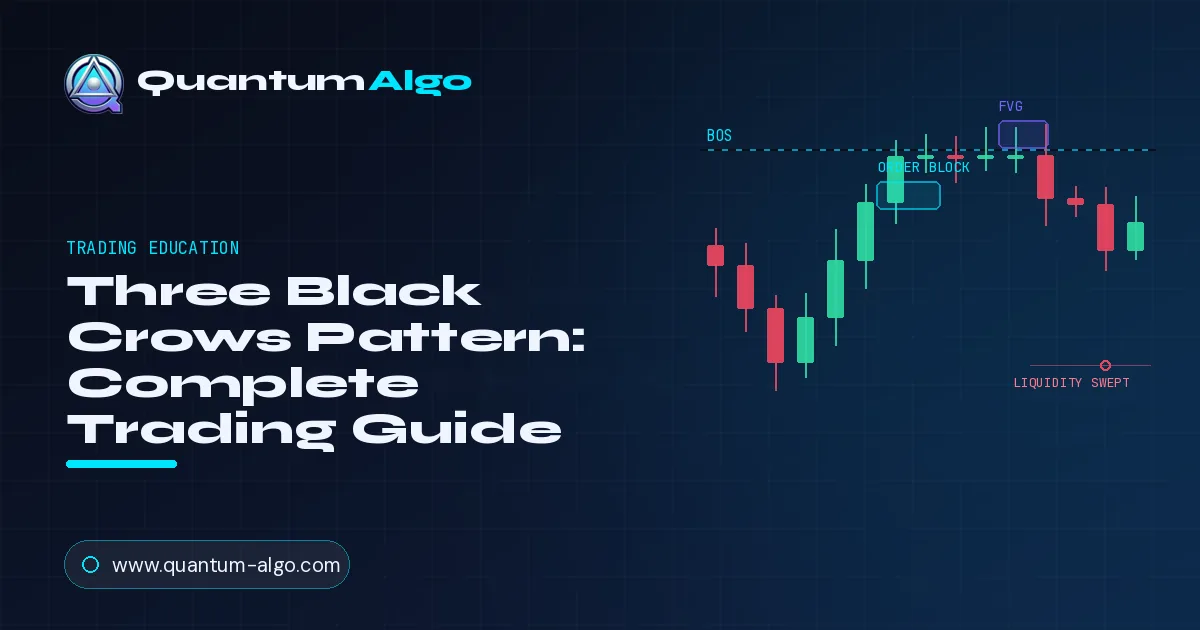
Three black crows is a bearish reversal pattern of three consecutive long-bodied red candles, each opening inside the prior body and closing lower near its low, at the top of an uptrend. It shows sellers taking control over three sessions, mirrors the three white soldiers, and is strongest confirming a reversal at resistance, not after price has already fallen far.
What is the three black crows pattern?
Three black crows is a classic three-candle bearish reversal pattern that signals a strong shift from buying to selling pressure, typically appearing at the top of an uptrend or after a period of consolidation. Its evocative name captures the imagery perfectly: three dark candles descending one after another, like crows settling on a branch, each lower than the last.
The pattern is prized for its clarity. Where some reversal signals are subtle, three black crows is emphatic — three full sessions of sustained, committed selling with little hesitation. Each of the three candles is a long-bodied bearish (red) candle that closes near its low, and each opens within the body of the candle before it, then pushes to a new closing low.
The cumulative effect is a steady, stair-stepping decline that leaves no doubt about who is now in control. Because it represents three consecutive sessions of selling rather than a single dramatic candle, the pattern is read as evidence of a durable change in sentiment rather than a one-off spike of fear.
What makes a valid three black crows structure?
The three black crows pattern has a precise structure, and each criterion exists to confirm that the selling is genuine and sustained rather than erratic. A valid pattern meets all of the following.
- Three consecutive bearish candles. All three must be red, with long real bodies that show decisive selling each session.
- Each closes near its low. Small or non-existent lower wicks confirm sellers held control right into the close, leaving no late-session recovery.
- Each opens within the prior body. The open of each candle sits inside the real body of the one before it, showing the decline is orderly rather than a single gap-down panic.
- Progressively lower closes. Each candle closes below the previous candle’s close, building a clear downward staircase.
The ideal version has three candles of similar, substantial size with minimal lower wicks. Long lower wicks would suggest buyers are fighting back intraday and weaken the signal. The cleaner and more uniform the three bodies, the more convincing the pattern — it shows sellers in steady, unchallenged control across all three sessions.
What does three black crows reveal about market psychology?
Three black crows narrates a decisive handover of power from buyers to sellers over three sessions. At the start, the market is in an uptrend or has stalled near a high, and bullish complacency is widespread. Then the first crow appears: a strong down candle that closes near its low, catching optimistic buyers off guard.
What makes the pattern so telling is what happens next. On the second day, buyers attempt to recover — price opens back up within the prior candle’s body — but sellers overwhelm them again and drive price to another low close. The same thing repeats on the third day. This repeated failure of buyers to mount any meaningful recovery, three sessions running, is the psychological heart of the pattern.
It signals that selling pressure is not a momentary panic but a sustained, building conviction. Each lower close traps more buyers and emboldens more sellers, and the trend that was once up has clearly rolled over. By the third crow, the burden of proof has flipped entirely: the market now expects lower prices, and buyers are on the defensive.
How to trade three black crows
The chief challenge in trading three black crows is timing: by the time the third candle closes, price has already fallen a long way, so entering carelessly risks selling right into support. A disciplined process manages that risk.
- Confirm the context. The pattern is most powerful at the top of an uptrend or breaking down from resistance — not after price has already collapsed.
- Beware the extended move. If the three crows have travelled a huge distance, the easy downside may be gone. Favour patterns that are just beginning a reversal.
- Wait for a retest entry. Rather than chasing the third candle’s close, wait for a small pullback toward the broken structure or a prior support-turned-resistance for a better entry.
- Place the stop above the pattern. The stop sits above the high of the first crow — the level that would invalidate the reversal.
- Target the next demand zone. Aim for the nearest meaningful support or demand zone below, scaling out as price approaches it.
The retest entry is the key discipline. It trades the patience of waiting for a pullback against the risk of chasing an already-extended move, dramatically improving your reward-to-risk.
How do you confirm three black crows?
Confirmation turns three black crows from a suggestive shape into a tradeable signal. As always, location leads: the pattern is most reliable when it forms at the top of an uptrend and breaks a meaningful level — a prior support, a trendline, or the edge of a range — rather than appearing in the middle of an already-established downtrend.
Volume is a vital filter. A genuine three black crows pattern is ideally accompanied by strong or rising volume across the three candles, confirming that real selling pressure is driving the decline rather than a thin drift lower. Heavy volume on the crows signals institutional participation and makes the reversal far more convincing.
Finally, watch for confluence and exhaustion. The pattern is strengthened when it coincides with a break of structure, a rejection from a moving average, or a bearish momentum signal. But you should also respect signs of exhaustion: if the third crow develops a long lower wick, or the RSI is already deeply oversold, the immediate downside may be limited and a bounce could be near.
The best crows are confirmed by volume and structure but have not yet run themselves into the ground.
Three black crows versus three white soldiers
Three black crows is the exact bearish mirror of the three white soldiers, the bullish reversal pattern of three consecutive strong up candles. The two are best learned together, because the logic is identical and only the direction flips.
| Feature | Three Black Crows | Three White Soldiers |
|---|---|---|
| Trend before | Uptrend / top | Downtrend / bottom |
| Signal | Bearish reversal | Bullish reversal |
| Candles | Three long red | Three long green |
| Each closes | Near its low, progressively lower | Near its high, progressively higher |
| Each opens | Within the prior body | Within the prior body |
| Action | Sell / go short | Buy / go long |
Both patterns share the same core message: three consecutive sessions in which one side decisively and repeatedly overpowers the other, signalling a durable shift in control. And both share the same main pitfall — by the time the third candle completes, the move is already extended, so the retest entry is the disciplined way to trade either one. Master the structure once and you can read committed reversals at both tops and bottoms.
What is the three black crows extension trap?
The greatest danger with three black crows is its own success. Because the pattern only completes after three full down candles, price has by definition already fallen a considerable distance by the time you can confirm it. Traders who simply sell the close of the third crow frequently find they have shorted directly into a support level or demand zone, just as the selling exhausts and a bounce begins.
The defence is to always measure the move against the bigger picture before acting. Ask where the next significant support sits: if the three crows have stopped right at a major demand zone or a prior swing low, the risk of an immediate bounce is high and a fresh short is poorly timed.
If, by contrast, the crows have just broken down from a top with clean air below them, the reversal is likely just beginning and a retest entry offers genuine downside. A long lower wick on the third candle is a specific warning — it shows buyers are already stepping in.
Three black crows tells you the trend has turned, but it does not tell you the move has room left; judging the remaining distance to support is what keeps you from selling the bottom.

Automate your trades. Let Quantum Algo trade for you.
Every signal executed on your own account — 24/7, hands-off.
Is three black crows more reliable on higher timeframes?
As with every candlestick pattern, three black crows is far more reliable on higher timeframes. On the daily or weekly chart, three consecutive strong down candles represent three full sessions of committed institutional selling — a meaningful event. On a one-minute chart, the same shape can form and dissolve in the noise of a single hour and means very little on its own.
The pattern’s reliability also depends on the cleanliness of its structure. Three uniform, long-bodied candles with small wicks on the daily chart, breaking a clear level, is a textbook high-conviction signal. Three small, choppy red candles with long wicks on a low timeframe is barely a pattern at all.
The practical rule is the familiar top-down one: identify the trend and the key levels on the higher timeframe, and use three black crows as confirmation of a reversal when it appears at those levels. A daily three black crows breaking a weekly support is worth acting on; a five-minute version against a strong daily uptrend is far more likely to be absorbed and reversed.
Three black crows and Smart Money Concepts
Through the Smart Money Concepts lens, three black crows is the visible footprint of institutional distribution and a decisive shift in order flow. The first crow often forms as price is rejected from a higher-timeframe supply zone or after sweeping the liquidity above an obvious high. The three steady down candles that follow frequently contain or trigger a break of structure — the SMC confirmation that the trend has genuinely changed rather than merely paused.
This pairing sharpens both your entries and your risk. The strongest three black crows appear exactly where SMC tells you to expect a reversal: dropping away from a supply zone, breaking a key structural low, and leaving an imbalance behind.
And SMC also warns you when not to chase — if the crows are diving straight into a fresh demand zone or a pool of sell-side liquidity, smart money may be preparing to reverse the move, and selling the third candle would mean handing your stop to them. Reading the pattern alongside structure, supply and liquidity is what lets you trade the crows that run and ignore the ones that are about to be reversed.
What does a complete three black crows trade look like?
Walk through a textbook reversal. On the daily chart, a crypto pair has rallied into a higher-timeframe resistance and stalled, printing a couple of indecisive candles right at the level. The context is set: an extended uptrend pressing into a place that matters, with momentum visibly fading.
The first crow appears — a long red candle that closes near its low, breaking the minor support that had held during the stall. The second crow opens within the first crow’s body, buyers try to lift it, but sellers drive it to another low close. The third crow repeats the story, and by its close price has broken decisively below the prior swing low on rising volume. The trend has clearly rolled over.
Rather than chasing the third candle straight into the next support, you set an alert and wait for a retest: price bounces back toward the broken swing low, which now acts as resistance, and stalls there. That retest is your short entry, with a stop just above the high of the first crow. Your target is the next demand zone below, which you confirmed has room before entering.
By trading the retest instead of the close, you turn an already-extended move into a clean, well-defined trade with asymmetric reward-to-risk.
Which indicators confirm three black crows?
Like every candlestick signal, three black crows is sharper when independent tools agree with it. Volume is the first and most important confirmation, as covered earlier, but momentum oscillators add real value too. If the RSI was showing a bearish divergence into the high — price making a higher high while the RSI made a lower high — before the crows appeared, the reversal has a strong underlying cause.
A MACD bearish cross developing as the crows print reinforces the shift from buying to selling.
Moving averages and structure complete the picture. Three black crows that break below a rising 50 EMA, or that confirm a break of a key trendline or swing low, carry far more weight than the same three candles in open space.
The one caution is the oscillator’s double edge: if the RSI is already deeply oversold by the third crow, the immediate downside may be limited and a bounce could be near — a reason to favour a retest entry over chasing. Used together, the pattern and its confirming indicators answer two questions at once: has control shifted to sellers, and is there still room for the move to run?
Does three black crows work in stocks, forex and crypto?
Three black crows shows up across stocks, forex, crypto and commodities, and its reliability scales with the timeframe in every one of them. On the daily and weekly charts of any liquid market, three consecutive strong down candles represent sustained, committed selling and serve as a genuine reversal warning.
On very low timeframes, the same shape forms constantly in the noise and should be heavily discounted unless it aligns with the higher-timeframe trend and a key level.
The pattern is particularly common and useful in trending markets after a climax. In stocks, three black crows after an extended rally — especially following a blow-off top — often marks the start of a meaningful correction. In crypto, where moves are violent, the crows can appear quickly and run far, but the same volatility means they can also exhaust fast, so respecting the next support is essential.
In forex, the pattern is most trustworthy on the higher timeframes where the daily close reflects institutional positioning. Everywhere, the core discipline is the same: trade the crows that break real structure with room below, confirm with volume, and use the retest rather than chasing — and always let the higher timeframe arbitrate whether the signal deserves attention.
What mistakes do traders make with three black crows?
- Chasing an extended move. By the third crow, price has already fallen far. Selling the close risks shorting straight into support — wait for the retest.
- Ignoring location. The pattern matters at the top of an uptrend or breaking resistance, not deep inside an existing downtrend.
- Trading it without volume. Three down candles on thin volume lack conviction. Favour patterns backed by strong or rising volume.
- Overlooking long lower wicks. Big lower wicks show buyers fighting back and weaken the signal. The best crows close near their lows.
- Forgetting the next support. Always check how far the nearest demand zone is before shorting; little room means little reward.
- Trusting low-timeframe crows. A one-minute three black crows against a strong daily uptrend will usually fail. Respect the higher-timeframe trend.
◆ Test Your Knowledge
Three Black Crows with Quantum Algo
Three black crows is a powerful signal, but chasing it after a long fall is how traders sell the bottom. Quantum Algo’s Smart Money Concepts indicators show you where demand zones, liquidity and structure sit below price — so you can trade the crows that break real structure and avoid shorting straight into support.
Related guides
◇ Frequently Asked Questions
Three black crows is a bearish reversal pattern made of three consecutive long-bodied red candles, each opening within the previous candle's body and closing lower, near its low. It signals that sellers have taken sustained control, typically at the top of an uptrend.
It is a bearish reversal pattern. It indicates that buying pressure has given way to sustained selling over three sessions, suggesting price is likely to continue lower.
It is a strong signal when it forms at the top of an uptrend on rising volume and breaks a meaningful level. Its main weakness is that the move is already extended by the third candle, so chasing the close can mean selling into support.
They are mirror images. Three black crows is three strong red candles signalling a bearish reversal at a top, while three white soldiers is three strong green candles signalling a bullish reversal at a bottom. The structure is identical but the direction is reversed.
Confirm the pattern forms at the top of an uptrend or breaks resistance, then favour a retest entry on a pullback rather than chasing the third candle. Place the stop above the high of the first crow and target the next support or demand zone below.
Because by the third crow, price has already fallen a long way and may be approaching support where a bounce is likely. Selling the close risks shorting into exhaustion. Waiting for a retest gives a better entry and reward-to-risk.
Yes. The pattern is far more reliable when the three down candles form on strong or rising volume, which confirms genuine selling pressure and institutional participation rather than a thin drift lower.
Long lower wicks on the candles, which show buyers fighting back; low volume; the pattern forming in an already-established downtrend; and price diving into a major support or demand zone where a reversal is likely.
Higher timeframes such as the daily and weekly are most reliable, since each candle represents a full session of committed selling. Lower-timeframe versions can be used for timing but should be filtered by the higher-timeframe trend.
The pattern often forms as price is rejected from a supply zone or after sweeping liquidity above a high, with the three candles producing a break of structure. SMC also warns against chasing it when price is diving into a demand zone where smart money may reverse the move.
References & Related Guides
More in this topic
- Best TradingView Indicators — Complete Guide
- Divergence Trading: Complete Guide
- Elliott Wave Theory — Complete Trading Guide
- Fisher Transform Indicator: Complete Guide
- Harmonic Patterns: Complete Trading Guide
- Heikin Ashi — Complete Smoothed Candlestick Guide
- Inside Bar Trading: Complete Guide
- Leverage Trading: The Complete Guide
- Machine Learning Trading Indicators (Lorentzian): Complete Guide
- Pin Bar Trading: Complete Guide
- Pivot Points — Complete Intraday Support & Resistance Guide
- Position Trading: Complete Guide
Core reading
- BOS & CHoCH: Complete Market Structure Guide
- Order Blocks Trading: Complete Guide
- Risk Management in Trading — Complete Guide
- Candlestick Patterns Guide — Engulfing, Pinbar & More
- All Premium Guides
- Quantum Algo on TradingView
- Public Track Record