Morning Star Pattern: The Complete Three-Candle Bullish Reversal Guide
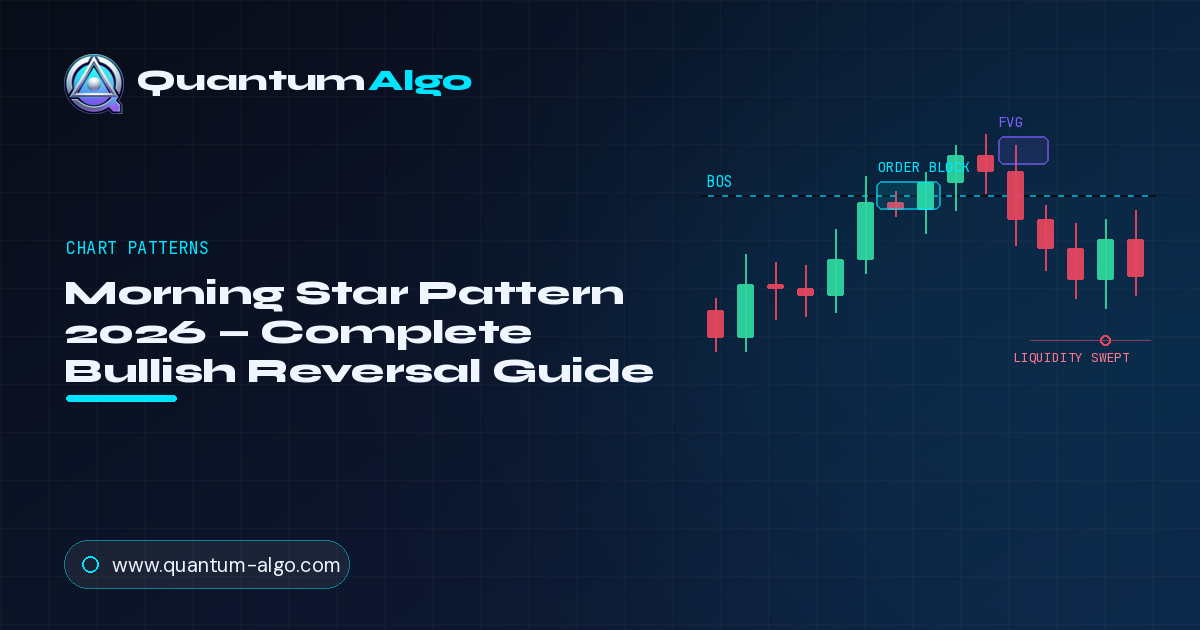
| Signal type | Candlestick (3-bar reversal) |
| Directional bias | Bullish |
| Best context | Downtrend exhaustion at support: large red, small-body star, strong green |
| Confirmation | Third candle closing above the first candle's midpoint |
| Invalidation | Close below the star's low |
1. What Is the Morning Star Pattern?
The morning star pattern is a three-candle bullish reversal pattern that forms at the bottom of downtrends. The pattern\'s name comes from its visual resemblance to the morning star (Venus) appearing in the sky before sunrise — signaling that the bearish "night" is ending and the bullish "day" is about to begin.
When properly validated at structural levels, morning star patterns produce some of the highest win rates among classical candlestick reversal signals — typically 65-78% on confirmed setups.
The morning star was formalized for Western traders through Steve Nison\'s 1991 book "Japanese Candlestick Charting Techniques," though the concept dates back to 18th-century Japanese rice markets where it was used by Munehisa Homma and his successors. The pattern\'s appeal comes from its narrative clarity — three candles tell a complete story of trend exhaustion, indecision at the bottom, and bullish takeover.
Unlike single-candle patterns that require subjective context, the morning star is largely self-validating through its three-candle structure.
The pattern\'s reliability comes from what it represents. The first candle is a strong bearish continuation of the downtrend. The second candle is a small-bodied indecision candle showing that selling pressure has exhausted — sellers can no longer push price decisively lower. The third candle is a strong bullish reversal candle showing that buyers have taken control, often closing well into the body of the first bearish candle.
This three-stage transition — bearish momentum → indecision → bullish takeover — captures the complete reversal psychology in three bars.
Morning star patterns work on every timeframe and every liquid market. The most reliable signals form on 1H, 4H, and Daily timeframes where institutional flow dominates and the three-candle structure represents meaningful order-flow shifts. On lower timeframes (1M-15M), morning star shapes appear frequently but most lack the institutional backing that gives the pattern its reliability. This guide focuses on identifying patterns that carry true edge.
For broader context, see our Candlestick Patterns Guide, Doji Candlestick Guide, and Hammer Candlestick Guide.
2. Pattern Anatomy — The 3 Candles Explained
The morning star\'s three candles each tell a specific part of the reversal story. Understanding what each represents is essential to identifying valid patterns versus coincidental shapes.
Candle 1: The Strong Bearish Continuation. The first candle of the pattern is a LARGE BEARISH CANDLE that extends the existing downtrend. The body should be substantial (typically in the upper 50% of recent candle ranges). Strong volume is preferred — confirming the bearish momentum that the reversal will need to overcome.
This candle tells the trader "the downtrend is still firmly in control." Without this strong bearish establishing candle, the subsequent reversal lacks the directional contrast that makes the pattern meaningful.
Candle 2: The Indecision Star. The middle candle is small-bodied — ideally a doji (open ≈ close) or a small spinning top (small body with wicks on both sides). The "star" in morning star refers to this small candle, named because it appears separated from the candles on either side, like a star in the sky.
The small body signals that selling pressure has exhausted — sellers can no longer push price decisively lower, but buyers haven\'t yet stepped in aggressively. This indecision phase is the critical pivot.
The Gap Question: Classical Japanese candlestick theory specifies that Candle 2 should GAP DOWN from Candle 1\'s close (open below Candle 1\'s low) and Candle 3 should GAP UP from Candle 2\'s close (open above Candle 2\'s high). These gaps are common in stock markets that have overnight gaps but RARE in 24-hour markets like forex and crypto.
Modern practical interpretation treats the gaps as preferred but not mandatory — what matters is the body sizes and the relative positioning, not literal price gaps.
Candle 3: The Bullish Reversal Confirmation. The third candle is a LARGE BULLISH CANDLE that closes well into the body of Candle 1 — ideally closing above the midpoint of Candle 1\'s body. The closer Candle 3\'s close is to (or above) Candle 1\'s open, the stronger the reversal signal.
This candle is the institutional buying signature — buyers have taken decisive control, erasing a significant portion of Candle 1\'s bearish move within a single period.
The Midpoint Rule: The single most important geometric requirement. Candle 3 should close at or above the midpoint of Candle 1\'s body. If Candle 3 closes below this midpoint, the reversal signal is weak — buyers couldn\'t reclaim enough of the bearish move to confirm sustained reversal. Candles 3 that close above Candle 1\'s OPEN are the strongest variant — sometimes called "morning star with engulfing third candle" — and produce the highest win rates.
3. Evening Star — The Bearish Mirror
The evening star pattern is the bearish mirror image of the morning star. It forms at the top of uptrends and signals the same psychological transition in the opposite direction: bullish momentum → indecision → bearish takeover. Understanding the evening star alongside the morning star completes the family of three-candle reversal patterns.
Evening Star Anatomy: Forms at the top of established uptrends. Candle 1: large bullish candle continuing the uptrend. Candle 2: small-bodied indecision candle (doji or spinning top) at the top of the rally. Candle 3: large bearish candle closing well into the body of Candle 1 (at or below the midpoint). The three-candle sequence shows bulls exhausting, market pausing in indecision, then bears taking decisive control.
Evening Star Trading Implication: Treat as a bearish reversal signal. Enter short on confirmation. Stop just above Candle 1\'s high + 0.5 ATR. Target the next opposing structural level. Win rates 60-75% on properly validated patterns — slightly lower than morning stars due to general upward bias in most asset classes.
Win Rate Comparison: Morning stars produce slightly higher win rates than evening stars (typically 65-78% vs 60-75%) due to the same upward bias that gives bullish reversal patterns an edge across stocks, indices, and crypto markets. In forex markets, the two variants produce comparable win rates.
The "Doji Star" Variant: when Candle 2 is specifically a doji (rather than a small spinning top), the pattern becomes a "morning doji star" or "evening doji star." These variants produce slightly higher win rates than spinning-top versions because the doji represents stronger indecision and momentum exhaustion. The most powerful version is "Abandoned Baby" — where Candle 2 is a doji that gaps away from both Candle 1 and Candle 3, completely isolated.
Abandoned Baby patterns are rare but produce 80%+ win rates when properly identified.
Three Inside Up/Down Variants: Related three-candle reversal patterns. "Three Inside Up" is similar to morning star but Candle 2 is an inside bar (high lower than Candle 1\'s high, low higher than Candle 1\'s low). Slightly less reliable than morning star but easier to identify. "Three Inside Down" is the bearish mirror. Useful when the strict morning star geometry isn\'t present but a three-candle reversal is clearly forming.

Automate your trades. Let Quantum Algo trade for you.
Every signal executed on your own account — 24/7, hands-off.
4. Five Rules for a Valid Morning Star
Most "morning star patterns" identified by beginning traders fail because they violate one or more validation rules. The five strict rules below filter out the noise.
Rule 1: Clear prior downtrend required. The morning star is a REVERSAL pattern — it requires an existing downtrend to reverse. At minimum, the prior downtrend should be 5-10 candles of clear downward action on the relevant timeframe. Without a sustained prior downtrend, the three-candle shape lacks the directional context that gives the pattern its reversal meaning.
Rule 2: Candle 1 must be a strong bearish candle. Candle 1\'s body should be substantial — typically in the upper 50% of recent candle ranges. Small Candle 1 bodies don\'t establish enough bearish momentum to be meaningfully reversed by Candle 3. The strength of Candle 1 sets up the directional contrast that makes the reversal meaningful.
Rule 3: Candle 2 must be small-bodied. The middle "star" candle should have a body size in the lower 30% of recent candle ranges, ideally a doji (open ≈ close) or small spinning top. Large Candle 2 bodies don\'t represent the indecision pivot that defines the pattern. The smaller the body, the stronger the indecision signal.
Rule 4: Candle 3 must close at or above Candle 1\'s midpoint. The single most important geometric rule. Candle 3 should close in the upper half of Candle 1\'s body — ideally above Candle 1\'s open for the strongest variant. Candles 3 that fail to reach Candle 1\'s midpoint indicate weak buyer follow-through and produce unreliable reversal signals.
Rule 5: Forms at a structural level. The pattern\'s edge multiplies when it forms at major support, an order block, an FVG, or a Fibonacci level. Morning star patterns at random locations have moderate edge (55-60% win rate). Morning star patterns at confirmed structural levels produce 70-78% win rates. The location IS part of the trade thesis — always identify the structural reason before trading any morning star.
The institutional-grade pattern test: All five rules align for high-probability setups. Patterns missing 1-2 rules may produce some edge but with reduced reliability. Patterns missing 3+ rules are essentially random shapes mislabeled as morning stars. Strict adherence to the 5-rule filter eliminates roughly 60-70% of perceived morning stars, leaving only the high-probability setups.
5. Entry, Stop, and Target Calculation
Pattern identification alone doesn\'t produce profit — entry timing, stop placement, and target calculation determine actual results.
Entry Trigger #1 — Standard (Candle 3 close): Enter long on the close of Candle 3. This is the textbook morning star entry — the moment the pattern completes. Slightly later entry than aggressive variants but eliminates ambiguity about whether the pattern has fully formed.
Entry Trigger #2 — Confirmation (Candle 4 close): Wait for the candle AFTER the morning star to close in the same bullish direction. This adds one bar of confirmation that buyers continue to control price. Better win rates (75%+ vs 65-70% on standard entry) but slightly worse entry price.
Entry Trigger #3 — Breakout entry (best R:R): Wait for price to break ABOVE Candle 1\'s high. This confirms that buyers have not only reversed but extended beyond the bearish move\'s origination point. Tighter stop and best R:R, but you may miss patterns where price never breaks Candle 1\'s high (about 30% of valid morning stars).
Stop-Loss Placement: Place stop just below the LOW OF THE THREE-CANDLE PATTERN (typically Candle 2\'s low or Candle 1\'s low, whichever is lower) plus 0.5 to 1 ATR buffer. If price breaks below the pattern\'s low, the reversal signal has failed and the bullish thesis is invalidated.
Target Calculation Methods: Three reliable approaches. (1) Next structural level — target the most recent significant resistance level above. (2) Measured move — target a distance equal to the height of the morning star pattern (Candle 1 high to Candle 1 low) projected up from Candle 3\'s close. (3) Fibonacci extension — use 1.618 or 2.618 extension from the pattern\'s low to recent swing high for longer-term targets.
The structural-level target is the most popular and produces the most reliable results.
Typical R:R: With stop below the pattern and target at the next structural resistance, R:R typically falls between 2:1 and 4:1. Always aim for minimum 2:1; below this, the edge becomes too thin for consistent profitability. Scale partial positions: 50% at 1.5x R:R, remainder trailing for runners.
6. How Do You Trade the Morning Star? Four Proven Strategies
Strategy 1: Classic Morning Star at Support (Beginner)
The foundational morning star setup. Identify a clear downtrend approaching a major support level. Wait for the three-candle morning star to form at the level. Verify all 5 validation rules. Enter on Candle 3 close. Stop below pattern low + 0.5 ATR. Target the next resistance level above.
Expected metrics: Win rate 65-70% when all rules align. R:R 2:1 to 3:1.
Strategy 2: Morning Star + Momentum Divergence (Intermediate)
Combine pattern signal with momentum confirmation. Wait for morning star patterns that coincide with RSI or MACD bullish divergence (price making lower low while indicator makes higher low). The dual confirmation — three-candle pattern plus momentum exhaustion — significantly increases reversal probability. Win rates climb to 72-78% on these confluence setups.
Strategy 3: Morning Star + Order Block Confluence (Advanced)
The institutional-grade variant. Look for morning star patterns forming inside bullish order blocks on the higher timeframe. The order block marks where institutions positioned; the morning star marks the moment of accumulation. Combined, these signals produce win rates above 78%. See our Order Block Trading Guide for OB identification mechanics.
Strategy 4: Morning Star After Liquidity Sweep (Expert)
The most sophisticated application. Wait for price to sweep a recent swing low (taking out sell-side liquidity). The sweep itself triggers stop orders and creates a brief liquidity vacuum. Watch for a morning star pattern immediately after the sweep — this signals the institutional reversal that the sweep set up. Win rates 78-82% on properly identified sweep-morning-star setups. See our Liquidity Sweep Guide for sweep mechanics.
7. Common Morning Star Mistakes
Mistake 1: Trading morning stars without a prior downtrend. The pattern is a REVERSAL signal — it requires a downtrend to reverse. Three-candle shapes in sideways ranges or in the middle of consolidation lack the directional context that gives the pattern meaning. Always verify the prior downtrend before considering any morning star setup.
Mistake 2: Accepting weak Candle 3 closes. Candle 3 must close at or above Candle 1\'s midpoint for the pattern to be valid. Candles 3 that close below this level indicate weak buyer follow-through and produce unreliable reversal signals. The midpoint rule is the single most important geometric requirement — never relax it.
Mistake 3: Ignoring the structural context. Morning stars at random levels have moderate edge (55-60% win rate). Morning stars at confirmed support, order blocks, or FVGs produce 70-78% win rates. The structural level is what multiplies the pattern\'s edge from "OK setup" to "institutional-grade entry." Always identify the structural reason.
Mistake 4: Trading on lower timeframes without context. Morning star shapes appear frequently on 1M-5M charts but most are retail noise rather than institutional flow shifts. Focus on patterns on 1H, 4H, and Daily timeframes where the three-candle structure represents meaningful order-flow shifts. Use lower timeframes only for entry refinement, not primary signal generation.
Mistake 5: Skipping the confirmation candle. Entering on Candle 3\'s close alone produces 65-70% win rates. Waiting for the next candle (Candle 4) to close bullishly improves win rates to 75%+. The minor delay in entry is more than compensated by the improved win rate and reduced fake-out exposure.
Mistake 6: Setting overly tight stops. The three-candle pattern often involves significant volatility, particularly within Candle 2. Stops placed too close to the pattern low get triggered by normal post-pattern volatility. Use the entire pattern low + 0.5-1 ATR buffer; never tighter.
8. Test Your Knowledge
Seven questions on morning star pattern trading.
9. Morning Star + Smart Money Confluence
Morning star patterns at random levels have moderate edge. Morning star patterns at institutional zones — order blocks, FVGs, liquidity sweep completion points — produce some of the highest-edge reversal setups available to retail traders.
• Bullish OB detection at morning star locations — institutional confluence
• FVG overlay — patterns aligned with bullish gaps automatically
• Liquidity sweep detection — morning stars after sweeps are highest-edge variant
• Multi-timeframe context — HTF reversal context for LTF morning star entries
• Smart alerts — notified when pattern + SMC confluence forms
Frequently Asked Questions
A three-candle bullish reversal pattern that forms at the bottom of downtrends. The three candles tell a complete reversal story: Candle 1 is a strong bearish continuation; Candle 2 is a small-bodied indecision candle (often a doji); Candle 3 is a strong bullish candle closing well into Candle 1\'s body. The pattern signals exhaustion of selling and bullish takeover.
The evening star is the bearish mirror image of the morning star. It forms at the top of uptrends with the same three-candle structure but reversed: strong bullish Candle 1, small indecision Candle 2, strong bearish Candle 3 closing into Candle 1\'s body. Signals bullish exhaustion and bearish takeover.
Properly validated morning star patterns at structural levels produce win rates of 65-78%. With Smart Money confluence (order blocks, FVGs, liquidity sweeps), win rates climb to 78-82%. Standalone morning stars without structural context produce only moderate edge (55-60% win rate).
Candle 3 must close at or above the midpoint of Candle 1\'s body. This geometric requirement confirms that buyers have reclaimed enough of the bearish move to signal sustained reversal. Candles 3 that fail to reach Candle 1\'s midpoint produce unreliable reversal signals.
No, but it must be small-bodied — typically in the lower 30% of recent candle ranges. A doji (open ≈ close) is the ideal Candle 2 because it represents perfect indecision. A small spinning top also qualifies. Large-bodied middle candles invalidate the pattern.
A morning star has any small-bodied middle candle. A morning doji star specifically has a doji as the middle candle. Morning doji stars produce slightly higher win rates because the doji represents stronger indecision and momentum exhaustion than a spinning top.
The abandoned baby is a rare and powerful variant where Candle 2 is a doji that gaps away from both Candle 1 and Candle 3 — completely isolated. The bullish abandoned baby forms at downtrend bottoms; the bearish version forms at uptrend tops. These patterns produce 80%+ win rates when properly identified.
Yes. Morning star patterns work on every liquid market — forex, crypto, stocks, indices, futures. Crypto markets produce particularly clean morning star formations at major support levels during cycle lows. Bitcoin\'s 4H and Daily charts frequently produce textbook morning stars during bullish reversal phases.
References & Related Guides
More in this topic
- Ascending Triangle Pattern: Complete Guide (2026)
- Bear Flag Pattern 2026 — Complete Bearish Continuation Guide
- Bullish Harami Pattern: Complete Trading Guide (2026)
- Candlestick Patterns Guide 2026 — Engulfing, Pinbar & More
- Chart Patterns: The Complete Guide (2026)
- Cup and Handle Pattern 2026 — Complete Trading Guide
- Dark Cloud Cover: Complete Candlestick Guide (2026)
- Doji Candlestick 2026 — Complete Indecision Pattern Guide
- Double Bottom Pattern 2026 — Complete Bullish Reversal Guide
- Double Top Pattern 2026 — Complete Bearish Reversal Guide
- Engulfing Candle 2026 — Complete Reversal Pattern Guide
- Evening Star Pattern: Complete Trading Guide (2026)
- Three White Soldiers 2026 — Bullish Reversal Pattern Guide