Best Options Trading Platform: Per-Contract Fees, Tools and Which Broker Fits Your Trading
There is no single best options platform; it depends on how you trade. For the lowest commissions, Robinhood, Webull and moomoo charge $0 per equity options contract. For active traders who want strong options tools, tastytrade ($1 to open, $0 to close, capped at $10 a leg) and Interactive Brokers ($0.15 to $0.65 by volume) stand out. Schwab's thinkorswim, Fidelity and E*TRADE charge about $0.65 a contract but offer full-service brokerage and well-regarded platforms.
Options platforms differ far more than stock brokers do. The per-contract fee, whether you pay to close, how multi-leg orders are handled, what analysis you get and how easily you get approved for spreads all change your results. I'll compare the main US brokers on what actually matters to an options trader, show what the fees add up to at different volumes, and help you match a platform to how you trade. Fees were checked against published schedules in October 2026.
How should you compare options trading platforms?
Five things decide whether a platform suits an options trader. First, total cost: the per-contract commission on both opening and closing, plus regulatory and exchange fees. Second, execution: how multi-leg orders fill and whether you get price improvement on options. Third, tools: option chains, probability and profit-and-loss analysis, Greeks and volatility views. Fourth, access: approval levels, margin rules and which products you can trade, such as index options or futures options. Fifth, the app or desktop you will actually use every day.
We compared the brokers most US options traders consider on all five, using their published fee schedules. If options are new to you, start with options trading for beginners.
Which options platform has the lowest fees?
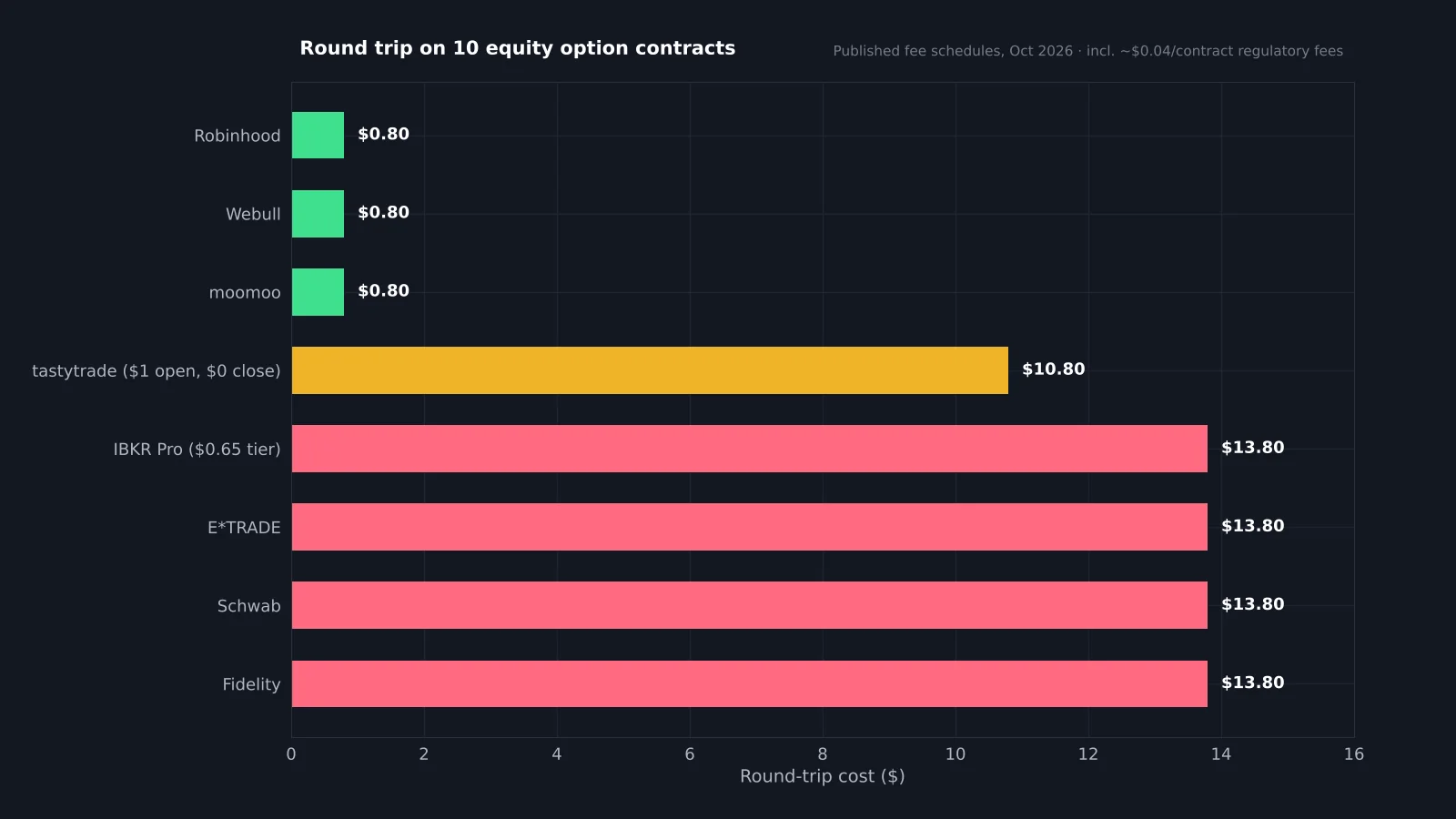
Opening and closing 10 equity option contracts costs well under a dollar at the zero-commission apps (only regulatory fees), $10.80 at tastytrade because closing is free, and about $13.80 at brokers charging $0.65 each way. Interactive Brokers' Pro pricing falls from $0.65 toward $0.15 per contract as your monthly volume grows.
| Broker | Open (per contract) | Close (per contract) | Notes |
|---|---|---|---|
| Robinhood | $0 | $0 | Index options $0.50 ($0.35 with Gold) |
| Webull | $0 | $0 | Index options about $0.50 |
| moomoo | $0 | $0 | Index options about $0.50 |
| tastytrade | $1.00 | $0 | Capped at $10 per leg |
| Interactive Brokers (Pro) | $0.15–$0.65 | $0.15–$0.65 | Volume tiers; $1 minimum per order |
| E*TRADE | $0.65 | $0.65 | $0.50 with 30+ trades a quarter |
| Charles Schwab | $0.65 | $0.65 | thinkorswim platform |
| Fidelity | $0.65 | $0.65 | No base fee |
Index options such as SPX usually carry extra exchange fees at every broker, and the zero-commission apps charge for them (around $0.35 to $0.50 a contract). If you mainly trade SPX or futures options, compare those fees specifically.
What do commissions add up to at your volume?
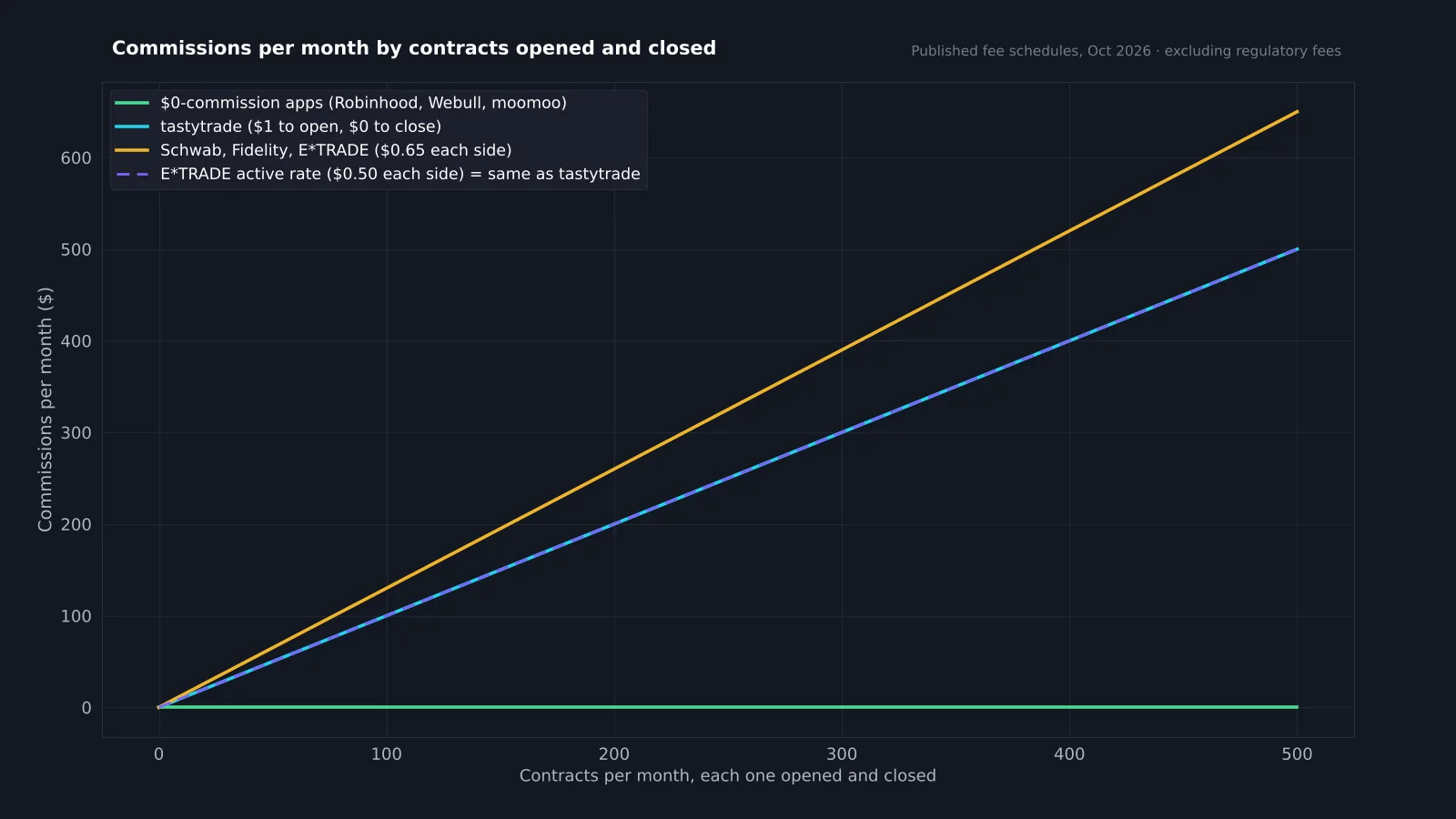
Fees scale with contracts, not trades. A trader opening and closing 100 contracts a month pays about $100 at tastytrade and $130 at a $0.65 broker; at 500 contracts that becomes $500 and $650 a month. Spread traders feel this most, because a four-leg iron condor is four contracts per unit on the way in and four on the way out.
Commissions are not the only cost. The bid-ask spread you cross on each leg is often larger than the commission, especially in less liquid strikes. A broker with slightly higher fees but better fills on multi-leg orders can be cheaper overall. The calculator below lets you put in your own numbers.
Which platforms have the best options analysis tools?
- Schwab thinkorswim: one of the deepest retail options platforms, with probability analysis, risk profiles, strategy builders and paper trading.
- tastytrade: built around options, with fast multi-leg order entry, probability of profit on every trade and a curve view of positions.
- Interactive Brokers: professional-grade tools (strategy builder, option analytics, volatility lab) and the widest product range, with a steeper learning curve.
- Webull and moomoo: clean mobile option chains, Greeks and simple strategy builders, good for smaller accounts.
- Robinhood: the simplest interface, with basic chains and strategy templates; less depth for analysis.
Most traders still do their chart analysis elsewhere and use the broker for the chain and execution. Our guide to the best indicator for options trading covers what to watch on the chart.
Which options platforms offer paper trading?
Practising with simulated money is worth more in options than in stocks, because assignment, expiry and multi-leg fills behave in ways that are hard to learn from reading. Schwab's thinkorswim has a full paperMoney mode, Interactive Brokers offers a paper account that mirrors the live platform, and Webull and moomoo include paper trading in their apps. tastytrade offers a sandbox mainly aimed at developers, so most beginners there practise with one-lot trades instead.
Paper fills are usually kinder than real ones, especially on wide spreads, so treat simulated results as an upper bound. Our guide to the best paper trading platforms compares the simulators in more detail.
How do platforms handle spreads and multi-leg orders?
If you trade credit spreads, iron condors or calendars, check three things. Can you send the whole spread as one order at a net price, so you never get filled on one leg only? Does the broker reduce margin to the spread's defined risk? And can you close or roll the whole structure in one ticket?
tastytrade, thinkorswim and IBKR are strongest here. The zero-commission apps support common spreads but offer fewer order types and less control over complex structures. Whatever you use, send spreads as a single net-price order rather than legging in, unless you have a reason to take the extra risk.
What are options approval levels?
US brokers grade options permissions, typically in four or five levels. The lowest allows covered calls and cash-secured puts; the next adds buying calls and puts; then spreads in a margin account; and the highest allows selling uncovered (naked) options. Each broker asks about your experience, income and objectives before approving you.
| Typical level | What it allows |
|---|---|
| 1 | Covered calls, cash-secured puts |
| 2 | Buying calls and puts |
| 3 | Spreads (defined risk), in a margin account |
| 4–5 | Uncovered (naked) option selling, higher minimums |
Levels are not standard across brokers, so check what each one requires for the strategies you plan. Spreads usually need a margin account, and many brokers require a minimum balance for naked selling.
Which platform is best for a small options account?
With a small account, fees take a larger share of each trade, so the $0-commission apps or tastytrade's free closing are attractive. Watch the pattern day trader rule: in a US margin account under $25,000, four or more day trades in five business days can restrict the account. Options day trades count. Our guide to the pattern day trader rule explains the limits and the cash-account workaround.
Also check minimums for spreads: most brokers need a margin account for them, and some set balance thresholds above the legal minimums.
Which platform suits active and professional options traders?
High-volume traders tend to choose between tastytrade and Interactive Brokers. tastytrade's free closing and $10-per-leg cap favour traders who scale size per trade; IBKR's volume tiers favour very high contract counts and add global markets, futures options and portfolio margin for larger accounts. thinkorswim remains popular for analysis even among traders who route elsewhere.
For heavy users, ask about execution statistics on options, API access and whether the broker passes through exchange rebates. If you trade on charts with automated alerts, see connecting brokers to TradingView for what each supports.
Reference data
| Item | Value |
|---|---|
| Contract size (US equity options) | 100 shares |
| Typical regulatory + exchange fees | a few cents per contract each side |
| tastytrade cap | $10 per leg on opening |
| IBKR Pro tiers | $0.65 down to $0.15 per contract by volume |
| Pattern day trader threshold | $25,000 in a US margin account |
| Fees checked | October 2026, published schedules |
Options commission calculator
Enter how many contracts you open each month, what share you close rather than let expire, and the broker's open and close fees. The calculator returns your monthly and yearly commissions including regulatory fees.
What should you avoid in an options platform?
- Hidden closing or exercise fees that make 'free' trading expensive at expiry.
- No net-price spread orders, forcing you to leg into structures.
- Automatic liquidation near expiry without clear rules.
- Poor assignment communication, so you discover stock positions after the fact.
- Offshore 'options' apps that are really binary options or CFDs; see our guide to binary options platforms for the difference.
Which options trading platform should you choose?
If cost per contract is your priority and your strategies are simple, a zero-commission app is hard to beat. If you trade spreads actively and want options-first tools, tastytrade is the natural fit, with Interactive Brokers for the highest volumes and the widest market access. If you want deep analysis inside a full-service broker, thinkorswim at Schwab is the long-standing choice, with Fidelity and E*TRADE as alternatives at the same price.
Open a paper or small live account first, place a few spread orders, and compare the fills you get against the mid-price. Record them in a trading journal; after a month, the right platform is usually obvious.
Compare options platforms on total cost (open and close fees plus regulatory fees), multi-leg execution, analysis tools, approval levels and the app you will use. Zero-commission apps are cheapest per contract; tastytrade ($1 open, $0 close, $10 cap) and IBKR (volume tiers) suit active traders; Schwab, Fidelity and E*TRADE charge about $0.65 with full-service tools. Spreads and fills on illiquid strikes often cost more than commissions.
◆ Interactive check
Can you pick the right options platform?
Questions traders ask about options platforms
Robinhood, Webull and moomoo charge $0 commission on equity options; you still pay regulatory fees of a few cents per contract.
Yes. It is built around options, charges $1 to open and nothing to close, caps fees at $10 a leg and handles multi-leg orders well.
Yes, at Charles Schwab, which took it over from TD Ameritrade. Options cost $0.65 a contract.
At most brokers, yes. tastytrade charges $0 to close, and expiring options usually carry no closing fee.
Usually the level that allows defined-risk spreads, in a margin account. The number varies by broker.
The commission is zero, but you pay regulatory fees and the bid-ask spread, and the broker may be paid for routing your order.
One with a clear interface, paper trading and good education. thinkorswim and tastytrade offer both; simpler apps are easier but less instructive.
Most major brokers offer them, but fees are higher than for equity options and some apps limit access.
References & Related Guides
Read next
- Options Trading for Beginners
- Credit Spread Options
- Best Stocks for Covered Calls
- Day Trading Options
- Best Indicator for Options Trading
- thinkorswim Review
- Interactive Brokers for Day Trading
- Pattern Day Trader Rule
- Options Prop Firms
- Gamma Squeeze