What Are the Safest Binary Options Platforms? Regulation, Red Flags and the Math Against You
The safest binary options platforms are exchanges regulated in your country. In the US that means a CFTC-registered exchange (a designated contract market) such as those offering event contracts; in the EU, UK and Australia, binary options are banned for retail traders, so any broker offering them to you there is unregulated. Most binary options websites are offshore and are not safe. Even on a regulated exchange, payouts below 100% mean you need a win rate above 52% to 59% just to break even.
Search for binary options platforms and you will find dozens of slick apps promising 90% payouts in 60 seconds. Most of them are offshore companies that regulators have warned about for years. This answer explains where binary options are actually legal, how to check a platform in two minutes, the red flags that identify the rest, and the payout arithmetic that makes the product hard to beat even when the platform is honest.
What are binary options?
A binary option is a yes-or-no bet on a price. You choose whether an asset will finish above or below a level (the strike) at a fixed time. If you are right, you receive a fixed payout; if you are wrong, you lose your stake, or on an exchange the contract settles at zero. The name comes from the two possible outcomes.
Unlike standard options, there is no position to manage and no sliding scale of profit: finishing one tick in the money pays the same as finishing far in it. Expiries can be as short as 30 seconds. For how standard options work, see options trading for beginners.
Where are binary options legal?
It depends on where you live, and that is the first safety test.
| Region | Status for retail traders | Regulator |
|---|---|---|
| United States | Legal only on CFTC-registered exchanges (DCMs) or SEC-registered markets | CFTC, SEC, NFA |
| European Union | Banned EU-wide from 2 July 2018, then by national rules | ESMA and national regulators |
| United Kingdom | Permanently banned since 2 April 2019 | FCA |
| Australia | Banned since 3 May 2021 | ASIC |
| Canada | Generally prohibited for short-term contracts | CSA members |
| Elsewhere | Varies; many offshore brokers are licensed in small jurisdictions with weak oversight | Local regulator |
The key point: in places where retail binary options are banned, a platform that still lets you trade them is by definition not regulated for you. Its licence, if it has one, is from another country and gives you little or no protection.
Which binary options platforms are actually safe?
A safe platform has three things: it is regulated in your country, your money is held in segregated accounts, and prices come from an exchange, not from the company you are betting against.
In the US, that rules out almost every app you see advertised. What remains are CFTC-registered exchanges that list binary-style contracts, often called event contracts: they pay $1 if a statement is true at expiry and $0 if not. Nadex, the best-known US binary options exchange, was bought by Crypto.com in 2022; the Nadex brand closed, and the exchange continues under Crypto.com as a CFTC-registered market offering event contracts. Kalshi is another CFTC-registered exchange offering event contracts. Check the CFTC's list of designated contract markets for the current names.
Outside the US, if your regulator has banned retail binary options, the safe answer is that there is no safe platform for you. Consider regulated products instead, covered below.
How do you check if a binary options platform is regulated?
- Find the legal entity. Look at the website footer and terms for the company name and registration number, not the brand.
- Search the regulator's own register. US: NFA BASIC and the CFTC's DCM list. UK: the FCA register. EU: the national regulator. Australia: ASIC Connect. Never trust a licence number shown only on the platform's site.
- Check warning lists. The CFTC RED list, FCA warning list, and IOSCO's I-SCAN portal list firms regulators have flagged.
- Match the details. Domain, address and phone numbers on the register must match the site; scammers clone real firms.
- Test a small withdrawal before depositing more. Problems withdrawing are the most common complaint.
If something has already gone wrong, our guide on what to do if you were scammed by a trading platform lists the steps.
What are the red flags of an unsafe binary options broker?
- Licensed offshore only while advertising to you in a country where binary options are banned.
- Bonuses that lock your money, with turnover requirements before you can withdraw.
- Account managers who phone you, push larger deposits or offer to trade for you.
- "Signals" or "robots" promising 80% to 90% win rates.
- Payment by crypto, wire to a third party, or card processed under another name.
- Withdrawal delays, repeated identity checks or new fees when you ask for your money.
- Prices you cannot verify: the platform sets its own quotes and takes the other side of your trade.
The CFTC and SEC have published joint investor alerts about binary options fraud describing exactly these practices: refusing withdrawals, identity theft and manipulating software to make trades lose.
What win rate do you need to profit from binary options?
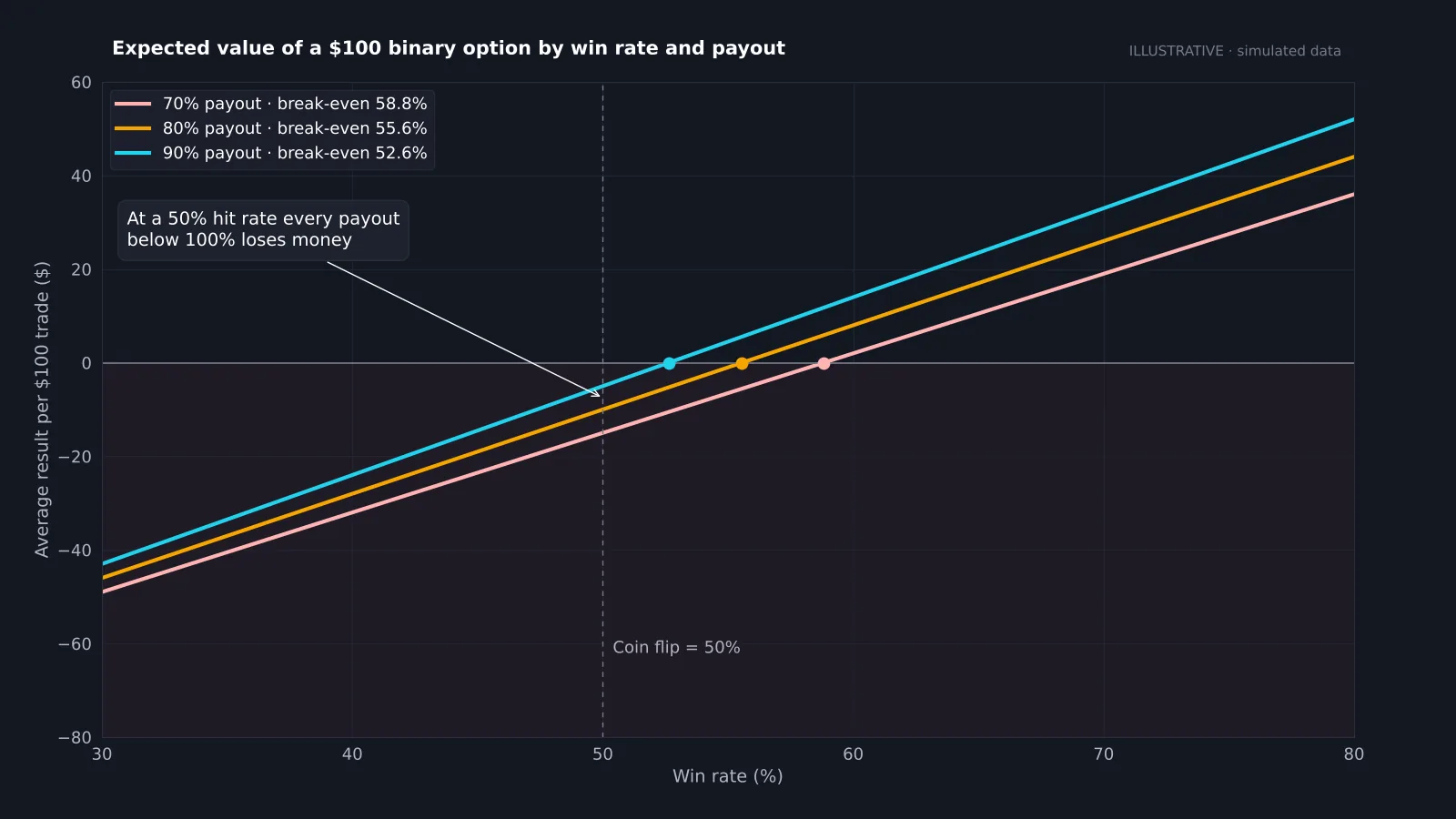
On a typical broker binary, a win pays a percentage of the stake (say 80%) and a loss costs the whole stake. Break-even win rate = 1 ÷ (1 + payout). At 80% that is 1 ÷ 1.8 = 55.6%. At 70% it is 58.8%; at 90% it is 52.6%.
That gap is the platform's edge. A trader who is right 55% of the time, which is already hard on short timeframes, still loses money at an 80% payout. The chart shows expected value per $100 bet across win rates: only the area to the right of each break-even point is profitable. Use the calculator below to test your own numbers.
Binary options expected-value calculator
Enter the payout, your realistic win rate, stake and number of trades.
Expected value assumes your win rate is real and stable. On short expiries, most people's true win rate is close to 50% or below.
Why are 60-second and 5-minute binaries so hard to win?
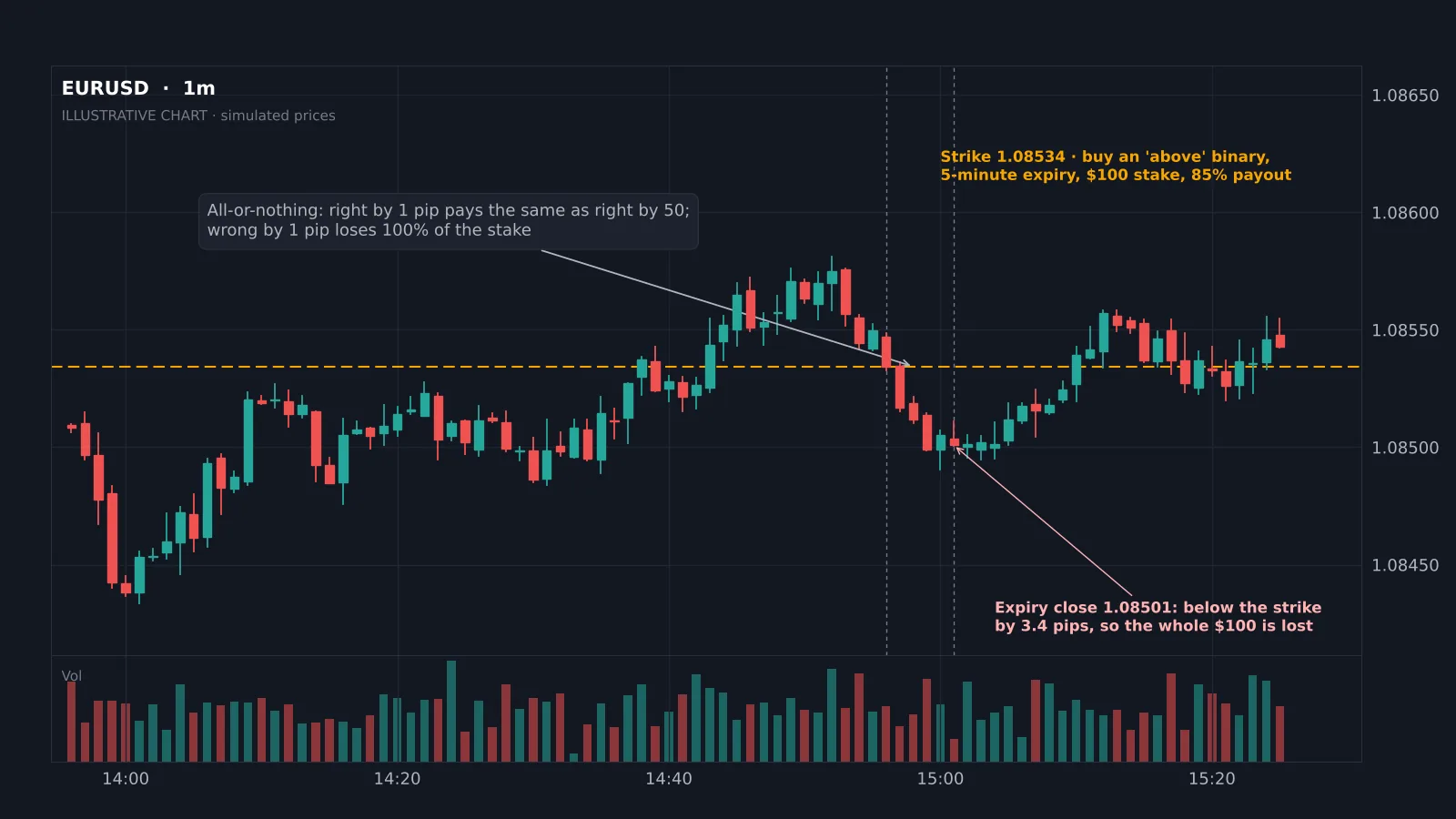
Over very short periods, price movement is mostly noise. In the example, a 5-minute call on EUR/USD at 1.08534 expires at 1.08501 and loses by 3.4 pips, a move smaller than ordinary bid-ask noise. Analysis has little to work with at that scale, so results drift toward a coin flip, and a coin flip at an 80% payout loses 10% of every stake on average.
Short expiries also encourage many trades in a row, which compounds the house edge and the emotional pressure. If you want to trade short timeframes, standard instruments with defined risk and real price action give your analysis a chance; see our guide to day trading options.
What is the difference between exchange and broker binary options?
On a regulated exchange, binary contracts trade between participants at prices set by the market, usually between $0 and $100 (or $0 and $1). You can buy or sell before expiry, the exchange charges a fee, and it does not profit from your loss. Your funds are held under the regulator's segregation rules.
On an over-the-counter broker platform, the broker sets the price, sets the payout and usually takes the other side of every trade. Its profit is your loss. That conflict is the root of most binary options problems, and the reason regulators in Europe, the UK and Australia banned the product for retail clients.
Reference data
| Item | Value |
|---|---|
| Break-even win rate | 1 ÷ (1 + payout) |
| At 70% / 80% / 90% payout | 58.8% / 55.6% / 52.6% |
| ESMA retail ban (EU) | from 2 July 2018 |
| FCA permanent ban (UK) | from 2 April 2019 |
| ASIC ban (Australia) | from 3 May 2021 |
| US checks | NFA BASIC, CFTC DCM list, CFTC RED list |
| Nadex | acquired by Crypto.com in 2022; brand closed |
What are safer alternatives to binary options?
- Standard exchange-traded options: defined risk when buying, real market prices and the ability to exit early.
- Regulated event contracts on CFTC-registered exchanges, if you are in the US and want a yes-or-no product.
- Stocks and ETFs through a regulated broker, for longer-term exposure.
- Futures or CFDs with a stop loss through a regulated broker, where your profit is not capped at a fixed payout.
Each carries its own risks, but none is built so that the provider wins when you lose. For how to keep losses small on any instrument, read our risk management guide, and avoid sizing schemes like the martingale strategy that binary options sites often promote.
Do binary options signals and robots work?
Treat them as a red flag. A signal service with a real edge above the break-even win rate would be worth far more than its subscription price, and robots marketed with 85% to 90% win rates are a common fraud pattern named in regulator alerts. Some services are paid commissions by the broker on your losses.
If you want to evaluate any trading signal or system, insist on a long, independently verified record, as explained in our Myfxbook review. For charting tools that help you analyse markets yourself, the free Quantum Algo indicators on TradingView show structure and liquidity without promising outcomes.
Should you trade binary options?
For most people, no. The only safe venues are regulated exchanges, which are unavailable in much of the world, and even there the product requires a win rate above 50% after fees. Offshore broker platforms combine the same tough math with a direct conflict of interest and little legal protection. If you still want to try, use only an exchange regulated where you live, start with money you can afford to lose, and test a withdrawal first.
The safest binary options platforms are regulated exchanges in your own country; in the US that means CFTC-registered markets. Retail binary options are banned in the EU, UK and Australia, so platforms offering them there are unregulated. Check the regulator's own register and warning lists, not the website. At an 80% payout you need 55.6% wins to break even, and short expiries are close to a coin flip.
◆ Interactive check
Could you spot an unsafe binary options platform?
Questions traders ask about binary options platforms
One regulated where you live. In the US, that means a CFTC-registered exchange offering binary or event contracts. In the EU, UK and Australia no platform may legally offer them to retail traders.
Yes, but only on exchanges registered with the CFTC or SEC. Most binary options websites are offshore and not registered, which makes offering them to US residents illegal.
The product itself is not a scam, but much of the industry has been fraudulent. Regulators report refused withdrawals, identity theft and manipulated prices at unregistered platforms.
Only with a win rate above the break-even rate (52.6% to 58.8% at common payouts) sustained over many trades. Few traders achieve that, especially on short expiries.
ESMA and national regulators found that most retail clients lost money, the products were complex, and brokers had a conflict of interest by taking the other side of trades.
Search the regulator's own register for the legal entity name and licence number, compare contact details and domain, and check warning lists such as the CFTC RED list and the FCA warning list.
Crypto.com acquired Nadex in 2022. The Nadex brand closed, and the CFTC-registered exchange continues under Crypto.com offering event contracts.
It lowers the break-even win rate to 52.6%, but that is still above a coin flip. Very high advertised payouts are also a common lure at unregulated platforms.
References & Related Guides
Read next
- Scammed by a Trading Platform?
- Options Trading for Beginners
- Day Trading Options
- Martingale Strategy
- Risk Management
- Myfxbook Review
- Best Forex Brokers
- Is Swing Trading Profitable?
- Best Indicator for Options Trading
- Best MetaTrader Alternatives
Primary sources
- CFTC & SEC — Binary Options and Fraud investor alert
- SEC Investor.gov — binary options fraud alert
- ESMA — prohibition of binary options for retail investors
- FCA — permanent ban on binary options for retail consumers
- ASIC — ban on binary options for retail clients
- NFA BASIC — check registration