Credit Spread Options Explained: Bull Put and Bear Call Spreads, Max Profit and Loss, and How to Manage Them
A credit spread is an options position where you sell one option and buy another, further out of the money, in the same expiration, and collect a net premium (the credit). A bull put spread uses puts below the price and profits if the stock stays above the short strike; a bear call spread uses calls above the price and profits if it stays below. Your maximum profit is the credit, your maximum loss is the strike width minus the credit, and both are known before you enter.
Credit spreads are usually the second options strategy people learn after covered calls, and for good reason: they let you sell premium with a loss that is capped from the moment you enter. They also look safer than they are, because they win often and lose big. I'll take you through both versions with real numbers, the formulas you need, how time decay helps you, how to pick strikes, when to take the trade off, and a calculator for your own setup.
What is a credit spread in options?
A credit spread combines two options of the same type and expiration. You sell the one closer to the current price, which has more premium, and buy the one further away, which has less. The difference lands in your account as a credit. The option you buy is insurance: it caps how much you can lose if the stock moves hard against you.
There are two kinds. A bull put spread uses puts and makes money if the stock stays above the short put. A bear call spread uses calls and makes money if the stock stays below the short call. Both are defined-risk, which is why many brokers allow them in accounts that cannot sell naked options. If options are new to you, read options trading for beginners first.
How does a bull put spread work? A worked example
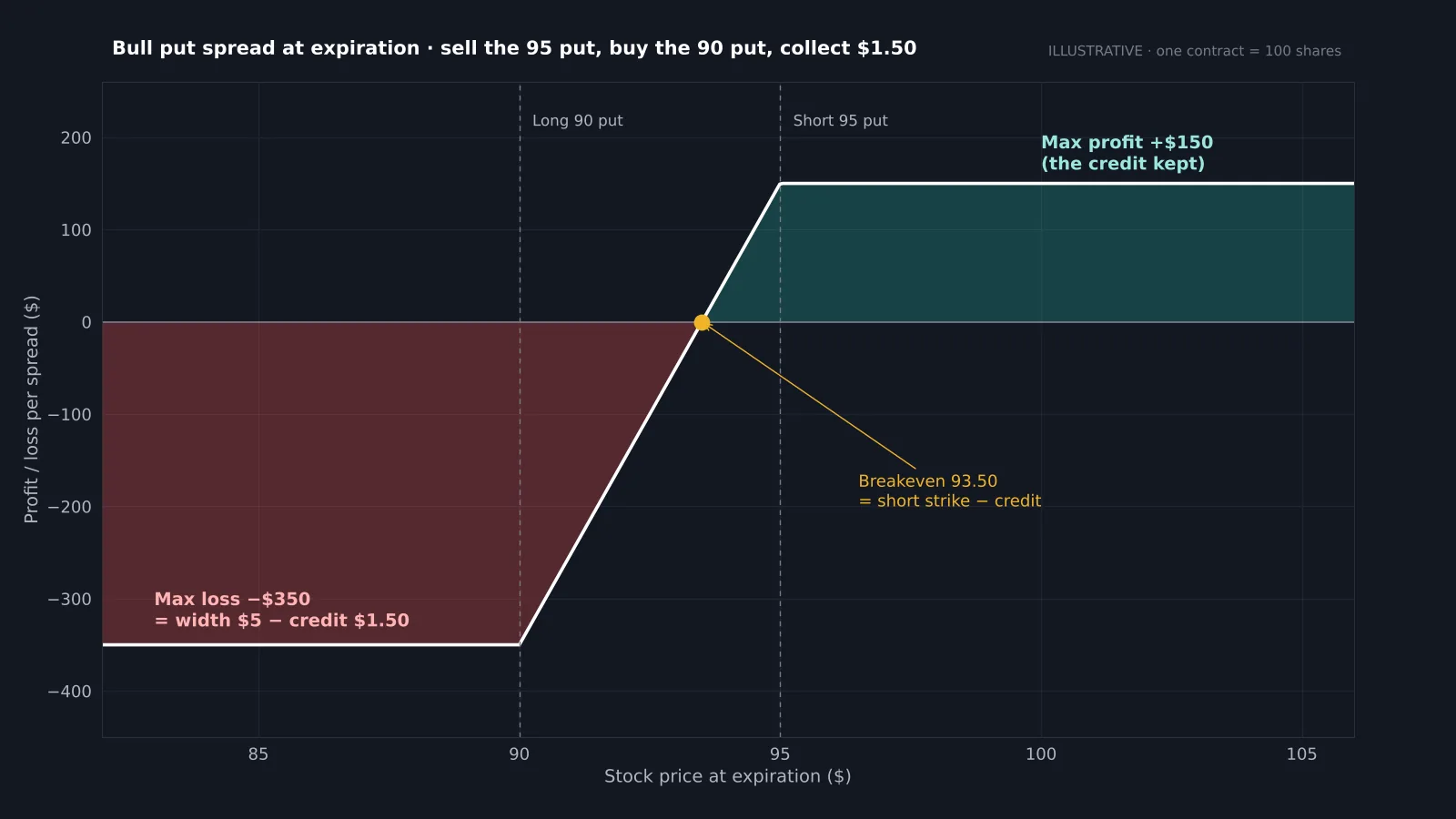
Say a stock trades at $100 and you think it will hold above $95 for the next month. You sell the $95 put and buy the $90 put in the same expiration for a net credit of $1.50 per share, or $150 per contract (one contract covers 100 shares).
| Stock at expiration | Short 95 put | Long 90 put | Result per contract |
|---|---|---|---|
| $100 | Expires worthless | Expires worthless | +$150 (keep the credit) |
| $95 | Expires worthless | Expires worthless | +$150 |
| $93.50 | Worth $1.50 | Worthless | $0 (break-even) |
| $92 | Worth $3 | Worthless | −$150 |
| $90 | Worth $5 | Worthless | −$350 (max loss) |
| $80 | Worth $15 | Worth $10 | −$350 (still max loss) |
Above $95 at expiration both puts expire worthless and you keep the $150. Between $95 and $90 you lose part or all of it, crossing break-even at $93.50. Below $90 the long put stops the damage: the loss is capped at $350 however far the stock falls. You risk $350 to make $150, so the trade has to win about 70% of the time just to break even before costs.
How does a bear call spread work?
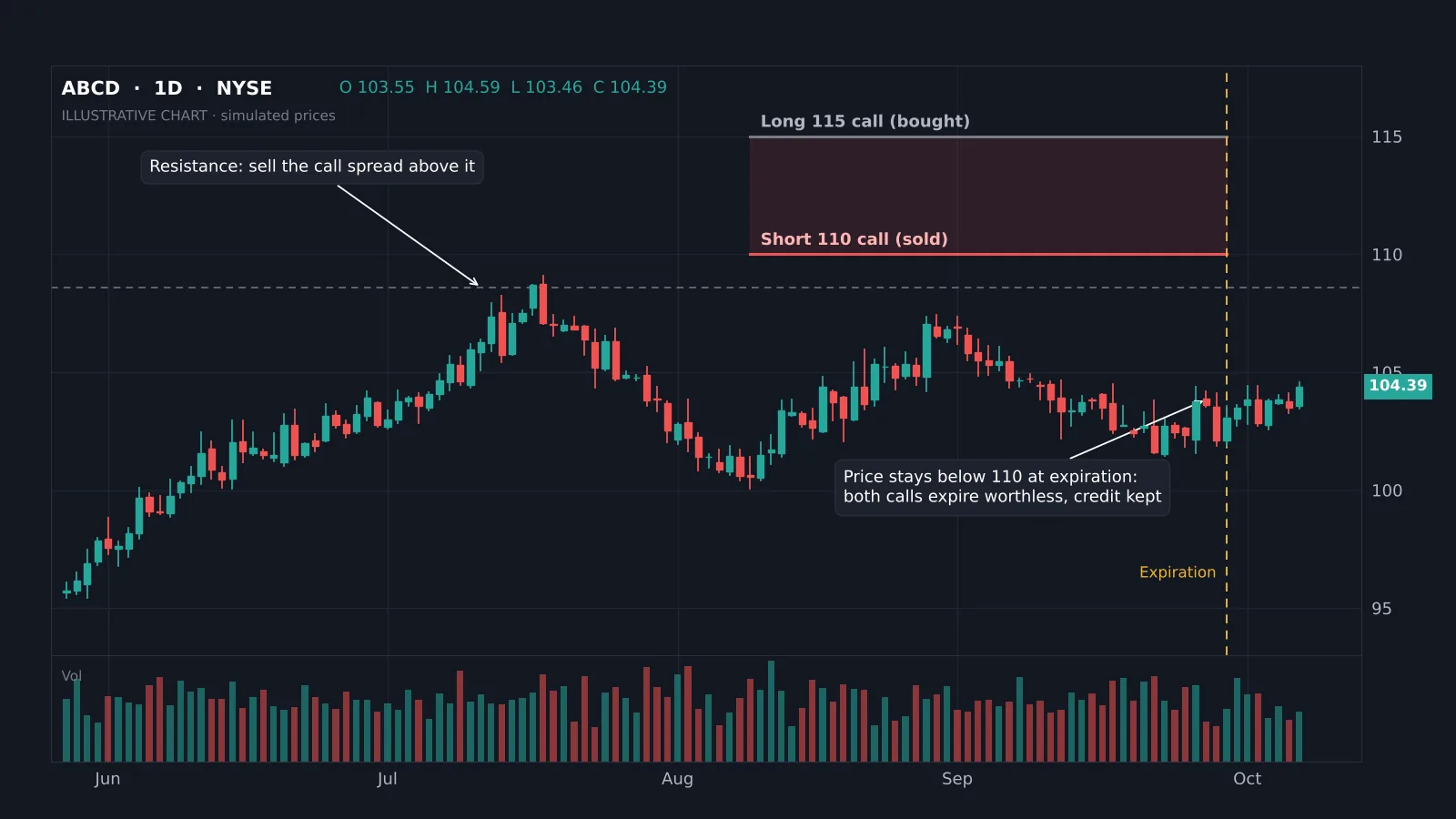
A bear call spread is the mirror image. With the stock at $104 and stalling under resistance near $109, you sell the $110 call and buy the $115 call for a credit. If the stock stays below $110 at expiration, both calls expire worthless and you keep the credit. Above $115, the loss is capped at the $5 width minus the credit.
This works best on stocks that have run into a ceiling and lost momentum, which is why reading structure matters. Our guide to support and resistance shows how to find the levels to sell above or below. One extra risk with short calls: if the stock pays a dividend, an in-the-money short call can be exercised early the day before the ex-dividend date.
Credit spread formulas: max profit, max loss and break-even
Everything about a credit spread is known at entry. These are the numbers to write down before you place the order:
| Measure | Bull put spread | Bear call spread |
|---|---|---|
| Max profit | Credit × 100 | Credit × 100 |
| Max loss | (Width − credit) × 100 | (Width − credit) × 100 |
| Break-even | Short put strike − credit | Short call strike + credit |
| Return on risk | Credit ÷ (width − credit) | Credit ÷ (width − credit) |
| Win-rate needed to break even | (Width − credit) ÷ width | (Width − credit) ÷ width |
A useful shortcut: the delta of the short option is a rough market estimate of the chance it finishes in the money. A short put with a delta of 0.20 suggests roughly an 80% chance of expiring worthless, before you account for early management and skew. The calculator further down works through these numbers for your own strikes.
How do time decay and volatility affect a credit spread?
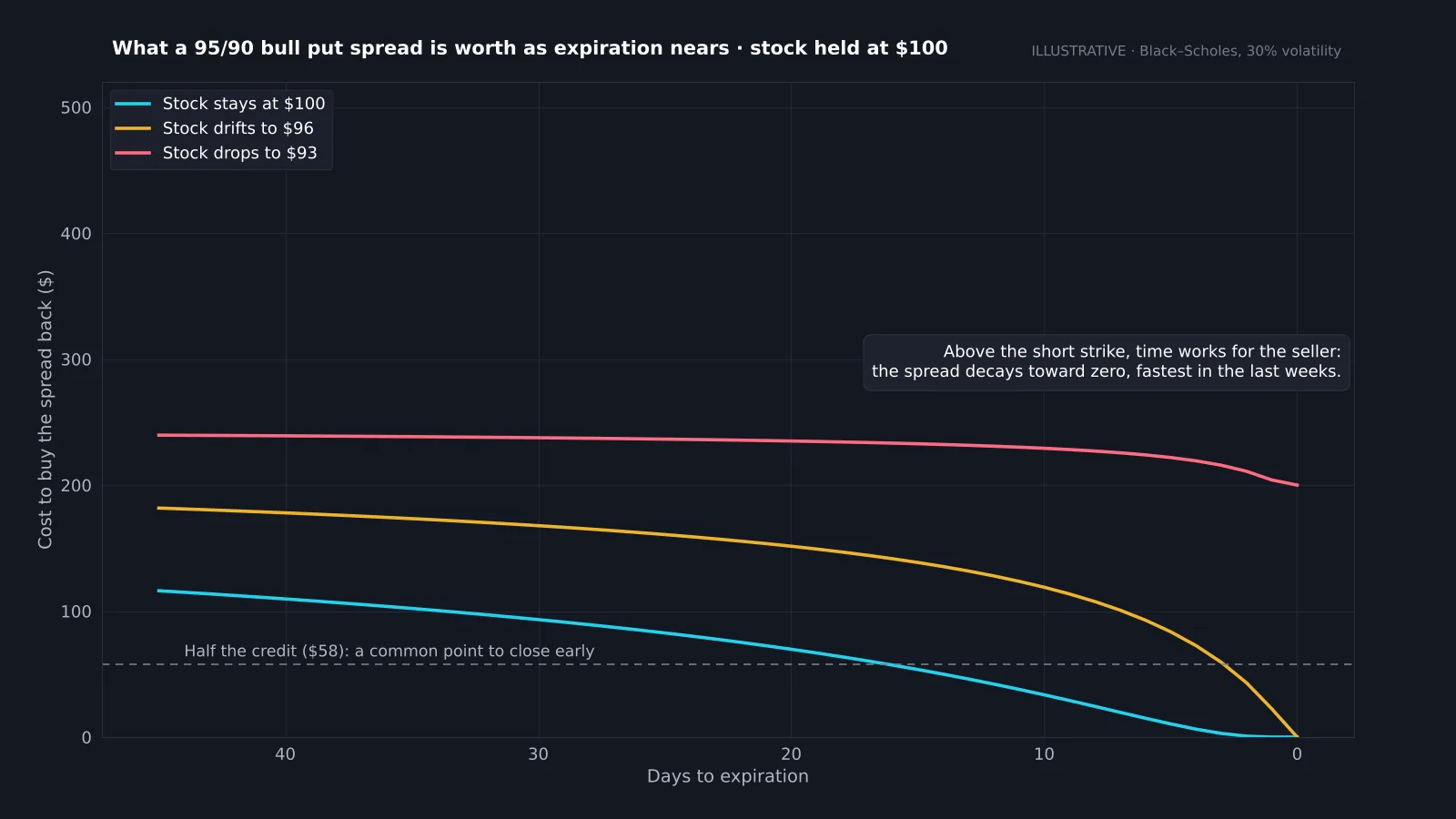
Time is on the seller's side. As expiration approaches, out-of-the-money options lose value, and a spread you sold for about $1.16 with 45 days left gradually becomes cheaper to buy back if the stock stays put. The decay is slow at first and fastest in the last few weeks, which is why many traders sell spreads 30 to 45 days out and close them well before expiry.
Volatility works the other way. When implied volatility rises, option prices rise, and your short spread costs more to close even if the stock has not moved. Selling spreads when implied volatility is high, and seeing it fall, helps you; selling when it is very low gives you a thin credit for the same risk. Big events such as earnings can push volatility up and the stock through your strikes in one gap, so many traders avoid holding spreads through them.
How do you choose strikes and expiration?
- Expiration: 30 to 45 days is a common window: enough premium, decay picking up, time to adjust.
- Short strike: beyond a support or resistance level you trust, often at a delta between about 0.15 and 0.30.
- Width: wider spreads collect more but risk more. Keep the max loss within your normal risk per trade.
- Credit: a common rule of thumb is to collect at least a quarter to a third of the width; much less, and the risk-reward is poor.
- Liquidity: trade options with tight bid-ask spreads and open interest; wide markets eat the credit.
Use the chart first. A bull put spread under a clear support level in an uptrend makes more sense than one placed at a random delta. The free Institutional Key Levels indicator helps mark those levels, and the best indicator for options trading guide covers the rest.
When should you close a credit spread?
You do not have to hold to expiration, and usually you should not. Common management rules:
- Take profits early. Many traders buy the spread back at 50% of the credit. You give up the rest for much less time exposed.
- Close or roll with about three weeks left. Gamma rises near expiry, so small moves swing the spread hard.
- Set a loss exit. For example, close if the spread costs twice the credit to buy back, or if the stock closes through your short strike.
- Do not let it expire near the strikes. Pin risk can leave you assigned on one leg and not the other over a weekend.
Write the exit rules down before entry and record every trade in a trading journal. Credit spreads lose rarely but heavily, and the journal shows whether your winners actually cover your losers.
What are the risks of credit spreads?
- Skewed payoff: you usually risk more than you can make, so a few full losses wipe out many wins.
- Gaps: an earnings or news gap can take the stock straight to max loss with no chance to exit.
- Early assignment: American-style short options can be exercised at any time, especially in the money near expiry or before a dividend.
- Pin risk: if the stock closes between your strikes at expiration, you may be assigned shares you did not plan to hold.
- Costs: two legs mean two commissions and two bid-ask spreads, on the way in and out.
None of this is a reason to avoid credit spreads, but it is a reason to size them small. Keep each spread's max loss to a small share of the account, as in our position sizing guide.
Credit spreads vs other income strategies
Credit spreads sit between owning stock and selling naked options. Here is how they compare with the strategies people usually weigh them against:
| Strategy | Capital needed | Max loss | Best when |
|---|---|---|---|
| Bull put spread | Width − credit | Capped | Mildly bullish or neutral |
| Bear call spread | Width − credit | Capped | Mildly bearish or neutral |
| Cash-secured put | Strike × 100 | Large (stock to zero) | Happy to buy the stock |
| Covered call | 100 shares | Large (stock falls) | Holding shares already |
| Iron condor | One side's width − total credit | Capped | Range-bound stock |
| Debit spread | The debit paid | The debit | Expecting a move |
If you already own shares, covered calls are the natural first step. If you want a market-neutral version, an iron condor is simply a bull put spread and a bear call spread on the same stock.
Reference data
| Item | Value |
|---|---|
| Contract multiplier | 100 shares per contract |
| Max profit | Credit × 100 |
| Max loss | (Width − credit) × 100 |
| Bull put break-even | Short strike − credit |
| Bear call break-even | Short strike + credit |
| Common expiry window | 30–45 days |
| Common short-strike delta | about 0.15–0.30 |
| Common profit-taking rule | Close at 50% of the credit |
Credit spread calculator
Enter your strikes, the credit per share and the number of contracts. The calculator returns the max profit, max loss, break-even and how far the stock can move before you lose money.
What do you need to trade credit spreads?
Brokers grade options permissions in levels. Buying calls and puts and selling covered calls sit at the lower levels; spreads usually need a higher approval level and a margin account, because you are short an option even though the long leg covers it. Your broker holds the max loss as margin while the spread is open, so a $5-wide spread with a $1.50 credit ties up about $350 per contract.
Before you place the first one, check three things with your broker: the approval level needed for spreads, how it handles early assignment on a short leg, and whether it closes positions automatically near expiration. Commissions matter more than people expect with two legs in and two out; on small credits they can take a real share of the profit. If you also trade futures options or want to trade spreads with a firm's capital, our list of options prop firms covers which ones allow them.
Are credit spreads a good strategy?
Credit spreads are a solid tool when you have a directional or range view and want a capped loss. They suit traders who are patient, can read support and resistance, and manage trades by rules. They do not suit anyone hoping for a high win rate to make up for no plan: the payoff is lopsided, and the occasional full loss is part of the deal.
Start with one contract on liquid stocks or ETFs, sell beyond a clear level, take profits early and keep the max loss small. Once you can show positive results across a few dozen trades in your journal, size up. For more on short-term options work, see day trading options.
A credit spread sells a closer option and buys a further one for a net credit. Max profit is the credit, max loss is width minus credit, and break-even is the short strike minus (puts) or plus (calls) the credit. Time decay helps you, rising volatility and gaps hurt you. Choose strikes beyond real levels, take profits around half the credit, close before the final weeks and keep each spread's max loss small.
◆ Interactive check
Can you work out a credit spread?
Questions traders ask about credit spreads
Selling one option and buying a cheaper one further out of the money in the same expiration, so you collect a net premium with a capped maximum loss.
The width between the strikes minus the credit received, multiplied by 100 for each contract.
Yes, mildly. It profits if the stock stays above the short put strike, so it also works if the stock moves sideways.
Many traders close at 50% of the credit, or with about three weeks left, and set a loss exit before entering. Avoid holding to expiry near the strikes.
Yes. The short option can be exercised early, especially when it is in the money near expiry or before a dividend for short calls.
They cap the loss and need far less margin, at the cost of a smaller credit. Most brokers allow spreads at a lower approval level than naked selling.
A credit spread collects premium and profits from time decay; a debit spread pays premium and needs the stock to move in your direction.
Usually a margin account with options approval for spreads. Requirements vary by broker.
References & Related Guides
Read next
- Options Trading for Beginners
- Best Stocks for Covered Calls
- Day Trading Options
- Best Indicator for Options Trading
- What Is Short Selling?
- Options Prop Firms
- Support and Resistance
- Position Sizing
- Interactive Brokers for Day Trading
- Trading Journal