Wilson Score Interval
The Wilson score interval is a confidence interval for a proportion such as a win rate that stays honest on small samples; its lower bound is the conservative win rate — the number a strategy must clear before an edge deserves to be trusted.
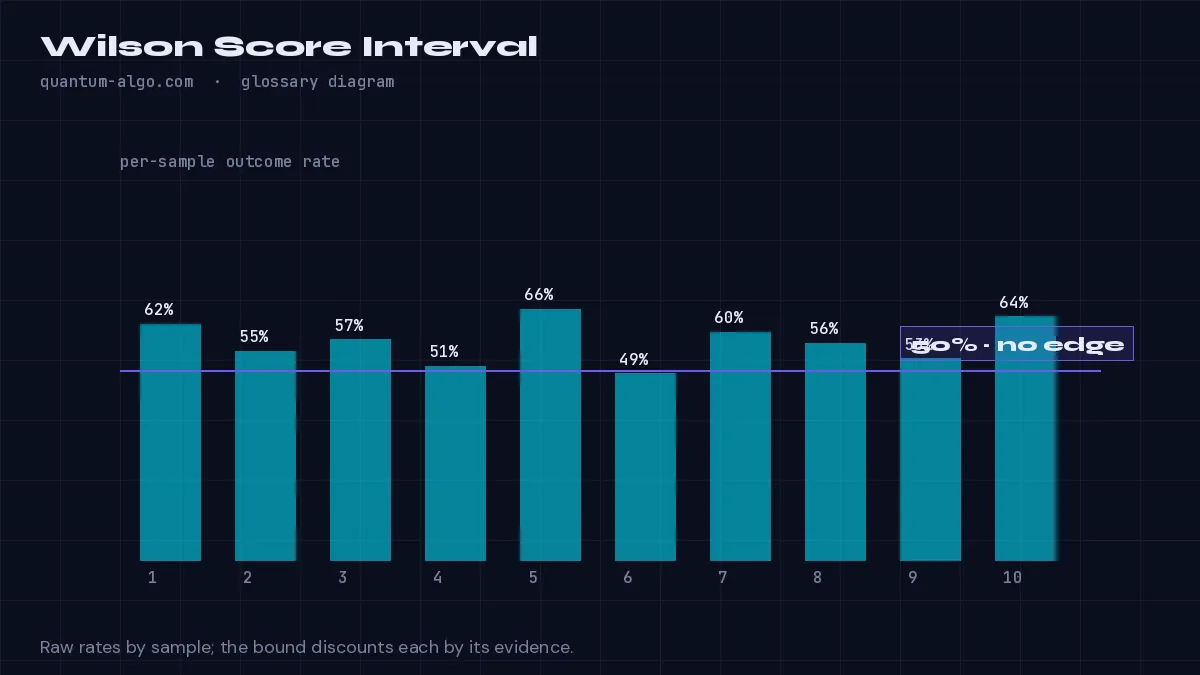
What it means
Ten wins out of fifteen is 67% — but fifteen trades can produce 67% by luck. The Wilson score interval, published by Edwin B. Wilson in 1927, gives the range of true win rates consistent with the observed sample at a chosen confidence. Its lower bound is the useful number: for 10 of 15 at 90% one-sided confidence it is roughly 48%, meaning the evidence cannot yet rule out a coin flip.
Unlike the naive interval (rate ± z × standard error), Wilson does not collapse or overshoot at small samples or extreme rates, which is why it is the standard for ranking by proportion — and why Quantum Algo scripts report it beside every win rate.
The interval also tells you how many samples you need: the lower bound rises toward the observed rate as the sample grows, and a strategy whose lower bound crosses 50% has demonstrated an edge rather than a streak. Combined with shrinkage toward 50% the reporting becomes conservative twice over.
How to identify it on a chart
- Count wins and total samples.
- Compute the Wilson lower bound at your z (1.28 for 90% one-sided, 1.645 for 95%).
- Compare the bound, not the raw rate, with 50% (or your break-even rate).
Worked example
SuperTrend flips on this chart: 34 wins of 52. Raw rate 65%; Wilson lower bound at z = 1.28 ≈ 57%. The edge survives the bound. On a different symbol, 9 of 14 (64%) gives a lower bound near 47% — not yet an edge.
See it on the chart, read it in depth
Frequently asked questions
Why not use the plain win rate?
Because small samples produce extreme rates by chance; the lower bound discounts the rate by how little evidence there is.
What z-score should I use?
1.28 for a 90% one-sided bound (used in most Quantum Algo scripts), 1.645 for 95%; higher z is more conservative.
What is the break-even win rate?
It depends on reward-to-risk: at 2:1 it is 33%, at 1:1 it is 50%. Compare the Wilson bound with your break-even, not with 50% blindly.
Where is it used on the site?
The SuperTrend Engine, Golden Cross Engine, Keltner Rings, MACD Matrix, Market Bottom Finder and Event Probability Engine all report Wilson bounds.
Related terms
See Wilson Score Interval on your TradingView chart
Zeno reads Smart Money structure across timeframes and prints the entry, stop and targets — with a public record of every posted trade. The free indicators draw the concepts this page defines.