What Is CFD Trading? How Contracts for Difference Work, What They Cost and Why Most Retail Accounts Lose
CFD trading is speculating on the price of an asset, such as an index, currency pair, commodity or share, through a contract for difference with a broker. You never own the asset: when you close the trade, you and the broker settle the difference between the opening and closing price, multiplied by your position size. CFDs are traded on margin, so a small deposit controls a larger position and gains and losses are magnified. In the EU, UK and Australia retail leverage is capped between 30:1 and 2:1, and CFDs are not offered to retail traders in the United States.
CFDs are the main way retail traders outside the US access gold, indices, forex and shares from one account. They are simple to open and flexible, which is exactly why they need understanding before you use them: the leverage that makes a $1,950 deposit control $39,000 of gold is the same leverage that turns a 5% move into a total loss. Below is how a CFD works step by step, what it really costs to hold one, the leverage rules, a worked example on a real gold chart, how CFDs compare with futures and shares, and a calculator.
What is a CFD?
A contract for difference (CFD) is an agreement between you and a broker to exchange the change in an asset's price between the moment you open the contract and the moment you close it. Buy (go long) and you gain if the price rises; sell (go short) and you gain if it falls. The broker is your counterparty, or passes your order to one.
Because you do not buy the underlying share, ounce of gold or currency, there is no ownership, no voting rights and, in some countries, no stamp duty. You are trading the price, nothing else. That makes CFDs closer to a cash-settled derivative than to an investment.
How does CFD trading work?
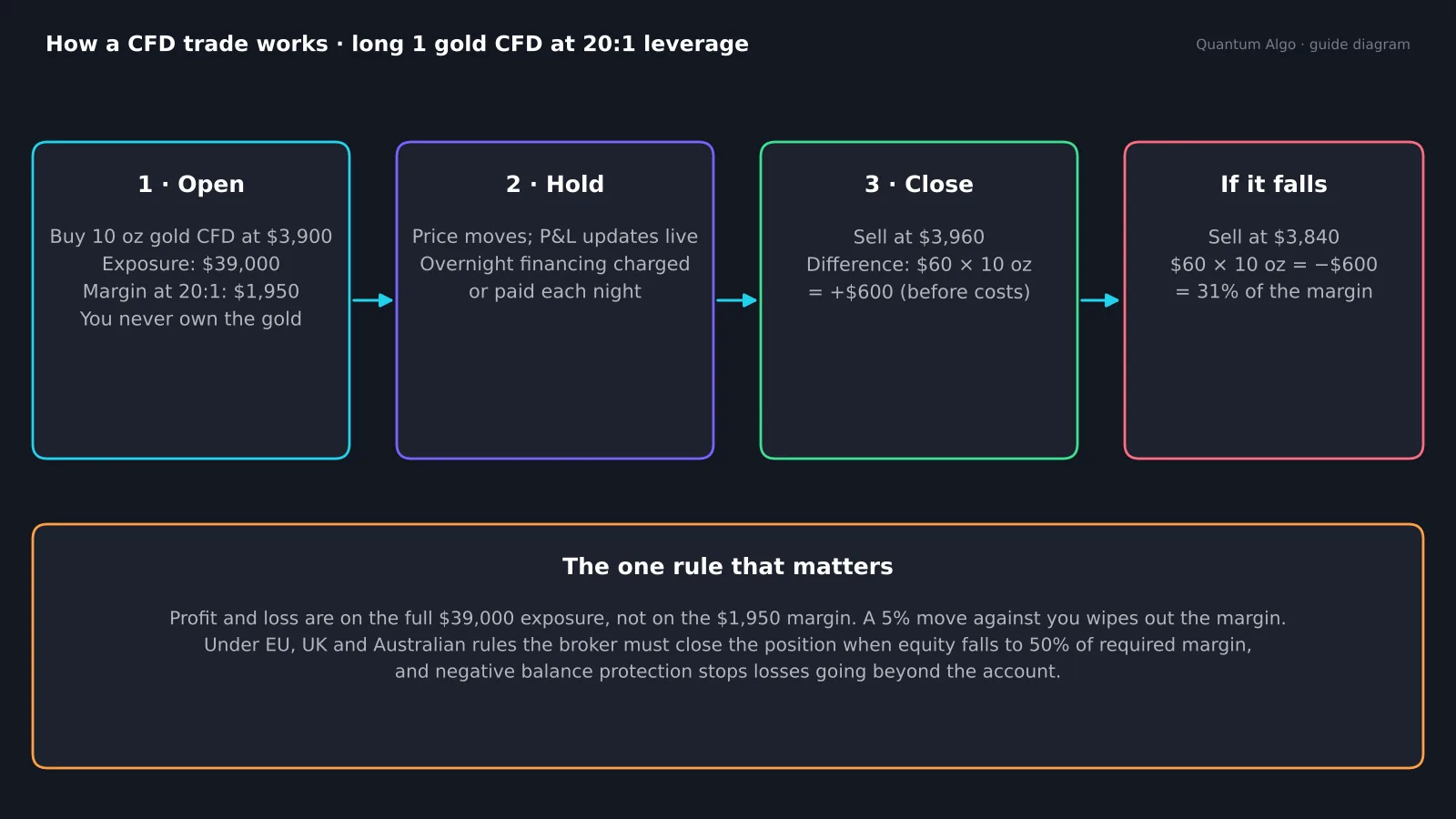
- Choose the market and direction. For example, buy 10 ounces of gold at $3,900.
- Post margin. The position is worth $39,000. At 20:1 leverage the broker asks for 5%, or $1,950.
- Hold. Profit and loss update with every tick. If you keep the position overnight, a financing charge (or credit) is applied.
- Close. Sell at $3,960 and you receive $60 × 10 = $600, before costs. Sell at $3,840 and you pay $600, which is 31% of your margin.
The key point: profit and loss are calculated on the full $39,000, not on the $1,950 deposit. Our margin trading guide covers margin in more depth.
How much leverage can you use on CFDs?
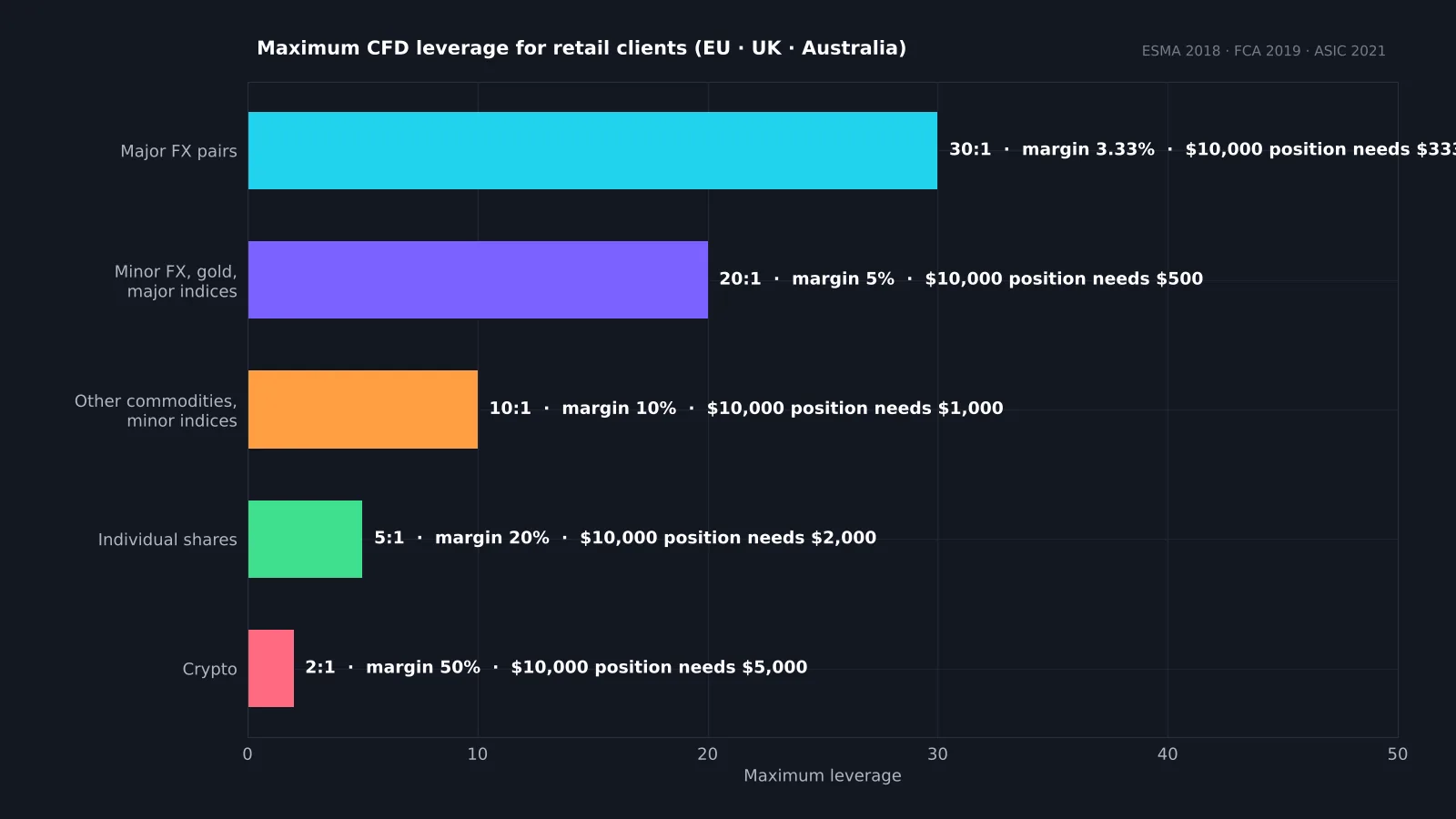
In 2018 the European Securities and Markets Authority capped retail CFD leverage by asset class, and the UK's FCA (2019) and Australia's ASIC (2021) adopted the same limits. Professional clients can be offered more, but must meet strict experience and wealth tests.
| Asset class | Max leverage | Margin needed |
|---|---|---|
| Major currency pairs | 30:1 | 3.33% |
| Minor pairs, gold, major indices | 20:1 | 5% |
| Other commodities, minor indices | 10:1 | 10% |
| Individual shares and other assets | 5:1 | 20% |
| Cryptocurrencies | 2:1 | 50% |
The same rules force the broker to close your positions when your account equity falls to 50% of the margin required, guarantee that you cannot lose more than the money in your account, and require a warning showing the percentage of the broker's retail accounts that lose money.
What does it cost to trade CFDs?
- Spread. The gap between buy and sell prices. You start every trade slightly negative.
- Commission. Usually charged on share CFDs instead of a wider spread.
- Overnight financing. Positions held past the daily cut-off pay (or receive) interest, typically a benchmark rate plus or minus the broker's markup, on the full position value. Over weeks this can outweigh the spread.
- Guaranteed stop premium, if you choose a stop that cannot slip.
- Currency conversion when the market is priced in a different currency from your account.
Financing is why CFDs suit short- and medium-term trading. For a multi-month position, futures or the asset itself are usually cheaper. Compare broker charting and costs in our best CFD trading platforms guide.
What does a CFD trade look like on a real chart?
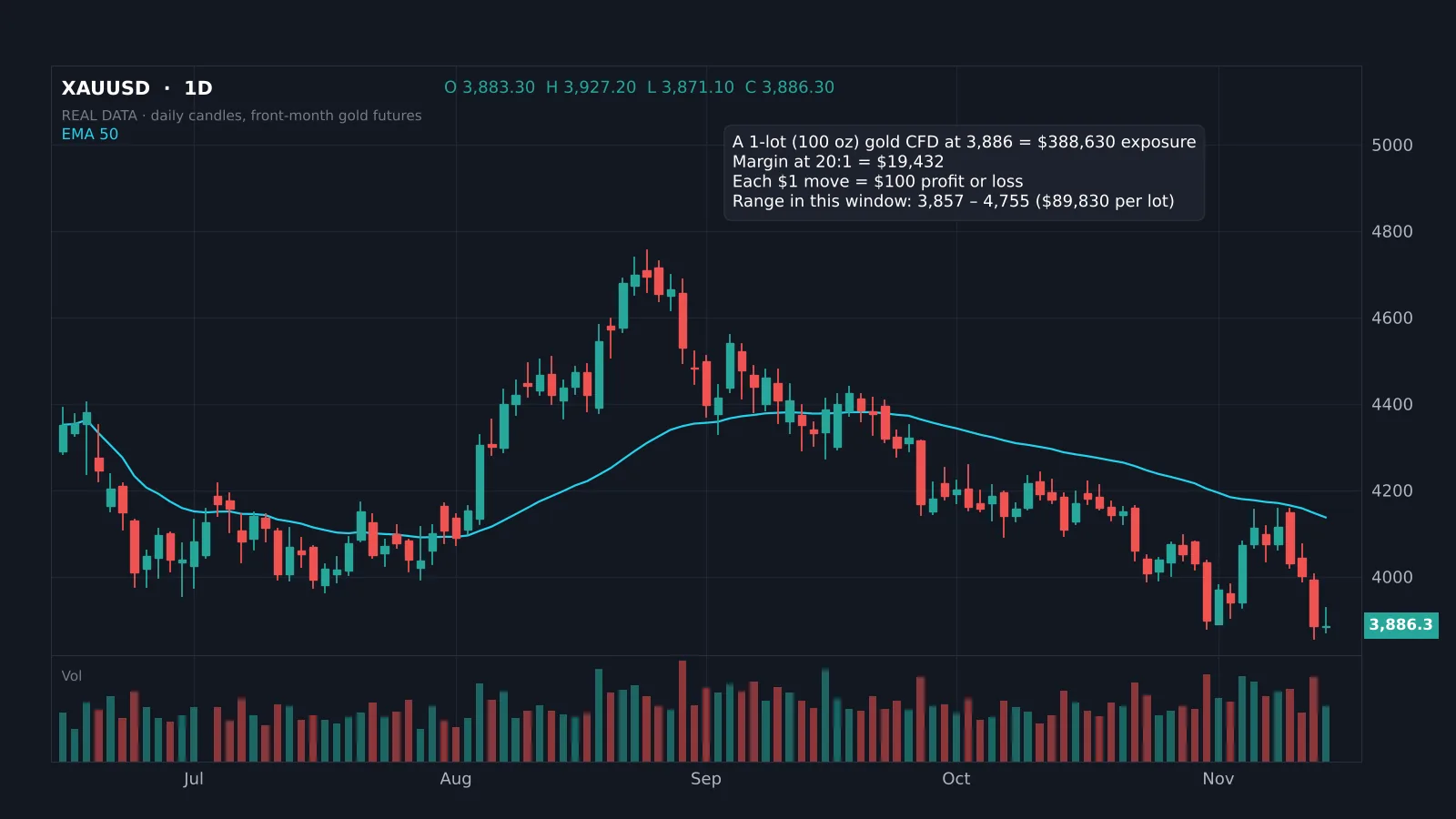
Gold is one of the most traded CFDs. On 13 November 2026 it closed at about $3,886 an ounce. A standard 1-lot gold CFD is 100 ounces, so one lot was worth about $388,600, and the margin at 20:1 was about $19,400. Every $1 move in gold meant $100 of profit or loss per lot.
Since mid-June 2026 gold has traded between about $3,857 and $4,755, a range of nearly $900, or $89,800 per lot. That is why most retail traders use 0.01 to 0.1 lots, and why the position size should come from the stop distance, not from the margin available. Our lot size calculator does that maths.
CFDs vs futures vs shares: what is the difference?
All three let you profit from price moves, but they differ in ownership, venue, costs and protection.
| CFD | Futures | Shares | |
|---|---|---|---|
| Own the asset? | No | No (cash or delivery at expiry) | Yes |
| Where it trades | With a broker (OTC) | On an exchange | On an exchange |
| Expiry | None (rolling) | Fixed dates | None |
| Leverage | Up to 30:1 retail (EU/UK/AU) | Set by exchange margin | None, or 2:1 on margin |
| Holding cost | Overnight financing | Built into price; roll costs | None |
| Short selling | Easy | Easy | Needs borrow |
| US retail access | No | Yes | Yes |
If you trade in the US, futures are the regulated alternative for indices, commodities and crypto. Our futures guide explains contract sizes and margin.
Why do most CFD traders lose money?
Every EU, UK and Australian CFD broker must publish the share of its retail accounts that lose money, and the figures are usually well above half. When ESMA introduced its restrictions in 2018, it cited national regulators' studies showing that roughly 74% to 89% of retail accounts typically lost money.
The reasons are consistent: positions too large for the account, stops too tight for normal volatility or no stops at all, holding losers while financing accrues, and overtrading after losses. None of these are unique to CFDs, but leverage makes each of them faster. Our guide on why most traders lose money covers the behaviour behind it.
Is CFD trading legal in the US?
CFDs are not offered to retail traders in the United States. Under the Dodd-Frank Act, products like CFDs fall under swap rules, which restrict over-the-counter swaps to eligible contract participants, broadly institutions and very wealthy individuals. US brokers therefore offer futures, options and margin accounts instead.
US residents who open accounts with offshore CFD brokers lose the protections of US regulation and usually break the broker's own terms. Canada allows CFDs through regulated dealers in most provinces.
Which markets can you trade with CFDs?
Almost anything with a reliable price. The most traded CFDs are stock indices (such as the S&P 500, Nasdaq 100, DAX and FTSE 100), major currency pairs, gold and oil. Brokers also offer CFDs on thousands of individual shares, on bonds, on other commodities, and, outside the UK, on cryptocurrencies at a maximum of 2:1 for retail clients.
Index and commodity CFDs are usually based on the futures price or a cash price built from it, so check the contract details: some track the front-month future and expire, others are rolling "cash" contracts with daily financing. Our guides to the S&P 500 and gold trading cover two of the most popular CFD markets.
Reference data
| Item | Value |
|---|---|
| Retail leverage caps (EU/UK/AU) | 30:1 · 20:1 · 10:1 · 5:1 · 2:1 |
| Margin close-out | When equity falls to 50% of required margin |
| Negative balance protection | Required for retail clients |
| Introduced | ESMA 2018 · FCA 2019 · ASIC 2021 |
| Retail accounts losing money (ESMA, 2018) | Typically about 74%–89% |
| Standard gold CFD lot | 100 ounces |
| US retail access | Not offered |
CFD trade calculator
Enter the price, position size, leverage and exit price. The calculator shows exposure, margin, profit or loss, financing cost and the price at which a 50% margin close-out would be triggered for the balance you hold.
How do you start trading CFDs?
- Check the broker's regulator (FCA, CySEC, ASIC, BaFin and so on) on the regulator's own register.
- Read the loss percentage in the risk warning and the financing rates in the cost sheet.
- Practise on a demo until you know how margin and financing move on your account; see our paper trading guide.
- Use a stop on every trade and risk no more than 1% of the account per position.
- Keep leverage low. The maximum is a ceiling, not a target.
Is CFD trading a good idea?
CFDs are a flexible tool: one account, many markets, easy shorting and small position sizes. They are also expensive to hold for long periods and dangerous when leverage is used fully, which is why most retail accounts lose. Used with small sizes, stops and a tested plan, they are a reasonable way to trade short-term moves; used as a shortcut to fast profits, they are one of the quickest ways to empty an account.
A CFD is a contract with a broker to settle the price difference of an asset between opening and closing; you never own it. Retail leverage in the EU, UK and Australia is capped from 30:1 (major FX) to 2:1 (crypto), with a 50% margin close-out and negative balance protection. Costs include spread, commission and overnight financing on the full position. Profit and loss are on the full exposure, so a 5% move at 20:1 can wipe out the margin. CFDs are not offered to US retail traders.
◆ Interactive check
Do you understand CFD trading?
Questions traders ask about CFD trading
Agreeing with a broker to exchange the change in an asset's price between when you open and close a trade, without owning the asset.
It is a regulated financial product, but with high leverage and no plan it behaves like gambling, which is why most retail accounts lose.
Not as a retail client in the EU, UK or Australia, where negative balance protection is required. Elsewhere it depends on the broker and regulator.
They fall under swap rules that restrict such over-the-counter contracts to eligible contract participants, so they are not offered to retail traders.
It depends on the country. In the UK, CFD profits are generally subject to capital gains tax, while spread betting is usually tax-free; check local rules.
Both are leveraged bets on price; spread betting is priced per point and is mainly a UK and Ireland product with different tax treatment.
Only with small sizes, low leverage and stops, after practising on a demo; the leverage punishes mistakes quickly.
Indefinitely in most cases, but overnight financing is charged on the full position every night, which makes long holds expensive.
References & Related Guides
Read next
- Best CFD Trading Platforms
- What Is Margin Trading?
- Leverage Trading
- Lot Size Calculator
- Notional Value
- Futures Trading for Beginners
- Gold Trading (XAUUSD)
- Why Most Traders Lose Money
- What Is a Stop Loss?
- Best Forex Brokers