What Is Notional Value in Trading? (Notional vs Margin vs Risk + Calculator)
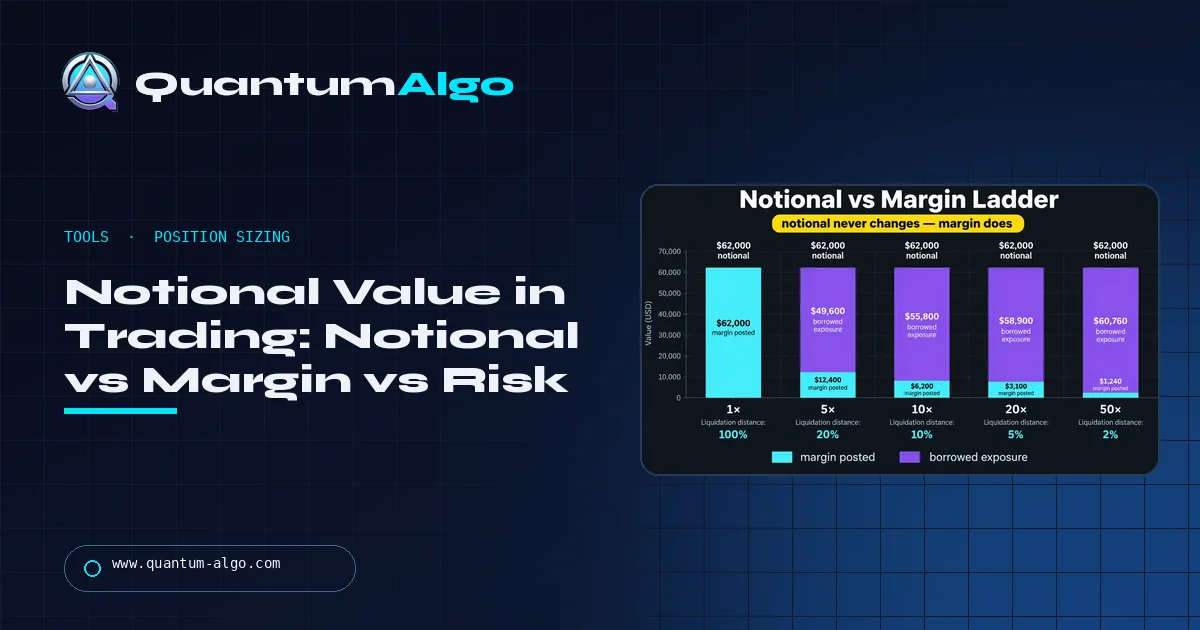
Notional value is the full market value of the position you control — quantity × price × contract multiplier — regardless of how much margin you posted. Leverage changes the margin, never the notional; fees, funding and liquidation are all calculated on the notional. Use the calculator below to see all three numbers for any trade.
Every "why was my fee so big" and "why did I get liquidated so fast" message I get has the same root: the trader sized the position to the margin field and never looked at the notional. This page is the fix — what notional is, how it differs from margin and from risk, where exchanges quietly charge it, and a calculator that shows all three numbers before you click. Quantum Algo’s Zeno dashboard prints margin and leverage on the chart for the same reason.
Indicators that prove themselves in public.
One engine, four precision tools — the Gold (XAU) Scalper, the institutional Gravity Zone, the Zeno momentum Oscillator, and Zeno Stocks for equities.
What does notional value actually measure?
Notional value is the full size of the position you control, priced at the market — not the money you put down to open it. Buy 0.32 BTC at $62,000 and your notional is $19,840, whether the exchange asked you for $19,840 in cash or $1,984 at 10× leverage. The word "notional" is there because most of that value is never in your account; it is the exposure you have agreed to carry.
I keep coming back to this number because almost every fee, funding charge and liquidation calculation on an exchange is computed on it, while almost every retail trader is looking at the margin field instead. If you have ever been surprised by how large a "small" trade's fee was, or how quickly a position was liquidated, the surprise was a notional-value surprise.
The formula is the same everywhere, only the contract size changes:
notional = quantity × price × contract multiplier
For spot crypto the multiplier is 1. For a forex lot it is 100,000 units of the base currency. For a CME micro E-mini it is $5 per index point. For a CFD it is whatever the broker's contract specification says, which is why the CFD row on every calculator on this page asks you to enter the size yourself.
How is notional different from margin and risk?
These three get used interchangeably in trading chats and they are not interchangeable at all.
Notional is exposure. It is what moves with price. If BTC drops 3%, your $19,840 position loses roughly $595 no matter how much margin you posted.
Margin is collateral. It is the deposit the venue holds so it can close you out before the loss exceeds what you have. Margin is notional divided by leverage, which is why it shrinks as leverage goes up while the exposure stays put.
Risk is the cash you will lose if your stop is hit. It is the distance from entry to stop, times the quantity, times the multiplier. It has nothing to do with margin at all, and a position can be tiny in margin terms and enormous in risk terms if the stop is far away.
The confusion usually comes from the exchange UI. The order ticket shows "Cost" or "Margin" in large type and the notional in small type, so people size their trades to the margin they are comfortable losing. Then the position moves against them by the amount they expected to be their whole loss and it is only a fraction of the way to the stop.
Why doesn't leverage change notional value?
Leverage changes the split between what you post and what you borrow. The Notional vs Margin ladder in this guide shows the same $62,000 BTC position at 1×, 5×, 10×, 20× and 50×: the notional stays at $62,000 on every rung, while the margin posted falls from $62,000 to $1,240 and the distance to liquidation falls from 100% to about 2%.
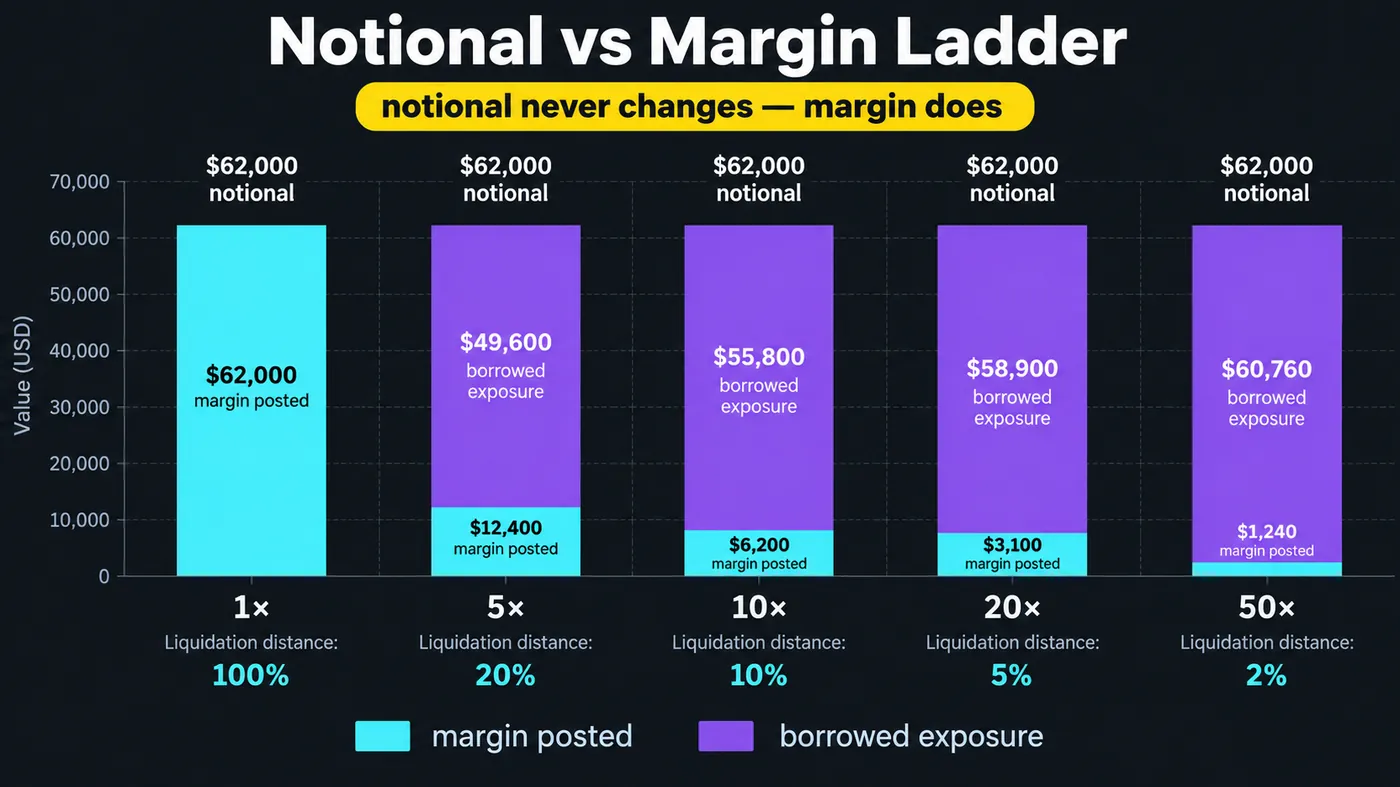
That last column is the one that matters. Liquidation distance is approximately 1 ÷ leverage, minus the maintenance margin rate. At 50× a 2% move against you wipes the collateral; at 10× it takes roughly a 10% move. Nothing about the price behaviour of BTC changed between those rungs — only how much of the move you can survive.
So when someone says "I'm trading with 20× leverage", the useful follow-up question is "what notional is that?" A $500 margin at 20× is a $10,000 notional. A 1% move is $100. That is a normal trade. A $5,000 margin at 20× is $100,000 notional, and a 1% move is $1,000 — which is a very different afternoon.
How does the same notional look in three products?
Here is where most guides stop and where the calculator on this page earns its keep. The same $108,000 of EUR/USD exposure can be built three ways:
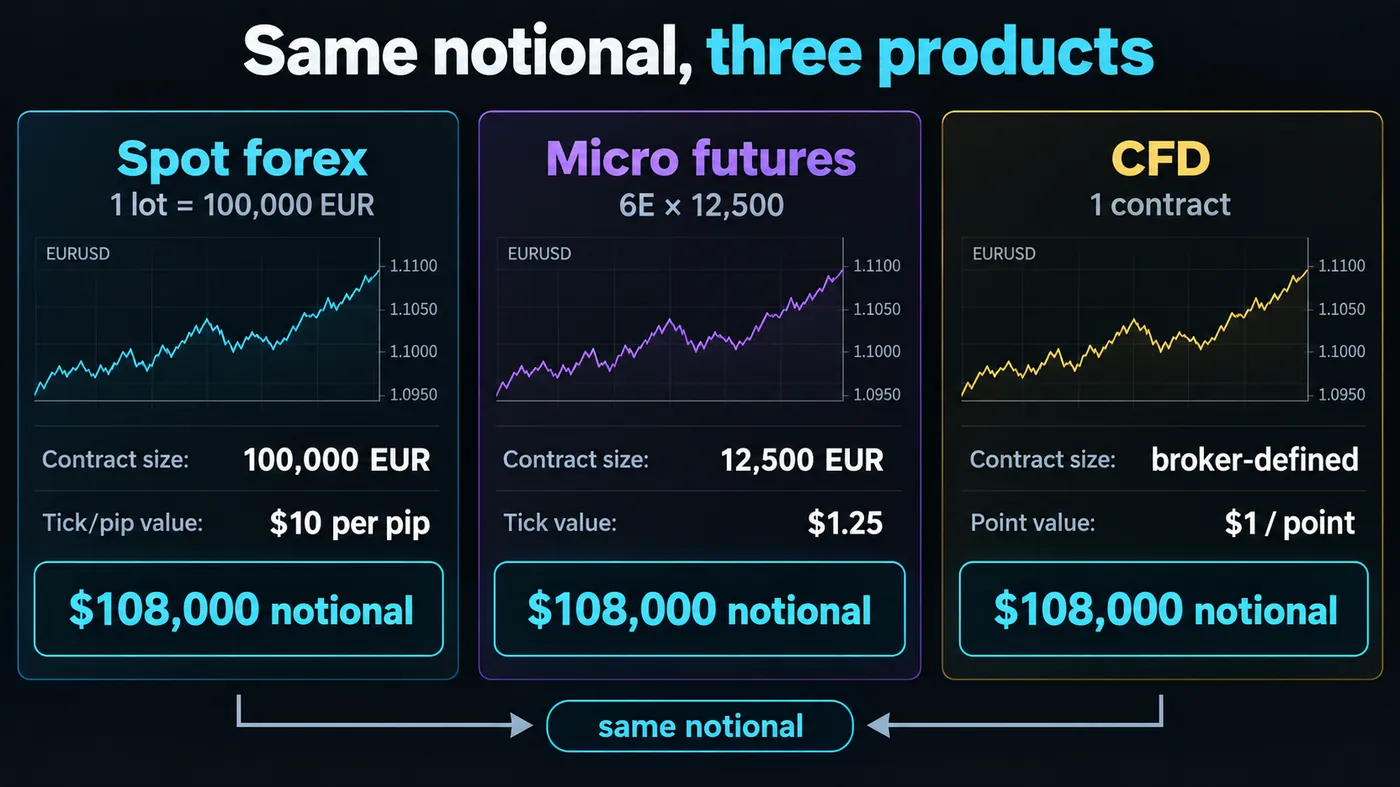
| Product | Contract | Size for $108k notional | Tick / pip value |
|---|---|---|---|
| Spot forex (retail broker) | 1 standard lot = 100,000 EUR | 1.00 lot at 1.0800 | $10 per pip |
| CME micro futures (M6E) | 12,500 EUR per contract | 8 contracts | $1.25 per tick |
| CFD | broker-defined, often 1 = 100,000 units | 1 contract | $1 per point |
The exposure is identical. The margin is not: a regulated EU forex broker will hold about 3.3% (1:30), the CME sets its own performance bond per contract, and a CFD broker sets a percentage that can change overnight around news. The fees are not identical either — spot forex charges you in the spread, futures charge a per-contract commission plus exchange fees, CFDs charge spread plus an overnight financing rate calculated, again, on the notional.
If you compare products by margin you will pick the one that lets you post the least. If you compare by notional you will pick the one whose fees and financing are lowest for the exposure you actually want. The second comparison is the one that shows up in your P&L.
Where does notional show up on an exchange order ticket?
Look at any perpetual futures order ticket and count the lines that are computed from notional:
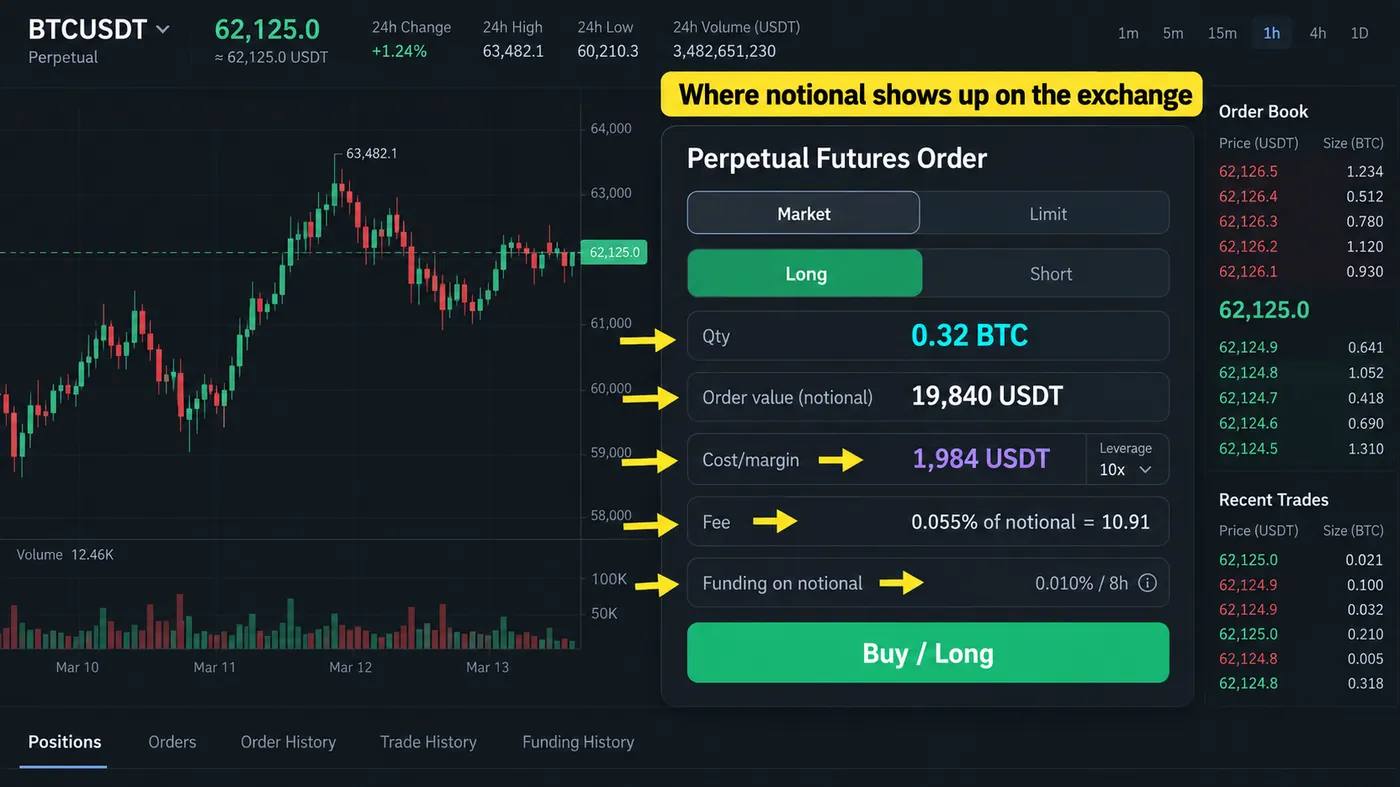
- Order value — that is the notional itself, 19,840 USDT in the example above.
- Fee — 0.055% of notional, not of margin. On $19,840 that is $10.91 per side; on the $1,984 margin it would have been $1.09, which is what people expect and never get.
- Funding — paid or received every eight hours on the notional. At 0.01% per interval a $19,840 position pays about $1.98 three times a day, roughly $180 a month if you hold through every mark.
- Liquidation price — derived from notional, leverage and the maintenance margin tier, which itself steps up as notional grows.
The last point is the one nobody reads until it bites. Exchanges use tiered maintenance margin: the bigger your notional, the higher the percentage they require, so a large position gets liquidated closer to entry than a small one at the same leverage. Two traders at 10× can have different liquidation distances purely because one of them is carrying more notional.
How does notional work with forex lots and units?
Forex traders rarely say "notional"; they say "lot size", but it is the same idea. One standard lot of EUR/USD is 100,000 EUR of exposure — at 1.0800 that is $108,000 of notional. A mini lot is a tenth of it, a micro lot a hundredth.
The wrinkle is the account currency. Your notional is denominated in the base currency, your P&L in the quote currency, and your account in whatever you funded it with. A GBP account trading USD/JPY has three currencies in play, and the notional you see in the platform is usually converted at the current rate, so it drifts during the trade. It never drifts by much, but if you are sizing to a maximum notional per position — which is a sensible rule — it is worth knowing why the number changes.
Our pip value calculator handles the conversion step; the notional calculator on this page shows you the exposure before you get there.
Why does options notional fool people twice?
Options make this harder because there are two notionals. The contract notional is 100 shares × strike (or × underlying price). The premium notional is what you paid — 100 × the option price. A $2.50 call on a $150 stock has a $250 premium notional and a $15,000 contract notional.
Traders fool themselves twice: first by thinking their risk is $15,000 (it is $250 for a long call), then, when they sell options, by thinking their risk is the $250 premium they received (it is the $15,000 contract notional, minus the premium, if the stock goes to zero). The dealers who take the other side size their books on delta-adjusted notional — contract notional times delta — which is a better single number for exposure than either of the raw figures.
How do you size a position from notional instead of margin?
This is the rule I actually use and the one I put in front of subscribers who come from a margin-first mindset:
- Decide the maximum notional you will carry in one position — a percentage of account equity. Two to three times equity is aggressive; one times equity is where most funded-account rules sit.
- Decide the cash risk per trade — usually 0.5% to 1% of equity.
- Let the stop distance set the quantity: quantity = risk ÷ (stop distance × multiplier).
- Check the notional that quantity implies. If it exceeds the cap from step 1, the trade is too big for the stop you drew — widen nothing, just skip it or reduce the size.
- Only then look at the margin, and only to confirm the exchange will let you open it.
Margin comes last because margin is the exchange's problem; notional and risk are yours.
Worked examples
Crypto perpetual. Account $12,000, risk 1% = $120, BTC at $62,000, stop at $60,750 (a $1,250 stop). Quantity = 120 ÷ 1,250 = 0.096 BTC. Notional = 0.096 × 62,000 = $5,952, or about 0.5× equity — fine. At 10× the margin is $595; at 5× it is $1,190. The risk is $120 either way.
Forex. Account $15,000, risk 1% = $150, EUR/USD stop 25 pips. Pip value per unit is 0.0001, so risk per unit is 25 × 0.0001 = $0.0025. Units = 150 ÷ 0.0025 = 60,000, or 0.60 lots. Notional = 60,000 × 1.0800 = $64,800 — about 4.3× equity. That is a lot of exposure for a 25-pip stop, which is exactly why intraday forex traders need the notional cap in step 1.
Micro futures. Account $8,000, risk 1% = $80, MES at 5,300 with a 6-point stop. Risk per contract = 6 × $5 = $30, so 2 contracts ($60 risk). Notional = 2 × 5,300 × $5 = $53,000. Margin is set by the exchange — currently a few hundred dollars per contract overnight — and again has nothing to do with the $60 you are risking.
Where the number comes from in Zeno
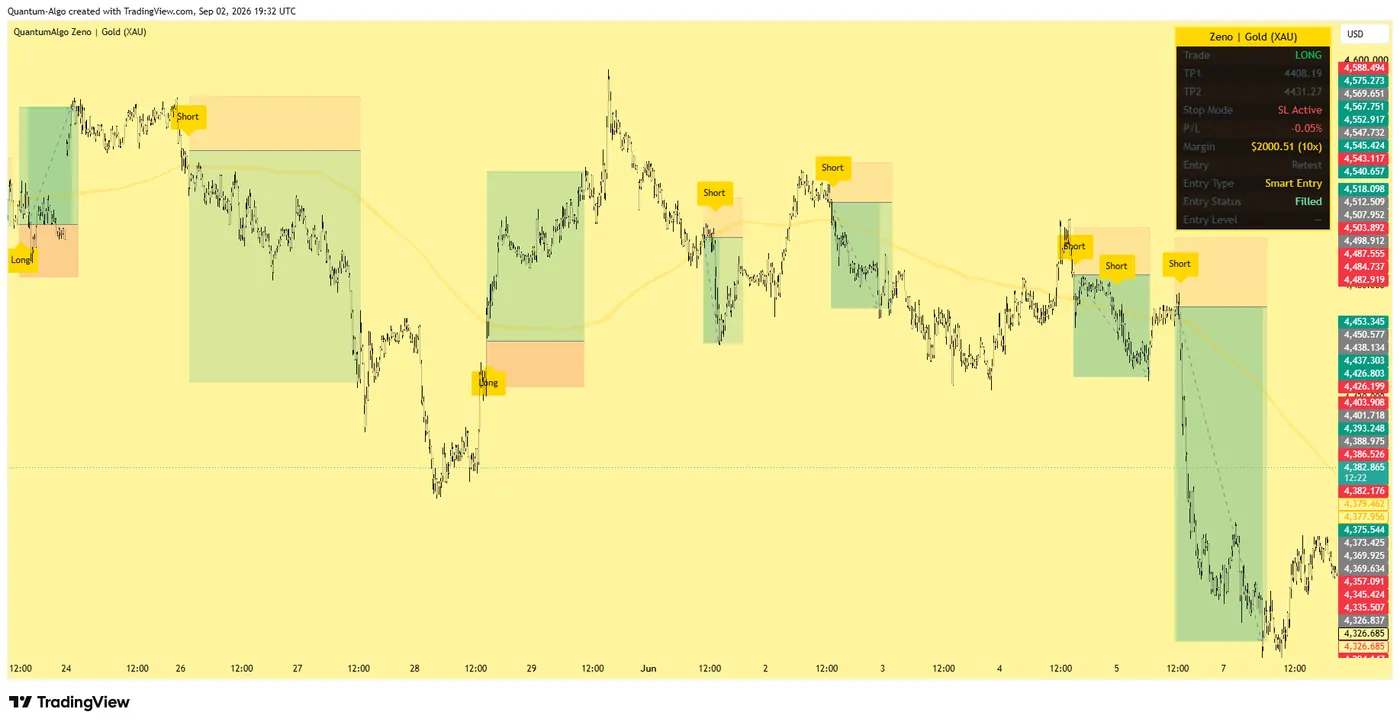
The dashboard in the hero screenshot above shows a real XAUUSD position: margin $2,000.51 at 10×, which is $20,005 of notional on gold. The stop and the two take-profit zones are drawn against that notional, not against the margin — which is why the P/L line reads in percent of margin while the risk was fixed as a cash amount before the trade was placed. Seeing the two numbers side by side on a live chart is the fastest way I know to make the distinction stick.
What are the most common notional value mistakes?
- Sizing to margin and discovering the real risk when the position is already open.
- Comparing brokers by margin requirement instead of by fees on notional.
- Ignoring tiered maintenance margin, then being liquidated earlier than "1 ÷ leverage" suggested.
- Holding perpetuals through funding marks without pricing the funding on notional.
- Treating option premium as exposure when selling, and contract notional as exposure when buying.
- Letting the platform's converted notional drift past a cap because the account currency moved.
Notional is exposure, margin is collateral, risk is what the stop costs you — three different numbers with three different jobs. Leverage re-splits notional into margin and borrowed exposure without changing it, and everything the exchange charges you is computed on the notional. Size from a notional cap and a cash risk; check margin last.
◆ Interactive check
Notional, margin or risk?
Questions traders ask about notional value
Only when position size is expressed in currency at market price. "Position size" is often used to mean quantity — 0.5 BTC, 2 lots, 3 contracts — while notional is that quantity multiplied out into money.
No. Leverage decides how much of the notional you post as margin. A $10,000 position is $10,000 of notional at 1× and at 100×; only the collateral changes.
Because fees are charged on notional, not margin. At 10× leverage a fee that looks like 0.05% of what you posted is actually 0.5% of your margin per side.
The contract notional is 100 shares times the underlying price; the premium notional is 100 times the option price. Sellers are exposed to the contract notional, buyers to the premium.
Most funded-account programs cap exposure around one times equity per position and two to three times in total. Above that, ordinary volatility becomes account-threatening.
Multiply the quantity by the mark price: 0.32 BTC × $62,000 = $19,840. The "order value" field on the ticket shows the same number; the "cost" field shows the margin, which is the notional divided by your leverage.
For a fully funded spot position they are the same. For a leveraged or derivative position, market value usually refers to what you posted or what the position is worth to close, while notional is the total exposure you control.
Exchanges use tiered maintenance margin: larger notionals require a higher maintenance percentage, so the buffer between entry and liquidation shrinks as the notional grows even when leverage is unchanged.
Yes, but usually without the word. Shares × price is the notional; margin accounts let you post 50% of it. The word becomes essential with options, futures and CFDs, where the exposure and the cash outlay separate.
References & Related Guides
Read next
- What Is Margin Trading? Initial vs Maintenance Margin, Margin Calls and a Calculator
- Pip Value Calculator for All Forex Pairs
- Lot Size Calculator for Forex and Gold
- Position Sizing: The Complete Guide
- Leverage Trading: Complete Guide
- Liquidation in Trading
- Funding Rate Trading Guide
- Trading Profit Calculator
- Spot vs Futures Trading
Authoritative sources
- CME Group: contract specifications and multipliers
- Investopedia: notional value
- Bybit: order cost and notional on USDT perpetuals
- Binance: leverage and tiered maintenance margin
- ESMA: retail CFD leverage limits and negative balance protection