SPY vs QQQ for Traders: Which ETF to Day Trade, Swing Trade, or Trade Options On, and Why
For most traders QQQ is the better instrument to trade and SPY the better one to hold. QQQ tracks the Nasdaq-100 — about a hundred large growth companies, technology-heavy — and moves roughly 1.3–1.5 times as far as SPY in a normal session, so more range per trade and more premium per option; SPY tracks the S&P 500 across every sector, with the deepest options market on earth and a one-cent spread. SPY for scalping the open and for options where liquidity beats everything; QQQ for day and swing trades that need a move to pay; SPY for the core the swing slice sits beside.
The two most traded ETFs in the world move together nearly all the time and are still different instruments, and the difference decides which one your trade should be in. This page is the composition and behaviour side by side, the intraday overlay that shows the range gap, the decision grid by trading style, why you never hold both in the same direction, the Smart Money read on both, the tickers around them, a worked opening trade on each and the checklist. The picker below returns the ETF for your style and reason.
Indicators that prove themselves in public.
One engine, four precision tools — the Gold (XAU) Scalper, the institutional Gravity Zone, the Zeno momentum Oscillator, and Zeno Stocks for equities.
SPY or QQQ: which is better for trading?
For most traders, QQQ is the better instrument to trade and SPY is the better instrument to hold. QQQ tracks the Nasdaq-100 — about a hundred large growth companies, heavily weighted to technology — so it moves roughly 1.3 to 1.5 times as far as SPY in a normal session, which is more range per trade and more premium per option; SPY tracks the S&P 500 — five hundred companies across every sector — so it is the broader, steadier market, with the deepest options market on earth and the tightest spread of any ETF. The right answer depends on the job: SPY for scalping the cash open and for options where liquidity beats everything, QQQ for day and swing trades that need a move to pay, and SPY for the index core the swing slice sits beside. This guide gives the numbers, the overlay and the decision grid.
Composition and behaviour
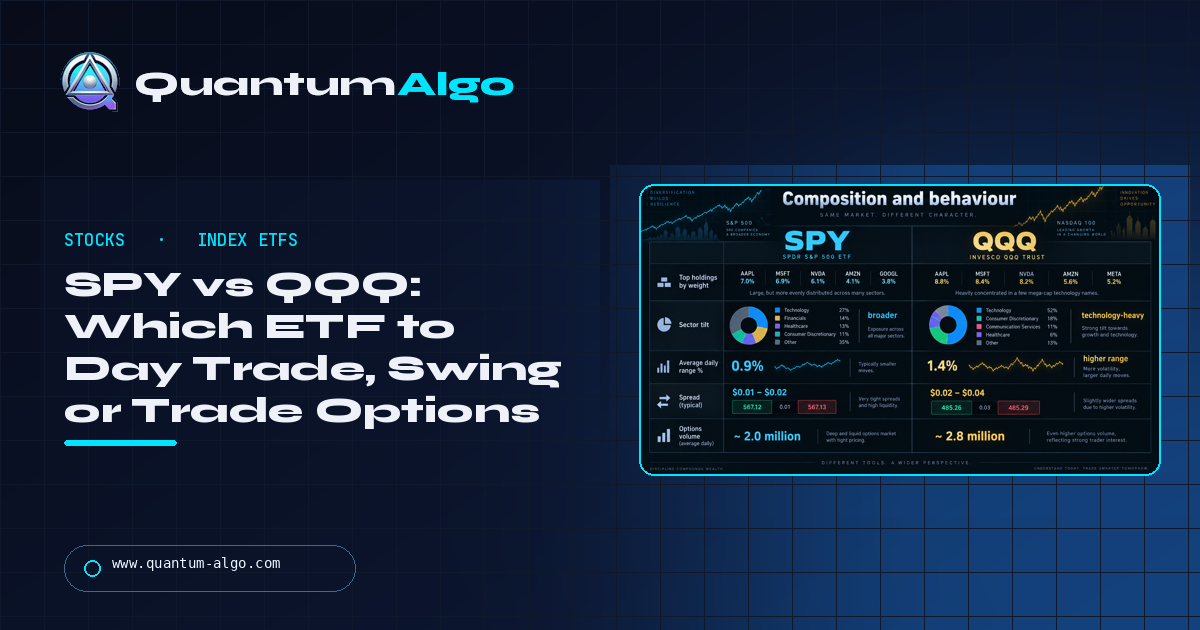
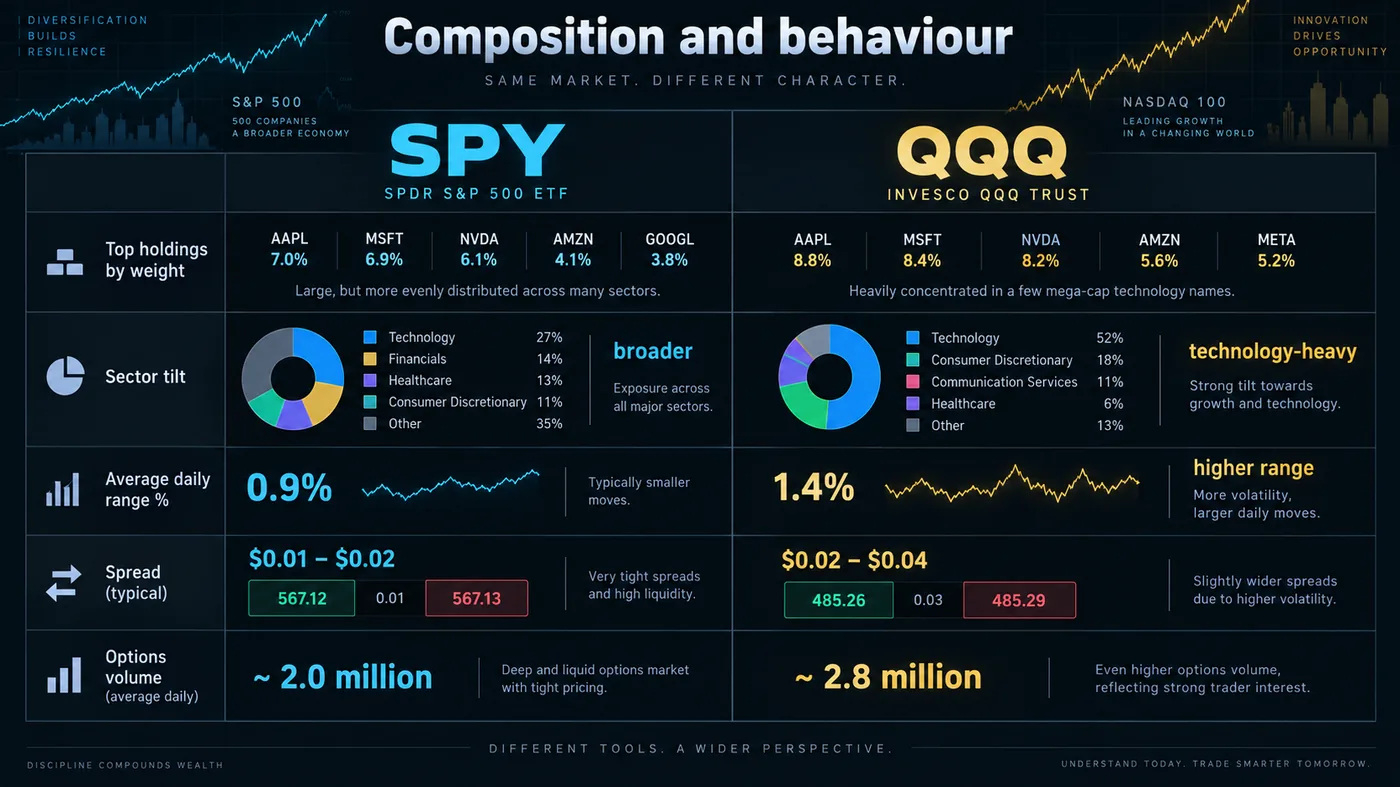
The comparison illustration in this guide puts the two side by side:
| SPY | QQQ | |
|---|---|---|
| Tracks | S&P 500 | Nasdaq-100 |
| Holdings | ~500 companies, all sectors | ~100 companies, technology-heavy |
| Top-10 weight | Roughly a third of the fund | Roughly half the fund |
| Sector tilt | Diversified; tech the largest slice | Technology and communication dominate; no financials |
| Typical daily range | Around 1% | Around 1.3–1.5% |
| Spread | One cent — the tightest of any ETF | One cent most of the session |
| Options | The most liquid options market in the world; daily expiries | Very liquid; daily expiries; higher premium per contract |
| Beta to the market | 1.0 by definition | Above 1 — moves further both ways |
| Best for | Scalping, options liquidity, the core holding | Day and swing trades that need range; directional options |
The composition explains the behaviour: QQQ is a concentrated bet on large-cap growth, so it amplifies the market's moves; SPY is the market.
The intraday overlay
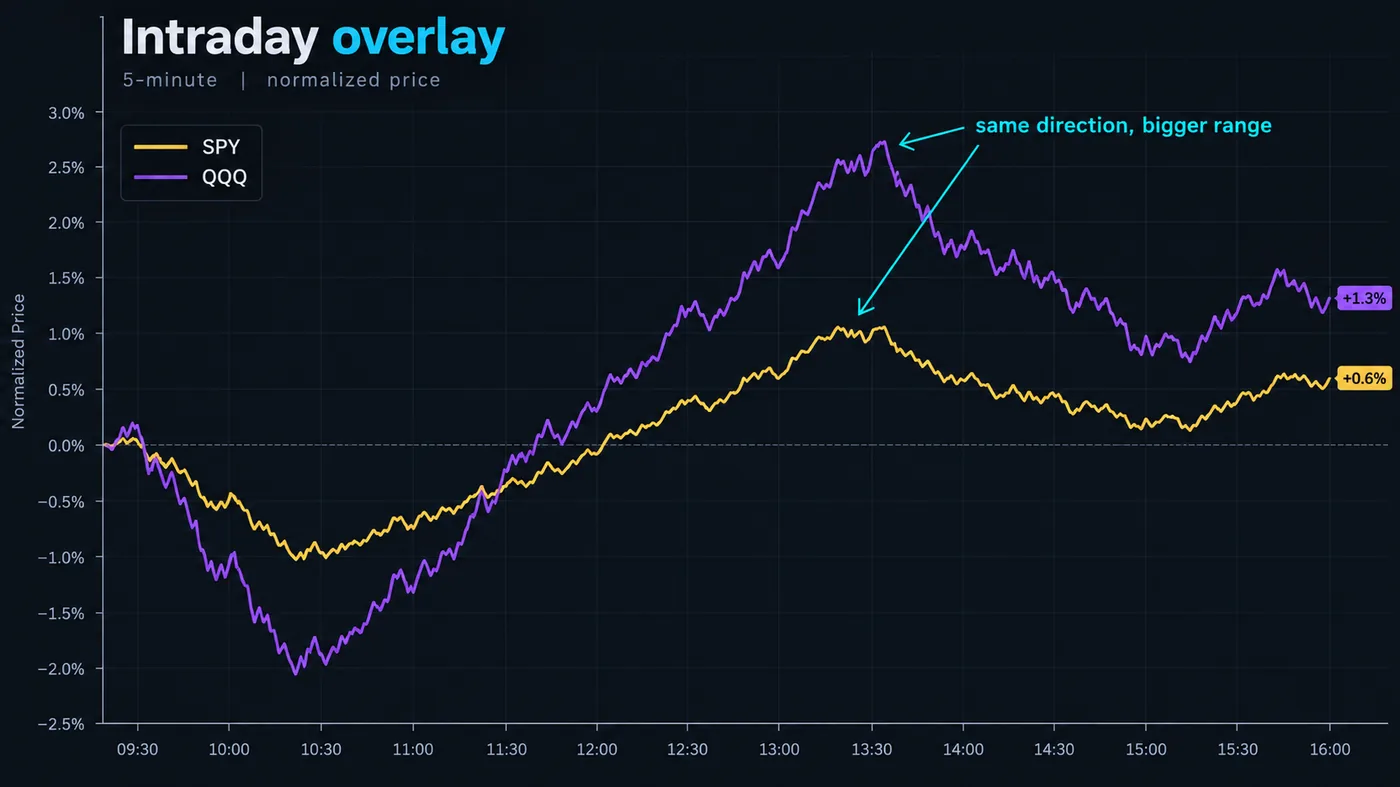
The overlay illustration in this guide normalises SPY and QQQ on the same 5-minute chart for one session. They move in the same direction almost all day — the correlation is above 0.9 — but QQQ's swings are visibly larger: the same open-sweep-and-reclaim produces a bigger range in QQQ, and the same afternoon fade falls further. The callout says it: same direction, bigger range. For a trader that is the whole trade-off — more room for the target and more room for the stop to be hit.

Automate your trades. Let Quantum Algo trade for you.
Every signal executed on your own account — on your account, with the plan you define.
Which one for what
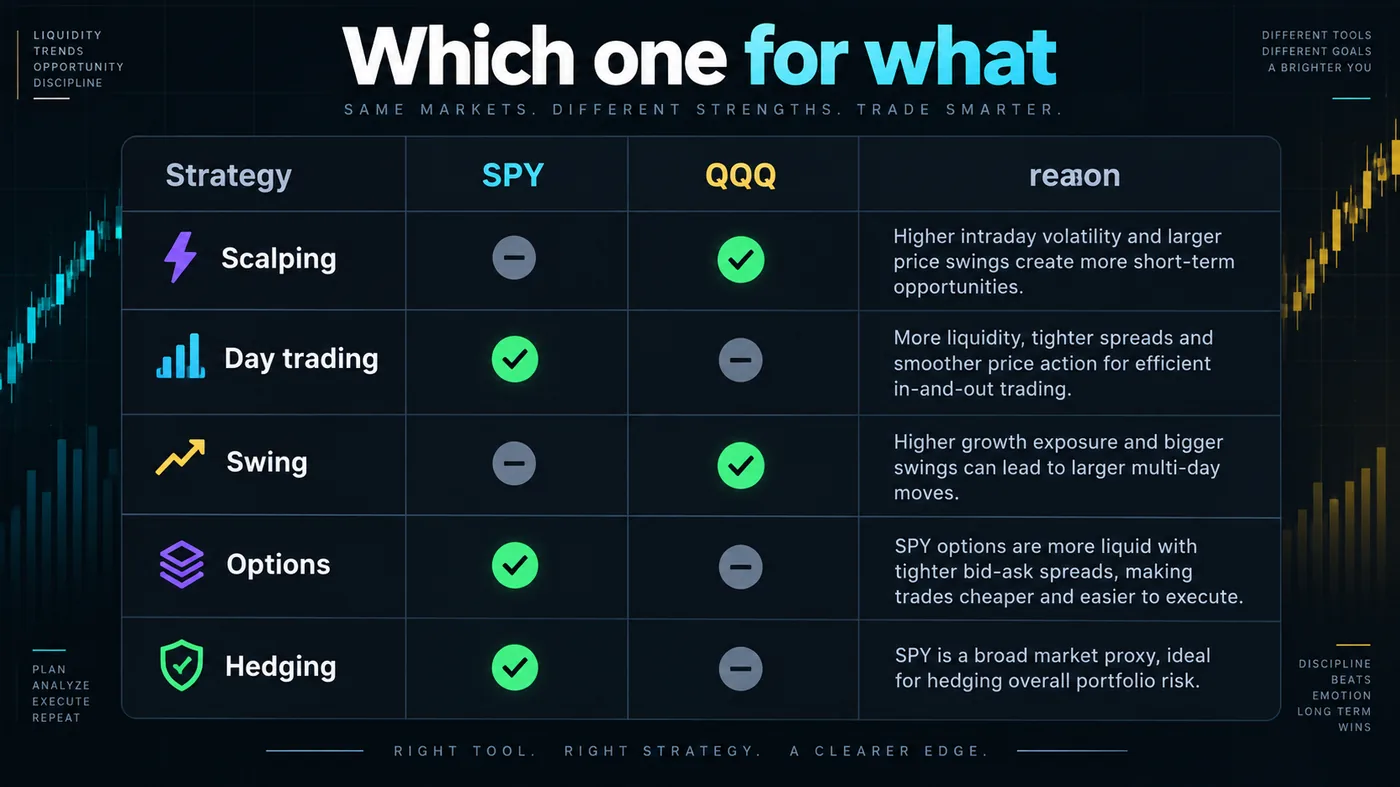
The decision grid illustration in this guide, in words:
- Scalping the open (1–5 minute): SPY — the one-cent spread and the depth matter more than range when you are taking twenty cents.
- Day trading (5–15 minute): QQQ — a normal day's range gives the target room; the structure is as clean as SPY's and the moves pay.
- Swing trading (4-hour to daily): QQQ for the trade, SPY for the core; a swing slice in QQQ beside an index holding in SPY is the arrangement our swing-versus-buy-and-hold page describes.
- Options, directional: QQQ — more premium per contract for the same delta because the underlying moves more; higher implied volatility.
- Options, income and hedging: SPY — the deepest chains, the tightest option spreads, and the SPX cash-settled alternative for size.
- Hedging a portfolio: SPY (or SPX) — it is the market.
- 0DTE: either; SPX for cash settlement and size, SPY for retail contracts; QQQ for the larger move. Our day-trading options page covers the mechanics.
Correlation, and why you do not trade both
Because the two move together, a long in SPY and a long in QQQ is one bet at larger size, not diversification — the same rule the forex pairs page gives for EUR/USD and GBP/USD. Pick one per direction. The exception is the relative trade — long QQQ and short SPY when growth is leading, or the reverse — which is a ratio, not two trades, and belongs to traders with a specific thesis.
The Smart Money read on both
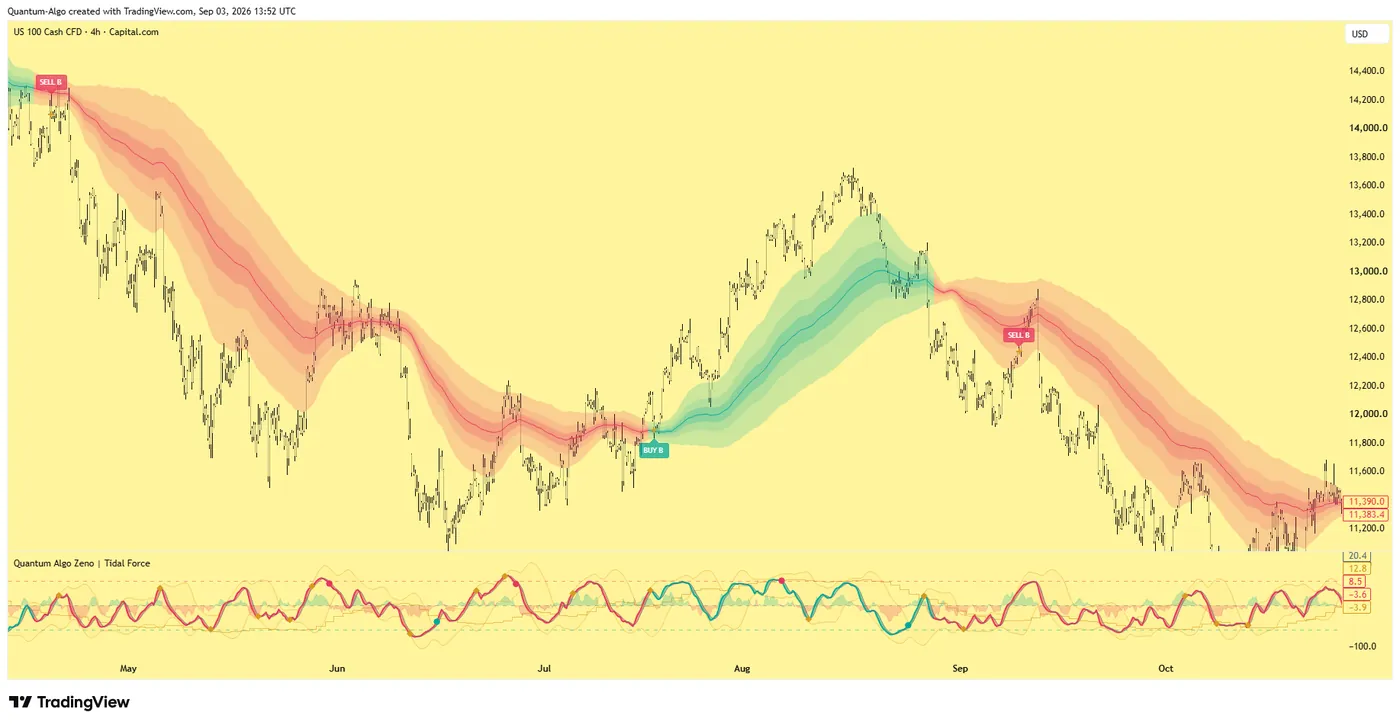
Both ETFs respect the same structure: the pre-market high and low as the first liquidity, the opening-range break as the displacement, the pullback to the order block as the entry. The difference is only scale — the stop and target distances in QQQ are larger in dollars for the same setup, so the position size is smaller at the same risk. Zeno marks the structure identically on either; the free Liquidity Sweeps and Order Blocks tools work on both; the NAS100 chart in our real-chart set is QQQ's underlying on the 4-hour.
The tickers around them
SPY has SPX (cash-settled index options), ES and MES futures, and VOO/IVV as cheaper holding vehicles. QQQ has NDX (index options), NQ and MNQ futures, and QQQM as the cheaper holding vehicle. Traders trade the ETFs or the futures; investors hold the cheaper share classes. TQQQ and SQQQ are leveraged daily-reset products — for day trading only, and never for holding, because the daily reset decays them in a range.
A worked example: the same setup on both
09:31 ET. Both ETFs open, sweep the pre-market low in the first minute and reclaim it — the standard opening sweep. On the 5-minute chart the change of character prints at 09:45 on both. Entry on the retest of the opening-range low: SPY at $524.10 with the stop at $523.30 (80 cents), QQQ at $452.60 with the stop at $451.40 ($1.20). Target the pre-market high: SPY $526.20 (2.6R), QQQ $455.40 (2.3R). At 1% risk on $25,000, the SPY position is 312 shares, the QQQ position 208 shares — the same dollar risk, the same trade, and the QQQ version pays $580 to SPY's $655 in this instance, with a larger stop in dollars that the larger range justified. Over a month the two trades track each other; QQQ's extra range shows up as larger targets on trend days and larger stops on chop days, which is the trade-off in one sentence. The Choppiness Index on both tends to agree; when it does not, trade the one in the lower regime.
SPY and QQQ through the trading day
- Pre-market (04:00–09:30): thin; the high and low are the day's first liquidity. QQQ gaps more on tech earnings.
- The open (09:30–10:00): the sweep of the pre-market range; SPY's spread stays one cent throughout, QQQ's widens to two or three for a minute.
- Mid-morning (10:00–11:30): the trend, if there is one; QQQ leads on growth-driven days.
- Lunch (11:30–13:30): ranges; the Choppiness Index above 61.8 on both.
- Afternoon (13:30–15:00): the second trend or the reversal; the Fed and macro data land here.
- Close (15:00–16:00): index rebalancing flows; SPY's volume peak; QQQ's largest bars on tech-heavy days.
The picker checklist
- Scalping under five minutes: SPY.
- A target that needs range: QQQ.
- Directional options: QQQ; income and hedging options: SPY or SPX.
- Never both long at once; one bet per direction.
- The core holding: SPY (or VOO/IVV); the swing slice: either, sized by risk.
- Leveraged versions only intraday.
Same direction, bigger range: QQQ for trades that need the move, SPY for the ones where the spread and the depth matter, SPY for the core. Scale the stop to the range and the size to the risk, never hold both the same way, and read the same structure on either — the pre-market levels, the opening sweep, the pullback to the block.
◆ Interactive check
Do you know the two ETFs?
Questions traders ask about SPY vs QQQ
Yes — a typical daily range of 1.3–1.5% against SPY's roughly 1%, because QQQ is a concentrated large-cap-growth index with a beta above 1.
SPY has the deepest and tightest options market in the world; QQQ is very liquid and carries more premium per contract because the underlying moves more. Liquidity favours SPY, directional payoff favours QQQ.
QQQ for range on 5- to 15-minute charts; SPY for scalping the first minutes where the one-cent spread dominates. Not both in the same direction.
SPY to learn on — steadier, the tightest spread, the most educational material — and it is the index a beginner should also hold. QQQ once the fifty-trade record exists.
Above 0.9 on daily returns in most periods; they diverge for weeks at a time when growth leads or lags, which is the relative trade.
Yes — Zeno Stocks and the free indicators read structure on both; the NAS100 4-hour chart on our pages is QQQ's underlying, and the setups are the same as on gold and crypto.
SPY — the most traded ETF and the deepest options market in the world, with a one-cent spread throughout the session. QQQ is close behind and more than liquid enough for any retail size.
Per share, yes: larger daily range, higher beta, and concentration in growth and technology. At equal dollar risk with the stop scaled to range, the trade risk is the same — the position is smaller.
SPY (or VOO/IVV) is the market and the conventional core; QQQ (or QQQM) is a growth tilt with larger drawdowns. Our swing-versus-buy-and-hold page covers the core-and-slice arrangement.
QQQ ÷ SPY, a chart of growth relative to the broad market; rising means growth is leading. It is the basis of the relative trade and a useful regime read for both.
Either; SPX for cash settlement and size, SPY for retail-sized contracts, QQQ when you want the larger move. The day-trading-options page covers the theta and PDT mechanics.
Yes — Zeno Stocks and the free indicators read structure on both; the NAS100 4-hour chart on our pages is QQQ's underlying, and the setups match gold and crypto.
References & Related Guides
Read next
- Best Indicator for NASDAQ
- Best Indicator for Stocks
- Day Trading Options
- How to Find Stocks for Day Trading
- Swing Trading vs Buy-and-Hold
- Opening Range Breakout
- Choppiness Index
- Futures Trading for Beginners