Day Trading vs Swing Trading: The Real Difference, the Costs, and Which One Fits You
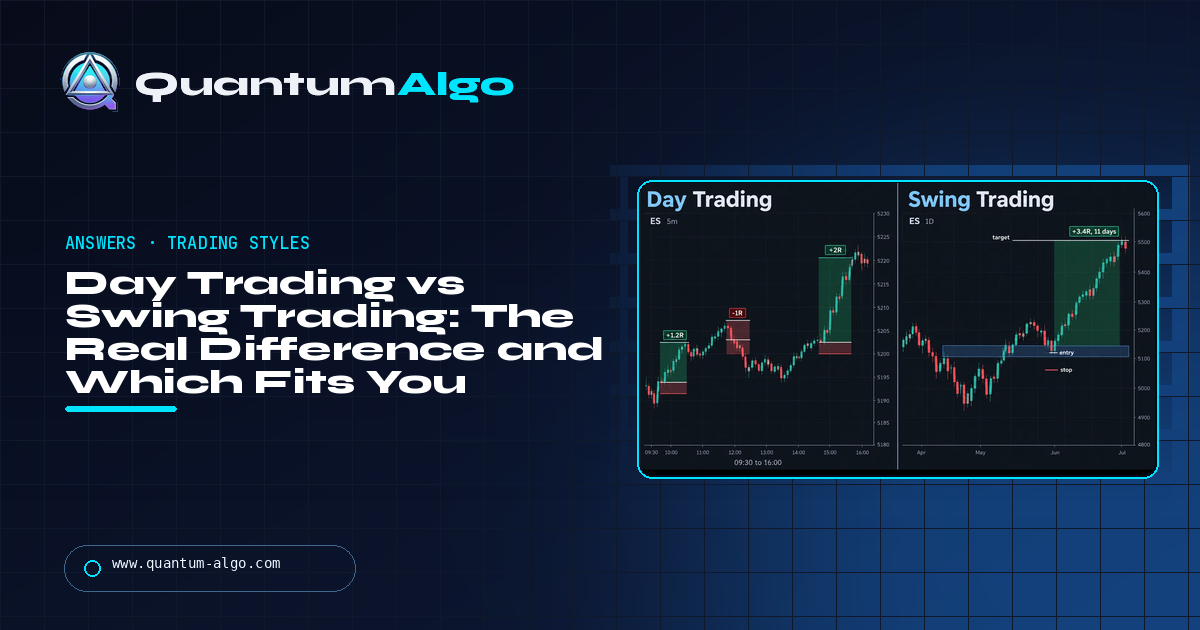
Day trading closes every position inside the session — no overnight risk, ten to thirty decisions a day on 1- to 15-minute charts, costs paid on every trade, and a $25,000 minimum to day trade US stocks under the pattern day trader rule. Swing trading holds for days to weeks, manages on the daily or 4-hour close, makes a few decisions a month, pays costs rarely, works with any account size, and accepts gap risk in exchange. The method can be identical — a liquidity sweep into an order block is the same setup on the 5-minute and the daily chart — so the choice comes down to three things that are not about the market: whether you can watch a session live, whether the PDT rule applies to you, and whether you want twenty decisions a day or two a week. Beginners usually do better swing trading the same setups they would day trade, because the cost tax and the emotional load are what beat them, not the edge.
Every trader answers this question once, usually by temperament, and most answer it wrong the first time — they choose the action and pay for it in spread and sleep. The useful comparison is not "which makes more money" but what each style charges for the same edge, and whether you can afford that particular currency. This page is the actual difference, a side-by-side of holding period, decisions, capital, costs and risk, the two numbers that decide most cases (the cost tax and the PDT rule), a three-question decision tree, the same Smart Money setup traded on both clocks, a month of one trader running both on paper, and a calculator that scores the styles against your hours, account and temperament.
Indicators that prove themselves in public.
One engine, four precision tools — the Gold (XAU) Scalper, the institutional Gravity Zone, the Zeno momentum Oscillator, and Zeno Stocks for equities.
Day trading vs swing trading: the actual difference
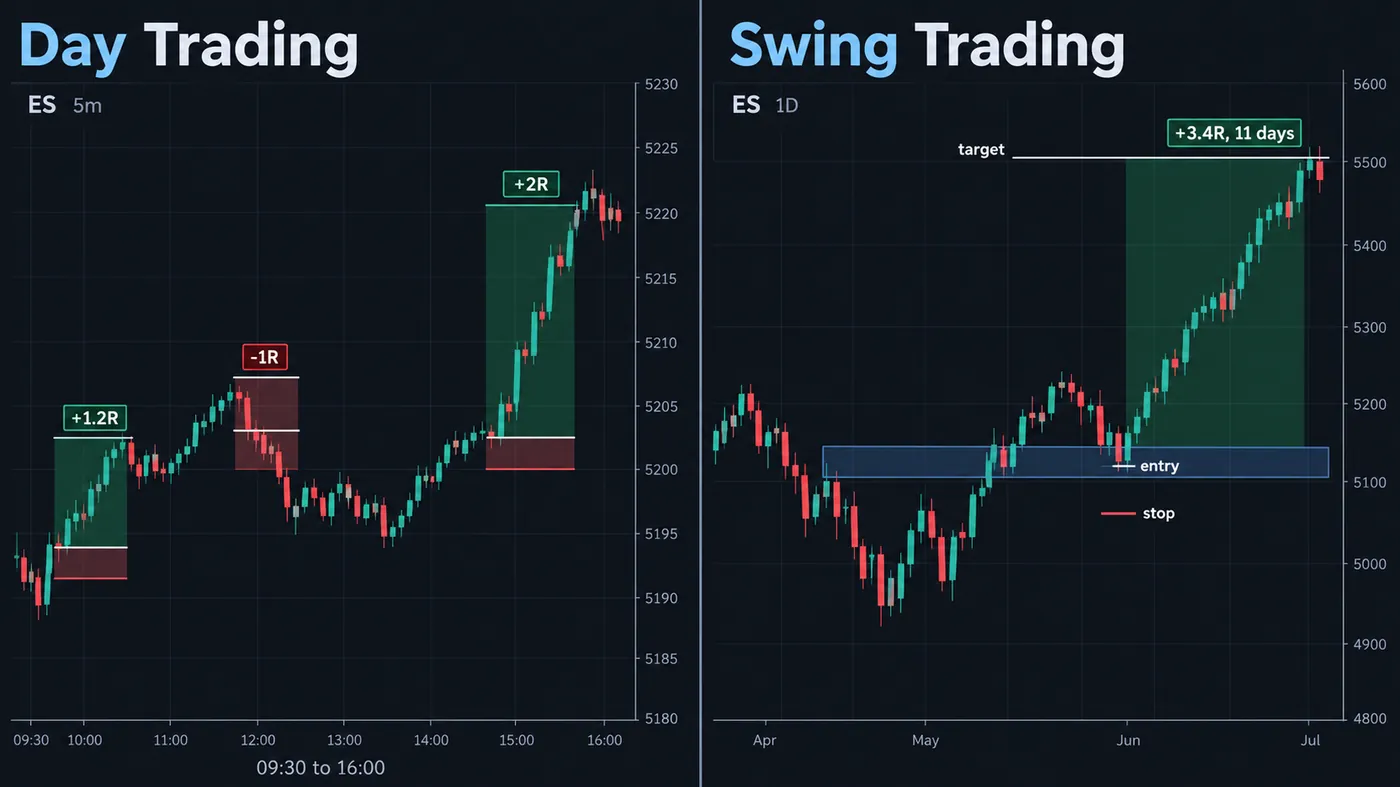
The difference is the clock, and everything else follows from it. A day trader opens and closes every position inside one session — nothing held overnight, nothing exposed to the gap — and makes many decisions a day on charts of one to fifteen minutes. A swing trader holds for days to weeks, manages on the daily or 4-hour close, makes a handful of decisions a month, and accepts the overnight and weekend gap as the price of catching moves that take time to play out. Both can use the same method; the Smart Money trader who buys the sweep of a low into an order block does it on the 5-minute chart in the New York open or on the daily chart over a fortnight, and the setup is identical.
What changes is what the edge costs you. Day trading costs screen time, spread and commission paid twenty times a day, and a temperament that can take a loss at 09:47 and trade cleanly at 09:52. Swing trading costs patience, gap risk, and the discipline to leave a winning position alone for a week. The day trading strategies guide and the swing trading strategies guide cover the methods; this page is the choice between them, made with numbers rather than temperament — although temperament turns out to be one of the numbers.
Side by side
| Day trading | Swing trading | |
|---|---|---|
| Holding period | Minutes to hours; flat by the close | Days to weeks; managed on the daily or 4-hour close |
| Charts | 1- to 15-minute for entries, 1-hour for context | Daily and 4-hour for entries, weekly for context |
| Decisions | Ten to thirty a day | Two to ten a month |
| Screen time | The session, or at least one session block | Twenty minutes at the close, more at the weekend |
| Capital (US stocks) | The $25,000 PDT minimum for more than three day trades in five days | Any size; the PDT rule does not apply to overnight holds |
| Costs | Spread and commission on every trade, twenty times a day — the single largest drag | A few round trips a month; costs are a rounding error on a 3% stop |
| Overnight risk | None | Gaps, news, weekends — sized for by halving the intraday risk |
| Stop size | Tight, 0.2–0.5% of price | Wide, 2–5% of price |
| Feedback | Immediate; a bad habit shows up the same day | Slow; a bad habit takes a quarter to show |
| Emotional load | High and constant | Low and episodic — until the gap |
| Best markets | Index futures, liquid stocks, forex majors in session | Stocks, indices, crypto, gold, anything with multi-day trends |
Two rows matter more than the rest. Costs: a 0.05% round-trip cost on a 0.3% day-trade stop is a sixth of the stop — 0.17R — paid on every trade; the same cost on a 2.5% swing stop is 0.02R. Day trading has to overcome a tax that swing trading barely notices, which is why so many day traders with a real edge still lose. Capital: the pattern day trader rule makes stock day trading impossible under $25,000 in a margin account, while a $5,000 account can swing trade the same names — or day trade futures, where the rule does not exist.
Time, cost and capital
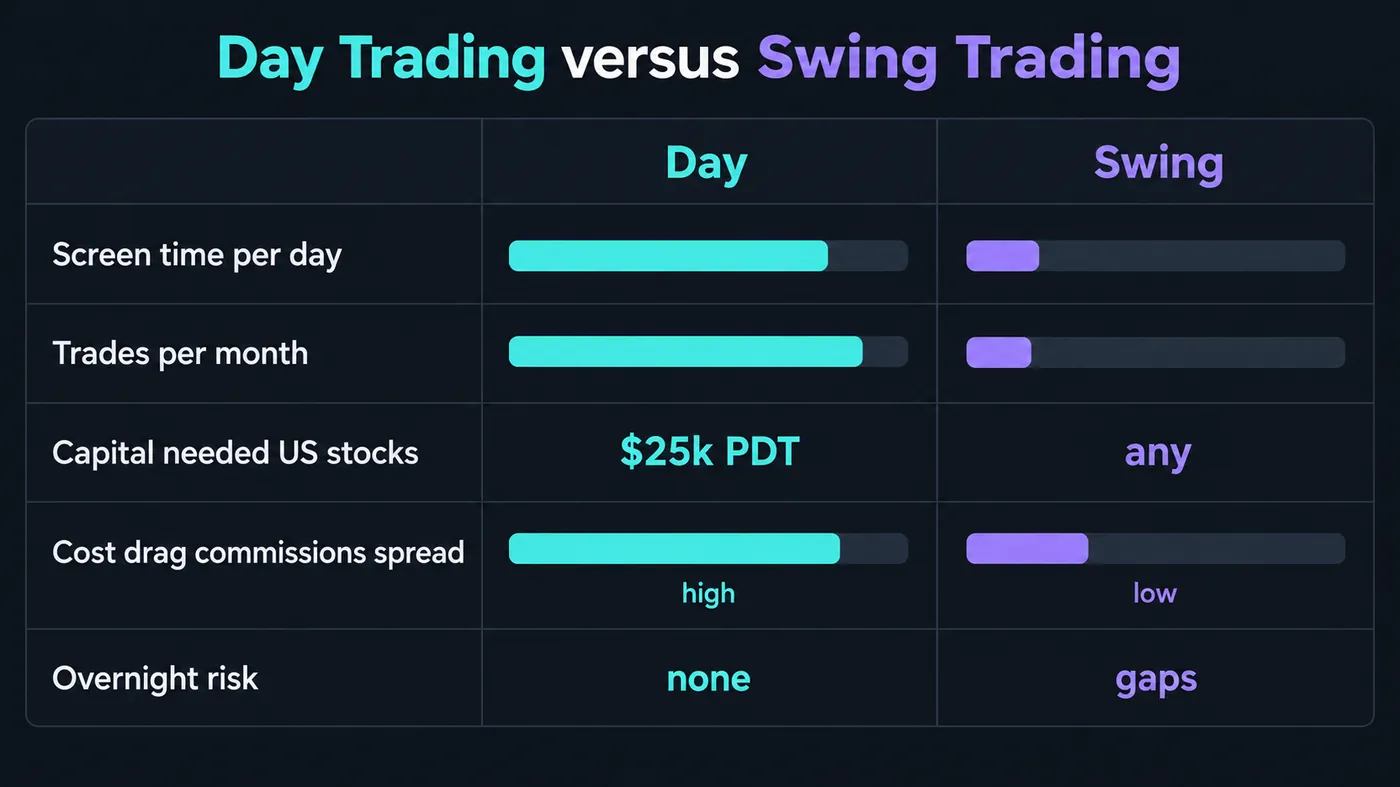
The honest picture of screen time is not "day traders work more". A day trader who trades one session structure — the New York open, the London sweep — works two focused hours and is done; a swing trader who checks the daily close works twenty minutes but is never quite off, because the position is open through the news. What differs is the shape of the attention: intense and bounded versus light and continuous. Pick the shape your life allows, because the wrong one is not sustained.
The cost picture is the one most people get wrong. They see swing trading's wider stops and assume more risk; the risk per trade is the same in R, the stop is simply a bigger fraction of price because the target is too. What actually changes is how often you pay the spread. At twenty round trips a day on a tight stop, the cost tax can exceed the edge of a good system — the bot reality calculator shows the arithmetic — while at eight round trips a month it is invisible. Day trading is a business with high fixed costs; it works at scale and with excellent execution, and not otherwise.

Automate your trades. Let Quantum Algo trade for you.
Every signal executed on your own account — on your account, with the plan you define.
Which fits you: the decision
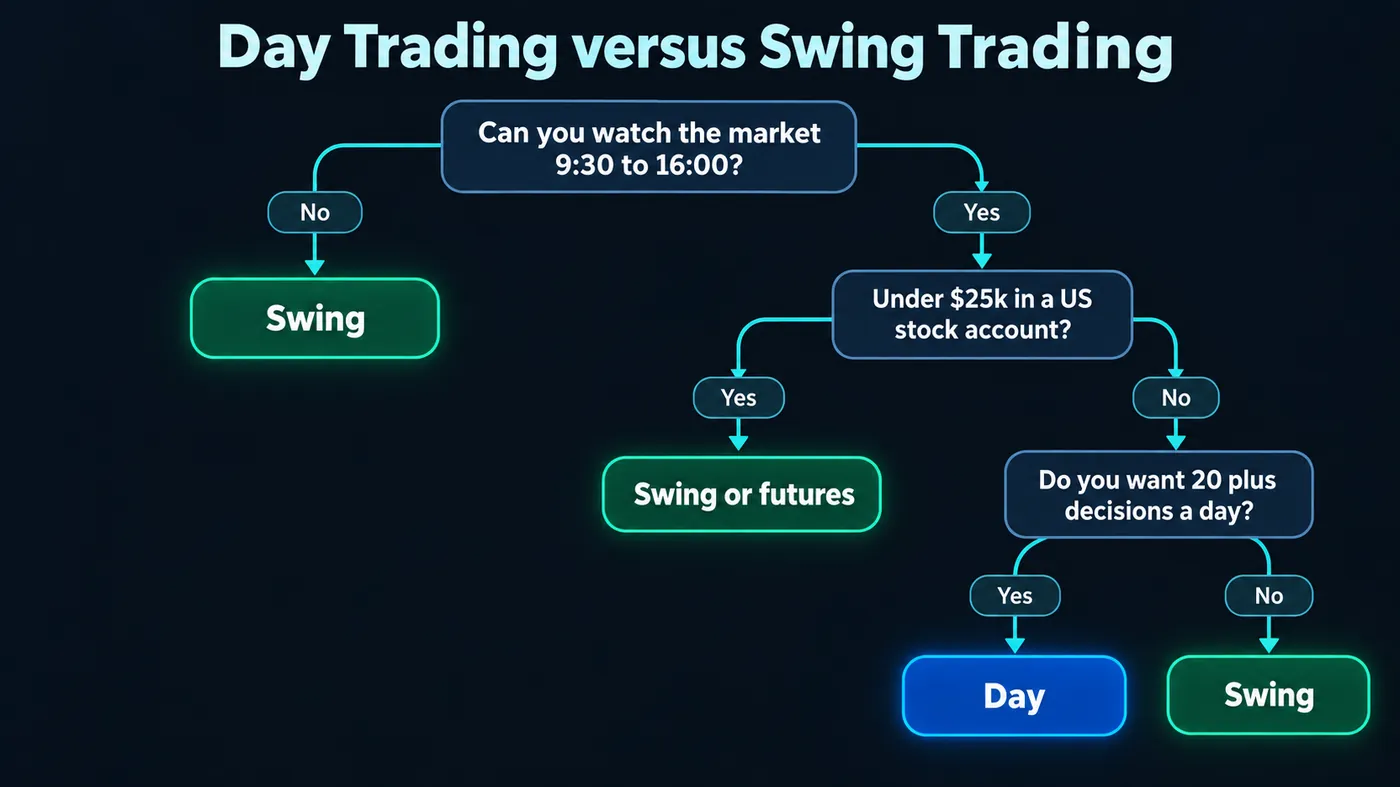
- Can you watch the market live for at least one full session block? No → swing. Day trading is not compatible with a job that owns your mornings; end-of-day management is.
- Do you trade US stocks with under $25,000? Yes → swing, or day trade futures or forex instead. The PDT rule decides this one for you.
- Do you want twenty decisions a day, or two a week? This is temperament, and it is a real constraint. Fast feedback suits some people and destroys others.
- Can you sit through a gap against you? No → day. Swing trading means waking up to a loss you could not have stopped; size for it or avoid it.
- Run your costs against your stop. If the round trip is more than 15% of your day-trade stop, day trading needs a cheaper venue or a wider stop before it needs a better strategy.
- Try each for a month on paper with real costs. The one whose losses you can sit through without changing the plan is the one.
Fit calculator
Enter your live hours, account size, market, round-trip cost, typical stops for each style and how you handle a losing run. The tool scores both styles against the hours, the PDT rule, the cost tax and the temperament, and tells you which the numbers favour and what to fix in it.
The same setup, traded both ways
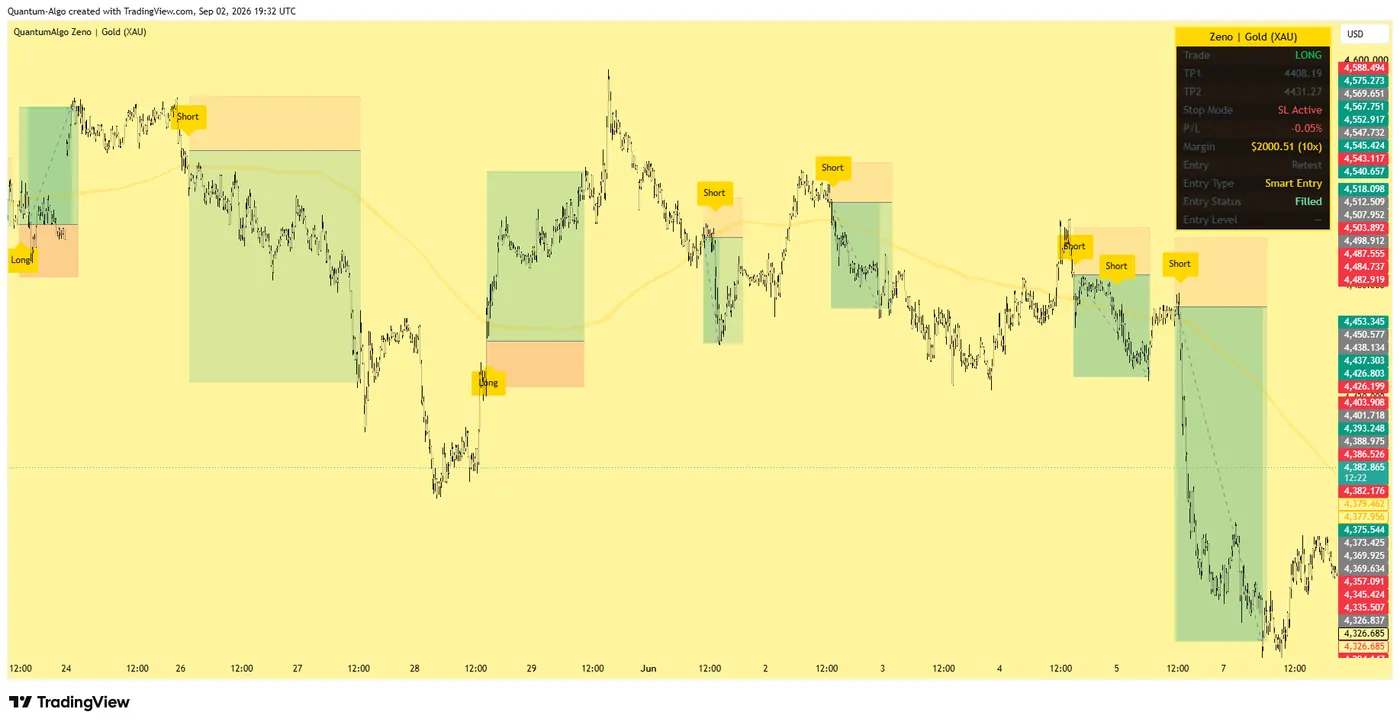
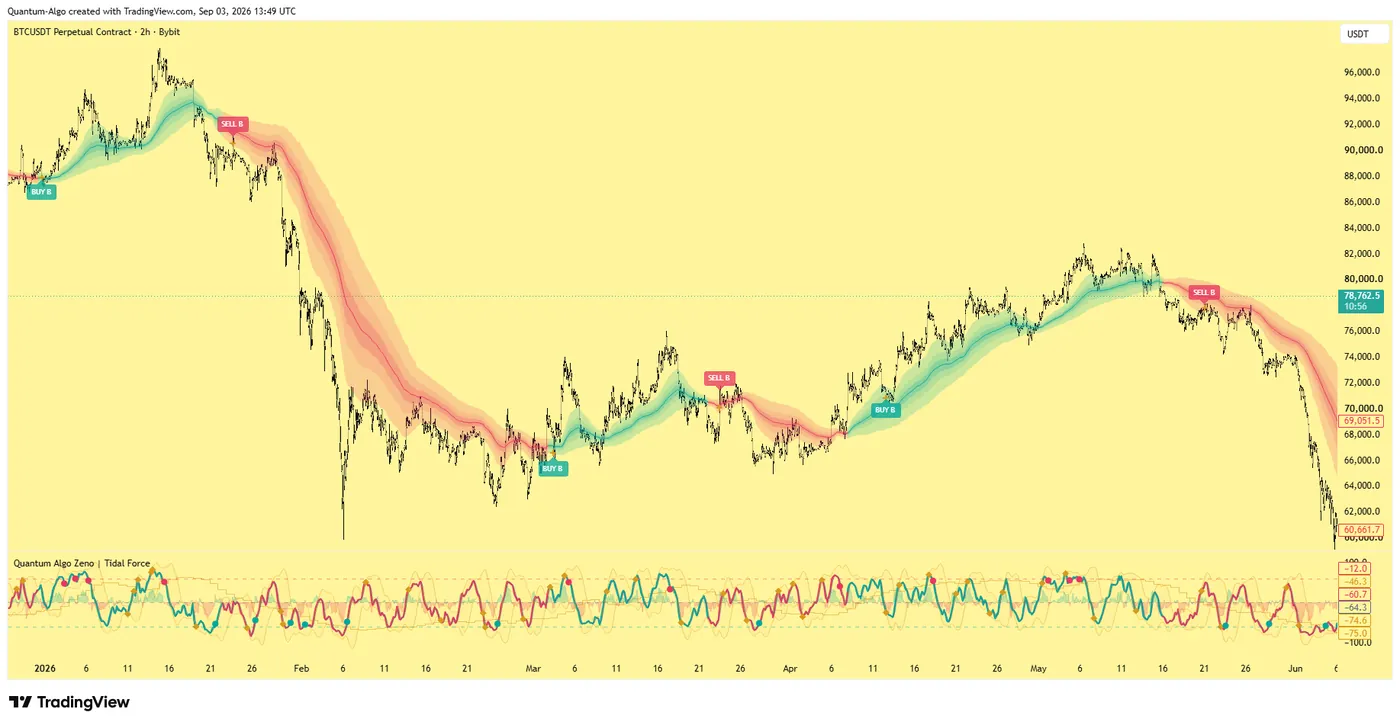
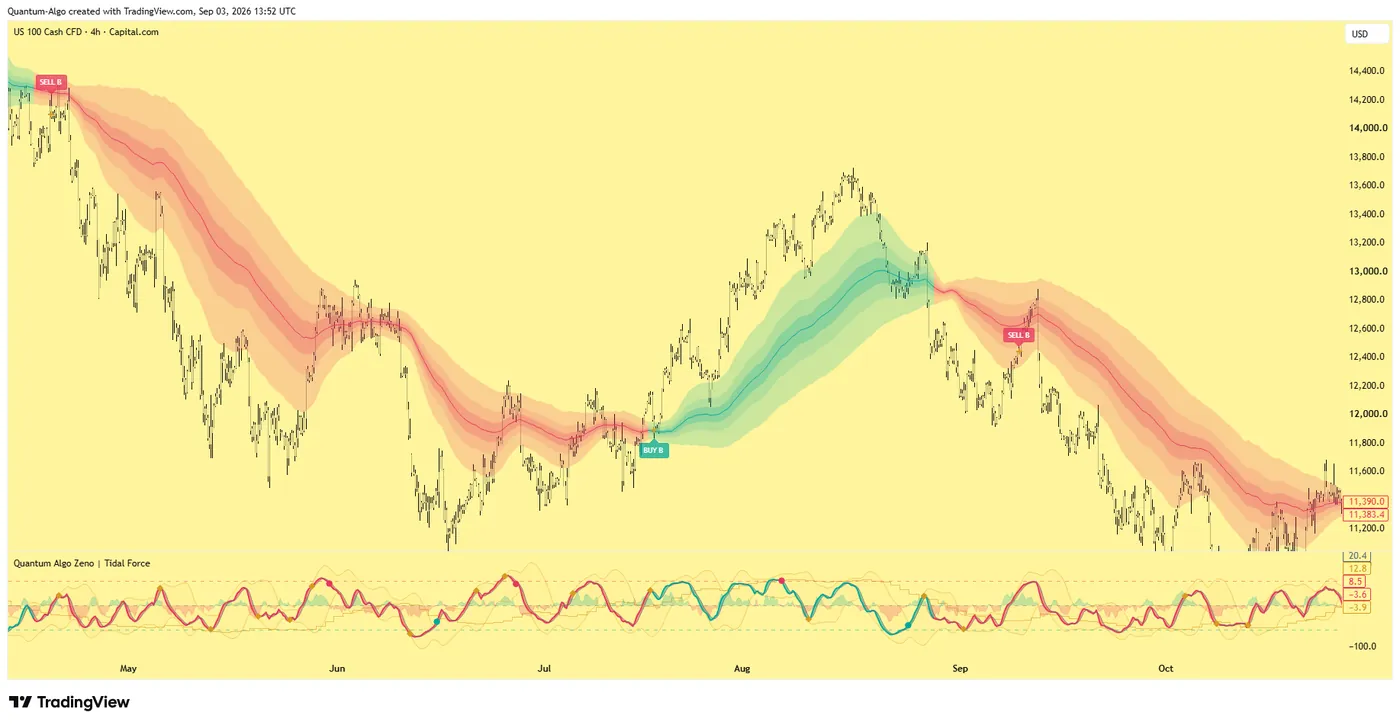
The Smart Money setup used on this site does not care which clock you use. The liquidity sweep of a swing low followed by a close back above it, entered on the return into the order block with the stop under the sweep and the target at the last swing high — that is a 5-minute trade at the New York open and a daily trade over two weeks. The Liquidity Sweeps script marks it on both, the Smart Money Concepts Engine marks the block on both, and the premium engine, Zeno, prints the signal with a stop and targets on whichever timeframe you run it. What changes is the sizing — halve the risk on swing trades to survive the gap — and the management, which the trailing stop guide covers for both. The intraday vs end-of-day guide is the closer look at the two daily routines; the position trading guide is the next step out from swing.
Reference data
| Item | Value |
|---|---|
| Day trading | Positions closed within the session; 1–15-minute charts; 10–30 decisions a day; no overnight risk; high cost drag; $25,000 PDT minimum for US stocks |
| Swing trading | Positions held days to weeks; daily and 4-hour charts; 2–10 decisions a month; gap risk; negligible cost drag; any account size |
| Cost tax | Round-trip cost ÷ stop distance, in R — 0.17R on a 0.3% stop at 0.05% cost; 0.02R on a 2.5% stop |
| PDT rule | Four or more day trades in five business days in a US margin account under $25,000 flags the account; does not apply to futures, forex or overnight holds |
| Gap sizing | Swing positions sized at roughly half the intraday risk per trade to survive an adverse gap |
| Same method | Sweep → close back inside → order-block entry works on both clocks; only sizing and management change |
| Feedback loop | Day: same day. Swing: a quarter |
| Common outcome | Beginners day trade for the action and lose to costs; the same beginners swing trading the same setups often survive |
Worked example: one trader, one setup, both clocks
A trader with a $12,000 account and a full-time job tests both styles on ES for a month, on paper, with real costs. Day trading: he can watch 09:30–11:00 ET before work, so he trades the opening sweep of the overnight range on the 5-minute chart. Twenty-two trades in the month, 12 winners at an average 1.6R, 10 losers, stop 8 points ($400) with a $6 round-trip cost per contract — 0.015R, negligible on futures. Result +9.2R, about $3,700 at one contract, for roughly thirty focused hours. Two mornings he broke his rules after a first loss; both were losers he should not have taken.
Swing trading: the same sweep on the daily chart, entered on the 4-hour close, stop 45 points ($2,250 per contract — too large for the account, so he trades one micro contract at $225). Four trades in the month, three winners at an average 2.9R, one loser; +7.7R, about $1,700 on micros, for perhaps six hours of work including the weekend review, and two nights of sleeping badly through a CPI release. Per hour, swing won by a distance; per dollar, day trading won because the stop let him size a full contract. He chose day trading and the two rule-breaks were the thing he worked on next — which is the real lesson: the style that exposes your weakness fastest is usually the right one, if you can afford the tuition.
Mistakes traders make choosing
- Choosing day trading for the action. The action is the cost; the edge is the same in both.
- Day trading stocks under $25,000 and discovering the PDT rule on the fourth trade.
- Swing trading with intraday sizing and meeting a gap.
- Judging swing trading over a month. Its feedback loop is a quarter.
- Ignoring the cost tax. Round trips over 15% of the stop need a cheaper venue before a better strategy.
- Switching styles after a losing week. Each needs a hundred trades to judge.
- Believing the choice is permanent. Many good traders swing a core position and day trade around it.
Pick the clock your life and your account allow, not the one that looks exciting. Day trading needs a session you can sit, a venue cheap enough that costs stay under 15% of the stop, and a temperament that trades cleanly after a loss; swing trading needs patience and gap-sized positions. The setup is the same on both — test each for a month on paper with real costs, and keep the one whose losses you can sit through.
◆ Interactive check
Do you know which clock you are on?
Questions traders ask about day trading vs swing trading
Day trading opens and closes every position within one session, on 1- to 15-minute charts, with many decisions a day and no overnight exposure. Swing trading holds positions for days to weeks, manages them on the daily or 4-hour close, makes a few decisions a month, and accepts overnight and weekend gap risk. The trading method can be the same; the clock, the costs and the capital rules differ.
Neither by nature. Per hour of screen time, swing trading usually wins; per dollar of account, day trading can win because tight stops allow larger size. What decides it in practice is the cost tax — spread and commission paid twenty times a day on tight stops — and the trader's ability to execute cleanly under fast feedback. Most beginners do better swing trading the same setups.
Usually, yes. The cost drag is negligible, the decisions are few and can be made calmly at the close, the PDT rule does not apply, and mistakes cost less per day. The price is patience and gap risk, and a feedback loop of about a quarter before you know whether the method works.
To day trade US stocks in a margin account you need $25,000 under the pattern day trader rule; futures and forex have no such rule and can be day traded with far less. Swing trading has no regulatory minimum in any market; the practical minimum is whatever lets you risk a sensible fraction per trade on a 2–5% stop.
Yes. A Smart Money setup — a liquidity sweep, a close back inside, an entry at the order block with the stop under the sweep — is identical on the 5-minute chart in the New York open and on the daily chart over two weeks. The changes are sizing (smaller for swing, to survive gaps) and management (session close vs daily close).
Risk per trade is the same in R for both when sized properly. Day trading has execution and cost risk and no gap risk; swing trading has gap and news risk and almost no cost risk. The style with more risk is whichever one you are temperamentally unsuited to.
Day trading needs at least one session block you can watch live — two focused hours around the open is enough for a single-setup trader. Swing trading needs twenty minutes at the daily close and a weekend review, but the position is open through the week's news, so the attention is lighter and continuous rather than intense and bounded.
The round-trip cost of a trade — spread, commission, slippage — divided by the stop distance, expressed in R. A 0.05% cost on a 0.3% day-trade stop is 0.17R on every trade; on a 2.5% swing stop it is 0.02R. Day trading has to overcome that tax on every one of twenty daily trades, which is why good day traders can still lose.
Many experienced traders hold a swing core position and day trade around it, or day trade one session and swing the rest of the book. Start with one; the two require different routines, and mixing them before either is consistent usually means doing neither well.
The free library and Zeno run on any timeframe: the Liquidity Sweeps script and the Smart Money Concepts Engine mark the same setup on the 5-minute and the daily, and Zeno prints the signal with a stop and targets on whichever chart you run it. The SessionScope script suits the day trader; the daily-close routine suits the swing trader.
References & Related Guides
Read next
- Day Trading Strategies
- Swing Trading Strategies
- Intraday vs End-of-Day Trading
- Pattern Day Trader Rule
- How Much Money to Start Day Trading
- Is Day Trading Worth It?
- Position Trading
- Best Indicators for Day Trading
- Best Indicators for Swing Trading
- Trailing Stop Loss
- SessionScope (free indicator)
- Zeno — the premium engine
Primary sources
- FINRA: Pattern day trader rule — the $25,000 minimum equity requirement
- Barber & Odean — Trading Is Hazardous to Your Wealth: turnover and costs vs returns
- CME Group: E-mini and Micro E-mini S&P 500 contract specifications
- Wilder, New Concepts in Technical Trading Systems — ATR, used for stop sizing on both timeframes