Trailing Stop Loss Explained: How It Works, How Far to Trail, and When It Beats a Fixed Target
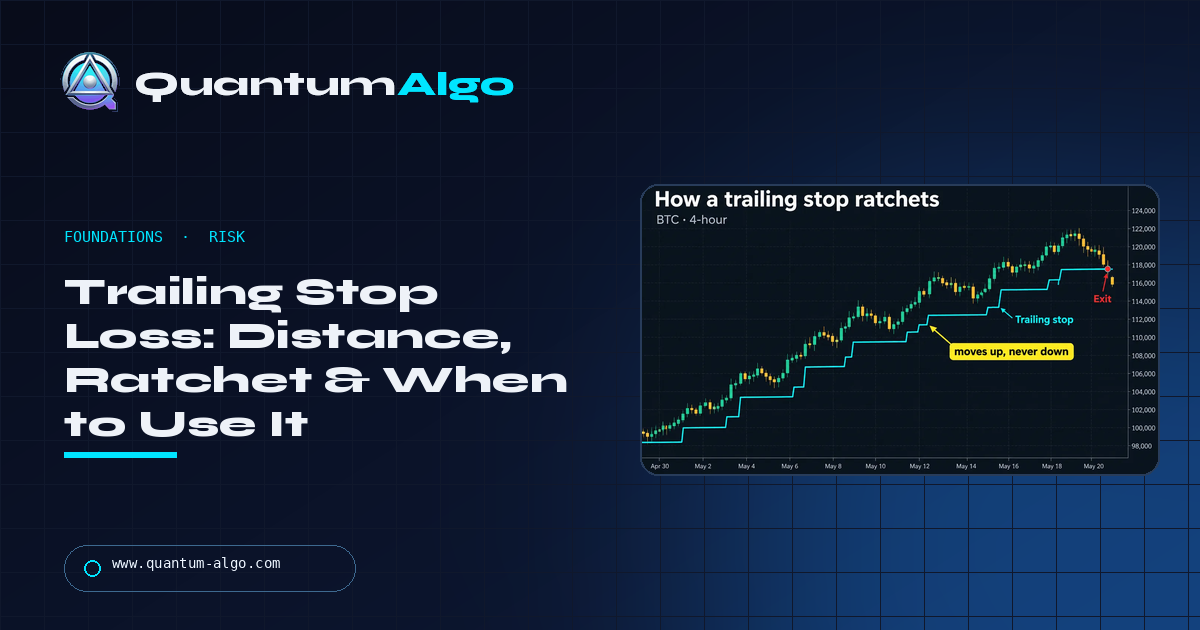
A trailing stop loss follows price in your favour by a set distance — a percentage, an amount or a multiple of ATR — and never moves back. It lets a winner run without a predefined target, at the cost of always exiting the trailing distance below the peak. Set the distance just beyond the market's normal pullback (often 2–3 ATR), activate it after the trade is at least 1R in profit, and use a fixed target for the first part of the position.
A trailing stop is the simplest way to let a winner run and the easiest to get wrong: too tight and every trade is a small win, too wide and you hand the move back. This page is how the ratchet works, how to pick a distance from the market's own pullbacks instead of a round number, structure-based trailing, and the honest comparison with a fixed target — on the same trades. The simulator below shows where each distance would have exited.
Indicators that prove themselves in public.
One engine, four precision tools — the Gold (XAU) Scalper, the institutional Gravity Zone, the Zeno momentum Oscillator, and Zeno Stocks for equities.
What is a trailing stop loss?
A trailing stop loss is a stop order that follows price in your favour by a set distance and never moves back. Long a stock with a 5% trailing stop from $100: the stop sits at $95; when price reaches $110 the stop is $104.50; when price falls to $104.50 you are out. The ratchet illustration in this guide shows it on a BTC uptrend — the stop steps up with every new high, holds flat in pullbacks, and the exit prints where price finally closes through it.
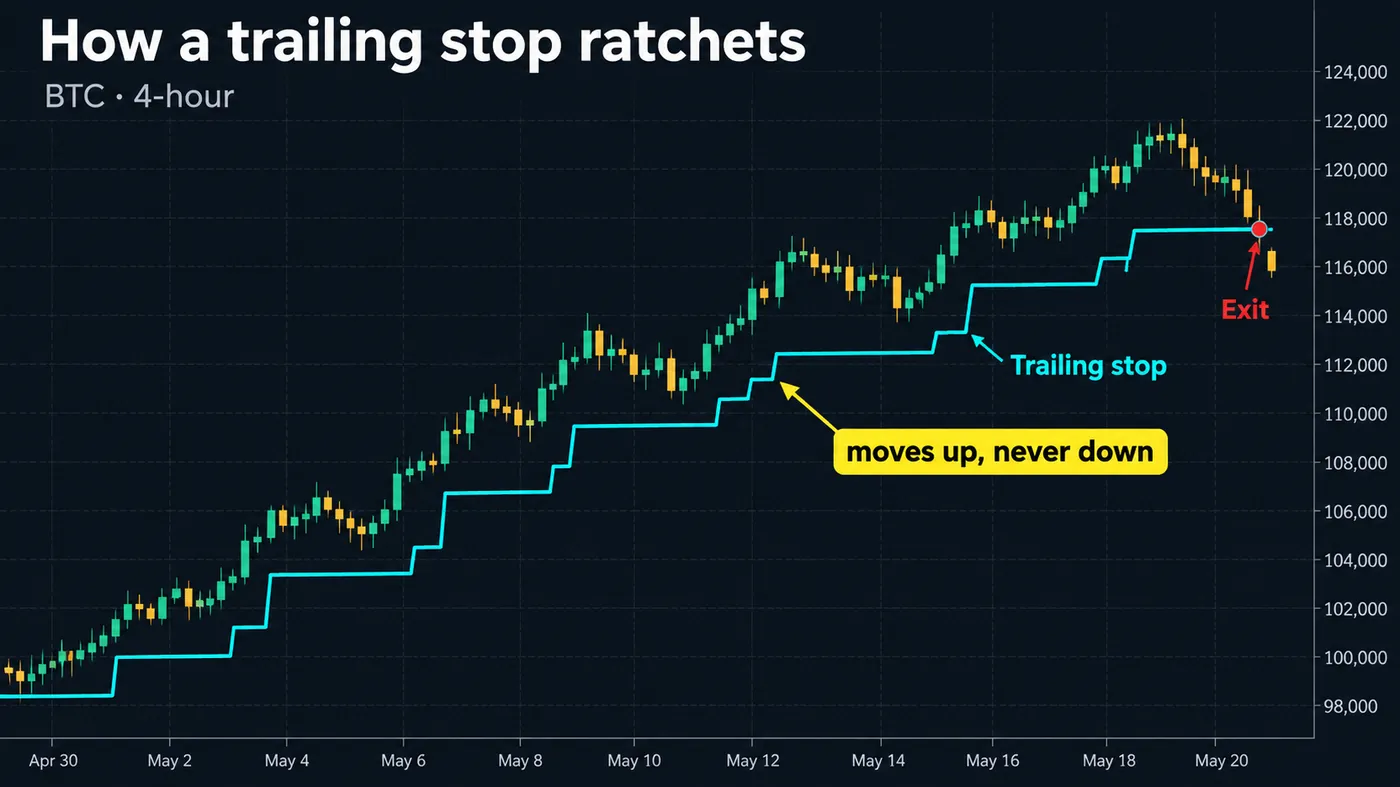
The point of a trailing stop is to let a winning trade run without deciding in advance where it ends. The cost is that you will always exit below the peak — by exactly the trailing distance — and if the distance is wrong for the market you will either be shaken out early or give back most of the move. This page is about choosing that distance and knowing when a fixed target is the better tool.
How the ratchet works
The mechanics are simple and the same on every platform:
- You set a distance — a percentage, a dollar amount, a number of pips or points, or a multiple of ATR.
- For a long, the stop is the highest price reached since entry minus that distance. For a short, the lowest price plus it.
- The stop only moves in your favour. A pullback does not lower it.
- When price trades at the stop it fires as a market order (or a limit, if you configured a trailing stop-limit).
Brokers differ in what "highest price reached" means: some use the last trade, some the bid or ask, some the candle close. On volatile markets that choice moves the stop by more than you would think. Check it once.
Choosing the distance
This is where trailing stops are won or lost, and the three-panel illustration in this guide shows why. Same NAS100 move, three distances:
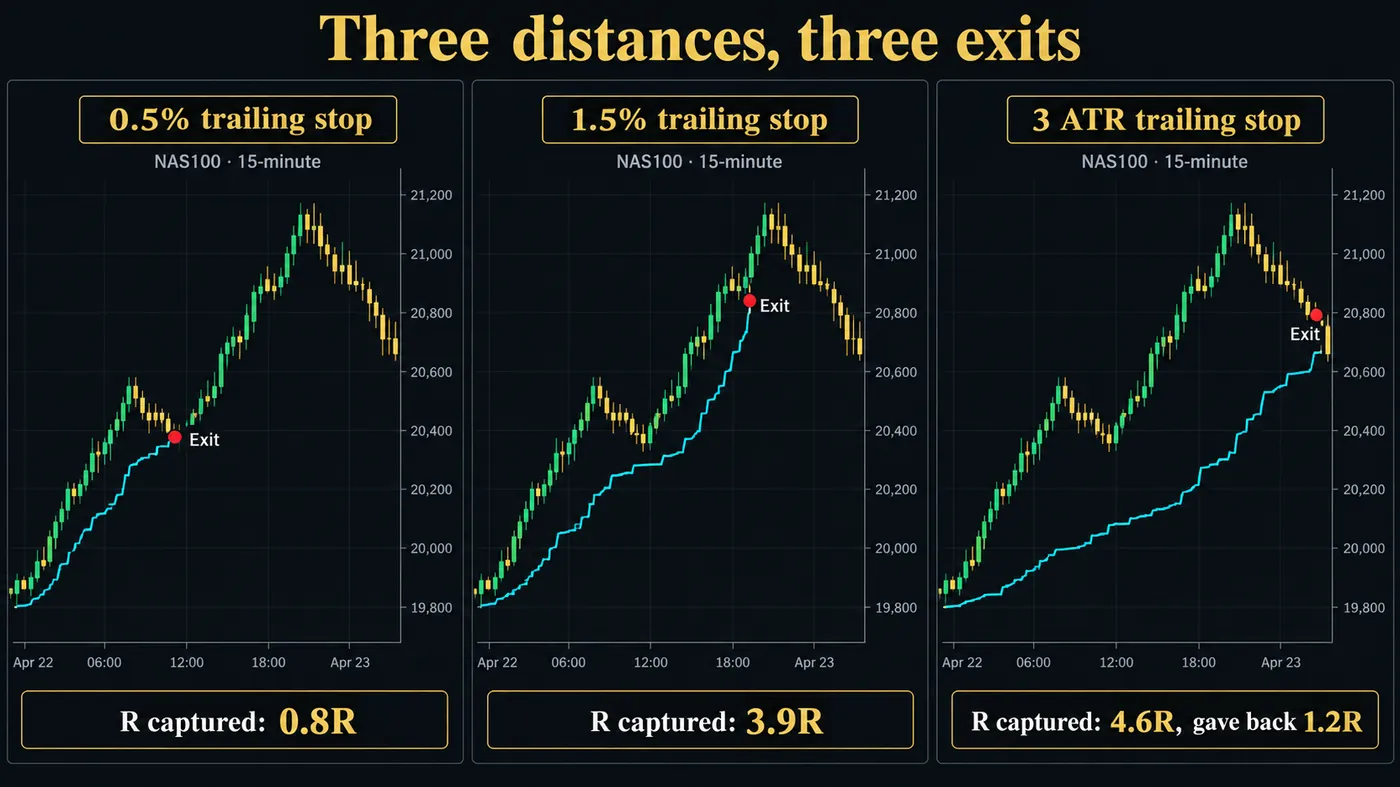
- 0.5% trailing — stopped out in the first pullback, 0.8R captured. Too tight for the market's normal noise.
- 1.5% trailing — rides most of the move, 3.9R captured. The distance matches the size of ordinary pullbacks.
- 3 ATR trailing — captures 4.6R but gives back 1.2R at the end, because the wide distance takes a long time to be hit once the trend turns.
The right distance is a property of the market and timeframe, not a preference. The test: look at the last twenty pullbacks in a trend on your chart and measure them. A trailing distance smaller than the median pullback will be hit by noise; one larger than the largest pullback will give back too much. Somewhere between the two is the working range, and ATR is the cleanest way to express it because it rescales automatically as volatility changes.
For most intraday and swing trends, 2–3 ATR of the trading timeframe is where I start; for slow daily trends, a multiple of the 20-day ATR or a structure-based trail (below the last higher low) works better than any percentage.

Automate your trades. Let Quantum Algo trade for you.
Every signal executed on your own account — on your account, with the plan you define.
Trailing stop versus fixed take-profit
The comparison illustration in this guide puts both on one EURUSD trend. The fixed take-profit exits at 2R, every time, with no drawdown from peak. The trailing stop carries the same trade to 4.6R but exits 0.8R below the peak — and on the trades where the trend fails early, it exits with less than the fixed target would have captured.
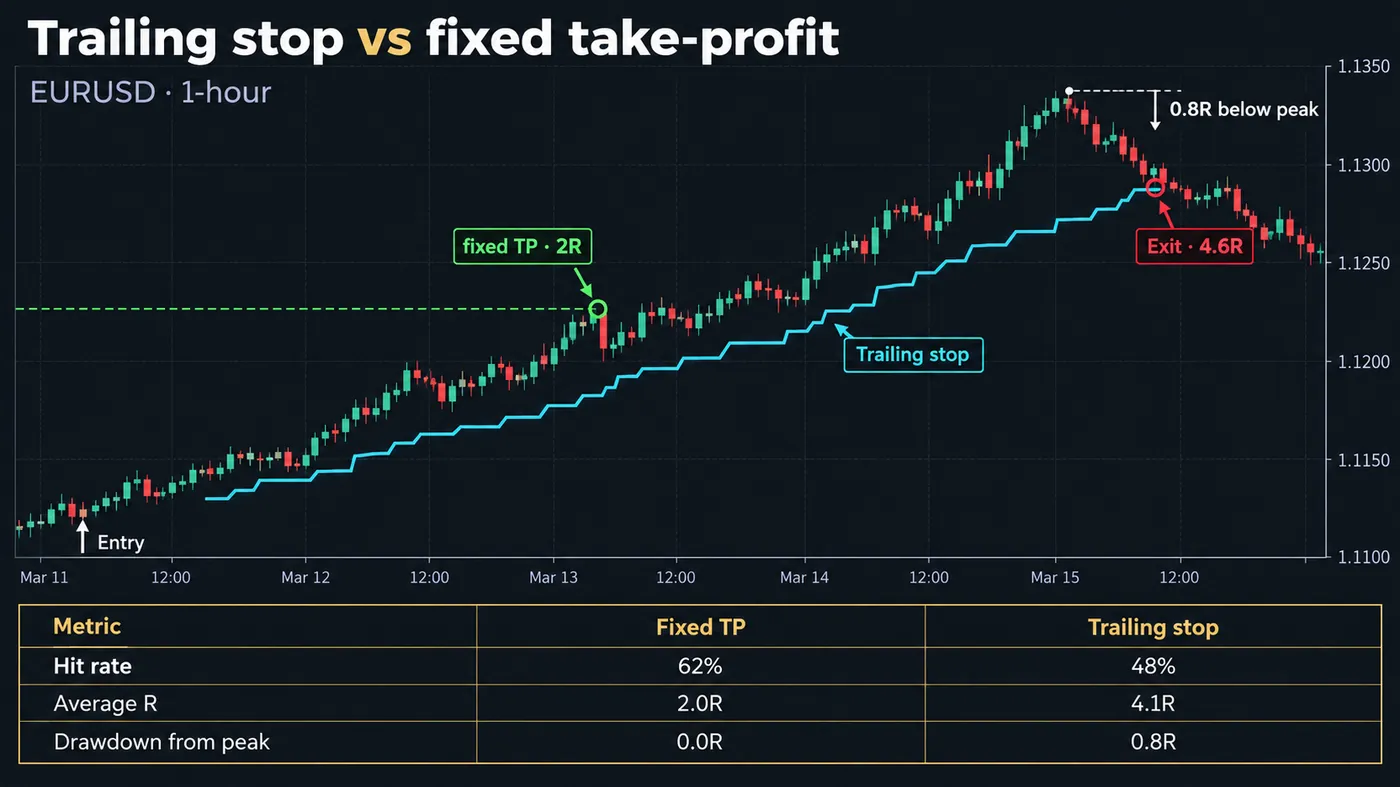
Over many trades the two produce different shapes: the fixed target has a higher hit rate and a lower average R; the trailing stop has a lower hit rate and a higher average R with more variance. Which one wins depends on the market. In markets that trend — crypto, gold in a session, indices during a directional day — trailing stops harvest the tail. In markets that revert — ranges, most forex most of the time — the fixed target takes the money before the reversal gives it back.
The compromise most professionals use: a fixed target for the first part of the position (TP1) and a trail on the rest. That is how Zeno's TP1/TP2 structure is meant to be traded: scale at TP1, trail the runner.
Structure-based trailing
A percentage or ATR trail is blind to the chart. A structure trail follows the market's own swing points: for a long, move the stop to just below each new higher low once the next higher high forms. It exits when structure breaks — which, in Smart Money terms, is the Change of Character that says the leg is over — rather than at an arbitrary distance.
This trail is slower to update and demands attention on every candle close, but it gives back less at the end of a trend than any fixed distance, because the exit is triggered by the thing that actually ends trends: a lower low.
Where trailing stops go wrong
- Too tight. The commonest mistake, and the one that turns a good entry into a string of tiny wins.
- Trailing from the first candle. Trailing before the trade has moved away from entry just recreates a tight fixed stop. Activate the trail after 1R, or at TP1.
- Trailing on last price in crypto. A wick on the perpetual's last price can fire a stop the mark price never reached. Use mark-price triggers.
- Trailing into news. A trail sitting a normal distance away is a market order waiting for a spike. Widen or flatten before scheduled events.
- Trailing on a broker that only supports it server-side during session hours. Some stock brokers hold trailing stops locally on your device — if the app closes, the stop stops trailing. Ask.
Setting a trailing stop in practice
On TradingView with an integrated broker, the position's stop-loss line can be set to trail by a fixed number of ticks or a percentage; most brokers expose the same in their own tickets as "trailing stop" with an amount or percent field, and crypto exchanges offer "trailing stop" with a callback rate and an activation price. In QuantumBot the trail is a rule in the risk settings, applied after TP1 fills, so the runner is managed without watching the chart.
The simulator on this page lets you set a distance in percent, dollars or ATR on a sample trend and see where each choice would have exited and how much of the move it kept.
A trailing stop ratchets behind price and exits the trailing distance below the peak. Measure the market's pullbacks and set the distance just beyond them — usually 2–3 ATR — activate after 1R, trail on mark price in crypto, and combine it with a fixed TP1 so ranging markets pay you before they reverse. Structure-based trails give back the least.
◆ Interactive check
Do you know where your trail would exit?
Questions traders ask about trailing stops
There is no universal number. Measure the typical pullback on your market and timeframe and set the trail just beyond it — for many intraday trends that is 2–3 ATR, which translates to very different percentages on gold, a stock and a crypto perpetual.
No. It guarantees an exit at the trailing distance below the peak, which can still be below your entry if the trade never moved far enough in your favour before reversing.
Fixed targets in ranging conditions, trailing stops on directional days. The practical answer is both: take part at a fixed TP1 and trail the remainder.
Never. The stop only moves in the trade's favour; a pullback leaves it where it is. If your platform's stop moved the wrong way, it was reset manually.
When triggered, a standard trailing stop becomes a market order. A trailing stop-limit becomes a limit order, which can fail to fill in a fast move — use it for entries, not for protection.
They are different tools. The initial stop-loss defines the risk before the trade works; the trailing stop manages the exit once it does. Use both: the fixed stop at entry, the trail after the trade is in profit.
An ATR-based trail on the trading timeframe, triggered on mark price rather than last price so a single wick cannot fire it. Crypto pullbacks are large; percentage trails that suit stocks are far too tight.
With an integrated broker, yes — the position's stop line can be set to trail by ticks or percent from the Trading Panel. Without a broker, an alert on a moving level can approximate it.
Moving the stop to entry is a form of trailing and the most common way to get stopped out of a trade that then works. Trail to breakeven only once the trade has moved at least 1R, and prefer to trail below structure rather than to a round number.
As a rule in the risk settings, applied to the remaining position after TP1 fills, so the runner is managed by the same logic on every trade without watching the chart.
References & Related Guides
Read next
- Order Types Explained
- Stop-Loss Placement (Academy)
- Position Sizing: The Complete Guide
- ATR: Average True Range Guide
- Risk-Reward Ratio Calculator
- BOS & CHoCH: Market Structure
- What Is Slippage in Trading?
Authoritative sources
- SEC Investor.gov: trailing stop orders
- FINRA: understanding order types
- TradingView: order types (trailing stop)
- Bybit: trailing stop on perpetuals
- Investopedia: trailing stop