Intraday vs End-of-Day Trading: Which Is Better, and Which Fits Your Life
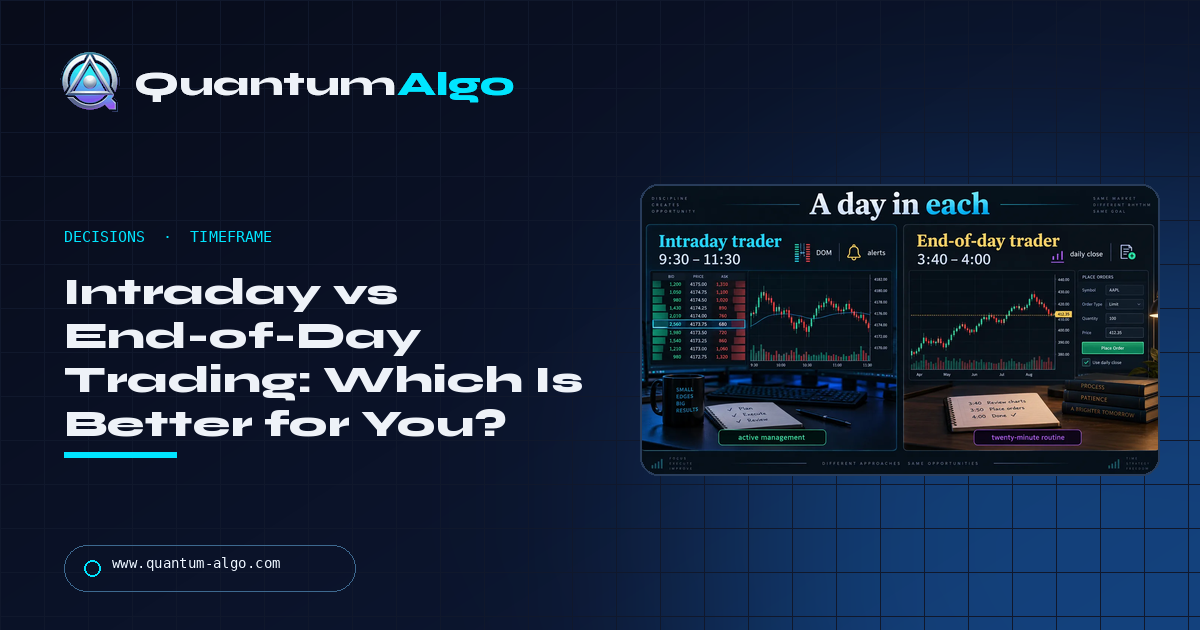
End-of-day trading is better for most retail traders; intraday is better for a minority with a free session every day, capital above the pattern-day-trader threshold and an edge that survives the higher costs of short timeframes. On 5-minute bars spread and slippage eat most of the expected edge per trade; on daily bars they are a rounding error — and the end-of-day trader decides once a day, off a closed candle, in twenty minutes.
Same market, same setups, same structure — the timeframe decides the costs, the hours and the rules. This page shows a day in each, the cost-versus-edge arithmetic that ends most of the debate, the capital and rule differences, a decision tree that answers the question for your life rather than in general, and the end-of-day method in practice. The picker below runs the tree from your inputs.
Indicators that prove themselves in public.
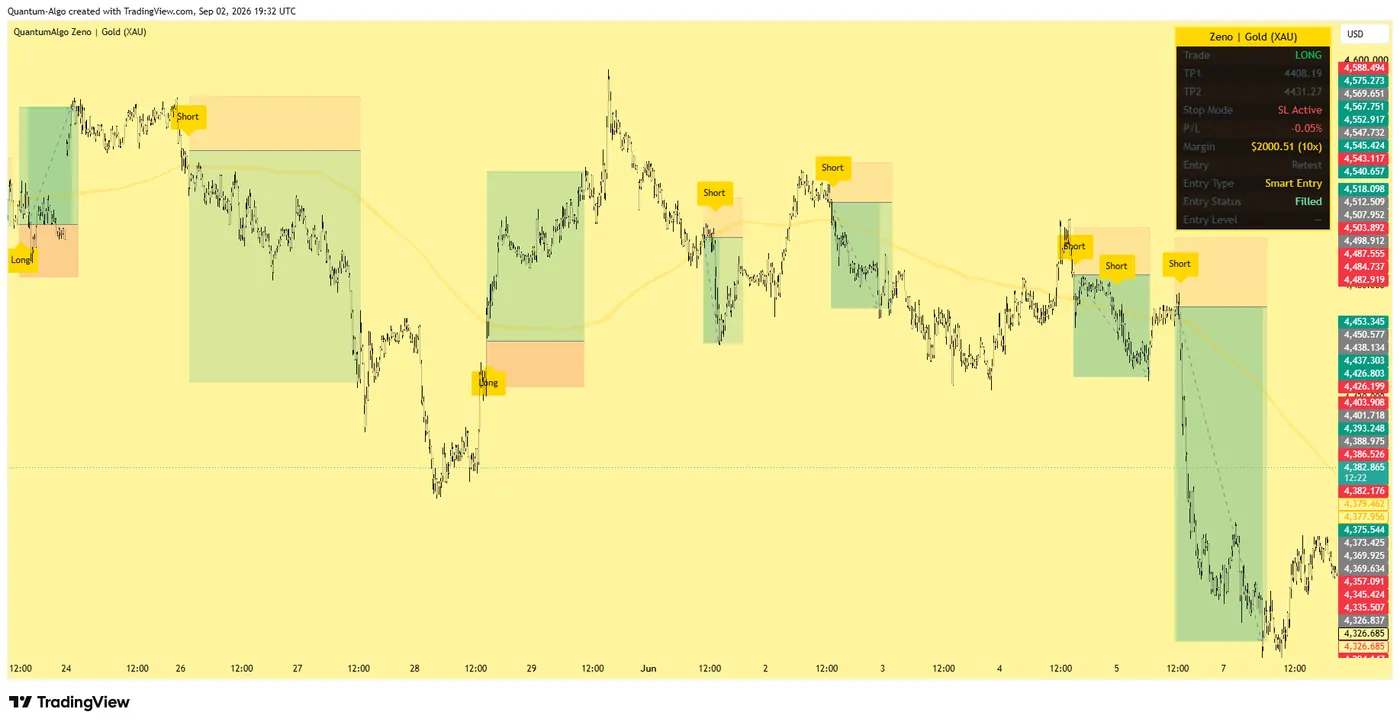
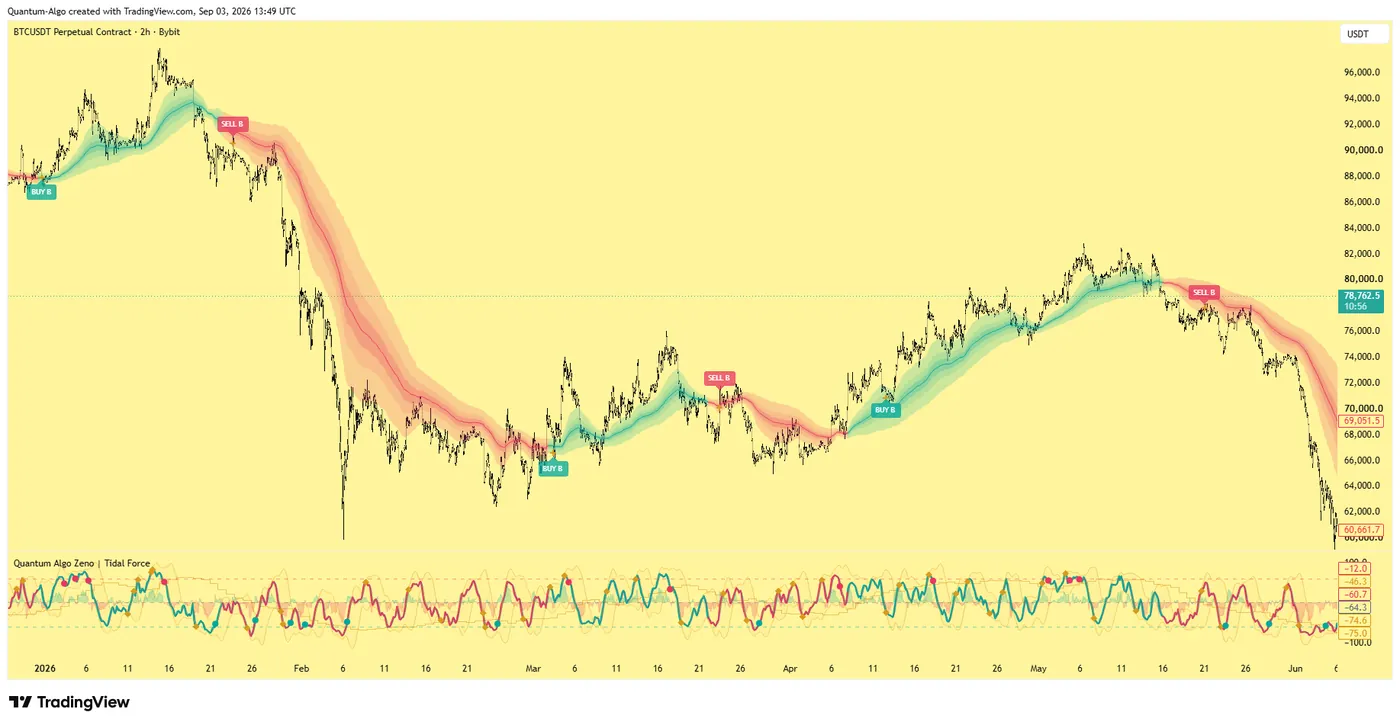
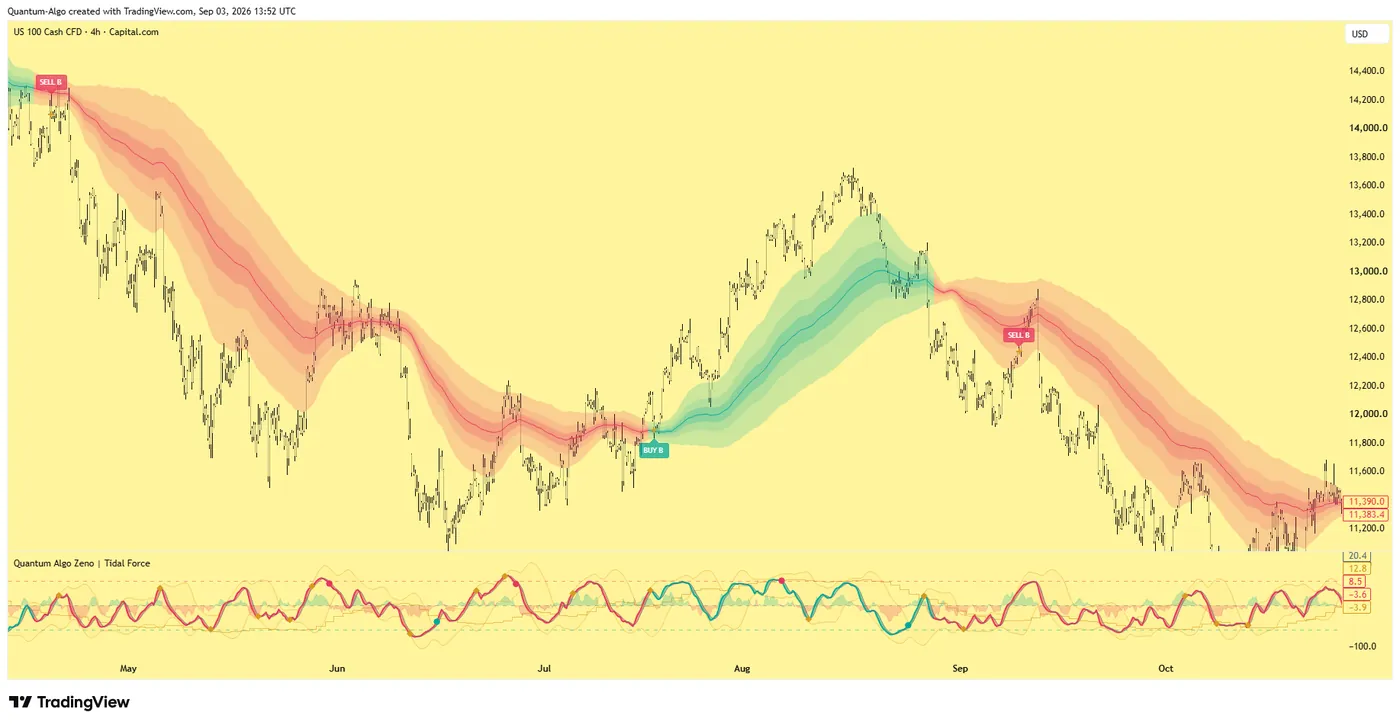
One engine, four precision tools — the Gold (XAU) Scalper, the institutional Gravity Zone, the Zeno momentum Oscillator, and Zeno Stocks for equities.
Is intraday trading or end-of-day trading better?
End-of-day trading is better for most retail traders; intraday trading is better for a small minority with a free session every day, capital above the pattern-day-trader threshold, and a documented edge that survives the higher costs of short timeframes. The reason is arithmetic before it is psychology: on a 5-minute chart the spread and slippage eat most of the expected edge per trade, while on daily bars they are a rounding error; and the end-of-day trader makes every decision once a day, off a closed candle, in twenty minutes, without watching the screen. Same market, same setups, same structure — the timeframe decides the costs, the hours and the rules, and this page decides which fits your life.
"End of day" here means placing and managing orders after the daily close (or the session close on a 4-hour chart) — the swing trader's working method. "Intraday" means positions opened and closed within the session on charts of 15 minutes and below.
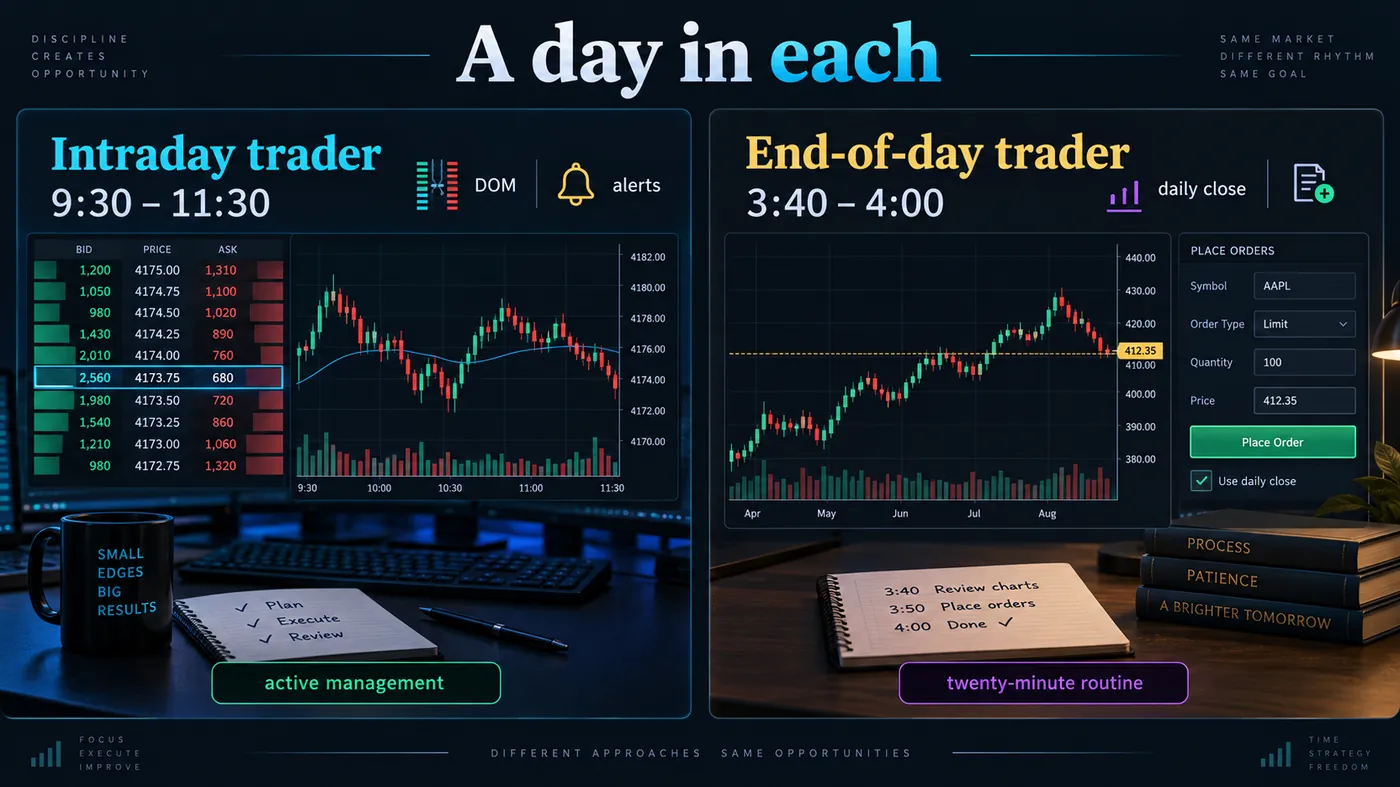
A day in each
The two-timeline illustration in this guide shows the same trader's Tuesday two ways. Intraday: 9:30–11:30 at the screen, a DOM and alerts open, three to eight decisions under time pressure, positions flat by lunch. End-of-day: 3:40–4:00 pm, the daily candle about to close, the watchlist reviewed, two orders placed as brackets for tomorrow, the screen closed. The intraday day has more trades, more information and more opportunity; the end-of-day day has more sleep, more consistency and a job it fits around. Neither is more serious than the other.
Costs and edge per trade
The bar chart in this guide is the argument that ends most debates. Take the expected edge of a decent setup and the spread-plus-slippage cost of executing it on three timeframes. On 5-minute bars the cost is most of the edge — a 0.2-pip spread and a pip of slippage on a 6-pip target is a third of the move before the trade begins, and on a stock with a 3-cent spread and a 15-cent target it is worse. On 1-hour bars the cost is a fifth of the edge. On daily bars it is a few percent.
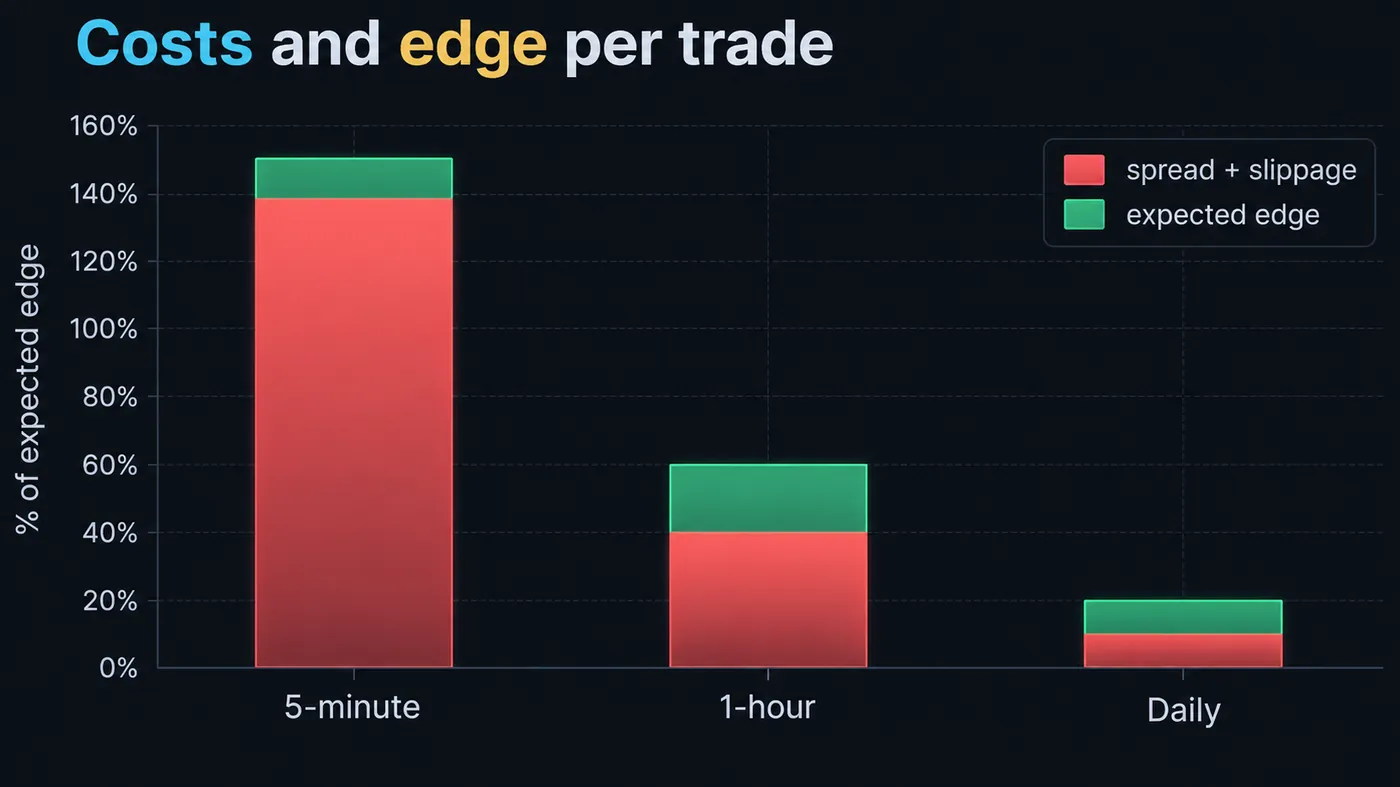
That is why intraday trading demands a much larger raw edge to net the same result, and why "the same strategy" performs worse the faster you run it. The intraday trader is not necessarily worse; they are paying a toll on every trade the end-of-day trader pays once a week.

Automate your trades. Let Quantum Algo trade for you.
Every signal executed on your own account — on your account, with the plan you define.
The rules, the hours and the capital
- Hours. Intraday needs the liquid session, every day, undistracted: the first two hours after the open for stocks and indices, the London–New York overlap for forex and gold. End-of-day needs twenty minutes at the close and a weekend review.
- Capital. In a US margin account, intraday trading under $25,000 runs into the pattern day trader rule; end-of-day trading has no such constraint anywhere. Below the threshold, end-of-day is not a preference; it is the only version available on stocks.
- Costs. As above: intraday pays the spread many times a day; end-of-day pays it rarely and pays overnight financing or swaps instead, which are small on futures and stocks and worth checking on CFDs.
- Decisions. Intraday: dozens a day, under pressure, with the temptation to trade what you see rather than what you planned. End-of-day: a few a week, off closed candles, with time to think.
- Feedback. Intraday produces fifty trades in a fortnight — a record fast. End-of-day takes months to reach fifty. The speed of learning is the one genuine advantage of intraday for a beginner, and bar replay gives the end-of-day trader most of it without the costs.
Which fits your life
The decision tree in this guide asks three questions in order: how many hours you have free each day, how much capital you have, and which temperament you have — the fast-paced version of you or the patient one. Fewer than two free hours a day is end-of-day, whatever the temperament. Under $25,000 on US stocks is end-of-day, whatever the hours. A full free session, capital above the threshold and a preference for fast decisions is intraday. A full free session with a patient temperament is the hybrid: end-of-day analysis with intraday entries taken off alerts — the setup marked on the daily, the order placed when the 15-minute chart confirms.
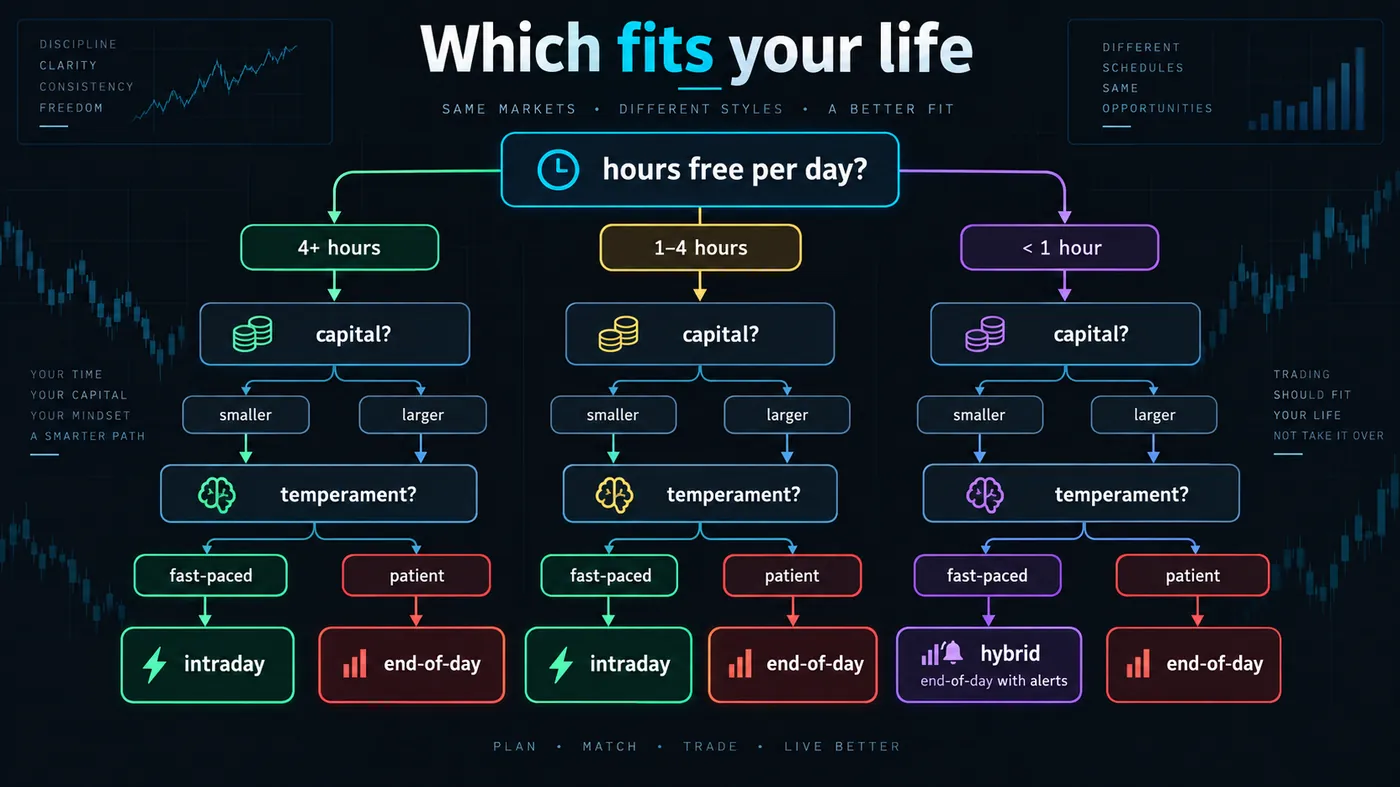
The hybrid is where most experienced retail traders end up, and it is how we run our own calls: the bias and the levels from the 2-hour and 4-hour charts, the entry timed on the 15-minute, the management at candle closes.
Intraday vs end-of-day: the comparison in one table
| Intraday | End-of-day | |
|---|---|---|
| Timeframes | 1–15 minute | Daily, 4-hour |
| Time at the screen | Full session, daily | ~20 minutes at the close |
| Trades per week | 10–40 | 1–5 |
| Cost per trade vs edge | High — spread is a large share | Low |
| Overnight risk | None | Gaps; swaps/financing on CFDs |
| PDT rule (US stocks) | Applies under $25k | Does not apply |
| Speed of building a record | Fast | Slow — use replay |
| Biggest risk | Overtrading, costs, fatigue | Impatience, oversizing the few trades |
| Best for | Full-time traders with capital | Anyone with a job; every beginner |
End-of-day trading strategy, in practice
- After the close, mark the structure on the daily and 4-hour charts: trend, the last order block, the liquidity above and below.
- Choose the one or two setups that meet the written rules.
- Place bracket orders — limit entry at the level, stop beyond the structure, target at the next liquidity — good till cancelled.
- Set an alert at the entry level so you know when it fills; do nothing else until the next close.
- At each close, manage: move the stop to breakeven after 1R, take TP1, trail the rest below the last higher low.
- Journal weekly; fifty trades takes a quarter, and bar replay can compress the learning without the costs.
End-of-day for anyone with a job, under the PDT threshold, or still building a record; intraday for the minority with a free session, capital and an edge large enough to pay the toll; the hybrid for most experienced traders. The setups do not change with the timeframe — the costs, the hours and the rules do.
◆ Interactive check
Do you know what the timeframe costs?
Questions people ask about intraday and end-of-day trading
As profitable as the edge, minus far lower costs than intraday. The published loss rates cover all retail traders; the end-of-day method removes the two biggest contributors — overtrading and spread — which is why it is the version we recommend to anyone with a job.
Not the liquid session, which is when a job is happening. The hybrid — end-of-day planning with alerts for intraday entries — is the practical version, and the pattern day trader rule still applies on US stocks under $25,000.
The daily chart for the decision, the 4-hour for management, and the 15-minute only to time an entry off an alert. Anything faster reintroduces the intraday costs.
Per trade, it has to be much more profitable just to break even against the costs; per year, the published distribution for day traders is worse than for swing traders. More trades is not more profit.
Any liquid market with a clean daily close: index futures and ETFs, major forex pairs, gold. Crypto works with a fixed daily-close convention (00:00 UTC) though it never closes; our crypto day-trading guide covers the intraday side.
The 2-hour and 4-hour regime labels are built for it — read at the close, traded with a bracket. The public track record is mostly that method.
Placing and managing orders after the daily (or session) close, off closed candles, with bracket orders and alerts — the swing trader's working method. Decisions are made once a day in a short window; the trade plays out over days.
End-of-day is the method; swing trading is the holding period it usually produces. Most swing traders work end-of-day; a few manage intraday, which reintroduces the costs.
Per trade, intraday must be far more profitable just to cover its costs; per year, the published distribution for day traders is worse than for swing and position traders. The hybrid captures most of the intraday timing edge at end-of-day costs.
Twenty minutes at the close: mark the structure, place brackets good till cancelled, set alerts; manage at the next close. Our roadmap assumes exactly this.
References & Related Guides
Read next
- How to Start Trading: 90-Day Roadmap
- Swing Trading vs Buy-and-Hold
- Is Day Trading Worth It?
- Pattern Day Trader Rule
- Swing Trading Strategies
- Day Trading Crypto
- FX Replay Review (bar replay)
- Multi-Timeframe Analysis
Authoritative sources
- FINRA: day trading and the pattern day trader rule
- Chague, De-Losso & Giovannetti: "Day Trading for a Living?" (SSRN)
- SEC: day trading — your dollars at risk
- ESMA: retail CFD loss-rate disclosures
- TradingView: paper trading and bar replay