Scammed by a Trading Platform? What to Do in the First 72 Hours, Where to Report, and the Second Scam to Avoid
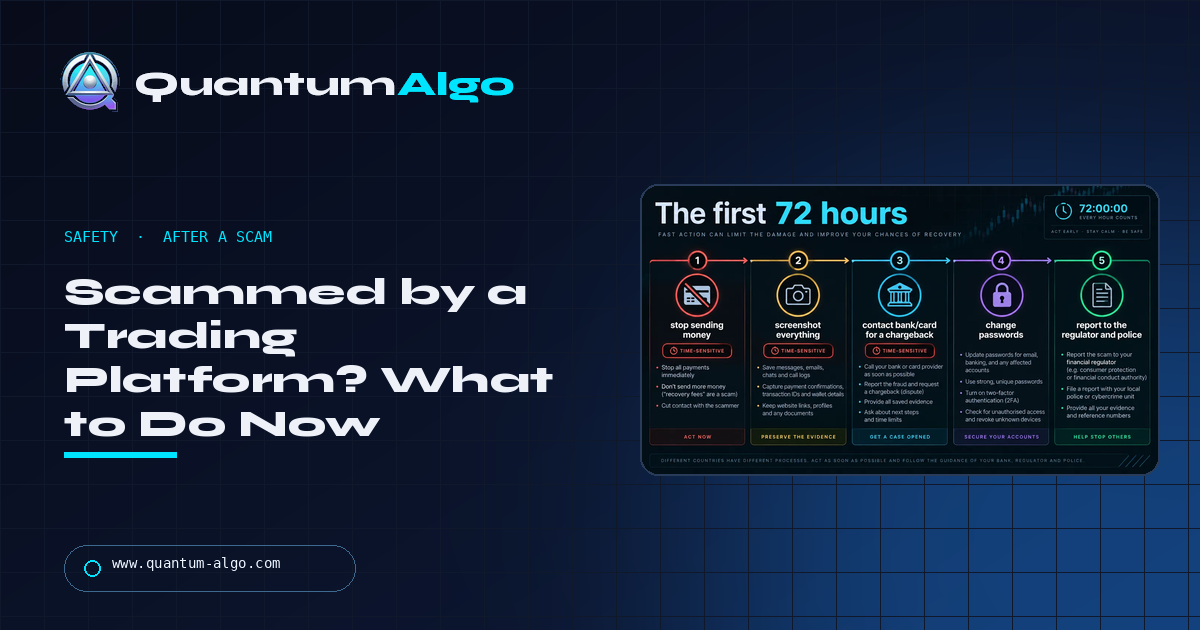
Stop sending money immediately, document everything, contact your bank or card issuer to dispute the payments, secure your accounts, and report to your financial regulator and the police — in that order and within seventy-two hours, because chargeback windows and the trail both go cold. Then expect the second scam: a "recovery service" offering to get your money back for a fee. No legitimate recovery asks for money first.
This page is written for the person reading it the day after, not as a warning to the person before. It is the sequence of what to do, the reporting addresses by country, the honest odds of recovery by payment method — card disputes often partially succeed, crypto almost never — and the tells of the recovery scam that arrives within weeks because the first scam sold your details to the second. The checklist below is the same sequence with the time-sensitive steps marked.
Indicators that prove themselves in public.
One engine, four precision tools — the Gold (XAU) Scalper, the institutional Gravity Zone, the Zeno momentum Oscillator, and Zeno Stocks for equities.
What should you do if you were scammed by a fake trading platform?
Stop sending money immediately, document everything, contact your bank or card issuer to dispute the payments, secure your accounts, and report the scam to your financial regulator and the police — in that order, and within the first seventy-two hours, because the chargeback windows and the trail both get colder by the day. Then be ready for the second scam: the "recovery service" that will contact you within weeks offering to get your money back for a fee. No legitimate recovery asks for money first. This page is the sequence, the reporting addresses by country, the realistic odds of getting money back by payment method, and the tells of the recovery scam — written for the person reading it the day after, not as a warning to the person before.
If you are not yet sure whether the platform is fake, our forex-legitimacy guide has the register check; if it is not on any regulator's register under the exact entity name on your agreement, treat it as a scam and start here.
The first 72 hours
The checklist timeline in this guide is ordered by urgency:
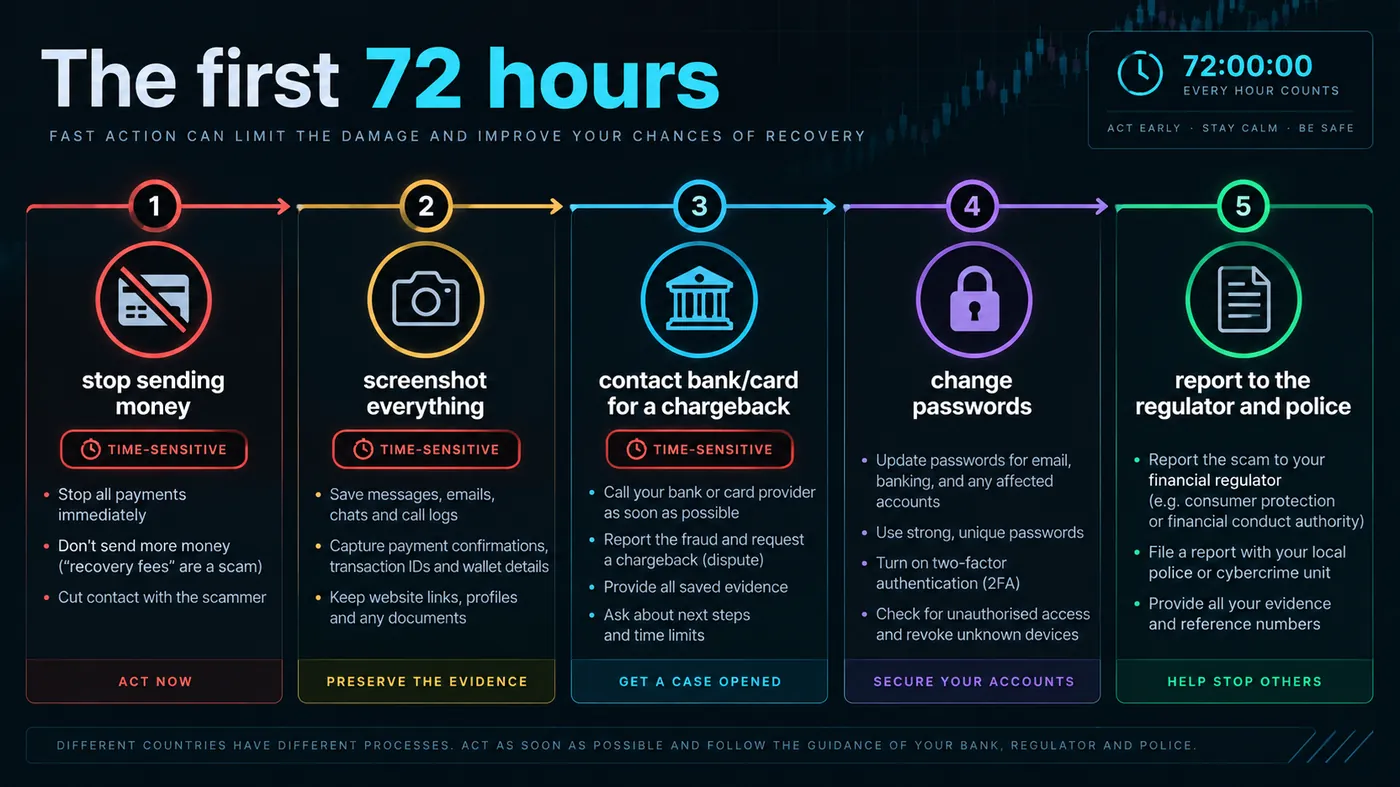
- Stop sending money. Every request from here — a "tax" to release profits, a "verification deposit", a fee to unlock the account — is the scam continuing. There are no profits to release.
- Screenshot everything. The platform, your account page, the deposits, every message, the people's names and handles, the URLs, the wallet addresses. Do it before the site disappears or your login is revoked, which happens once you stop paying.
- Contact your bank or card issuer for a chargeback. Card payments and some bank transfers can be disputed as fraud; the window is typically 120 days from the transaction for cards and far shorter for some transfers. State that you were the victim of a fraudulent investment platform, provide the evidence, and ask for the fraud team. This step has the best odds of any and is the most time-sensitive.
- Change passwords and secure accounts. The email you used, your real broker or exchange accounts, anything with the same password; enable two-factor authentication; revoke any remote-access software the "account manager" had you install.
- Report to the regulator and the police. The addresses are below. Reporting rarely returns money directly, but it builds the case that gets a platform's payment channels shut down, and some regulators have compensation routes for regulated-firm failures.
Where to report
The grid in this guide lists the addresses by jurisdiction:
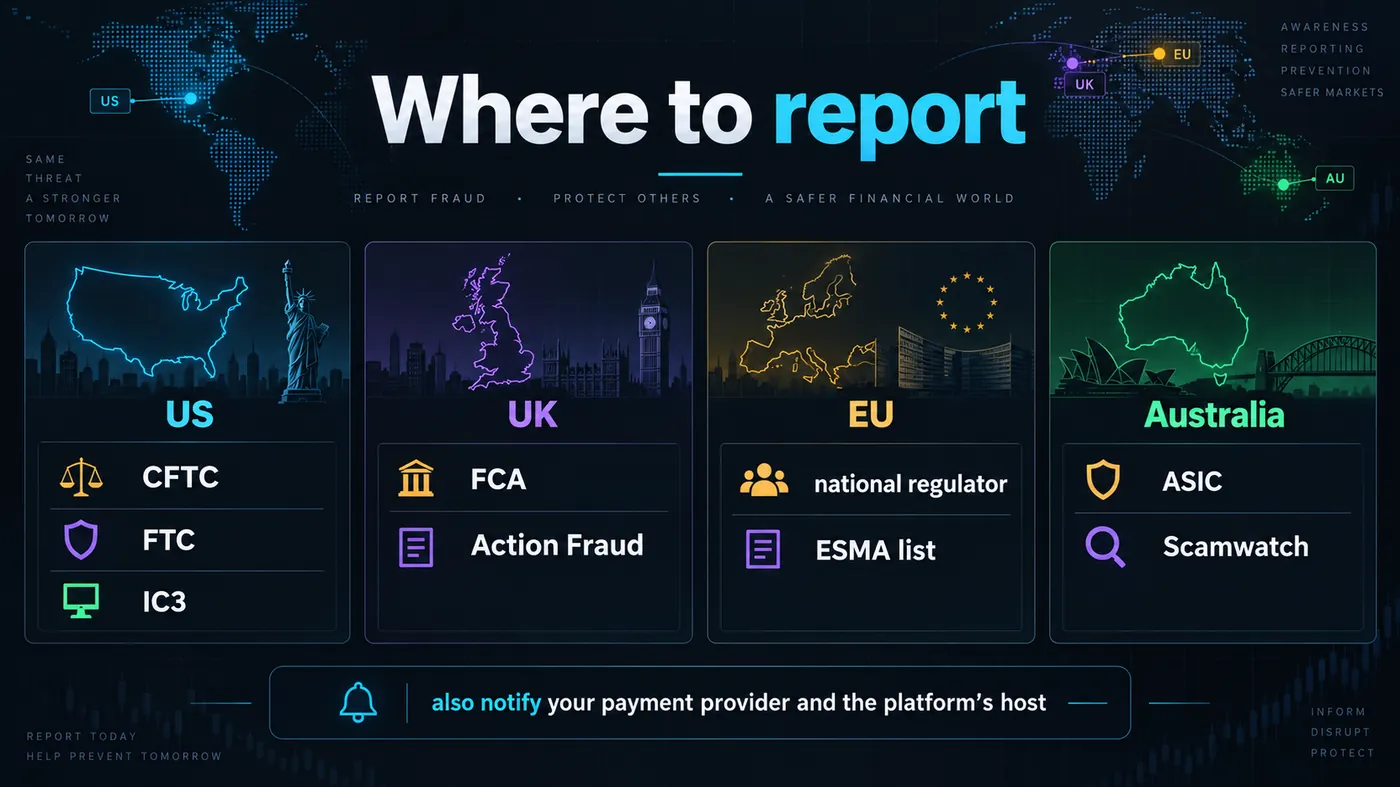
- United States: the CFTC (for forex, crypto and futures scams) and the SEC (securities); the FTC at ReportFraud.ftc.gov; the FBI's IC3 at ic3.gov. Your state securities regulator through NASAA.
- United Kingdom: the FCA's ScamSmart and its consumer helpline; Action Fraud (the national reporting centre); your bank's fraud team, which is bound by the reimbursement code for authorised push-payment fraud.
- European Union: your national financial regulator (BaFin, AMF, CONSOB, CySEC and so on) and its warning list; ESMA's list of national warnings; national police cybercrime units; Europol's reporting guidance.
- Australia: ASIC's report-a-scam page and Scamwatch (ACCC); ReportCyber for the police report.
- Everywhere: the payment provider (card network, PayPal, the crypto exchange you sent from), the platform's hosting provider and domain registrar (abuse addresses — the site may come down), and the app store if there was an app.
Keep the reference numbers; the chargeback claim and any later compensation route will ask for them.

Automate your trades. Let Quantum Algo trade for you.
Every signal executed on your own account — on your account, with the plan you define.
What you can realistically get back
- Card payments: the best odds. A fraud chargeback within the window succeeds often enough to be worth every effort.
- Bank transfers: depends on the country. The UK's reimbursement rules for push-payment fraud cover many cases; elsewhere, recall requests work only if the funds have not moved, which is usually within a day.
- Crypto: almost never recoverable once it has left your wallet; the exchange you sent from can sometimes freeze funds still on a known deposit address if contacted within hours, and reporting the addresses helps investigators map the network.
- Payment apps and gift cards: rarely recoverable; report anyway.
- Money the platform "shows" in your account: not real and never was. The balance on a scam platform is a number on a webpage.
Honest expectation: partial recovery through card disputes is common; full recovery is rare; recovery of crypto is exceptional. Anyone who promises otherwise is the next section.
The recovery scam
The illustration in this guide is the second wave, and it arrives because the first scam sold your details to the second. Within weeks of being scammed you will be contacted — by email, phone, social media, or a "law firm", "blockchain forensics company" or "regulator" — offering to recover your funds. The message is confident, sometimes knows the exact amount you lost, and asks for an upfront fee, a "release tax" or your account access.
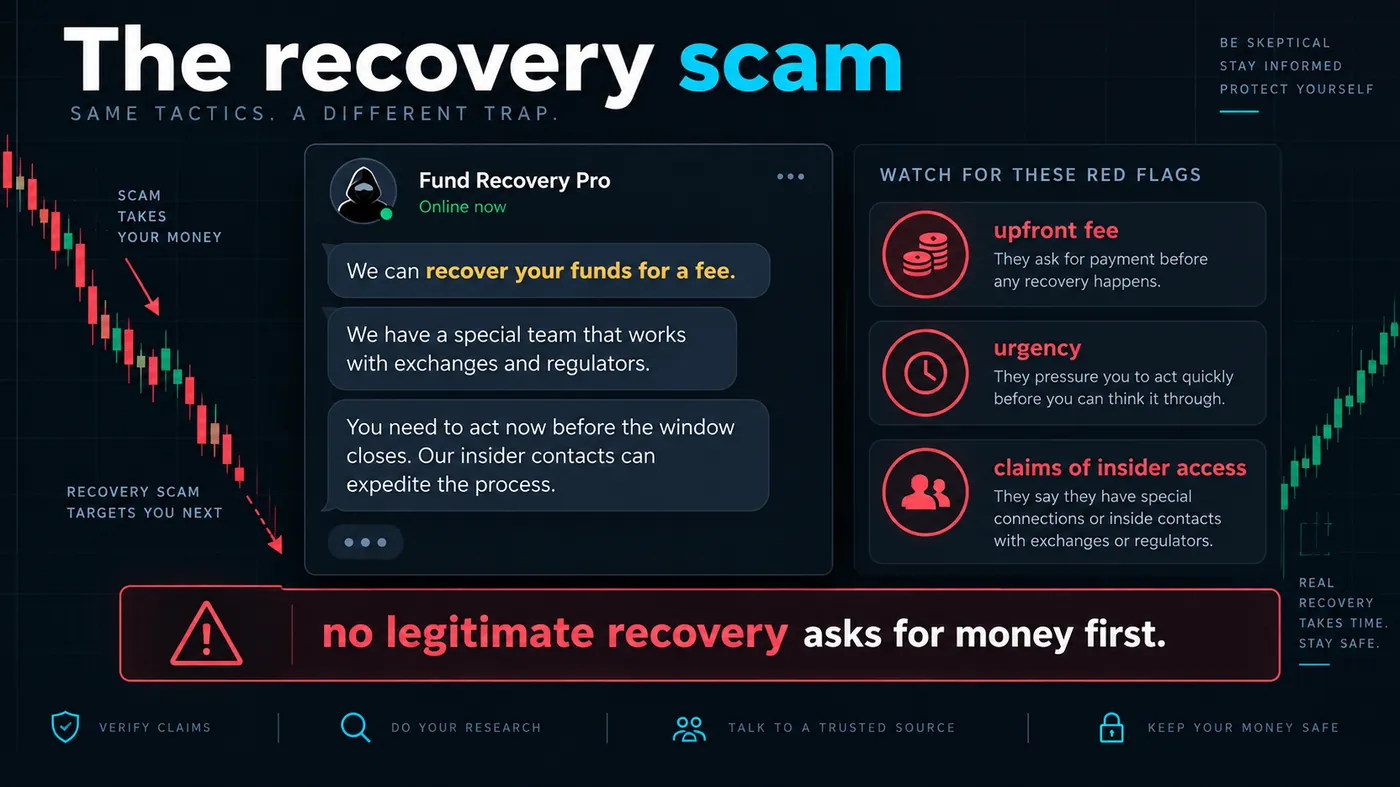
The tells, from the illustration: an upfront fee of any kind; urgency ("the funds are about to be moved"); claims of insider access ("our contacts at the exchange"); unsolicited contact; a regulator or police force that would never charge or cold-call. The rule in the callout: no legitimate recovery asks for money first. Real recovery, where it exists, comes through your bank's dispute process, a court, or a regulator's compensation scheme — none of which contacts you on WhatsApp.
Protecting yourself afterwards
- Assume your details are on a list; expect more approaches, and treat every unsolicited investment contact as a scam by default.
- If remote-access software was installed, have the device cleaned or reset.
- Tell someone. Scam victims are re-targeted precisely because they are isolated; a second pair of eyes on the next message is worth more than any software.
- When you return to trading — and there is no shame in it — do so only through a regulated entity you have checked on the register yourself, with a withdrawal tested at small size before a real deposit. Our forex-brokers and best-platforms guides are the criteria.
How this relates to what we do
We publish indicator software and a public trade record; we hold no client funds, manage no accounts and require no broker or platform. Any message claiming to be from Quantum Algo that asks you to deposit money anywhere, join a "VIP" managed account, or pay to recover funds is not from us — our only payments are subscriptions through Stripe on our own site. If you receive one, report it to us through the contact page and to the channels above.
Stop paying, document, chargeback, secure, report — in seventy-two hours. Expect partial recovery through the card issuer at best and none for crypto, and refuse every recovery offer that asks for money first. Then return to the market only through an entity you have checked on a register yourself, with a withdrawal tested before a real deposit.
◆ Interactive check
Do you know the sequence?
Questions people ask after a trading scam
Sometimes, partially, mainly through a card chargeback or a bank fraud claim filed quickly. Crypto sent to the platform is rarely recoverable. Report everything regardless; it shuts channels and supports any later compensation route.
To your financial regulator (CFTC/SEC, FCA, ASIC, your EU national regulator), the national fraud-reporting centre (IC3, Action Fraud, Scamwatch), your bank or card issuer, and the payment provider — with screenshots, reference numbers and the platform's details.
Assume not. Legitimate routes — bank disputes, courts, regulator compensation schemes — do not cold-call and do not charge upfront fees. A company that guarantees recovery for a fee is the second scam.
No. Every further payment is lost; every conversation gives them more information. Stop, document, report.
The balance is a number on a webpage controlled by the scammer. It is not money and will not become money. Do not pay anything to "withdraw" it.
It is on a regulator's public register under the exact legal entity on your agreement, prints its retail loss rate, returns a test withdrawal within days, and never asks you to hand over account control. Our forex-legitimacy guide walks through the check.
Card chargebacks typically allow 120 days from the transaction; bank recalls work within a day or two; regulator and police reports have no deadline but help most when filed early. Do the chargeback first, the reports the same week.
Rarely directly. Police and regulator reports build the case that shuts down the platform's payment channels and can support compensation or insurance claims; the money itself comes back, if at all, through your bank or card issuer.
A real lawyer can pursue a claim against an identifiable party in a real jurisdiction; against an anonymous offshore platform there is usually no one to sue. Any "law firm" that contacts you unsolicited and asks for a fee to recover funds is the second scam.
Threats — of legal action, of exposing you, of "penalties" for not paying — are pressure to extract more money. Stop responding, keep the messages as evidence, and include them in the police report.
References & Related Guides
Read next
- Is Forex Trading Legit?
- Best Forex Brokers
- Best Trading Platforms
- Is Day Trading Gambling?
- What Is a Trading Bot?
- How to Start Trading: 90-Day Roadmap
- Risk Disclosure
- Contact Quantum Algo
Authoritative sources
- CFTC: fraud advisories and how to report
- FTC: report fraud
- FBI Internet Crime Complaint Center (IC3)
- FCA ScamSmart
- Action Fraud (UK)
- Scamwatch (Australia)
- ESMA: warnings for investors